 Cosmology
 Albert
 Problems
 Unite
Unite Cosmology
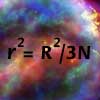 Equation
 Hubble
 (CMBR) Cosmic
 Thermodynamics
 Unite
Unite Solar System
 Hubble
 Life
Life Simple
 Metaphysics
 Maths
Maths Einstein
 Quantum
 Cosmology
 Philosophy
 Theology
 Evolution
 Health
 Education
 Politics
Cosmology: Exploring the Milky Way Galaxy, other Galaxies,
Stars, Supernovas, & Quasars
Brief Summaries / Information & Pictures
Summary of the Milky Way Galaxy
|
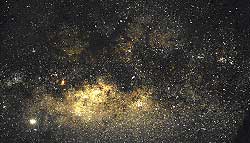
The Milky Way galaxy in the Southern hemisphere |
The Milky Way is a spiral galaxy which is the home of our Solar System together with at least 200 billion other stars, their planets, thousands of clusters and nebulae.
A spiral galaxy can be described as having a bulge in the center, surrounded by a disk (flat, moving) and spherical halo.
Compared with other galaxies, the Milky Way is very large - its mass is probably between 750 billion and one trillion solar masses, its diameter about 100,000 light years.
Galaxies, which are made up of stars, gas and dust, rotate very slowly. Our Sun, one of many stars in our Milky Way Galaxy, completes a circuit around the Milky Way every 250 million years.
The term "milky" originates from the hazy band of white light appearing across the celestial sphere visible from Earth, which comprises stars and other material lying within the galactic plane. The Greek philosopher, Democritus (450 BC – 370 BC) was the first known person to claim that the Milky Way consists of distant stars.
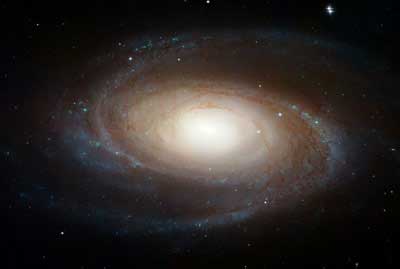
Spiral Galaxy M81: Photo by Hubble Space Telescope.
This is a spiral galaxy which is similar to our Milky Way galaxy.
It is 11.6 million light-years away.
Definition of Supernova
 A
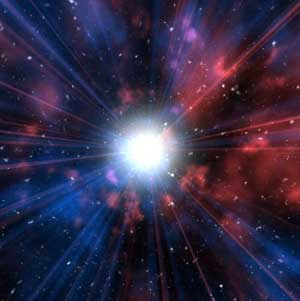
supernova is a stellar explosion that creates an extremely luminous object
that is initially made of plasma - an ionized form of matter. A supernova
may briefly out-shine its entire host galaxy before fading from view over
several weeks or months. During this brief period of time, the supernova
radiates as much energy as the Sun would emit over about 10 billion years.
The explosion expels much or all of a star's material at a velocity of up
to a tenth the speed of light, driving a shock wave into the surrounding
interstellar gas. This shock wave sweeps up an expanding shell of gas and
dust called a supernova remnant.
A
supernova is a stellar explosion that creates an extremely luminous object
that is initially made of plasma - an ionized form of matter. A supernova
may briefly out-shine its entire host galaxy before fading from view over
several weeks or months. During this brief period of time, the supernova
radiates as much energy as the Sun would emit over about 10 billion years.
The explosion expels much or all of a star's material at a velocity of up
to a tenth the speed of light, driving a shock wave into the surrounding
interstellar gas. This shock wave sweeps up an expanding shell of gas and
dust called a supernova remnant.
What is a Quasar?
Modern physics understands quasars to be extremely bright
and distant active nucleus of a young galaxy. They were first identified
as being high-redshift (thus very distant) sources of electromagnetic energy,
including radio waves and visible light that were point-like similar to
stars rather than extended sources similar to galaxies.
However Halton
Arp clearly shows in his book 'Seeing Red' that these supposedly very
distant objects are actually part of much closer constellations - proving
that their high redshift is not related to distance and thus contradicting
the standard 'Big Bang' theory of cosmology. His work is now suppressed
in the USA (he was banned from using their telescopes) and he works at the
Max Planck institute in Germany. A sad insight into the state of modern
physics and its suppression of the truth to maintain existing beliefs over
empirical facts.
Picture Gallery of Supernovas, Galaxies,
The Milky Way Galaxy and Doomed Stars
Discover the amazing beauty of the cosmos!
|
|
|
|
|
|
|
|
|
|
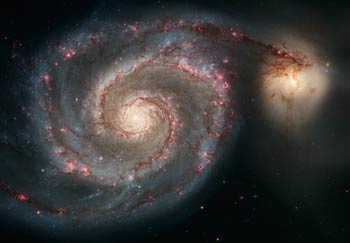
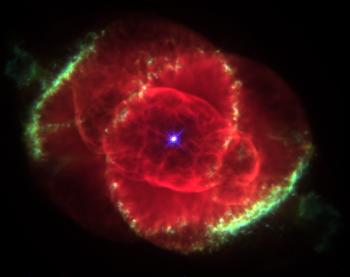
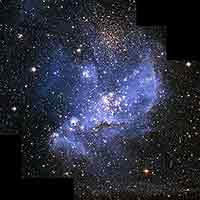
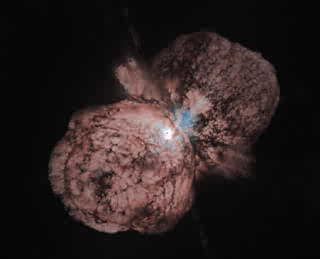
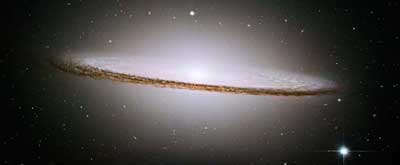
Sombrero Galaxy, M104, NGC 4594
Spiral Galaxy, 28 million light-years away.
Help Humanity
"You must be the change you wish to see in the world."
(Mohandas Gandhi)
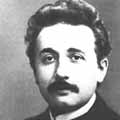 "When forced to summarize the general theory of relativity in one sentence:
Time and space and gravitation have no separate existence from matter. ... Physical objects are not in space, but these objects are spatially extended. In this way the concept 'empty space' loses its meaning. ... The particle can only appear as a limited region in space in which
the field strength or the energy density are particularly high. ...
"When forced to summarize the general theory of relativity in one sentence:
Time and space and gravitation have no separate existence from matter. ... Physical objects are not in space, but these objects are spatially extended. In this way the concept 'empty space' loses its meaning. ... The particle can only appear as a limited region in space in which
the field strength or the energy density are particularly high. ...
The free, unhampered exchange of ideas and scientific conclusions is necessary for the sound development of science, as it is in all spheres
of cultural life. ... We must not conceal from ourselves that no improvement in the present depressing situation is possible without
a severe struggle; for the handful of those who are really determined to do something is minute in comparison with the mass of the lukewarm
and the misguided. ...
Humanity is going to need a substantially new way of thinking if it is to survive!" (Albert Einstein)
 Our world is in great trouble due to human behaviour founded on myths and customs that are causing the destruction of Nature and climate change. We can now deduce the most simple science theory of reality - the wave structure of matter in space. By understanding how we and everything around us are interconnected
in Space we can then deduce solutions to the fundamental problems of human knowledge in physics, philosophy, metaphysics, theology, education, health, evolution and ecology, politics and society.
Our world is in great trouble due to human behaviour founded on myths and customs that are causing the destruction of Nature and climate change. We can now deduce the most simple science theory of reality - the wave structure of matter in space. By understanding how we and everything around us are interconnected
in Space we can then deduce solutions to the fundamental problems of human knowledge in physics, philosophy, metaphysics, theology, education, health, evolution and ecology, politics and society.
This is the profound new way of thinking that Einstein
realised, that we exist as spatially extended structures of the universe - the discrete and separate body an illusion. This simply confirms the
intuitions of the ancient philosophers and mystics.
Given the current censorship in physics / philosophy of science journals (based on the standard model of particle physics / big bang cosmology) the internet is the best hope for getting new knowledge
known to the world. But that depends on you, the people who care about science and society, realise the importance of truth and reality.
It is Easy to Help!
Just click on the Social Network links below, or copy a nice image or quote you like and share it. We have a wonderful collection of knowledge from the greatest minds in human history, so people will appreciate your contributions. In doing this you will help a new generation of scientists see that there is a simple sensible explanation of physical reality - the source of truth and wisdom, the only cure for the madness of man! Thanks! Geoff Haselhurst (Updated September, 2018)
A new scientific truth does not triumph by convincing its opponents and making them see the light, but rather because its opponents eventually die, and a new generation grows up that is familiar with it. (Max Planck, 1920)
| Tweet Follow @philosophytruth | |
| Geoff | |
 |
Connect with Geoff Haselhurst at Facebook
"All that is necessary for evil to succeed is for good people to do nothing."
(Edmund Burke)
"In a time of universal deceit - telling the truth is a revolutionary act."
(George Orwell)
"Hell is Truth Seen Too Late."
(Thomas Hobbes)


Legal Disclaimer and Privacy Policy
We support 'Fair Use' of these pages for Academic & Non Commercial use.
You are welcome to use images and text, but please reference them with a link to relevant web page on this site. Thanks!
