 Erotic
 Gallery
 Sensual
 Vintage
 Lesbian
 Vintage
 Philosophy
 Indian
 Kamasutra
 Kamasutra
 Foreplay
 Fellatio
 Sex Toys
 Human
Human Sexology
 Female
 Male
Male Child
Child Sexual
 Sex
Sex Oral
Oral Masturbation
 Film
Film Fetish
 Sacred
 Gay
Gay Sexual
 Law
Law Adult
Adult Sexual
 Slang
Slang

Introduction / Summary (2018): Hello and welcome to our Sexuality pages. While this is not a pornographic site, it is provocative - founded upon what people search on the Internet (which is very interesting!). We then relate this to our biological and cultural evolution.
Sex is obviously important to people - and if you want to improve your sexual relationships then knowing the truth about our human evolution is the best foundation. By opening our minds to a greater diversity of behaviors, this knowledge will help you creatively cultivate healthy pleasurable moral attitudes and sexy smutty relationships (free from religious guilt & cultural myths).
Support an open honest discussion on the truth of our sexual evolution and behaviour. If you support sex positive, moral, informed sexual behaviour please share this knowledge. (These pages have a diverse collection of fascinating information relating to our human sexual evolution so people will appreciate it - see our 'nice letters' page!).
Sincerely, Karene.
"It is not enough to conquer; one must learn to seduce." (Voltaire) - "Desire is the essence of a man." (Spinoza)
Kama Sutra Sex Positions


Ancient Indian Philosophy of Kama Sutra: The Art of Love
Kama Sutra Sex Quotes / Pictures of Sex Positions
Though a woman is reserved, and keeps her feelings concealed; when she gets on the top of a man, she shows all her love and desire. A man should gather from the actions of the woman of what disposition she is, and in what way (positions) she likes to be enjoyed. (Kama Sutra Sex Positions, 1883)
Such passionate actions and amorous gesticulations or movements, which arise on the spur of the moment, and during sexual intercourse, cannot be defined, and are as irregular as dreams. A horse having once attained the fifth degree of motion goes on with blind speed, regardless of pits, ditches, and posts in his way; and in the same manner a loving pair become blind with passion in the heat of congress, and go on with great impetuosity, paying not the least regard to excess. For this reason one who is well acquainted with the science of love (Kama Sutra), and knowing his own strength, as also the tenderness, impetuosity, and strength of the young women, should act accordingly. The various modes of sex, enjoyment and positions are not for all times or for all persons, but they should only be used at the proper time. and in the proper countries and places. (Kama Sutra Sex Positions, 1883)
An ingenious person should multiply the kinds of positions after the fashion of the different kinds of beasts and of birds. For these different kinds of congress, performed according to the usage of each country, and the liking of each individual, generate love, friendship, and respect in the hearts of women. (Kama Sutra Sex Positions, 1883)
.. those things which increase passion should be done first, and those which are only for amusement or variety should be done afterwards. (Kama Sutra Sex Positions, 1883)
Embracing Sex Positions of Kama Sutra
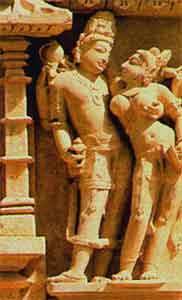 The
two kinds of sex positions take place when the lover is standing are:
The
two kinds of sex positions take place when the lover is standing are:
When a woman, clinging to a man as a creeper twines round a tree, bends his head down to hers with the desire of kissing him and slightly makes the sound of sut sut, embraces him, and looks lovingly towards him, this position is called the 'twining of a creeper'.
When a woman, having placed one of her feet on the foot of her lover, and the other on one of his thighs, passes one of her arms round his back, and the other on his shoulders, makes slightly the sounds of singing and cooing, and wishes, as it were, to climb up him in order to have a kiss, this position is called an embrace like the 'climbing of a tree'.
These two kinds of positions take place at the time of sex (the sexual union):
When lovers lie on a bed, and embrace each other so closely that the arms and thighs of the one are encircled by the arms and thighs of the other, and are, as it were, rubbing up against them, this is called the sex position of 'mixture of sesamum seed with rice'.
When a man and a woman are very much in love with each other, and, not thinking of any pain or hurt, embrace each other as if they were entering into each other's bodies either while the woman is sitting on the lap of the man, or in front of him, or on a bed, then it is called the position of 'mixture of milk and water'.
Babhravya has thus related to us the above eight kinds of sex embraces. Suvarnanabha moreover gives us four ways of embracing simple members of the body, which are:
The embrace of the thighs.
The embrace of the jaghana, i.e. the part of the body from the navel downwards
to the thighs.
The embrace of the breasts.
The embrace of the forehead.
When one of two lovers presses forcibly one or both of the thighs of the other between his or her own, it is called the 'embrace of thighs'.
When a man presses the jaghana or middle part of the woman's body against his own, and mounts upon her to practise, either scratching with the nail or finger, or biting, or striking, or kissing, the hair of the woman being loose and flowing, it is called the 'embrace of the jaghana'.
When a man places his breast between the breasts of a of Vatsyayana woman and presses her with it, it is called the 'embrace of the breasts'.
When either of the lovers touches the mouth, the eyes and the forehead of the other with his or her own, it is called the 'embrace of the forehead'. (Kama Sutra Sex Positions, 1883)
 Lying Down Sex Positions of Kama Sutra
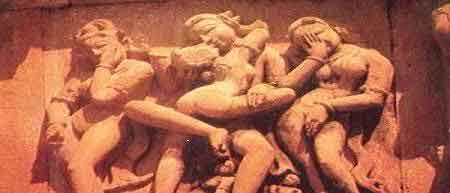
The Deer-woman has the following three ways of lying down for sex:
The widely opened position
The yawning positions
The position of the wife of Indra
When she lowers her head and raises her middle parts, it is called the
'widely opened position'. At such a time the man should apply some unguent,
so as to make the entrance easy.
When she raises her thighs and keeps them wide apart and engages in congress,
it is called the 'yawning positions'.
When she places her thighs with her legs doubled on them upon her sides,
and thus engages in congress, it is called the 'position of Indrani' and
this is learnt only by practice. The position is also useful in the case
of the 'highest congress'.
The 'clasping positions' is used in 'low congress', and in the 'lowest congress',
together with the 'pressing position', the 'twining position', and the 'mare's
positions'.
During sex, when the legs of both the male and the female are stretched
straight out over each other, it is called the 'clasping positions'.
It is of two kinds, the side position and the supine position, according
to the way in which they lie down. In the side position the male should
invariably lie on his left side, and cause the woman to lie on her right
side, and this rule is to be observed in lying down with all kinds of women.
When, after congress has begun in the clasping position, the woman presses
her lover with her thighs, it is called the 'pressing position'.
When the woman places one of her thighs across the thigh of her lover it
is called the 'twining position'.
When a woman during sex forcibly holds in her yoni the lingam after it is
in, it is called the 'mare's position'. This is learnt by practice only,
and is chiefly found among the women of the Andhra country.
The above are the different ways of lying down, mentioned by Babhravya.
Suvarnanabha, however, gives the following in addition:
When the female raises both of her thighs straight up, it is called the
'rising sex position'.
During sex when she raises both of her legs, and places them on her lover's
shoulders, it is called the 'yawning position'.
When the legs are contracted, and thus held by the lover before his bosom,
it is called the 'pressed positions'.
When only one of her legs is stretched out, it is called the 'half pressed
position'.
When the woman places one of her legs on her lover's shoulder, and stretches
the other out, and then places the latter on his shoulder, and stretches
out the other, and continues to do so alternately, this sex position is
called the 'splitting of a bamboo'.
When one of her legs is placed on the head, and the other is stretched out,
it is called the 'fixing of a nail'. This is learnt by practice only.
When both the legs of the woman are contracted, and placed on her stomach,
it is called 'crab's position'.
When the thighs are raised and placed one upon the other, during sex, it
is called the 'packed position'.
When the shanks are placed one upon the other, it is called the 'lotus-like
position'.
When a man, during sex, turns round, and enjoys the woman without leaving
her, while she embraces him
round the back all the time, it is called the 'turning position', and is
learnt only by practice.
Thus, says Suvarnanabha, these different ways of lying down, sitting, and
standing should be practised in water, because it is easy to do so therein.
But Vatsyayana is of opinion that congress in water is improper, because
it is prohibited by the religious law.
When a man and a woman support themselves on each other's bodies, or on
a wall, or pillar, and thus while standing engage in sex, it is called the
'supported congress'.
When a man supports himself against a wall, and the woman, sitting on his
hands joined together and held underneath her, throws her arms round his
neck, and putting her thighs alongside his waist, moves herself by her feet,
which are touching the wall against which the man is leaning, it is called
the 'suspended congress'.
When a woman stands on her hands and feet like a quadruped, and her lover mounts her like a bull, it is called the 'congress of a cow'. At this time everything that is ordinarily done on the bosom should be done on the back.
In the same way can be carried on the congress of a dog, the congress of a goat, the congress of a deer, the forcible mounting of an ass, the congress of a cat, the jump of a tiger, the pressing of an elephant, the rubbing of a boar, and the mounting of a horse. And in all these cases the characteristics of these different animals should be manifested by acting like them.
When a man enjoys sex with two women at the same time, both of whom love him equally, it is called the 'united congress'.
When a man enjoys sex with many women altogether, it is called the 'congress of a herd of cows'.
The following kinds of congress-sporting in water, or the congress of an
elephant with many female elephants which is said to take place only in
the water, the congress of a collection of goats, the congress of a collection
of deer take place in imitation of these animals.
In Gramaneri many young men enjoy a woman that may be married to one of them, either one after the other, or at the same time. Thus one of them holds her, another enjoys her, a third uses her mouth, a fourth holds her middle part, and in this way they go on enjoying her several parts alternately.
The same things can be done when several men are sitting in company with one courtesan, or when one courtesan is alone with many men. In the same way this can be done by the women of the king's harem when they accidentally get hold of a man.
The people in the Southern countries have also a sex in the anus, that
is called the 'lower congress'.
(Kama Sutra Sex Positions, 1883)
Kama Sutra Sex Positions for Role Reversal
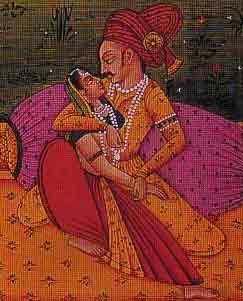 The
acts to be done by the man are:
The
acts to be done by the man are:
Moving forward
Friction or churning
Piercing
Rubbing
Pressing
Giving a blow
The blow of a boar
The blow of a bull
The sporting of a sparrow
When the organs are brought together properly and directly it is called 'moving the organ forward'.
When the lingam is held with the hand, and turned all round in the yoni, it is called 'churning'.
When the yoni is lowered, and the upper part of it is struck with the lingam, it is called 'piercing'.
When the same thing is done on the lower part of the yoni, it is called 'rubbing'.
When the yoni is pressed by the lingam for a long time, it is called 'pressing'.
When the lingam is removed to some distance from the yoni, and then forcibly strikes it, it is called 'giving a blow'.
When only one part of the yoni is rubbed with the lingam, it is called the 'blow of a boar'.
When both sides of the yoni are rubbed in this way, it is called the 'blow of a bull'.
When the lingam is in the yoni, and moved up and down frequently, and without being taken out, it is called the 'sporting of a sparrow'. This takes place at the end of congress.
 When
a woman acts the part of a man, during sex, she has the following things
to do in addition to the nine given above:
When
a woman acts the part of a man, during sex, she has the following things
to do in addition to the nine given above:
The pair of tongs
The top
The swing
When the woman holds the lingam in her yoni, draws it in, presses it, and keeps it thus in her for a long time, it is called the 'pair of tongs'.
When, while engaged in congress, she turns round like a wheel, it is called the 'top'. This is learnt by practice only.
When, on such an occasion, the man lifts up the middle part of his body, and the woman turns round her middle part, it is called the 'swing'.
When the woman is tired, she should place her forehead on that of her lover, and should thus take rest without disturbing the union of the organs, and when the woman has rested herself the man should turn round and begin sex again.
There are also some verses on sex and positions as follows:
'Though a woman is reserved, and keeps her feelings concealed; yet when she gets on the top of a man, she then shows all her love and desire. A man should gather from the actions of the woman of what disposition she is, and in what way she likes to be enjoyed. A woman during her monthly courses, a woman who has been lately confined, and a fat woman should not be made to act the part of a man.'
Kama Sutra Sex Positions, from The Kama Sutra of Vatsayayana, Sir Richard Burton, translator (1883)
Related Links: Kama Sutra
Eastern Philosophy: Kama Sutra - 'Praised be the three aims of life, virtue
(dharma), prosperity (artha), and love (kama), which are the subject of
this work.' Kama Sutra (Kama Shastra). Discussion and Quotes
/ Quotations, Pictures (Pics), Sex Positions from Famous Indian Sexual Philosophy of
the Kama Sutra.
Contents:
Kama Sutra Pictures - Kama
Sutra Positions - Kama
Sutra: Women - Kama
Sutra: Partners - Kama
Sutra: Marriage - Kama
Sutra: Love Potions - Kama
Sutra: Sex Aids - Kama
Sutra: Homosexuality - Kama
Sutra: Embrace - Kama
Sutra: Kissing - Kama
Sutra: Scratching - Kama
Sutra: Biting - Kama
Sutra: Sighs and Blows - Kama
Sutra: Foreplay - Kama
Sutra: Role Reversal - Kama
Sutra: Fellatio
Kama Sutra Pages (different spelling): Kamasutra
- Kamasutra
Pictures - Kamasutra
Positions - Kama
- Karma
- Karmasutra
- Karma Sutra
- Karma
Sutra Pictures - Karma
Sutra Positions
Create some good Sexual Karma - Share this Knowledge - Thanks!
| Tweet |

Site
Map - Banners
- Bibliography
/ Reference Books - Reasons
for this Sexuality Study - Legal
Disclaimer & Privacy Policy - Protect
Children Online


We support 'Fair Use' of these pages for Academic & Non Commercial use.
You are welcome to use images and text, but please reference them with a link to relevant web page on this site. Thanks!

The free, unhampered exchange of ideas and scientific conclusions is necessary for the sound development of science, as it is in all spheres of cultural life. ... Only the individual can think, and thereby create new values for society, nay, even set up new moral standards to which the life of the community conforms.
(Albert Einstein)