 Wave
Wave WSM
WSM Why WSM not
 Blind Truth
 Skeptics
 Unite
Unite Absolute
 Popper
 Incompleteness
 Unite
Unite Simple
 Metaphysics
 Maths
Maths Einstein
 Quantum
 Cosmology
 Philosophy
 Theology
 Evolution
 Health
 Education
 Politics
On the Relative and Absolute Meaning of Words
Wittgenstein argued that language is an imprecise 'language game' with many different rules for words depending upon how the word is used.
Philosophy is a battle against the bewitchment of our intelligence
by means of language. ... For philosophical problems arise when language
goes on holiday.
For we say that there isn't any doubt that we understand the word, and on
the other hand its meaning lies in its use.
For someone might object against me: ‘You take the easy way out! You
talk about all sorts of language games, but have nowhere said what the essence
of a language-game, and hence of language, is: what is common to all these
activities, and what makes them into language or parts of language. So you
let yourself off the very part of the investigation that once gave you yourself
most headache, the part about the general form of propositions and of language.’
And that is true. - Instead of producing something common to all that we
call language, I am saying that these phenomena have no one thing in common
which makes us use the same word for all, - but that they are related to
one another in many different ways. And it is because of this relationship,
or of these relationships, that we call them all ‘language’.
For naming and describing do not stand on the same level: naming is a preparation
for describing. We may say,: nothing has so far been done, when a thing
has been named. It has not even got a name except in the language-game.
This was what Frege meant too, when he said that a word had meaning only
as part of a sentence.
That is, the game with these words, their employment in the linguistic
intercourse that is carried on by their means, is more involved than we
are tempted to think. This role is what we need to understand in order
to resolve philosophical paradoxes. (Wittgenstein, 1958)
The solution to this problem is found in the Metaphysics of Space and Motion (the Wave Structure of Matter) which precisely defines the meaning of our words and connects them to the world around us. That simply pointing at the Space around us and saying "Space" doesn't really help, we must then explain what we mean by the word Space and define the Properties of Space (i.e. One Principle of the Wave Structure of Matter - Space Exists as a Wave Medium, Matter Exists as the Spherical Wave Motion of Space).
This then creates a logical system of language that we can deduce from (with logical certainty) and can compare against our sense of the real world. This is the method of Science and it confirms that the Wave Structure of Matter does in fact correctly deduce the laws of Nature as determined over many centuries of observation and experiment.
Understanding this limitation of our language (and how it can be overcome) is fundamentally important to philosophy. As reality was not known when Wittgenstein wrote, he was correct to argue that words only have meaning relative to other words - that our language was a complex tautology (or circular) in that any one word could only be defined relative to a number of other words.
Those who vainly reason without understanding the truth are lost in the jungle of the Vijnanas (the various forms of relative knowledge) (Lankavatara Sutra)
In hindsight it is obvious that relative truths exist when we we do not know physical reality. Absolute Truth and meaning require connecting language back to the one thing that necessarily exists and causes and connects the many things we experience, i.e. Space and its spherical standing wave motions that form (and interconnect) matter.
Thus I wish to draw particular attention to Stephen Hawking's following comments, as they profoundly demonstrate the error of the current view of Philosophy;
However, in the nineteenth and twentieth centuries, science became too technical and mathematical for the philosophers or anyone else except for a few specialists. Philosophers reduced the scope of their inquiries so much that Wittgenstein the most famous philosopher this century, said 'The sole remaining task for philosophy is the analysis of language.' What a comedown from the great tradition of philosophy from Aristotle to Kant! (Hawking, 1988)
 In
fact the solution to their problems comes directly from solving the problems
of Aristotle's
Metaphysics (One thing / substance must exist which connects the many
things) and Kant's
Synthetic a priori Knowledge (what must exist for us to exist
and experience the world).
In
fact the solution to their problems comes directly from solving the problems
of Aristotle's
Metaphysics (One thing / substance must exist which connects the many
things) and Kant's
Synthetic a priori Knowledge (what must exist for us to exist
and experience the world).
The Metaphysics of Space and Motion and the Wave Structure of Matter solves
this profound problem by defining and connecting our language to Reality
in the following way. I point at Matter in this Space around me and say;
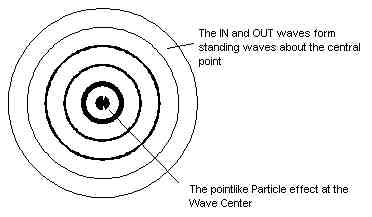
'Space is a Wave-Medium and the Particle Effect of Matter is caused by the Wave-Center of Spherical Standing Waves in Space'.
By doing this we are synthesizing / defining a new meaning to the words
'Space' and 'Matter / Particles'. (See Kant's Synthetic a priori
Knowledge) This then connects these words to the physical reality of the
world around us, this absolute Space that we all exist in and sense about
us. Thus the words 'Space' and 'Matter' have a new meaning and now contain
a priori knowledge that is then used as the foundation of deductive
(analytical) logic.
Thus once we know that absolute Space exists as a wave-medium, then we
can connect our language to this absolute Space and its wave motions that
form matter. This gives our language Absolute meaning and thus ends this
damaging relative (circular / tautology) meaning of words that has caused
such uncertainty and confusion both for the philosopher / scientist and
for our world in general.
The Wave Structure of Matter in Space is a 'Common Sense'
Theory of Reality
Note: This short essay is closely related to the above article - I hope it helps further clarify this new language for describing physical reality. Geoff Haselhurst
Our Mind is Limited to 'Representing' the World of our Senses
Our Mind 'represents' our senses (e.g. our mind constructs colours like blue and red) thus it is argued that our mind and language is limited to describing the represented world rather than the world as it really is, and this in turn limits our ability to describe reality. Ayer clearly describes this problem as;
.. the gap between things as they seem and things
as they are; and the problem consists in our having to justify our claims
to know how physical objects are on the basis of knowing only how they seem.
(A. J. Ayer, 1956)
Because of this 'apparent' separation of our mind and language from the real world, it was assumed by philosophers that all language theories of reality never exactly describe reality, but only how we 'represent' and 'picture' reality. This problem affects all of philosophy and largely resulted in the separate schools of Kantian Idealism, phenomenalism, and logical positivism. Basically they are saying that we can imagine things that do not exist, but we cannot imagine things that do exist (which is rather odd!)
For example, Kant writes; ... if we take away the subject (Humans), or even only the subjective constitution of our senses in general, then not only the nature and relations of objects in space and time, but even space and time themselves disappear; and that these, as appearances, cannot exist in themselves, but only in us. What may be the nature of objects considered as things in themselves and without reference to the receptivity of our sensibility is quite unknown to us. .... not only are the raindrops mere appearances, but even their circular form, nay, the space itself through which they fall, is nothing in itself, but both are mere modifications or fundamental dispositions of our sensible intuition, whilst the transcendental object remains for us utterly unknown. (Immanuel Kant, 1781)
Once the Wave Structure of Matter (WSM) is known then it becomes more obvious as to why our language can describe reality. While it is true that our language has evolved to describe the world of our representation, it is not true that this world is mutually exclusive from the physical reality which causes it.
Because of the WSM , these Wave aspects of reality naturally appeared to us in our represented world, as can be seen with waves on the surface of water, and heard due to sound waves. Wave phenomena are actually very common in our represented world due to the Wave Structure of Reality and thus our language has evolved to not only describe these 'represented' waves, but also the physical waves in Space which are the true foundations of reality.
This also explains why the Wave Structure of Matter (WSM) is a 'common sense' theory of the world. Firstly, as previously explained, it is common sense that we all exist in Space, so the very foundation of this theory is sensible to all of us. I accept though, that the obvious world of our senses seems very different from this world of Spherical Standing Waves in Space that we are describing. This is simply because of the difference between the real world and the world that we represent with our senses.
Once we understand that we create the world from our senses and that this is an 'naive real illusion', we then realize that the underlying physical world which causes our senses must be quite different (but nonetheless must explain the foundations / causes of our senses). It is from this perspective that we begin to understand that this is a common sense theory of the world, for it explains how we are connected to, and interact with the world around us and thus explains the very foundation of our senses.
Geoff Haselhurst
Simple Science Quotes
The deepest sin against the human mind is
to believe things without evidence.
Science is simply common sense at its best - that is, rigidly accurate in
observation, and merciless to fallacy in logic.
(Thomas Huxley)
We are to admit no more causes of natural
things than such as are both true and sufficient to explain their appearances.
(Sir Isaac Newton, Principia: The system of the world)
https://www.spaceandmotion.com/simple-science/relative-vs-absolute-meaning-of-words.htm
On Absolute Truth and Reality. Wittgenstein and the Relative Vs. Absolute
Meaning of Words
Help Humanity
"You must be the change you wish to see in the world."
(Mohandas Gandhi)
 "When forced to summarize the general theory of relativity in one sentence:
Time and space and gravitation have no separate existence from matter. ... Physical objects are not in space, but these objects are spatially extended. In this way the concept 'empty space' loses its meaning. ... The particle can only appear as a limited region in space in which
the field strength or the energy density are particularly high. ...
"When forced to summarize the general theory of relativity in one sentence:
Time and space and gravitation have no separate existence from matter. ... Physical objects are not in space, but these objects are spatially extended. In this way the concept 'empty space' loses its meaning. ... The particle can only appear as a limited region in space in which
the field strength or the energy density are particularly high. ...
The free, unhampered exchange of ideas and scientific conclusions is necessary for the sound development of science, as it is in all spheres
of cultural life. ... We must not conceal from ourselves that no improvement in the present depressing situation is possible without
a severe struggle; for the handful of those who are really determined to do something is minute in comparison with the mass of the lukewarm
and the misguided. ...
Humanity is going to need a substantially new way of thinking if it is to survive!" (Albert Einstein)
 Our world is in great trouble due to human behaviour founded on myths and customs that are causing the destruction of Nature and climate change. We can now deduce the most simple science theory of reality - the wave structure of matter in space. By understanding how we and everything around us are interconnected
in Space we can then deduce solutions to the fundamental problems of human knowledge in physics, philosophy, metaphysics, theology, education, health, evolution and ecology, politics and society.
Our world is in great trouble due to human behaviour founded on myths and customs that are causing the destruction of Nature and climate change. We can now deduce the most simple science theory of reality - the wave structure of matter in space. By understanding how we and everything around us are interconnected
in Space we can then deduce solutions to the fundamental problems of human knowledge in physics, philosophy, metaphysics, theology, education, health, evolution and ecology, politics and society.
This is the profound new way of thinking that Einstein
realised, that we exist as spatially extended structures of the universe - the discrete and separate body an illusion. This simply confirms the
intuitions of the ancient philosophers and mystics.
Given the current censorship in physics / philosophy of science journals (based on the standard model of particle physics / big bang cosmology) the internet is the best hope for getting new knowledge
known to the world. But that depends on you, the people who care about science and society, realise the importance of truth and reality.
It is Easy to Help!
Just click on the Social Network links below, or copy a nice image or quote you like and share it. We have a wonderful collection of knowledge from the greatest minds in human history, so people will appreciate your contributions. In doing this you will help a new generation of scientists see that there is a simple sensible explanation of physical reality - the source of truth and wisdom, the only cure for the madness of man! Thanks! Geoff Haselhurst (Updated September, 2018)
A new scientific truth does not triumph by convincing its opponents and making them see the light, but rather because its opponents eventually die, and a new generation grows up that is familiar with it. (Max Planck, 1920)
| Tweet Follow @philosophytruth | |
| Geoff | |
 |
Connect with Geoff Haselhurst at Facebook
"All that is necessary for evil to succeed is for good people to do nothing."
(Edmund Burke)
"In a time of universal deceit - telling the truth is a revolutionary act."
(George Orwell)
"Hell is Truth Seen Too Late."
(Thomas Hobbes)


Legal Disclaimer and Privacy Policy
We support 'Fair Use' of these pages for Academic & Non Commercial use.
You are welcome to use images and text, but please reference them with a link to relevant web page on this site. Thanks!
