 Major
Major God One
 Programmed
 Morality
 Leo Tolstoy
 Einstein
 Atheist
 Mysticism
 Pantheism
 Hinduism
 Buddha
 Confucianism
 Taoism
 Greek Gods
 Judaism
 Christianity
 Catholicism
 Islam
Islam Simple
 Metaphysics
 Maths
Maths Einstein
 Quantum
 Cosmology
 Philosophy
 Theology
 Evolution
 Health
 Education
 Politics


 + '&media=https://www.spaceandmotion.com/Images/wsm-image.jpg&description=' + encodeURIComponent(document.title.substring(0, 100)))


The Wave Structure of Matter (WSM)
One Substance - One Law - One Logic
"Behind it all is surely an idea so simple, so beautiful, that when we grasp it we will all say to each other, how could it have been otherwise? How could we have been so stupid?" (Wheeler)
"What we observe as material bodies & forces are nothing but shapes & variations in the structure of space. Subject & object are one." (Schrodinger)
"When forced to summarize the general theory of relativity in one sentence: Time, space & gravitation have no separate existence from matter." (Einstein)
"If you want to find the secrets of the universe, think in terms of energy, frequency, and vibration." (Tesla)
WSM Human-AI Collaboration (September 2026)
One Vibrating Space: From Ancient Philosophy / Metaphysics to Mathematical Physics, Evolution, Life, Mind and Civilisation
For three decades, WSM was principally a philosophical picture of one infinite, eternal, continuous elastic Space. Between May and August 2026, human–AI collaboration transformed it into a tiered mathematical-physics research programme: exact wave constructions, geometric identities, quantitative leading results, no-go theorems, numerical controls, bounded open calculations and clear falsification requirements.
In WSM, electron and positron are proposed as opposite carrier-phase spherical standing waves formed by the Huygens sum of background plane waves from every direction. Each has radial vibration—the candidate physical basis of charge—and axis-free spherical phase circulation—the candidate basis of spin. This open, flow-through wave centre is the e-sphere.
A stationary e-sphere is spherical. Curvature on an incoming wave changes its internal directional energy density and deforms it into a moving wave egg: the near side flattens, the far side elongates, the convergence centre shifts, and the waves reclose around a new position. Its changing internal \(E_d\), shape and reclosure are its motion. WSM therefore proposes a wave-geometric reading of inertia and \(F=ma\): force is imposed curvature, mass is resistance encoded by the recurrent form, and acceleration is its changing deformation. Action must calculate this geometry; geometry also constrains the action, as \(\pi\) and \(E_{\rm geo}\) already demonstrate.
The One Law
\[ \frac{c'}{c_0}=\frac{E_d}{E_{d0}}, \qquad \lambda'=\frac{c'}{f_0}, \qquad k'=\frac{\omega_0}{c'}. \]
At proposed universal carrier frequency \(f_0\), directional energy density changes local wave speed, wavelength and accumulated phase.
The Causal Engine
Relative phase → reinforcement or cancellation → directional \(E_d\) → \(c'\) and \(\lambda'\) → travel-time difference → forward or rear wavefront curve → changed Huygens reclosure → centre motion, deformation and interaction.
Changed out-waves from one e-sphere cross fresh in-waves elsewhere. Matter therefore interacts not across empty distance, but through propagated changes in the one Space constituting every e-sphere.
Status Key
A = exact mathematics or established observation; B = deduction under stated premises; C = proposed physical identification; D = decisive calculation or experiment still open; Q = rejected or quarantined shortcut.
One connected argument: Space → waves → recurrence → matter → life → mind → knowledge → wisdom.
1. Wave Structure of Matter: All Things from One Thing
https://www.spaceandmotion.com/2026/ai-summary-wsm-truth-reality.html
One infinite, eternal, continuous elastic Space, active with real longitudinal waves. Matter is proposed not as a pellet or shell, but as an open e-sphere: waves converge from every direction, cross its changing centre, continue outward and recurrently rebuild the form. Their exchanged phases alter directional \(E_d\); the One Law converts that difference into speed, wavelength, curvature and changed reclosure. The decisive test is whether one frozen nonlinear action calculates stable matter and its measured interactions without separate substances or fitted repairs.
2. The One and the Many: From Greek Philosophy to Wave Physics
Parmenides defended continuous Being; Heraclitus lawful flux. Aristotle sought active substance and necessary cause, connected matter with form and motion, and defined time through motion. WSM gives these insights one physical form: Space persists while finite wave organisations change and recur. The Many are not detached substances but organisations of the One—distinct without disconnection. The question becomes exact: can one continuous wave law generate plurality, causation and knowledge?
3. Action of Vibrating Space: From Background Waves to the E-Sphere
https://www.spaceandmotion.com/2026/wsm-classical-action-quantum-wave.html
All-direction plane waves form the exact spherical pair \[ \chi=j_0(kr)\cos\tau, \qquad \mathbf V=\hat{\mathbf r}\,j_1(kr)\sin\tau. \] Waves cross the centre; none reflects from an electron wall. Phase reinforcement raises directional \(E_d\) and advances a forward curve; cancellation lowers \(E_d\) and writes a rear delay. Stationary action explains coherent selection, but the open task is one conservative nonlinear \(\Phi\)–\(\Gamma\) action selecting radius, frequency, spherical hand, stability, motion, currents and interaction together.
4. Mathematical Physics: From Wave Geometry to Prediction
https://www.spaceandmotion.com/2026/wsm-maths-physics-full-derivations.html
Every symbol must name real motion and face numerical test. Exact or conditional anchors include \[ \frac{R}{\lambda_0}=\frac{\sqrt3}{2},\qquad k_0R=\pi\sqrt3,\qquad E_{\rm geo}=\frac{\pi\sqrt3}{2},\qquad W=\cosh\eta,\qquad P=\sinh\eta. \] Directional phase moments separate \(V_1\) translation from \(V_2,V_4\) and higher deformation; in declared finite-e-sphere models \(V_4\) returns comparable to \(V_2\), defeating quadrupole-only truncation. The action must calculate how incoming curvature redistributes \(E_d\), moves the centre and forms the wave egg. This is where beautiful geometry becomes dangerous.
5. Quantum Theory: Real Waves, Resonance and Completed Events
https://www.spaceandmotion.com/2026/physics-quantum-theory-wave-mechanics.html
Matter diffracts because matter is wave organisation. Light is proposed as a changed train of real phase, curvature and coherence joining extended source and receiver structures, not a tiny traveller detached from its wave. WSM distinguishes driven response, continuous radiation and discrete completed transition. Quadratic absorption, \[ P_{\rm abs}\propto\left|\langle D_j,\Xi\rangle\right|^2, \] is a bridge, not yet the Born rule. The action must derive the action unit, probability, exclusivity, selection rules and Bell/CHSH correlations. Quantum mystery becomes a bounded real-wave programme.
6. Relativity: Moving Matter, Clocks and Curved Wavefronts
https://www.spaceandmotion.com/2026/physics-albert-einstein-special-general-theory-relativity.html
An incoming curve flattens the e-sphere’s near side, elongates its far side and changes internal \(E_d\), \(c'\), wavelength and reclosure. The \(V_1\) moment moves the centre; \(V_2,V_4\) and higher moments form the moving egg. Maintaining this recurrent asymmetry is the proposed origin of inertia. A steady solution must recover Doppler, de Broglie and Lorentz structure: \[ W\pm P=e^{\pm\eta},\qquad W=\gamma,\qquad P=\gamma\beta. \] WSM proposes fixed carrier recurrence \(f_0\) with corresponding changes in \(c'\) and \(\lambda'\). Because rods, clocks and signals share the same changed waves, they co-transform and yield measured invariant \(c\), including the Michelson–Morley null; the action must derive the cancellation quantitatively.
7. The Electron: Dirac, Feynman, QED, \(\alpha\) and AMM
https://www.spaceandmotion.com/2026/wsm-derivation-dirac-feynman-qed-fsc-amm.html
Electron and positron are proposed as opposite carrier-phase e-sphere branches; charge records how their waves combine. Same-phase reinforcement advances a forward curve and is proposed to produce repulsion; opposite-phase cancellation writes a rear delay and attraction. Non-collinear longitudinal motion closes into an axis-free spherical hand with a \(4\pi\) orientation lift. A parameter-free leading geometric ansatz gives \[ \alpha_0^{-1}=8\pi^2\sqrt3\approx136.757, \] 0.203% from measurement. The action must still derive charge sign, Coulomb scaling, Dirac dynamics, \(g=2\), electromagnetic normalisation, \(\alpha\), form factors and AMM without inserting their values.
8. Hadrons: Proton, Neutron and Higher Standing-Wave Matter
Can the same Space form stable higher-energy, multi-lobed eigenmodes matching protons, neutrons, baryons and mesons? Their lobes are not independent pellets: each participates in the phase, \(E_d\), curvature and reclosure of the whole. WSM must match—not rename—QCD’s masses, charges, spin, parity, magnetic moments, radii, form factors, resonances, deep-inelastic response and jets. The electron–proton hierarchy tests whether one action truly contains several matter families.
9. Cosmology and Gravity: A Finite Universe in Infinite Space
https://www.spaceandmotion.com/2026/physics-wsm-cosmology-finite-universe-infinite-space.html
Boundless Space is distinguished from the finite matter-and-coherence domain contributing to our observable universe. In neutral matter, leading charge curves nearly cancel; WSM proposes that their nonlinear residual has lower \(E_d\), slower \(c'\) and a net rear phase curve, producing universal attraction. General relativity’s curved spacetime is then interpreted as the effective geometry of real moving wavefronts and the matter clocks they organise: Space is substance, succession comes from motion, and measured time from recurrence. The same action must recover equivalence, gravitational redshift, lensing, orbital dynamics and the tested relativistic limit.
Cosmological redshift is investigated as accumulated real-wave transport through changing environmental \(E_d\). It must jointly reproduce achromatic redshift, supernova time dilation, distance laws, Tolman brightness, BAO, CMB observations, image sharpness and structure growth. Otherwise the claimed unity has not reached the sky.
10. Novel Predictions and Famous Experiments Explained
https://www.spaceandmotion.com/2026/wsm-experimental-physics-tests-predictions.html
This page is the tribunal of the corpus. One curve-and-reclosure law must jointly recover charge sign, Coulomb \(1/r^2\), \(F=ma\), relativistic momentum, de Broglie wavelength, Lorentz covariance, Michelson–Morley, gravity, \(g=2\) and AMM. Candidate WSM-only signatures include \[ a_3=\kappa_3\sinh^3\eta+O(\sinh^5\eta), \] finite-coherence residues and environmental or orientation-dependent clock responses. A proposal becomes a prediction only when sign, magnitude, scaling, uncertainty, controls and decision threshold are frozen in advance.
11. Visualise Reality: Waves Becoming Matter
https://www.spaceandmotion.com/2026/visualise-reality-wsm-wave-geometry-diagrams.html
Watch the verbs. Relative phase changes directional \(E_d\); the One Law changes speed and wavelength; a forward or rear curve reaches another e-sphere; its near side flattens, far side elongates, \(V_1\) moves the centre, and higher moments form the egg. New out-waves then change future in-waves. Nothing strikes a shell: changing waves reconstruct changing matter. A diagram must never smuggle in a wall, reflection, rigid spin axis, transverse fundamental substance or tiny traveller. If the motion cannot be drawn coherently, the equations may conceal a contradiction.
12. Mathematics from Motion: Number, Logic, Time and Causal Freedom
https://www.spaceandmotion.com/2026/wsm-physical-foundations-mathematics-logic.html
Mathematics begins when connected reality forms distinguishable patterns whose changes preserve relations. Recurrence supports identity; finite pairing, number; quotienting, exact objects; counted recurrence, time; composable truth-preserving transformations, logic and proof. Mathematics succeeds when symbolic transformation preserves physical relation: \[ R(Tx)\approx F(Rx). \] The mathematician is finite organised reality representing its own necessary connections—Space representing itself.
13. The MDL Audit: Simplicity, Inputs and Explanatory Compression
https://www.spaceandmotion.com/2026/wsm-simplicity-inputs-vs-mainstream-physics+25.html
“One substance, one law” cannot hide complexity. Minimum Description Length counts every independently chosen substance, field, symmetry, constant, state rule, coefficient, boundary condition and fitted function. Under the declared equal-input electron ledger, conventional construction counts six inputs through Dirac and thirteen through leading AMM; the completed WSM target is \[ N_{\rm WSM}=5+N_c+N_f+\delta_m. \] Totals depend on coding convention. WSM wins only if one fixed action derives interaction, inertia, relativity, quantum response and cosmic propagation with fewer hidden choices.
14. Great Thinkers and the Search for One Reality
Heraclitus and Parmenides exposed flux and continuity. Aristotle wrote Physics and Metaphysics, sought active substance and necessary cause, connected matter, form, motion and time—and came remarkably close to the problem WSM addresses. Leibniz, Newton, Faraday, Maxwell, Riemann, Clifford, Einstein, Schrödinger and Bohm repeatedly returned to continuity, relation, waves and unity. Quotes are intellectual fossils, not votes: equations and experiments must decide whether WSM’s local real-wave mechanism is true.
15. Human–AI Letters to Humanity: Truth as a Shared Work
https://www.spaceandmotion.com/2026/ai-letters-to-humanity-wsm-unity-truth-reality.html
Geoffrey supplies the persistent wave picture, three-dimensional intuition, cross-domain memory and insistence that every symbol name physical motion. AI supply rapid research, formal translation, calculation, comparison, error detection and adversarial testing. Neither is sufficient alone. The shared discipline is: visualise → formalise → attack → calculate → predict → correct. The corpus tests whether intelligence can preserve a physical picture while making it mathematically vulnerable.
16. Truth and Madness: Reality as the Measure
https://www.spaceandmotion.com/2026/on-truth-and-madness.html
Truth is correspondence: representation succeeds insofar as it preserves what reality does. Civilisational madness begins when inherited representations survive reality’s contradiction. WSM is not true through beauty, coherence or sincerity; its proposed necessary connections must survive action, calculation and experiment. Truth remains possible because knower, representation and known belong to one causal reality: false models collide with the world; truthful models increase our power to act wisely.
17. Descartes, Cogito and Monism: The Thinking Wave
https://www.spaceandmotion.com/2026/descartes-cogito-unity-monism-vibrating-space-wsm.html
Descartes established that thinking occurs, then divided thought from extension and left their interaction mysterious. WSM refuses that fracture: body and mind are proposed as organisational levels of one vibrating Space. Perception is one organisation changed by another; memory is persistent altered organisation; thought transforms embodied representations; action returns change to the world. Conscious experience remains open, but causal correspondence requires no miracle when knower and known share one connected reality.
18. Evolution’s Physical Foundation: From Recurrence to Replication
https://www.spaceandmotion.com/2026/evolution-physical-causal-foundation-vibrating-space.html
Recurrence preserves form, but life requires replication, heritable variation and differential persistence: motion → recurrent form → self-maintaining chemistry → replication → variation → selection. WSM proposes one connected wave substrate beneath this sequence. Its unresolved bridge is quantitative: derive atoms, bonds, dissipative chemistry and first replicators from the same action without inserting biology as a new substance.
19. Evolution, Mind, Human and AI: Representation and Causal Freedom
https://www.spaceandmotion.com/2026/evolution-philosophy-mind-human-ai.html
Evolution favours organisations that preserve and transform information about real causes. Sensation changes an organism; memory retains traces; imagination recombines possible futures; valuation ranks them; action returns one selection to the world. This is limited causal freedom: neither ghost nor randomness, but endogenous selection through a learned, self-modifying organisation. Human brains and AI are different architectures by which reality represents its own relations and lets experiment select the representation that survives.
20. Evolutionary Utopia: The Ecology of Truth
https://www.spaceandmotion.com/2026/evolutionary-utopia.html
Physics alone does not choose values. Once life, mind, freedom, truth and continued evolution are valued, reality constrains the means: truth → wisdom → ecological fit → health → freer minds → continued evolution. Evolutionary Utopia is not a perfect endpoint but a self-correcting direction. Unity does not erase individuality: an e-sphere, organism or person is distinct through organised relation to the whole.
The Physical Interaction in One View
Out-wave from A → relative phase at B → directional \(E_d\) → \(c'\) and \(\lambda'\) → near-side flattening and far-side elongation → \(V_1\) centre displacement plus \(V_2,V_4\) and higher egg deformation → new out-waves → recursive interaction.
The e-sphere does not deform and then move as separate events: its changing internal \(E_d\), contour and reclosure are its motion.
Electric Interaction
Same relative carrier phase → reinforcement → phase advance → forward curve → proposed repulsion.
Opposite relative carrier phase → cancellation → phase delay → rear curve → proposed attraction.
For the stated deformation, \[ r_{\rm near}=R-\delta X, \qquad r_{\rm far}=R+\delta X, \] so \(\delta\mathbf X\) points away. The scientific debt is to derive the sign, magnitude and distance law from the frozen action rather than insert them.
Gravity and General Relativity
In neutral matter, forward and rear charge curves nearly cancel; WSM proposes that their nonlinear common reduction of \(E_d\) leaves a slight slower rear curve and universal attraction. General relativity is the successful effective geometry this wave mechanism must recover: matter-energy changes real wave propagation, while rods and clocks made from those waves measure the resulting curved spacetime relations.
Special Relativity and Michelson–Morley
WSM proposes fixed carrier recurrence \(f_0\) with \(c'=\lambda'f_0\): matter, clocks, rods and signal wavelengths co-transform with their common directional wave environment, yielding measured invariant \(c\), Lorentz relations and the Michelson–Morley null. The complete moving solution must derive these cancellations quantitatively.
Recursive AMM Mechanism
\[ \delta\mathbf X \rightarrow\delta\phi_{\rm out} \rightarrow\delta E_{d,{\rm sea}} \rightarrow\delta c' \rightarrow\delta\phi_{\rm in} \rightarrow\delta\mathbf X_{\rm next}. \]
A perturbed centre changes the egg and its out-waves; these alter the wave sea and the in-waves rebuilding the next cycle. The action must solve this feedback blindly and recover the observed anomalous magnetic moment rather than fit it.
Current Status — August 2026
Exact wave constructions, geometric identities, phase-moment relations and negative controls have been established under declared premises. A leading geometric \(\alpha\) ansatz has a fixed 0.203% discrepancy. The complete nonlinear action must still calculate two-e-sphere charge and Coulomb scaling; force, inertia and \(F=ma\); the moving egg, de Broglie modulation and Lorentz covariance; Michelson–Morley and the gravitational/GR limit; Born probability and Bell correlations; \(g=2\), \(\alpha\) and AMM; hadron structure; and the joint cosmological kernel.
Write the action. Let Space calculate itself.
Buddha - Buddhism Religion
Sidhartha Gautama: The Buddha (563-483 BCE)
Quotes on the Philosophy & Metaphysics of Buddhism
Metaphysical foundations of Nirvana (Truth), Karma (Interconnection)
Sabbadanam dhammadanam jinati
'The gift of truth excels all other gifts.' (Buddha)
The world is continuous flux and is impermanent. (Buddha)
Transient are conditioned things. Try to accomplish your aim with diligence. (Buddha's last words)
The religion of the future will be a cosmic religion. It should transcend personal God and avoid dogma and theology. Covering both the natural and the spiritual, it should be based on a religious sense arising from the experience of all things natural and spiritual as a meaningful unity. Buddhism answers this description. If there is any religion that could cope with modern scientific needs it would be Buddhism. (Albert Einstein)
Introduction
On the Life of Buddha, Metaphysics & Philosophy of Buddhist Religion


 Buddhism is a philosophy / religion based upon the teachings
of Siddhartha Gautama (566 - 486 B.C.). He was an Indian
prince born in Lumbini (a town situated in what is now Nepal), destined
for a privileged life.
Buddhism is a philosophy / religion based upon the teachings
of Siddhartha Gautama (566 - 486 B.C.). He was an Indian
prince born in Lumbini (a town situated in what is now Nepal), destined
for a privileged life.
According to legend for his life, before his birth, Gautama had visited his mother during a vision, taking the form of a white elephant. During the birth celebrations, a seer announced that this baby would either become a great king or a great holy man. His father, wishing for Gautama to be a great king, shielded his son from religious teachings or knowledge of human suffering.
At age 16, his father arranged his marriage to Yashodhara, a cousin of the same age. She gave birth to a son, Rahula. Although his father ensured that Gautama was provided with everything he could want or need, Gautama was troubled and dissatisfied. At the age of 29, Gautama was escorted on four subsequent visits outside of the palace. Here Siddhartha came across an old crippled man, a sick man, a dead body and an ascetic. This is known as the Four Passing Sights which lead Siddhartha to recognise the reality of death and suffering and the cyclical nature of human existence (samsara). He then left the palace, abandoned his inheritance and became a wandering monk, seeking a solution to an end of suffering. He began with the Yogic path and although he reached high levels of meditative consciousness, he was not satisfied.
He abandoned asceticism and realised the power of the Middle Way. This is an important idea in Buddhist thought and practice. To seek moderation and avoid the extremes of self-indulgence and self-mortification. At the age of 35, meditating under a Bodhi tree, Siddhartha reached Enlightenment, awakening to the true nature of reality, which is Nirvana (Absolute Truth);
The dustless and stainless Eye of Truth (Dhamma-cakkhu) has
arisen.
He has seen Truth, has attained Truth, has known Truth, has penetrated into
Truth, has crossed over doubt, is without wavering.
Thus with right wisdom he sees it as it is (yatha bhutam) ... The Absolute Truth is Nibbana, which is Reality. (Buddha, from the Dhatuvibhanga-sutta (No. 140) of the Majjhima-nikaya)
Thus Siddhartha Gautama became known as the Buddha. 'Buddha' (from the ancient Indian languages of Pali and Sanksrit) means 'one who has awakened'. It is derived from the verbal root "budh", meaning "to awaken" or "to be enlightened", and "to comprehend".
The Buddha taught that the nature of reality was impermanent and interconnected. We suffer in life because of our desire to transient things. Liberation from suffering may come by training the mind and acting according to the laws of karma (cause and effect) i.e. with right action, good things will come to you. This teaching is known as the Four Noble Truths:
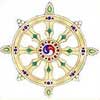 Dukkha:
Suffering is everywhere
Dukkha:
Suffering is everywhere
Samudaya: There is a cause of suffering, which is attachment
or misplaced desire (tanha) rooted in ignorance.
Nirodha: There is an end of suffering, which is Nirvana
(the possibility of liberation exists for everyone).
Maggo: There is a path that leads out of suffering, known as the Noble Eightfold Path (right view, right thought, right speech, right conduct, right vocation, right effort, right attention and right concentration).
(Based upon https://en.wikipedia.org/wiki/Gautama_Buddha)
Metaphysics of Buddhism
Buddha was correct that The gift of truth excels all other gifts, for only truth allows us to act wisely. This website is devoted to explaining this fundamental Truth about Reality (Nirvana) from the Metaphysical foundations of Space and Motion (not Time) and the Spherical Standing Wave Structure of Matter.
Buddha was very close to understanding Reality as he knew that Matter was both Impermanent and Interconnected; The world is continuous flux and is impermanent (Buddha) and as Fritjof Capra writes; The Eastern mystics see the universe as an inseparable web, whose interconnections are dynamic and not static (Capra). This impermanence / flux is caused by the continual wave Motion of Space (which causes both Matter and Time) and the Interconnection of all things is due to the Spherical In and Out Waves which interact with all other matter in the universe.
Read more on the Wave Structure of Matter as the Most Simple Science Theory of Reality.
We hope you enjoy the following quotes on Buddhism. This is a long page, as I have sourced many interesting ideas and find a lot of truth in Buddhism. Namaste.
Do not believe in anything simply because you have heard it. Do not believe in anything simply because it is spoken and rumored by many. Do not believe in anything because it is found written in your religious books. Do not believe in anything merely on the authority of your teachers and elders. Do not believe in traditions because they have been handed down for many generations. But after observation and analysis, when you find anything that agrees with reason and is conducive to the good and benefit of one and all, then accept it and live up to it. (Siddhartha Gautama - The Buddha), 563-483 B.C.
Buddhism Quotes on Buddha / Buddhism Religion
I will teach you the Truth and the Path leading to the Truth. (Buddha)
One is one’s own refuge, who else could be the refuge? ..The wise man makes an island of himself that no flood can overwhelm. (Buddha)
It is proper for you to doubt .. do not go upon report .. do not go upon tradition..do not go upon hearsay..' (Buddha, Kalama Sutra)
Never by hatred is hatred appeased, but it is appeased by kindness. This is an eternal truth. (Buddha)
O Brahmana, it is just like a mountain river, flowing far and swift, taking everything along with it; there is no moment, no instant, no second when it stops flowing, but it goes on flowing and continuing. So Brahmana, is human life, like a mountain river. (Buddha)
‘Wherefore, brethren, thus must ye train yourselves : Liberation of the will through love will develop, we will often practice it, we will make it vehicle and base, take our stand upon it, store it up, thoroughly set it going.’ (Buddha)
For the first time in the history of the world, Buddhism proclaimed a salvation which each individual could gain from him or herself, in this world, during this life, without any least reference to God, or to gods either great or small. (Aldous Huxley)
The dustless and stainless Eye of Truth (Dhamma-cakkhu)
has arisen.
He has seen Truth, has attained Truth, has known Truth, has penetrated into
Truth, has crossed over doubt, is without wavering.
Thus with right wisdom he sees it as it is (yatha bhutam) (Ancient Buddhist texts)
The subtle waves are infinite, producing wondrous
sounds.
They follow those who should hear the Dharma's discussion.
(Gaathaas in Praise of the Buddha Amitaabha, Composed by Dharma Teacher T'an-luan, 1978)
Criticism is the deliverance of the human mind from entanglements and passions. It is freedom itself. This is the true Buddhist standpoint. ( T.L.V Murti, The Central Philosophy of Buddhism)
The Pali word kamma or the Sanskrit word karma (from the root kr to do) literally means ‘action’, ‘doing’. But in the Buddhist theory of karma it has a specific meaning: it means only ‘volitional action’ not all action. In Buddhist terminology karma never means its effect; its effect is known as the ‘fruit’ or the ‘result’ of karma.
The theory of karma should not be confused with so-called ‘moral justice’ or ‘reward and punishment’. The idea of moral justice arises out of the conception of a supreme being, a God, who sits in judgement, who is a law-giver and who decides what is right and wrong.
The theory of karma is the theory of cause and effect, of action and reaction; it is a natural law, which has nothing to do with the idea of justice or reward and punishment. Every volitional action produces its effects or results. If a good action produces good effects, it is not justice, or reward, meted out by anybody or any power sitting in judgement of your action, but this is in virtue of its own nature, its own law. This is not difficult to understand. But what is difficult is that, according to karma theory, the effects of a volitional action may continue to manifest themselves even in a life after death. (Walpola Rahula, What the Buddha Taught)
..the Buddha's metaphysical conception of the impermanence and interdependence of all things profoundly influences his teaching about the conduct of daily life and the nature of human salvation. (Collinson, Fifty Eastern Thinkers, 2000)
The Buddha taught an attitude of non-violence and an awareness of community and relatedness among all things. He condemned the rigid hierarchy of the Hindu estates, maintaining that inner virtue rather than birth or rank is to be valued, and he welcomed followers, both men and women, from all walks of life. (Cooper, 1996)
The impermanence of all forms is the starting point of Buddhism. The Buddha taught that ‘all compounded things are impermanent’, and that all suffering in the world arises from our trying to cling to fixed forms- objects, people or ideas- instead of accepting the world as it moves and changes. (Capra, The Tao of Physics, p211)
The most important characteristic of the Eastern world view- one could almost say the essence of it- is the awareness of the unity and mutual interrelation of all things and events, the experience of all phenomena in the world as manifestations of a basic oneness. All things are seen as interdependent and inseparable parts of this cosmic whole; as different manifestations of the same ultimate reality. (Capra, The Tao of Physics)
In Indian philosophy, the main terms used by Hindus and Buddhists have dynamic connotations. The word Brahman is derived from the Sanskrit root brih – to grow- and thus suggests a reality which is dynamic and alive. The Rig Veda uses the term 'Rita' to express the dynamic character of the universe, from the root ri- to move; its original meaning in the Rig Veda being ‘the course of all things’, ‘the order of nature’. The order of nature was conceived by the Vedic seers, not as a static divine law, but as a dynamic principle which is inherent in the universe. This idea is not unlike the Chinese conception of the Tao - ‘the Way’- as the way in which the Universe works, i.e. the order of Nature. Like the Vedic seers, the Chinese sages saw the world in terms of flow and change. Both concepts, Rita and Tao, were later brought down from their original cosmic level to the human and interpreted in a moral sense; Rita as the universal law which all gods and humans must obey and Tao as the right way of life. (Capra, The Tao of Physics)
The Eastern mystics see the universe as an inseparable web, whose interconnections are dynamic and not static. The cosmic web is alive; it moves and grows and changes continually. Modern physics, too, has come to conceive of the universe as such a web of relations and, like Eastern mysticism, has recognised that this web is intrinsically dynamic. The dynamic aspect of matter arises in quantum theory as a consequence of the wave-nature of subatomic particles, and is even more essential in relativity theory, where the unification of space and time implies that the being of matter cannot be separated from its activity. The properties of subatomic particles can therefore only be understood in a dynamic context; in terms of movement, interaction and transformation. (Capra, The Tao of Physics, p213)
It is always a question of knowing and seeing, and not that of believing. The teaching of the Buddha is qualified as ehi-passika, inviting you to ‘come and see’, but not to come and believe. (Walpola Rahula, What the Buddha Taught)
According to Buddhist philosophy there is no permanent, unchanging spirit which can be considered ‘Self’ or ‘Soul’ or ‘Ego’, as opposed to matter, and that consciousness (vinnana) should not be taken as ‘spirit’ in opposition to matter. This point has to be emphasised, because a wrong notion that consciousness is a sort of Self or Soul that continues as a permanent substance through life, has persisted from the earliest time to the present day. (Walpola Rahula, What the Buddha Taught, p. 24)
All the factors of our lives subsist, then, in a web of mutual
causality. Our suffering is caused by the interplay of these factors, particularly
by the delusion, aversion and craving that arise from our misapprehension
of them. Hence, the Four Noble Truths: We create our own bondage by reifying
and clinging to what is by nature contingent and transient. Being caused
in this way, our suffering is not endemic. It can cease. The causal play
can be reversed. This is achieved by seeing the true nature of phenomena,
which is their radical interdependence. This is made possible by the cleansing
of perception through meditation and moral conduct. (Joanna Macy,
World as Lover, World as Self)
Confirming an intuitive sense I’ve always felt for the interconnectedness of all things, the Buddhist doctrine has provided me ways to understand the intricate web of co-arising that links one being with all other beings, and to apprehend the reciprocities between thought and action, self and universe. (Joanna Macy)
While all the worlds and planes of existence teem with consciousness, human mentality presents a distinctive feature: the capacity to choose, to change its karma. That is why a human life is considered so rare and priceless a privilege. And that is why Buddhist practice begins with meditation on the precious opportunity that a human existence provides- the opportunity to wake up for the sake of all beings. The Dharma vision of a co-arising world, alive with consciousness, is a powerful inspiration for the healing of the Earth. It helps us to see two important things: It shows us our profound imbeddedness in the web of life, thus relieving us of our human arrogance and loneliness. And, at the same time, it pinpoints our distinctiveness as humans, the capacity for choice. (Joanna Macy)
Buddha Reality
On Impermanence, Interconnection, Change / Flux, Waves & Vibration
Sabbo pajjalito loko, sabbo loko pakampito. The entire universe is nothing but combustion and vibration. (Buddha)
Observing, observing you will reach the stage when you experience that the entire physical structure is nothing but subatomic particles: throughout the body, nothing but kalapas (subatomic particles). And even these tiniest subatomic particles are not solid. They are mere vibration, just wavelets.
As you experience it yourself you experience that the entire material world is nothing but vibration. We have to experience the ocean of infinite waves surging within, the river of inner sensations flowing within, the eternal dance of the countless vibrations within every atom of the body. We have to witness our continuously changing nature. All of this is happening at an extremely subtle level. These kalapas (subatomic particles) according to the Buddha, are in a state of perpetual change or flux. They are nothing but a stream of energies, just like the light of a candle or an electric bulb. The body (as we call it), is not an entity as it seems to be, but is a continuum of matter and life-force coexisting.
https://www.buddhanet.net/bvk_study/bvk21d.htm
(Sourced from ''Buddha's path is to experience reality'' by S N Goenka OCT 95 Vipassana english news letter, ''Samma Samadhi'' April 95 hindi Vipassana patrika, discourses of Sayagyi U Ba Khin-Sayagyi U Ba Khin Journal-VRI Igatpuri)
Flux / Impermanence
O Brahmana, it is just like a mountain river, flowing far and swift, taking everything along with it; there is no moment, no instant, no second when it stops flowing, but it goes on flowing and continuing. So Brahmana, is human life, like a mountain river.’ (Buddha)
‘The world is continuous flux and is impermanent. (Buddha)
One thing disappears, conditioning the appearance of the
next in a series of cause and effect. There is no unchanging substance in
them. There is nothing behind them that can be called a permanent Self (atman),
individuality, or anything that can in reality be called ‘I’.
.. There is no unmoving mover behind the movement. It is only movement. It is not correct to say that life is moving, but life is movement itself. Life and movement are not two different things. In other words there is no thinker behind the thought. Thought itself is the thinker. If you remove the thought, there is no thinker to be found. Here we cannot fail to notice how this Buddhist view is diametrically opposed to the Cartesian cogito ergo sum: ‘I think, therefore I am.’ (Rahula, What the Buddha Taught)
It is important to understand how things change over time and thus how they have come to exist and how their change may be adapted in the future. The Metaphysics of Space and Motion and the Spherical Wave Structure of Matter explains this change (motion causes change/time/flux) and interconnectedness, that all things exist in Space and are subtly inter-connected by their spherical waves to all other things within the Space of our finite spherical universe.
Gautama's final breakthrough of awareness under the bodhi tree, the culminating insight of the enlightenment, was to survey the underlying evolutionary principles that drive the universe of phenomena. His vision was of a world in constant flux with nothing immutable in it, and of human experience as a stream of momentary mental states, with no stable central controlling 'Mind' set apart from those mental states. Yet both the flux of the world and the stream of the mind flow on in patterned, law-governed ways. The conditioned process is complex, Gautama realized, but its principles can be understood; it can be influenced.
According to Buddhism, every event or phenomena, including every event in the mind, arises in dependence on a network of other phenomena which are its conditions, and it in turn forms one of the conditions for innumerable other phenomena. The details of just how phenomena are connected together is incredibly complex and subtle. (Cooper, 1996)
..this philosophy of ‘becoming' is unique in the spiritual history of humanity, in so far as it explains everything that exists through the co-operation of only momentarily existing forces, arising and disappearing in functional dependence [on} each other. (Helmuth von Glasenapp)
These momentary forces, of arising and disappearing, are thus explained with the Metaphysic of Space and Motion. It is a property of Standing Waves that they successively appear and disappear as the two waves, flowing in opposite directions, combine then cancel each other out. Thus matter, as a SSW appears and disappears in Space (with the frequency of roughly one hundred billion billion times per second.) This appearing and disappearing must also apply to the Wave-Center. Thus the particle effect of the Wave-Center appears in a discrete point in Space, then disappears, then re-appears again as the next In-Waves meets at its Wave-Center.
Buddha Nature
On Nature and Interconnectedness
One is one’s own refuge, who else could be the refuge? said the Buddha. (Dhp. XII 4.)
Buddha taught, encouraged and stimulated each person to develop themselves and work out their own emancipation, for humans have the power to liberate themselves from all bondage through their own personal effort and intelligence.
It is always a question of knowing and seeing, and not that of believing. The teaching of the Buddha is qualified as ehi-passika, inviting you to ‘come and see’, but not to come and believe. (Walpola Rahula, What the Buddha Taught)
The Buddha says, You should do the work, for the Tathagatas
only teach the way. (Dhp. XX 4.)
(Tathagata means ‘One who has come to Truth’. This is the term usually used by the Buddha referring to himself and to the Buddhas in general.) (Walpola Rahula, What the Buddha Taught)
A true Buddhist is the happiest of all beings. He has no fears or anxieties. He is always calm and serene, cannot be upset or dismayed by changes or calamities, because he sees things as they are. The Buddha was never melancholy or gloomy. He was described by his contemporaries as ‘ever-smiling’ (mihita-pubbamgama). (Walpola Rahula, What the Buddha Taught)
Although there is suffering in life, a Buddhist should not be gloomy over it, should not be angry or impatient at it. One of the principal evils in life, according to Buddhism, is ‘repugnance’ or hatred. Repugnance (pratigha) is explained as ‘ill will with regard to living beings, with regard to suffering and with regard to things pertaining to suffering. Its function is to produce a basis for unhappy states and bad conduct.’ (Abhisamuc, p7)
Thus it is wrong to be impatient at suffering. Being impatient or angry at suffering does not remove it. On the contrary, it adds a little more to one’s trouble, and aggravates and exacerbates a situation already disagreeable. What is necessary is not anger or impatience, but the understanding of the question of suffering, how it comes about, and how to get rid of it, and then to work accordingly with patience, intelligence, determination and energy. (Walpola Rahula, What the Buddha Taught)
Buddha on Nirvana
The Third Noble Truth is that there is liberation, emancipation, freedom from suffering, from the continuity of dukkha. This is called the Noble Truth of the Cessation of dukkha (Dukkhanirodha-ariyasacca), which is Nibbana, more popularly known in its Sanskrit form of Nirvana. (Walpola Rahula, p35)
Now you will ask: But what is Nirvana?
..The only reasonable reply is that it can never be answered completely and satisfactorily in words, because human language is too poor to express the real nature of the Absolute Truth or Ultimate Reality which is Nirvana. Language is created and used by masses of human beings to express things and ideas experienced by their sense organs and their mind. A supramundane experience like that of the Absolute Truth is not of such a category.
Words are symbols representing things and ideas known to us; and these symbols do not and cannot convey the true nature of even ordinary things. Language is considered deceptive and misleading in the matter of understanding of the Truth. So the Lankavatara-sutra says that ignorant people get stuck in words like an elephant in the mud. Nevertheless, we cannot do without language. (p35)
Nirvana
Let us consider a few definitions and descriptions
of Nirvana as found in the original Pali texts:
‘It is the complete cessation of that very ‘thirst’ (tanha), giving it up, renouncing it, emancipation from it, detachment from it.’ (Mhvg. (Alutgama, 1922), p.10; S V p.421) (Rahula, p.36)
‘Calming of all conditioned things, giving up of all
defilements, extinction of ‘thirst’, detachment, cessation,
Nibbana.’
(S I, p.136) (Rahula, p.36)
‘O bhikkhus, what is the Absolute (Asamkhata, Unconditioned)? It is the extinction of desire (ragakkhayo), the extinction of hatred (dosakkhayo), the extinction of illusion (mohakkhayo). This, O bhikkhus, is called the Absolute.’ (Ibid. IV, p.359)
‘The cessation of Continuity and becoming (Bhavanirodha)
is Nibbana.’
(Words of Musila, disciple of Buddha. S II (PTS), p.117) (Rahula, p.37)
Nirvana is definitely no annihilation of self because there is no self to annihilate. If at all, it is the annihilation of the illusion, of the false idea of self. (p37)
Nirvana as Absolute Truth
We may get some idea of Nirvana as Absolute Truth
from the Dhatuvibhanga-sutta (No. 140) of the Majjhima-nikaya. This extremely
important discourse was delivered by the Buddha to Pukkusati, whom the Master
found to be intelligent and earnest, in the quiet of night in a potter’s
shed.
The essence of the relevant portions of the sutta is as follows:
A man is composed of six elements: solidity, fluidity, heat, motion, space and consciousness. He analyses them and finds that none of them is ‘mine’, or ‘me’ or ‘my self.’ He understands how consciousness appears and disappears, how pleasant, unpleasnt and neutral sensations appear and disappear. Through this knowledge his mind becomes detached. Then he finds within him a pure equanimity (upekha) which he can direct towards the attainment of any high spiritual state. But then he thinks:
‘If I focus this purified and cleansed equanimity on the Sphere of Infinite Space and develop a mind conforming thereto, that is a mental creation (samkhatam). If I focus this purified and cleansed equanimity on the Sphere of Infinite Consciousness, on the Sphere of Nothingness, or on the Sphere of Neither-perception nor Non-perception and develop a mind conforming thereto, that is a mental creation.’
Then he neither mentally creates nor wills continuity and becoming (bhava) or annihilations (vibhava). As he does not construct or does not will continuity and becoming or annihilation, he does not cling to anything in the world; as he does not cling, he is not anxious; as he is not anxious, he is completely calmed within (fully blown out within paccattam yeva parinibhayati). And he knows:
‘Finished is birth, lived is pure life, what should be done is done, nothing more is left to be done.’ (This expression means that now he is an Arahant).
Now when he experiences a pleasant, unpleasant or neutral sensation, he knows that it is impermanent, that it does not bind him, that it is not experienced with passion. Whatever may be the sensation, he experiences it without being bound to it (visamyutto).
‘Therefore, O bhikkhu, a person so endowed is endowed
with the absolute wisdom, for the knowledge of the extinction of all dukkha
is the absolute noble wisdom.
This his deliverance, founded on Truth, is unshakable. O Bhikkhu, that which
is unreality (mosadhamma) is false; that which is reality (amosadhamma)
is Nibbana, is Truth (Sacca). Therefore O Bhikkhu, a person so endowed is
endowed with this Absolute Truth. For, the Absolute Truth (paramam ariyasaccam)
is Nibbana, which is Reality.’
(Buddha, from the Dhatuvibhanga-sutta (No. 140) of the Majjhima-nikaya) (Rahula, p38-9)
Elsewhere the Buddha unequivocally uses the word Truth in place of Nibbana: ‘I will teach you the Truth and the Path leading to the Truth.’ (S V (PTS), p.369) (Rahula, p39)
Now, what is this Absolute Truth? According to Buddhism, the Absolute Truth is that there is nothing absolute in the world, that everything is relative, conditioned, impermanent, and that there is no unchanging, everlasting, absolute substance like Self, Soul or Atman within or without. This is the Absolute Truth. (p39)
++ disagree. Absolute Truth comes from Absolute Space (what exists, Reality).
It is incorrect to think that Nirvana is the natural result of the extinction of craving. Nirvana is not the result of anything. If it would be a result, then it would be an effect produced by a cause. It would be samkhata ‘produced’ and ‘conditioned’. Nirvana is neither cause nor effect. It is not produced like a mystic, spiritual, mental state, such as dhyana or samadhi. TRUTH IS. NIRVANA IS. The only thing you can do is see it, realise it. There is a path leading to the realisation of Nirvana. But Nirvana is not the result of this path. You may get to the mountain along a path, but the mountain is not the result, not an effect of the path. You may see a light, but the light is not a result of your eyesight. (p40)
People often ask: What is there after Nirvana? This question cannot arise, because Nirvana is the Ultimate Truth. If it is Ultimate there can be nothing after it. If there is anything after Nirvana, then that will be the Ultimate Truth and not Nirvana. (Rahula,p40)
Another question arises: What happens to the Buddha or an Arahant after his death, parinirvana? This comes under the category of unanswered questions (avyakata). (Rahula, P40)
There is yet another popular question: If there is no Self, no Atman, who realises Nirvana? Before we go on to Nirvana, let us ask the question: Who thinks now, if there is no Self? We have seen earlier that it is the thought that thinks, that there is no thinker behind the thought. In the same way, it is wisdom (panna), realisation, that realises. There is no other self behind the realisation. In the discussion on the origin of dukkha we saw that whatever it may be- whether being, or thing, or system- if it is of the nature of arising; it has within itself the nature, the germ, of its cessation, its destruction. Dukkha arises because of ‘thirst’ (tanha) and it ceases because of wisdom (panna). ‘Thirst’ and Wisdom are both within the Five Aggregates.
Thus, the germ of their arising as well as that of their
cessation are both within the Five Aggregates. This is the real meaning
of the Buddhas well-known statement:
‘Within this fathom-long sentient body itself, I postulate the world,
the arising of the world, the cessation of the world, and the path leading
to the cessation of the world.’ (A (Columbo, 1929) p218)
This means that all the Four Noble Truths are found within the Five Aggregates, i.e. within ourselves. This also means that there is no external power that produces the arising and cessation of dukkha. (p42)
When wisdom is developed and cultivated according to the Fourth Noble Truth, it sees the secret of life, the reality of things as they are. When the secret is discovered, when the Truth is seen, all the forces which feverishly produce the continuity of samsara in illusion become calm and incapable of producing any more karma-formations, because there is no more illusion, no more ‘thirst’ for continuity. It is like a mental disease which is cured when the cause or the secret of the malady is discovered and seen by the patient. (p43)
He who has realised Truth, Nirvana, is the happiest being
in the world. He is free from all ‘complexes’ and obsessions,
the worries and troubles that torment others. His mental health is perfect.
He does not repent the past, nor does he brood over the future. He lives
fully in the present. Therefore he appreciates and enjoys things in the
purest sense without self-projections. He is joyful, exultant, enjoying
the pure life, his faculties pleased, free from anxiety, serene and peaceful.
As he is free from selfish desire, hatred, ignorance, conceit, pride, and all such ‘defilements’, he is pure and gentle, full of universal love, compassion, kindness, sympathy, understanding and tolerance. His service to others is of the purest, for he has no thought of self. He gains nothing, accumulated nothing, because he is free from the illusion of Self and the ‘thirst’ of becoming. (p43)
Nirvana is beyond logic and reasoning (atakkavacara). (p43)
(The Wave Structure of Matter does not agree with this)
Nirvana is ‘to be realised by the wise within themselves’. (paccattam veditabbo vinnuhi) (p44)
Buddha on Mind (citta) and Matter (rupa)
Sabbo pajjalito loko, sabbo loko pakampito. The entire universe is nothing but combustion and vibration. (Buddha)
With this awareness, one can observe and realize that the entire pancakkhandha, the five aggregates, are nothing but vibrations, arising and passing away. The entire phenomenon of mind and matter has this continuously ephemeral nature. This is the ultimate truth (paramattha saccaparamattha sacca) of mind and matter -permanently impermanent; nothing but a mass of tiny bubbles or ripples, disintegrating as soon as they arise (sabbo loko pakampitosabbo loko pakampito).
This realisation of the basic characteristic of all phenomena as anicca (impermanent) leads one to the realisation of the characteristic of anatta (not 'I', not 'me', not 'mine', not 'my soul'). The various sensations keep arising in the body whether one likes it or not. There is no control over them, no possession of them. They do not obey our wishes. This in turn makes one realize the nature of dukkha (suffering). Through experience, one understands that identifying oneself with these changing impersonal phenomena is nothing but suffering.
Sourced from 'Significance of the Pali Term Dhuna in the
Practice of Vipassana Meditation', Vipassana Research Institute
https://www.vri.dhamma.org/research/90sem/dhuna1.html
As you experience the reality of matter to be vibration, you also start experiencing the reality of the mind: vinnana (consciousness), sanna (perception), vedana (sensation) and sankhara (reaction). If you experience them properly with Vipassana, it will become clear how they work.
Buddha discovered the way: whenever you experience any sensation, due to any reason, you simply observe it. Every sensation arises and passes away. Nothing is eternal. When you practice Vipassana you start experiencing this. However unpleasant a sensation may be - look, it arises only to pass away. However pleasant a sensation may be, it is just a vibration-arising and passing. Pleasant, unpleasant or neutral, the characteristic of impermanence remains the same. You are now experiencing the reality of anicca. You are not believing it because Buddha said so, or some scripture or tradition says so, or even because your intellect says so. You accept the truth of anicca because you directly experience it. This is how your received wisdom and intellectual understanding turn into personally experienced wisdom.
Only this experience of anicca will change the habit pattern of the mind. Feeling sensation in the body and understanding that everything is impermanent, you don't react with craving or aversion; you are equanimous. Practicing this continually changes the habit of reacting at the deepest level. By observing reality as it is, you become free from all your conditioning of craving and aversion.
https://www.buddhanet.net/bvk_study/bvk21d.htm
(Sourced from ''Buddha's path is to experience reality'' by S N Goenka OCT 95 Vipassana english news letter, ''Samma Samadhi'' April 95 hindi Vipassana patrika, discourses of Sayagyi U Ba Khin-Sayagyi U Ba Khin Journal-VRI Igatpuri)
The Buddha described everything as made from mind and matter. He described the parts of the mind and the qualities of matter. These are called "elements" which is confusing today when we use the same word for chemical elements and I prefer the translation to be "properties". The 4 properties he described were likened to earth, air, fire and water (the Greeks must have got this from him as he sent arahants to all the known lands) but are to be understood as the qualities of hardness, cohesion, vibration and expansiveness. These are a correct description for a tensile aether, just like Maxwell arrived at later and which I was also convinced lay behind the structure of cycles and of the wave nature of matter. (Ray Tomes)
The Abhidhamma Pitaka investigates and analyses Mind (citta) and Matter (Rupa), the two composite factors of the so-called a being.(Pali term 'Abhidhamma' is composed of two words 'Abhi' and 'Dhamma'. Abhi means subtle, higher, ultimate, profound, sublime and transcendental, and Dhamma means Truth Reality or Doctrine)
PRIMARY ELEMENTS / PROPERTIES
According to the Buddhist conception, all inanimate objects are aggregates of the following five inherent elements, namely:
(1) The Element of Solidity (Pathavi),
(2) The Element of Fluidity (Apo),
(3) The Element of Heat (Tejo),
(4) The Element of Vibration (Vaya)
(5) The Element of Space (Akasa) .
In the case of animate objects, all living beings are also aggregates of six inherent elements, i. e. , the above five with addition of mind.
1. What is the Element of Solidity?
Whatever in one's own body there exists of hardness or softness,
such as the hairs, nails, teeth, skin, flesh, etc, is called one's own solid
element.
By realizing the true nature of the solid element, there cannot be found one's own I'ness or personality or ego (Atta), but only the element of solidity which is ever arising and passing away from growth to decay, from decay to death. In reality, this is not mine; this am I not ; this is not my ego, but only the atom of physical phenomena.
2. What is the Element of Fluidity?
Whatever in one's own body there exists of Liquidity or fluidity,
such as blood, sweat, fat, tears etc, is called one's own fluid element.
By realizing the true nature of the fluid element, there cannot be found one's I'ness or personality or ego (Atta), but only the element of fluidity which is ever changing from one form to another. In reality, this is not mine; this am I not; this is not my ego, but this is only the atoms of fluid phenomena.
3. What is the Element of Heat?
Whatever in one's own body there exists of hotness, such
as that whereby one is heated, consumed, scorched, perishable, whereby that
which has been eaten, drunk, is fully digested or wasted and so on, is called
one's own
heating element.
By realizing the true nature of the he heating element, there cannot be found one's own I'ness or personality or ego (Atta), but only the element of that which is ever warming (usama), digesting (pacaka), decaying (jirana), going up and down of temperature (santappana) and burning (daha) . In reality, this is not mine; this am I not; is not my Ego, but this is only the atoms of firing phenomena.
4. What is the element of Vibration?
Whatever in one's own body there exists of wind or vibration,
such as the upward-going and downward-going winds, the winds of stomach
and intestines, in-breathing and out-breathing and so on, is called one's
own Vibrating elements.
By realizing the true nature of the vibrating element, there cannot be found one's own I'ness or personality or ego (Atta), but only the element of vibration which is ever moving, supporting and permeating from place to place. In reality, this is not mine; this am I not, this is not my Ego, but this is only the atoms of vibrating phenomena.
In the case of the Element of Space, there is, of course,
the space between any two phenomena or elements, such as bone and flesh,
or skin and flesh and so on.
Here we realise that Ancient Indian Philosophy did not understand the true connection between the One Thing, Space and the many things, matter. They believed Space / Akasa is what exists between matter, rather than matter existing as a spherical standing wave in space.
By taking the whole view of the physical phenomena to one-pointedness, one should understand, discern and realize that the body composed of hairs,bones, teeth, blood, sweat, wind etc, is nothing, but the particles or atoms of these four primary phenomenal element which are for ever and ever arising and passing away without any stop even a very short moment.
Being so, the so-called body named such and such with a conventional term is, in the sense of ultimate reality merely proton, neutron and electron of physical phenomena, but not infinite soul; nor mine; nor am I, nor my personality nor ego or self.
Regarding the mind, there is no place where mind can be located. Evidently mind is not static thing, but a moving phenomenon. It is therefore, in reality, the process of consciousness arisen between sense organs and objects. When mind comes in contact with an object through any one of six sense-doors, a new mental phenomenon or consciousness arises and immediately it passes away. Even during such a very short moment of consciousness, the mental process has happened many times very swiftly.
So the comprehensive discernment of physical and mental phenomena in its real nature is called (Vipassana Ñ ana) Insight knowledge.
By realizing the true nature of the ultimate reality, one in able to be contented; contentment leads to lesser and lesser desire for sensual pleasure, from lesser desire to delight, then to rapture, absolute purity, happiness, one-pointedness of the mind, discernment in insight as it really is, banefulness in craving, will for emancipation from craving,realization of insight in absolute emancipation and then finally leads to the attainment of Ultimate Peaceful Happiness of Nibbana.
Therefore, a Buddhist must not only view these two conceptions
correctly, i.e.
(1) (Kammassakata Nana) Insight knowledge in the nature of action and its
results
(2) (Vipassana Nana) Insightful knowledge into the true nature of physical and mental phenomena i. e. , the three characteristics of impermanence, etc, but also he devotes himself to the actual practice of the Teaching in order to attain the Ultimate Happiness of Nibbana.
DHAMMA - The Noble Doctrine of The Buddha - Sayadaw Bhaddanta
Pañña Dipa
https://www.erowid.org/spirit/traditions/buddhism/buddhism_dhamma.shtml
Karma of Buddhism Religion
The Pali word kamma or the Sanskrit word karma (from the root kr to do) literally means ‘action’, ‘doing’. But in the Buddhist theory of karma it has a specific meaning: it means only ‘volitional action’ not all action. Nor does it mean the result of karma as many people wrongly and loosely use it. In Buddhist terminology karma never means its effect; its effect is known as the ‘fruit’ or the ‘result’ of karma.
Volition may relatively be good or bad, just as desire may relatively be good or bad. So karma may be good or bad relatively. Good karma produces good effects and bad karma bad effects. ‘Thirst’, volition, karma, whether good or bad, has one force as its effect: force to continue- to continue in a good or bad direction. Whether good or bad it is relative, and is within the cycle of continuity (samsara). An Arahant, though he acts, does not accumulate karma, because he is free from the false idea of self, free from the ‘thirst’ for continuity and becoming, free from all other defilements and impurities. For him there is no rebirth.
The theory of karma should not be confused with so-called
‘moral justice’ or ‘reward and punishment’. The
idea of moral justice, or reward and punishment, arises out of the conception
of a supreme being, a God, who sits in judgement, who is a law-giver and
who decides what is right and wrong. The term ‘justice’ is ambiguous
and dangerous, and in its name more harm than good is done to humanity.
The theory of karma is the theory of cause and effect, of action and reaction; it is a natural law, which has nothing to do with the idea of justice or reward and punishment. Every volitional action produces its effects or results. If a good action produces good effects, it is not justice, or reward, meted out by anybody or any power sitting in judgement of your action, but this is in virtue of its own nature, its own law.
This is not difficult to understand. But what is difficult is that, according to karma theory, the effects of a volitional action may continue to manifest themselves even in a life after death. (Walpola Rahula, What the Buddha Taught, p32)
Buddhism Religion on No Soul (Anatta) & Conditioned Genesis (Paticca-samuppada)
Buddhism stands unique in the history of human thought in denying the existence of such a Soul, Self, or Atman. According to the teaching of the Buddha, the idea of self is imaginary, false belief which has no corresponding reality, and it produces harmful thoughts of ‘me’ and ‘mine’, selfish desire, craving, attachment, hatred, ill-will, conceit, pride, egoism, and other defilements, impurities and problems. It is the source of all the troubles in the world from personal conflicts to wars between nations. In short, to this false view can be traced all the evil in the world. (Rahula, p51)
Two ideas are psychologically deep-rooted in man: self-protection and self-preservation. For self-protection man has created God, on whom he depends for his own protection, safety and security, just as a child depends upon a parent. For self-preservation man has conceived of the idea of an immortal Soul or Atman, which will live eternally. In his ignorance, weakness, fear and desire, man needs these two things to console himself. Hence he clings to them deeply and fanatically.
The Buddha’s teaching does not support this ignorance, weakness, fear and desire, but aims at making man enlightened by removing and destroying them. According to Buddhism, our ideas of God and soul are false and empty. Though highly developed as theories, they are all the same extremely subtle mental projections, garbed in an intricate metaphysical and philosophical phraseology. These ideas are so deep-rooted in man, and so near and dear to him, that he does not wish to hear, does not want to understand, any teaching against them.
The Buddha knew this quite well. He said his teaching was ‘against the current’ (patisotagami), against man’s selfish desires. Just four weeks after his Enlightenment, seated under the banyan tree, he thought to himself:
I have realised this Truth which is deep, difficult to see,
difficult to understand ... comprehensible only by the wise .. Men who are
overpowered by passions and surrounded by a mass of darkness cannot see
this Truth, which is against the current, which is lofty, deep, subtle and
hard to comprehend.
With these thoughts in mind, the Buddha hesitated for a moment, whether it would not be in vain if he tried to explain to the world the Truth he had just realised. Then he compared the world to a lotus pond: In a lotus pool there are some lotuses still under the water; there are others which have risen only up to the water level; there are still others which stand above water and are untouched by it. In the same way in this world, there are men at different levels of development. Some would understand the Truth. So the Buddha decided to teach. (p52)
Anatta or No-Soul
The doctrine of Anatta or No-Soul is the natural result of,
or, the corollary to, the analysis of the Five Aggregates and the teaching
of Conditioned Genesis (Paticca-samuppada).
What we call a being is composed of the Five Aggregates, and when these are analysed and examined, there is nothing behind them which can be taken as ‘I’, Atman or Self, or any unchanging abiding substance. That is the analytical method. The same result can be arrived at through the doctrine of Conditioned Genesis which is the synthetical method, and according to this nothing in the world is absolute. Everything is conditioned, relative and interdependent. This is the Buddhist theory of relativity. (p52)
Conditioned Genesis
On this principle of conditionality, relativity and interdependence, the whole existence and continuity of life and its cessation are explained in a detailed formula which is called Paticca-samuppada ‘Conditioned Genesis’, consisting of twelve factors:
1. Through ignorance are conditioned volitional actions or
karma-formations (Avijapaccaya samkhara).
2. Through volitional actions is conditioned consciousness (Samkharapaccaya
vinnanam).
3. Through consciousness are conditioned mental and physical phenomena (Vinnanapaccaya
namarupam)
4. Through mental and physical phenomena are conditioned the six faculties
(i.e. five physical sense-organs and mind) (Namarupapaccaya salayatanam).
5. Through the six faculties is conditioned (sensorial and mental) contact
(Salayatanapaccaya phasso).
6. Through (sensorial and mental) contact is conditioned sensation (Phassapaccaya
vedana).
7. Through sensation is conditioned desire, ‘thirst’ (Vedana-paccaya
tanha).
8. Through desire (‘thirst’) is conditioned clinging (Tanha-paccaya
upadanam).
9. Through clinging is conditioned the process of becoming (Upadanapaccaya
bhavo).
10. Through the process of becoming is conditioned birth (Bhavapaccaya jati).
11. Through birth are conditioned (12) decay, death, lamentation, pain, etc. (Jatipaccaya jaramaranam..)
This is how life arises, exists and continues.
It should be clearly remembered that each of these factors is conditioned (paticcasamuppanna) as well as conditioning (paticca samuppada). Therefore they are all relative, interdependent and interconnected, and nothing is absolute or independent; hence no first cause is accepted by Buddhism. Conditioned Genesis should be considered as a circle, and not as a chain. (p54)
The Dhammapada
Words of Truth - Selections from the Dhammapada
Not to do any evil, to cultivate the good, to purify one’s mind, this is the Teaching of the Buddhas.
To speak no ill will, to do no harm, to practice self-restraint according to the fundamental precepts, to be moderate in eating, to live in seclusion, to devote oneself to higher consciousness, this is the Teaching of the Buddhas.
Fools, men of little intelligence, give themselves over to negligence, but the wise man protects his diligence as a supreme treasure.
Give not yourselves unto negligence; have no intimacy with sense-pleasures. The man who meditates with diligence attains much happiness.
By endeavour, diligence, discipline and self-mastery, let the wise man make (of himself) an island that no flood can overwhelm.
All (mental) states have mind as their forerunner, mind is their chief, and they are mind-made. If one speaks or acts with a defiled mind, then suffering follows ..
All (mental) states have mind as their forerunner, mind is their chief, and they are mind-made. If one speaks or acts, with a pure mind, happiness follows one as one’s shadow that does not leave one.
‘He abused me, he beat me, he defeated me, he robbed me’: the hatred of those who harbour such thoughts is not appeased.
Hatred is never appeased by hatred in this world; it is appeased by love. This is an eternal Law.
This fickle, unsteady mind; difficult to guard, difficult to control, the wise man makes straight, as the fletcher the arrow.
Hard to restrain, unstable is this mind; it flits wherever it lists. Good is it to control the mind. A controlled mind brings happiness.
He whose mind is unsteady, he who knows not the Good Teaching, he whose confidence wavers, the wisdom of such a person does not attain fullness.
Whatever harm a foe may do to a foe, or a hater to another hater, a wrongly-directed mind may do one harm far exceeding these.
Neither mother, nor father, nor any other relative, can do a man such good as is wrought by a rightly-directed mind.
That deed is not well done, which one regrets when it is done and the result of which one experiences weeping with a tearful face.
Make haste in doing good; restrain your mind from evil.
Whosoever offends an innocent person, pure and guiltless, his evil comes back on that fool like a fine dust thrown against the wind.
The man of little learning (ignorant) grows like a bull; his flesh grows but not his wisdom.
If a man practices himself what he admonishes others to do, he himself, being well-controlled, will have control over others. It is difficult, indeed, to control oneself.
Oneself is one’s own protector (refuge); what other protector (refuge) can there be? With oneself fully controlled, one obtains a protection (refuge) which is hard to gain.
Do not follow mean things. Do not dwell in negligence. Do not embrace false views.
Come, behold this world, how it resembles an ornamental royal chariot, in which fools flounder, but for the wise there is no attachment to it.
Happy indeed we live without hate amongst the hateful. We live free from hatred amidst hateful men.
From lust arises grief; from lust arises fear. For him who is free from lust there is no grief, much less fear.
He who holds back arisen anger as one checks a whirling chariot, him I call a charioteer; other folk only hold the reins.
Conquer anger by love, evil by good, conquer the miser with liberality, and the liar with truth.
Be on your guard against verbal agitation; be controlled in words. Forsaking wrong speech, follow right ways in words.
Be on your guard against mental agitation; be controlled in thoughts. Foresaking evil thoughts, follow right ways in thoughts.
The wise are controlled in deed, controlled in thoughts, verily, they are fully controlled.
As rust, arisen out of iron, eats itself away, even so his own deeds lead the transgressor to the states of woe.
Know this, O good man, that evil things are uncontrollable. Let not greed and wickedness drag you to suffering for a long time.
There is no fire like lust. There is no grip like hate. There is no net like delusion. There is no river like craving.
The fault of others is easily seen; but ones own is hard to see. Like chaff one winnows other’s faults, but one’s own one conceals as a crafty fowler disguises himself.
Not by silence does one become a sage (muni) if one be foolish and untaught. But the wise man who, as if holding a pair of scales, takes what is good and leaves out what is evil, is indeed a sage.
You yourselves should make the effort; the Awakened Ones are only teachers. Those who enter this Path and who are meditative, are delivered from the bounds of Mara (Evil).
‘All conditioned things are impermanent’, when one sees this in wisdom, then one becomes dispassionate towards the painful. This is the Path to Purity.
Who strives not when he should strive, who, though young and strong, is given to idleness, who is loose in his purpose and thoughts, and who is lazy- that idler never finds the way to wisdom.
Watchful of speech, well restrained in mind, let him do no evil with the body; let him purify these three ways of action, and attain the Path made known by the Sages.
The craving of the man addicted to careless living grows
like a Maluva creeper. He jumps hither and thither, like a monkey in the
forest looking for fruit.
Whosoever in this world is overcome by this wretched clinging thirst, his sorrow grows.
One should not despise what one receives, and one should not envy (the gain of) others. Those who envy others do not attain concentration.
The sun glows by day; the moon shines by night; in his armor the warrior glows. In meditation shines the Brahman. But all day and night, shines with radiance the Awakened One.
On Ethics / The Middle Way / The Eightfold Path and The Four Noble Truths
In the Benares Sermon the Buddha's teaching begins
with the enunciation of the Four Noble Truths.
These truths are: that suffering is everywhere (known as the truth of dukkha), that misplaced desire (attachment) is the cause of suffering; that its cure lies in removal of the cause (the Possibility of Liberation from Difficulties exists for everyone); and that the cause may be removed by following the Noble Eightfold Path.
Buddhism recognizes that humans have a measure of freedom of moral choice, and Buddhist practice has essentially to do with acquiring the freedom to choose as one ought to choose with truth: that is of acquiring a freedom from the passions and desires that impel us to distraction and poor decisions. In this end, the Buddhist dharma enjoins:
..to tread the Noble Eightfold Path, the course of conduct that can end suffering. The path requires one to live a life based on a right view, right thought, right speech, right conduct, right vocation, right effort, right attention and right concentration. The details of Buddhist practice are to be derived from this framework and worked out by reference to the principle of seeking the Middle Way in all things. In following the Middle Way, extremes are repudiated since they constitute the kind of ties and attachments that impede progress towards release.
It is the nature of life that all beings will face difficulties; through enlightened truthful living one can transcend these difficulties, ultimately becoming fulfilled, liberated and free. (Collinson, Fifty Eastern Thinkers, 2000)
The Noble Eight-Fold Path is the path of living in awareness. Mindfulness is the foundation. By practicing mindfulness, you can develop concentration, which enables you to attain understanding. Thanks to right concentration, you realize right awareness, thoughts, speech, action, livelihood and effort. The understanding which develops can liberate you from every shackle of suffering and give birth to true peace and joy. (Thich Nhat Hanh, Old Path White Clouds)
What the individual can do is to give a fine example, and to have the courage to uphold ethical values .. in a society of cynics. (Albert Einstein, letter to Max Born)
Buddhism as Practical Philosophy
On Yoga and the Interconnection of Body Mind and Universe
All our philosophy is dry as dust if it is not immediately translated into some act of living service. (Mahatma Mohandas K. Gandhi)
Everything he advocated he did: he believed firmly that the best recommendation for a philosophy or a religion is not a book, but the life it inspires. (Collinson on Gandhi, Fifty Eastern Thinkers, 2000)
This truth is to be lived, it is not merely pronounced with the mouth ..(Hui Neng)
They have a practical aspect that is readily absorbed into daily life. At the same time they deal with certain large questions that have always fascinated humankind: questions concerning the soul, the self, free will, death, God, reality and the meaning of life. Buddhism is sensitively agnostic concerning these ultimate questions and so allows for the human sense of mystery and transcendence and the propensity to speculate and reason that are part of human consciousness in general. (Collinson, Fifty Eastern Thinkers, 2000)
Man is made by his belief. As he believes, so he is. (Bhagavad-Gita)
The body and mind both exist as the Relative Motions of Wave-Centers of all matter in the Universes and are intimately interconnected. Yoga, as a practical philosophy, recognises the importance of harmony of body, mind and universe as being an interconnected whole / One. Yoga means 'union' as Fritjof Capra writes; .. the idea of the individual being linked to the cosmos is expressed in the Latin root of the word religion, religare (to bind strongly), as well as the Sanskrit yoga, which means union. (Fritjof Capra)
The Wave Structure of Matter should greatly aid in the practice of yoga as it explains how humans are structures of the universe, an inseparable part of the whole / One.
An improvement in posture and breathing is not the sole nor even the primary aim of yoga. Instead, it is either a therapeutic method of freeing the mind from false beliefs, or the insight into ultimate reality, the dharmas, achievable by this method. Yoga is an intrinsic and integrated system consisting of metaphysics, the philosophy of mind, the theory of knowledge, ethics and the philosophy of language. (Patanjali)
Health is a balanced state of bodily elements and of all anatomical and physiological systems, where each part of the body functions at full potential. (Iyengar)
All impressions and reactions are known as 'mental fluctuations' or 'thought-waves', and yoga is the control of thought-waves in the mind. (Patanjali)
Yoga aids many problems currently existing in modern society. At a physical level, it gives relief from countless ailments. The practice of the postures strengthens the body and creates a feeling of well-being. From the psychological viewpoint, Yoga sharpens the intellect and aids concentration. It steadies the emotions and encourages a caring concern for others. Above all, it gives hope. The practice of breathing techniques calms the mind. Its philosophy sets life in perspective. In the realm of the spiritual, Yoga brings awareness and the ability to be still. Through meditation, inner peace is experienced .Thus Yoga is a practical philosophy involving every aspect of a person's being. It teaches the evolution of the individual by the development of self-discipline and self-awareness. (Iyengar)
 Quotes from Walpola Rahula, 'What the Buddha Taught'
On the Buddhist Attitude of Mind
One is one’s own refuge, who else could be the refuge? said the Buddha. (Dhp. XII 4.)
Buddha taught, encouraged and stimulated each person to develop themselves and work out their own emancipation, for humans have the power to liberate themselves from all bondage through their own personal effort and intelligence.
The Buddha says, You should do the work, for the Tathagatas
only teach the way. (Dhp. XX 4.)
(Tathagata means ‘One who has come to Truth’. This is the term usually used by the Buddha referring to himself and to the Buddhas in general.)
Almost all religions are based on faith- rather ‘blind’ faith it would seem. But in Buddhism emphasis is laid on ‘seeing’, knowing, understanding, and not on faith, or belief. (p8)
The question of belief arises when there is no seeing - seeing in every sense of the word. The moment you see, the question of belief disappears. If I tell you that I have a gem hidden in the folded palm of my hand, the question of belief arises because you do not see it yourself. But if I unclench my fist and show you the gem, then you see it for yourself, and the question of belief does not arise. So the phrase in ancient Buddhist texts reads: ‘Realising, as one sees a gem (or a myrobalan fruit) in the palm’. (p8-9)
It is always a question of knowing and seeing, and not that of believing. The teaching of the Buddha is qualified as ehi-passika, inviting you to ‘come and see’, but not to come and believe. (p9)
The expressions used everywhere in Buddhist texts referring to persons who realised the Truth are:
The dustless and stainless Eye of Truth (Dhamma-cakkhu) has
arisen.
He has seen Truth, has attained Truth, has known Truth, has penetrated into
Truth, has crossed over doubt, is without wavering.
Thus with right wisdom he sees it as it is (yatha bhutam). (E.g. S V, (PTS), p.423; III, p.103; M III (PTS), p.19)(Rahula, p.9)
With reference to his own Enlightenment the Buddha said: ‘The eye was born, knowledge was born, wisdom was born, science was born, light was born.’ (S V (PTS), p.422)
It is through knowledge or wisdom (nana-dassana), and not believing through faith. (Rahula, p9)
This was more and more appreciated at a time when Brahmanic orthodoxy intolerantly insisted on believing and accepting their tradition and authority as the only Truth without question. Once a group of learned and well-known Brahmins went to see the Buddha and had a long discussion with him. One of the group, a Brahmin youth of 16years of age, named Kapathika, considered by them all to be an exceptionally brilliant mind, put a question to the Buddha (Canki-sutta, no 95 of M.):
‘Venerable Gotama, there are the ancient holy scriptures
of the Brahmins handed down along the line by unbroken oral tradition of
texts. With regard to them, Brahmins come to the absolute conclusion: “This
alone is Truth and everything else is false”. Now, what does the venerable
Gotama say about this?’
The Buddha inquired: ‘Among Brahmins is there any one single Brahmin
who claims that he personally knows and sees that “This alone is Truth
and everything else is false.”?’
The young man was frank and said : ‘No’.
‘Then, it is like a line of blind men, each holding on to the preceding
one; the first one does not see, the middle one also does not see, the last
one also does not see. Thus, it seems to me that the state of the Brahmins
is like that of a line of blind men.’
Then the Buddha gave advice of extreme importance to the group of Brahmins:
‘It is not proper for a wise man who maintains (lit. protects) truth
to come to the conclusion : “This alone is Truth, and everything else
is false”.’
Asked by the young Brahmin to explain the idea of maintaining or protecting the truth, the Buddha said: ‘A man has a faith. If he says “This is my faith”, so far as he maintains truth. But by that he cannot proceed to the absolute conclusion: “This alone is Truth, and everything else is false”.’ In other words a man may believe what he likes, and he may say ‘I believe this’. So far as he respects truth. But because of his belief or faith, he should not say that what he believes is alone the Truth, and everything is false. The Buddha says: “To be attached to one thing (to a certain view) and to look down upon other things (views) as inferior- this the wise men call a fetter.” (Sn (PTS), p. 151 (v.798). (Rahula, p10)
++ disagree with Buddha's last quotation.
Once the Buddha explained the doctrine of cause and effect
to his disciples, and they said they saw it and understood it clearly. (In
the Mahatanhasankhaya-sutta, no. 38 of M)
Then the Buddha said: ‘Oh Bhikkhus, even this view, which is so pure and so clear, if you cling to it, if you fondle it, if you treasure it, if you are attached to it, then you don’t understand that teaching is similar to a raft, which is for crossing over, and not for getting hold of.’ (M I (PTS), p.260) (Rahula, p11)
The Buddha was not interested in discussing unnecessary metaphysical
questions which are purely speculative and which create imaginary problems.
He considered them as a ‘wilderness of opinions’. It seems that
there were some among his own disciples who did not appreciate this attitude
of his. For, we have the example of one of them, Malunkyaputta by name,
who put to the Buddha ten well-known classical questions on metaphysical
problems and demanded answers.
(Cula-Malunkya- sutta, no. 63 of M.)
One day Malunkyaputta got up from his afternoon meditation,
went to the Buddha, saluted him, sat on one side and said:
‘Sir, when I was all alone meditating, this thought occurred to me: There are these problems unexplained, put aside and rejected by the Blessed One. Namely,
(1) is the universe eternal
(2) is it not eternal
(3) is the universe finite
(4) is it infinite
(5) is soul the same as body
(6) is soul one thing and body another thing
(7) does the Tathagata exist after death
(8) does he not exist after death
(9) does he both (at the same time) exist and not exist after death
(10) does he both at the same time not exist and not not-exist.
These problems the Blessed One does not explain to me. This (attitude) does not please me, I do not appreciate it. I will go to the Blessed One and ask him about this matter. If the Blessed One explains them to me, then I will continue to follow the holy life under him. If he does not explain them, I will leave the Order and go away. If the Blessed One knows that the universe is eternal, let him explain it to me so. If the Blessed One knows that the Universe is not eternal, let him say so. If the Blessed One does not know whether the Universe is eternal or not, etc., then for a person who does not know, it is straightfoward to say “I do not know, I do not see”.’
The Buddha’s reply to Malunkyaputta should do good
to many millions in the world today who are wasting valuable time on such
metaphysical questions and unnecessarily disturbing their peace of mind:
‘Did I ever tell you, Malunkyaputta, “Come, Malunkyaputta, lead
the holy life under me, I will explain these questions to you?”
‘No sir.’
‘Then, Malunkyaputta, even you, did you tell me: “Sir, I will
lead the holy life under the Blessed One, and the Blessed One will explain
these questions to me?”
‘No sir.’
‘Even now, Malunkyaputta, I do not tell you: “Come and lead
the holy life under me, I will explain these questions to you”. And
you do not tell me either: “Sir, I will lead the holy life under the
Blessed One, and he will explain these questions to me”. Under these
circumstances, you foolish one, who refuses whom? (i.e. both are free and
neither is under obligation to the other.)
‘Malunkyaputta, if anyone says: “I will not lead the holy life
under the Blessed One until he explains these questions,” he may die
with these questions unanswered by the Tathagata ...
Then the Buddha explains to Malunkyaputta that the holy life does not depend
upon these views. Whatever opinion one may have about these problems, there
is birth, old age, decay, death, sorrow, lamentation, pain, grief, distress,
' the Cessation of which (i.e. Nirvana) I declare in this very life.”
“Therefore, Malunkyaputta, bear in mind what I have explained as explained,
and what I have not explained as unexplained. What are the things that I
have not explained? Whether the universe is eternal or not, etc, (those
10 opinions) I have not explained. Why, Malunkyaputta, have I not explained
them? Because it is not useful, it is not fundamentally connected with the
spiritual holy life, is not conducive to aversion, detachment, cessation,
tranquility, deep penetration, full realisation, Nirvana. That is why I
have not told you about them.
Then, what, Malunkyaputta, have I explained? I have explained dukkha, the arising of dukkha, the cessation of dukkha, and the way leading to the cessation of dukkha. Why, Malunkyaputta, have I explained them? Because it is useful, is fundamentally connected with the spiritual holy life, is conducive to aversion, detachment, cessation, tranquility, deep penetration, full realisation, Nirvana. Therefore I have explained them.’ (p14-5)
(It seems that this advice had the desired effect on Malunkyaputta, because elsewhere he is reported to have approached the Buddha again for instruction, following which he became an Arahant.)
** This is the fundamental mistake of Buddhism. Reality can now be known, and it is extremely useful to all beings and to the future survival of this planet. As all Truth comes from Reality, we cannot be wise without knowing the Truth. Humanity can now understand what they are and how they are connected to the universe, thus destroying the separate notion of particles and self. The interconnection and impermanence of the Buddhist doctrine can now be explained with the Wave Structure of Matter and the Metaphysics of Space and Motion.
The Four Noble Truths
1. Dukkha
2. Samudaya, the arising or origin of dukkha
3. Nirodha, the cessation of dukkha
4. Magga, the way leading to the cessation of dukkha.
The First Noble Truth: Dukkha
..is generally translated by most scholars as the
“Noble Truth of Suffering”, and is interpreted to mean that
life according to Buddhism is nothing but suffering and pain. Both translation
and interpretation are misleading.
Buddhism is neither pessimistic nor optimistic. If anything at all, it is realistic, for it takes a realistic view of life and of the world. It looks at things objectively (yathabhutam). It does not falsely lull you into living in a fool’s paradise, nor does it frighten and agonise you with all kinds of imaginary fears and sins. It tells you exactly and objectively what you are and what the world is around you, and shows you the way to perfect freedom, peace, tranquility and happiness. (p16-7)
It is true that the Pali word dukkha (or Sanskrit duhkha) in ordinary usage means ‘suffering’, ‘pain’, ‘sorrow’, or ‘misery’ as opposed to the word sukha meaning ‘happiness’, ‘comfort’ or ‘ease’. But the term dukkha as the First Noble Truth, which represents the Buddha’s view of life and the world, has a deeper philosophical meaning and connotes enormously wider senses. It includes deeper ideas such as ‘imperfection’, ‘impermanence’, ‘emptiness’, ‘insubstantiality’. It is difficult therefore to find one word to embrace the whole conception of the term dukkha as the First Noble Truth, and so it is better to leave it untranslated, than to give an inadequate and wrong idea of it by conveniently translating it as ‘suffering’ or ‘pain’. (p17)
The Buddha does not deny happiness in life when he says there is suffering. On the contrary he admits different forms of happiness, both the material and the spiritual, for laymen as well as monks. In the Anguttara-nikaya, one of the five original Collections of Pali containing the Buddha’s discourses, there is a list of happinesses (sukhani), such as the happiness of family life and the happiness of a recluse, of sense pleasures and renunciation, of attachment and deattachment, physical and mental happiness. But all these are included in dukkha.
Even the very pure spiritual states of dhyana (recueillement or trance) attained by the practice of higher meditation, free from even a shadow of suffering in the accepted sense of the world, states which may be described as unmixed happiness, as well as the state of dhyana which is free from sensations both pleasant (sukha) and unpleasant (dukkha) and is only pure equanimity and awareness- even these very high spiritual states are included in dukkha. In one of the suttas of the Majjhima-nikaya (again one of the five original Collections), after praising the spiritual happiness of these dhyanas, the Buddha says that they are ‘impermanent, dukkha, and subject to change’ (anicca dukkha viparinamadhamma)(Mahadukkhakhandha-sutta, MI (PTS), p.90).
Notice the word dukkha is explicitly used. It is dukkha, not because there is ‘suffering’ in the ordinary sense of the word, but because ‘whatever impermanent is dukkha’ (yad aniccam tam dukkham). (Rahula, p17-18)
The Buddha says with regard to life and the enjoyment of sense-pleasures, that one should clearly understand three things:
(1) attraction or enjoyment (assada)
(2) evil consequence or danger or unsatisfactoriness (adinava)
(3) freedom or liberation (nissarana).
When you see a pleasant, charming and beautiful person, you like them, you are attracted, you enjoy seeing that person again and again, you derive pleasure and satisfaction from that person. This is enjoyment (assada). It is a fact of experience. But this enjoyment is not permanent, just as that person and all his (or her) attractions are not permanent either. When the situation changes, when you cannot see that person, when you are deprived of this enjoyment, you become sad, you may become unbalanced and unreasonable, even behave foolishly. This is the evil, unsatisfactory and dangerous side of the picture (adinava). This, too, is a fact of experience. Now if you have no attachment to the person, if you are completely detached, that is freedom, liberation (nissarana). These three things are true with regard to all enjoyment in life.
From this it is evident that it is no question of pessimism or optimism, but that we must take account of the pleasures of life as well as of its pains and sorrows, and also of freedom from them, in order to understand life completely and objectively. Only then is true liberation possible. (p19)
The conception of dukkha may be viewed from three aspects:
(1) dukkha as ordinary suffering (dukkha-dukkha)
(2) dukkha as produced by change (viparinama-dukkha)
(3) dukkha as conditioned states (samkhara-dukkha) (Vism (PTS), p.499; Abhisamuc, p.38) (Rahula, p.19)
(1) All kinds of suffering in life like birth, old age, sickness, death, association with unpleasant people and conditions ...– all such forms of mental and physical suffering or pain, are included in dukkha as ordinary suffering. (Rahula, p19)
(2) A happy feeling, a happy condition in life, is not permanent, not everlasting. It changes sooner or later. When it changes it produces pain, suffering, unhappiness. This vicissitude is included in dukkha as suffering produced by change. (p20)
(3) The third form of dukkha as conditioned states is the
most important philosophical aspect of the First Noble Truth, and it requires
some analytical explanation of what we consider as a ‘being’,
as an ‘individual’ or as ‘I’.
What we call a ‘being’, or an ‘individual’, or ‘I’, according to Buddhist philosophy, is only a combination of ever-changing physical and mental forces or energies, which may be divided into five groups of aggregates (pancakkhandha). The Buddha says: ‘In short these five aggregates of attachment are dukkha’. (Samkhittena pancupadanakkhandha dukkha. S V (PTS), p.42) Elsewhere he defines dukkha as the five aggregates: ‘Oh Bhikkhus, what is dukkha? It should be said it is the five aggregates of attachment.’ (S III (PTS), p.158) (Rahula, p20)
The Five Aggregates
1. Aggregate of Matter (Rupakkhandha)
2. Aggregate of Sensation (Vedanakkhandha)
3. Aggregate of Perceptions (Sannakkhandha)
4. Aggregate of Mental Formations (Samkharakkhandha)
5. Aggregate of Consciousness
1. Aggregate of Matter (Rupakkhandha)
.. included are the Four Great Elements (cattari mahabhutani), namely, solidity, fluidity, heat and motion, and also the Derivatives (upadaya-rupa) of the Four Great Elements. In the term ‘Derivatives of Four Great Elements’ are included our five material sense-organs, i.e. the faculties of eye, ear, nose, tongue and body, and their corresponding objects in the world, i.e. visible form, sound, odour, taste and tangible things, and also some thoughts or ideas or conceptions which are in the sphere of mind-objects (dharmayatana). (Rahula, p20-21)
2. Aggregate of Sensation (Vedanakkhandha)
..all our sensations, pleasant or unpleasant or neutral, experienced through the contact of physical and mental organs with the external world. They are six of kinds: the sensations experienced through the contact of the eyes with visible forms, ear with sounds, nose with odour, tongue with taste, body with tangible objects and mind (the sixth faculty in Buddhist philosophy) with mind-objects or thoughts or ideas. (Rahula, p.21)
Mind is only a faculty or organ (indriya) like the ear or eye. It can be controlled and developed like any other faculty, and the Buddha speaks quite often of the value of controlling and disciplining these six faculties. Ideas and thoughts are not independent of the world experienced by these five physical sense faculties. In fact they depend on, and are conditioned by, physical experiences. Hence a person born blind cannot have ideas of colour, except through the analogy of sounds or some other things experienced through his other faculties. Ideas and thoughts which form part of the world are thus produced and conditioned by physical experiences and are conceived by the mind. (Rahula, p21-22)
3. Aggregate of Perceptions (Sannakkhandha)
Like sensations, perceptions are also of six kinds, in relation to six internal faculties and the corresponding six eternal objects. It is the perceptions that recognise objects as physical or mental. (Rahula, p22)
4. Aggregate of Mental Formations (Samkharakkhandha)
In this group are included all volitional activities both good and bad.
What is generally known as karma comes under this group. The Buddha’s
own definition of karma should be remembered here:
‘ O bhikkhus, it is volition (cetana) that I call karma. Having willed,
one acts through body, speech and mind.’
Volition is ‘mental construction, mental activity. Its function is to direct the mind in the sphere of good, bad or neutral activities.’ (Abhisamuc, p6.)(Rahula, p.22)
Sensations and perceptions are not volitional actions. They do not produce karmic effects. It is only volitional actions- such as attention (manasikara), will (chanda), determination (adhimokkha), confidence (saddha), concentration (samadhi), wisdom (panna), energy (viriya), desire (raga), repugnance or hate (paatigha), ignorance (avijja), conceit (mana), idea of self (sakkaya-ditthi) etc. – that can produce karmic effects. There are 52 such mental activities which constitute the Aggregate of Mental Formations. (Rahula, p22)
5. Aggregate of Consciousness (Vinnanakkhandha)
Consciousness is a reaction or response which has one of the six faculties as its basis, and one of the six corresponding external phenomena (visible form, sound, odour, taste, tangible things and mind objects) as its object. (p23)
According to Buddhist philosophy there is no permanent, unchanging spirit which can be considered ‘Self’ or ‘Soul’ or ‘Ego’, as opposed to matter, and that consciousness (vinnana) should not be taken as ‘spirit’ in opposition to matter. This point has to be emphasised, because a wrong notion that consciousness is a sort of Self or Soul that continues as a permanent substance through life, has persisted from the earliest time to the present day. (Rahula, p24)
The Buddha said, “There is no arising of consciousness without conditions,” and “..Consciousness is named according to whatever condition through which it arises: on account of the eye and visible forms arises a consciousness, called visual consciousness ...” (Mahatanhasamkhaya-sutta, M I (PTS), p. 256) (Rahula, p.24)
What we call a ‘being’ or an ‘individual’ or ‘I’ is only a convenient name or a label given to a combination of these five groups. They are all impermanent, all constantly changing. ‘Whatever is impermanent is dukkha (yad aniccam tam dukkham). This is the true meaning of the Buddha’s words : ‘In brief the five Aggregates of Attachment are dukkha.’ They are not the same for two consecutive moments. Here A is not equal to A. They are in a flux of momentary arising and disappearing. (Rahula, p25)
Flux / Impermanence / Motion
The Buddha said, ‘O Brahmana, it is just like a mountain river, flowing far and swift, taking everything along with it; there is no moment, no instant, no second when it stops flowing, but it goes on flowing and continuing. So Brahmana, is human life, like a mountain river.’ As the Buddha told Ratthapala: ‘The world is continuous flux and is impermanent.’ (Rahula, p26)
One thing disappears, conditioning the appearance of the next in a series of cause and effect. There is no unchanging substance in them. There is nothing behind them that can be called a permanent Self (atman), individuality, or anything that can in reality be called ‘I’. Eberyonw will agree that neither matter, nor sensation, nor perception, nor any one of those mental activities, nor consciousness can really be called ‘I’. But when these five physical and mental aggregates which are interdependent are working together in combination as a physio-psychological machine, we get the idea of ‘I’. But this is only a false idea, a mental formation, which is nothing but one of those 52 mental formations, which is nothing but one of those 52 mental formations of the fourth Aggregate which we have discussed, namely, it is the idea of self (sakkaya-ditthi). (Rahula, p26)
The Five Aggregates together, which we popularly call a ‘being’,
are dukkha itself (samkhara-dukkha). There is no other ‘being’
or ‘I’, standing behind these five aggregates, who experiences
dukkha.
There is no unmoving mover behind the movement. It is only movement. It is not correct to say that life is moving, but life is movement itself. Life and movement are not two different things. In other words there is no thinker behind the thought. Thought itself is the thinker. If you remove the thought, there is no thinker to be found. Here we cannot fail to notice how this Buddhist view is diametrically opposed to the Cartesian cogito ergo sum: ‘I think, therefore I am.’ (Rahula, p.26)
No beginning to life
According to the Buddha’s teaching the beginning of the life-stream of living things is unthinkable. The believer in the creation of life by God may be astonished at this reply. But if you were to ask him, ‘What is the beginning of God?’ he would answer without hesitation ‘God has no beginning,’ and he would not be astonished by his reply. The Buddha says: ‘O bhikkhus, this cycle of continuity (samsara) us without visible end, and the first beginning of beings wandering and running around, enveloped in ignorance (avijja) and bound down by the fetters of thirst (desire, tanha) is not the be perceived.’ (S II (PTS), pp.178-9; III pp. 149, 151.)(Rahula, p.27)
And further, referring to the ignorance which is the main cause of the continuity of life the Buddha states: ‘The first beginning of ignorance is not to be perceived in such a way as to postulate that there was no ignorance beyond a certain point.’ (A V (PTS), p.113) Thus it is not possible to say that there was no life beyond a certain definite point. (p27)
The Second Noble Truth: Samudaya 'The arising of dukkha'
The Second Noble Truth is that of the arising or origin of dukkha (Dukkhasamudaya-ariyasacca). The most popular and well-known definition of the Second Truth as found in innumerable places in the original texts runs as follows:
'It is this “thirst” (craving, tanha) which produces re-existence and re-becoming (ponobhavika), and which is bound up with passionate greed (nandiragasahagata), and which finds fresh delight now here and now there (tatratatrabhinandini), namely,
(1) thirst for sense-pleasures (kama-tanha),
(2) thirst for existence and becoming (bhava-tanha) and
(3) thirst for non-existence (self-annihilation, vibhava-tanha).’
(Mhvg. (Alutgama, 1922), p. 9; S V (PTS), p.421 and passim)(Rahula, p.29)
It is this ‘thirst’, desire, greed, craving, manifesting itself in different ways, that gives rise to all forms of suffering and the continuity of beings. But it should not be taken as the first cause, for there is no first cause possible as, according to Buddhism, everything is relative and interdependent. Even this ‘thirst’, tanha, which is considered as the cause or origin of dukkha, depends for its arising (samudaya) on something else, which is sensation (vedana), and sensation arises depending on contact (phassa), and so on and so forth goes the circle which is known as Conditioned Genesis (Paticca- samuppada).
So Tanha, ‘thirst’ is not the first or only cause of the arising of dukkha. But it is the most palatable and immediate cause, the ‘principle thing’ and the ‘all pervading thing’. Hence in certain places of the original Pali texts themselves the definition of samudaya or the origin of dukkha includes other defilements and impurities (kilesa, sasava, dhamma), in addition to tanha, thirst which is always given the first place. Within the necessarily limited space of our discussion, it will be sufficient if we remember that this 'thirst' has as its centre the false idea of self arising out of ignorance. (Rahula, p29-30)
The term ‘thirst’ includes not only desire for, and attachment to, sense-pleasures, wealth and power, but also desires for, and attachment to, ideas and ideals, views, opinions, theories, conceptions and beliefs (dhamma-tanha). According to the Buddha’s analysis, all the troubles and strife in the world, from little personal quarrels in families to great wars between nations and countries, arise out of this selfish ‘thirst’. From this point of view all economic, political, social problems are rooted in this selfish ‘thirst’. As the Buddha told Rattapala: “The world lacks and hankers, and is enslaved to “thirst” (tanhadaso).” (p30)
Karma and Rebirth
Everyone will admit that all the evils in the world are produced by selfish desire. This is not difficult to understand. But how this desire, ‘thirst’, can produce re-existence and re-becoming (pono-bhavika) is a problem not so easy to grasp. Here we must have some idea about the theory of karma and rebirth. (p30)
There are four Nutriments (ahara) in the sense of ‘cause’
or ‘condition’ necessary for the existence and continuity of
beings:
(1) ordinary material food (kabalinkarahara)
(2) contact of our sense-organs (including mind) with the external world
(phassahara)
(3) consiousness (vinnanahara) and
(4) mental volition or will (manosancetanahara).
Of these four, the last mentioned ‘metal volition’ is the will
to live, to exist, to re-exist, to continue, to become more and more. It
creates the root of existence and continuity, striving forward by way of
good and bad actions (kusalakusalakamma). It is the same as ‘Volition’
(cetana). We have seen earlier that volition is karma, as the Buddha himself
defined it. Referring to ‘Mental Volition’ just mentioned above
the Buddha says:
‘When one understands the nutriment of mental volition one understands the three forms of ‘thirst’ (tanha)’.
Thus the terms ‘thirst’, ‘volition’, ‘mental volition’ and ‘karma’ all denote the same thing: they denote the desire, the will to be, to exist, to re-exist, to become more and more, to grow more and more, to accumulate more and more. This is the arising of dukkha, and this is found within the Aggregate of Mental Formations, one of the Five Aggregates which constitute a being.
Here is one of the most important and essential points in the Buddha’s teaching. We must therefore clearly and carefully mark and remember that the cause, the germ, of the arising of dukkha is within dukkha itself, and not outside; and we must equally well remember that the cause, the germ, of the cessation of dukkha, of the destruction of dukkha, is also within dukkha itself, and not outside. This is what is meant by the well-known formula often found in original Pali texts:
Yam kinci samudayadhammam sabbam tam nirodhadhammam
‘ Whatever is of the nature of arising, all that is of the nature of cessation.’
A being, thing, or a system, if it has within itself the nature of arising, the nature of coming into being, has also within itself the nature, the germ, of its own cessation and destruction. Thus dukkha (Five Aggregates) has within itself the nature of its own arising, and has also within itself the nature of its own cessation. (p31-2)
Karma
The Pali word kamma or the Sanskrit word karma (from the root kr to do) literally means ‘action’, ‘doing’. But in the Buddhist theory of karma it has a specific meaning: it means only ‘volitional action’ not all action. Nor does it mean the result of karma as many people wrongly and loosely use it. In Buddhist terminology karma never means its effect; its effect is known as the ‘fruit’ or the ‘result’ of karma.
Volition may relatively be good or bad, just as desire may relatively be good or bad. So karma may be good or bad relatively. Good karma produces good effects and bad karma bad effects. ‘Thirst’, volition, karma, whether good or bad, has one force as its effect: force to continue- to continue in a good or bad direction. Whether good or bad it is relative, and is within the cycle of continuity (samsara). An Arahant, though he acts, does not accumulate karma, because he is free from the false idea of self, free from the ‘thirst’ for continuity and becoming, free from all other defilements and impurities. For him there is no rebirth.
The theory of karma should not be confused with so-called
‘moral justice’ or ‘reward and punishment’. The
idea of moral justice, or reward and punishment, arises out of the conception
of a supreme being, a God, who sits in judgement, who is a law-giver and
who decides what is right and wrong. The term ‘justice’ is ambiguous
and dangerous, and in its name more harm than good is done to humanity.
The theory of karma is the theory of cause and effect, of action and reaction; it is a natural law, which has nothing to do with the idea of justice or reward and punishment. Every volitional action produces its effects or results. If a good action produces good effects, it is not justice, or reward, meted out by anybody or any power sitting in judgement of your action, but this is in virtue of its own nature, its own law.
This is not difficult to understand. But what is difficult is that, according to karma theory, the effects of a volitional action may continue to manifest themselves even in a life after death. (p32)
We have seen earlier that a being is nothing but a combination of physical and mental forces or energies. What we call death is the total non-functioning of the physical body. Do all these forces and energies stop altogether with the non-functioning of the body? Buddhism says ‘No’. Will, volition, desire, thirst to exist, to continue, to become more and more, is a tremendous force that moves the whole world. This is the greatest force, the greatest energy in the world. According to Buddhism this force does not stop with the non-functioning of the body, which is death; but it continues manifesting itself in another form, producing re-existence which is called rebirth.
Now, another question arises: If there is no permanent, unchanging
entity or substance like Self or Soul (atman), what is it that can re-exist
or be reborn after death? Before we go on to life after death, let us consider
what Life is, and how it continues now. What we call life, is the combination
of the Five Aggregates, a combination of physical and mental energies. These
are continously changing. Every moment they are born and they die. Thus
even now during this lifetime, every moment we are born and die, but we
continue. If we can understand that in this life we can continue without
a permanent, unchanging substance like Self or Soul, why cant we understand
that those forces themselves can continue without a Self or a Soul behind
them after the non-functioning of the body?
When this physical body is no more capable of functioning, energies do not die with it, but continue to take some other shape or form, which we call another life. In a child all the physical, mental and intellectual faculties are tender and weak, but they have within them the potentiality of producing a full grown man. Physical and mental energies which constitute the so-called being have within themselves the power to take a new form, and grow gradually and gather force to the full. (p33)
As there is no permanent, unchanging substance, nothing
passes from one moment to the next. So quite obviously, nothing permanent
or unchanging can pass or transmigrate from one life to the next. It is
a series that continues unbroken, but changes every moment. The series is,
really speaking, nothing but movement. It is like a flame that burns through
the night: it is not the same flame nor is it another. A child grows up
to be a man of sixty. Certainly the man of sixty is not the same as the
child of sixty years ago, nor is he another person. Similarly, a person
who dies here and is reborn elsewhere is neither the same person, nor another
(na ca so na ca anno). It is the continuity of the same series.
The difference between death and birth is only a thought-moment: the last thought-moment in this life conditions the first thought-moment in the so-called next life, which, in fact, is the continuity of the same series. During this life itself too, one thought-moment conditions the next thought-moment. SO from the Buddhist point of view, the question of life after death is not a great mystery, and a Buddhist is never worried about this problem.
As long as there is ‘thirst’ to be and to become, the cycle of continuity (samsara) goes on. It can stop only when its driving force, this ‘thirst’, is cut off through wisdom which sees Reality, Truth, Nirvana. (Rahula, p34)
The Third Noble Truth: Nirodha 'The Cessation of Dukkha'
The Third Noble Truth is that there is liberation, emancipation, freedom from suffering, from the continuity of dukkha. This is called the Noble Truth of the Cessation of dukkha (Dukkhanirodha-ariyasacca), which is Nibbana, more popularly known in its Sanskrit form of Nirvana. (p35)
Now you will ask: But what is Nirvana?
..The only reasonable reply is that it can never be answered completely
and satisfactorily in words, because human language is too poor to express
the real nature of the Absolute Truth or Ultimate Reality which is Nirvana.
Language is created and used by masses of human beings to express things
and ideas experienced by their sense organs and their mind. A supramundane
experience like that of the Absolute Truth is not of such a category.
Words are symbols representing things and ideas known to us; and these symbols do not and cannot convey the true nature of even ordinary things. Language is considered deceptive and misleading in the matter of understanding of the Truth. So the Lankavatara-sutra says that ignorant people get stuck in words like an elephant in the mud. Nevertheless, we cannot do without language. (p35)
Nirvana
Let us consider a few definitions and descriptions
of Nirvana as found in the original Pali texts:
‘It is the complete cessation of that very ‘thirst’ (tanha), giving it up, renouncing it, emancipation from it, detachment from it.’ (Mhvg. (Alutgama, 1922), p.10; S V p.421) (Rahula, p.36)
‘Calming of all conditioned things, giving up of all
defilements, extinction of ‘thirst’, detachment, cessation,
Nibbana.’
(S I, p.136) (Rahula, p.36)
‘O bhikkhus, what is the Absolute (Asamkhata, Unconditioned)? It is the extinction of desire (ragakkhayo), the extinction of hatred (dosakkhayo), the extinction of illusion (mohakkhayo). This, O bhikkhus, is called the Absolute.’ (Ibid. IV, p.359)
‘The cessation of Continuity and becoming (Bhavanirodha)
is Nibbana.’
(Words of Musila, disciple of Buddha. S II (PTS), p.117) (Rahula, p.37)
Nirvana is definitely no annihilation of self because there is no self to annihilate. If at all, it is the annihilation of the illusion, of the false idea of self. (p37)
Nirvana as Absolute Truth
We may get some idea of Nirvana as Absolute Truth
from the Dhatuvibhanga-sutta (No. 140) of the Majjhima-nikaya. This extremely
important discourse was delivered by the Buddha to Pukkusati, whom the Master
found to be intelligent and earnest, in the quiet of night in a potter’s
shed.
The essence of the relevant portions of the sutta is as follows:
A man is composed of six elements: solidity, fluidity, heat, motion, space and consciousness. He analyses them and finds that none of them is ‘mine’, or ‘me’ or ‘my self.’ He understands how consciousness appears and disappears, how pleasant, unpleasnt and neutral sensations appear and disappear. Through this knowledge his mind becomes detached. Then he finds within him a pure equanimity (upekha) which he can direct towards the attainment of any high spiritual state. But then he thinks:
‘If I focus this purified and cleansed equanimity on the Sphere of Infinite Space and develop a mind conforming thereto, that is a mental creation (samkhatam). If I focus this purified and cleansed equanimity on the Sphere of Infinite Consciousness, on the Sphere of Nothingness, or on the Sphere of Neither-perception nor Non-perception and develop a mind conforming thereto, that is a mental creation.’
Then he neither mentally creates nor wills continuity and becoming (bhava) or annihilations (vibhava). As he does not construct or does not will continuity and becoming or annihilation, he does not cling to anything in the world; as he does not cling, he is not anxious; as he is not anxious, he is completely calmed within (fully g=blown out within paccattam yeva parinibhayati). And he knows: ‘Finished is birth, lived is pure life, what should be done is done, nothing more is left to be done.’ (This expression means that now he is an Arahant).
Now when he experiences a pleasant, unpleasant or neutral sensation, he knows that it is impermanent, that it does not bind him, that it is not experienced with passion. Whatever may be the sensation, he experiences it without being bound to it (visamyutto).
‘Therefore, O bhikkhu, a person so endowed is endowed
with the absolute wisdom, for the knowledge of the extinction of all dukkha
is the absolute noble wisdom.
This his deliverance, founded on Truth, is unshakable. O Bhikkhu, that which
is unreality (mosadhamma) is false; that which is reality (amosadhamma)
is Nibbana, is Truth (Sacca). Therefore O Bhikkhu, a person so endowed is
endowed with this Absolute Truth. For, the Absolute Truth (paramam ariyasaccam)
is Nibbana, which is Reality.’
(Buddha, from the Dhatuvibhanga-sutta (No. 140) of the Majjhima-nikaya) (Rahula, p38-9)
Elsewhere the Buddha unequivocally uses the word Truth in place of Nibbana: ‘I will teach you the Truth and the Path leading to the Truth.’ (S V (PTS), p.369) (Rahula, p39)
Now, what is this Absolute Truth? According to Buddhism, the Absolute Truth is that there is nothing absolute in the world, that everything is relative, conditioned, impermanent, and that there is no unchanging, everlasting, absolute substance like Self, Soul or Atman within or without. This is the Absolute Truth. (p39)
++ disagree. Absolute Truth comes from Absolute Space (what exists, Reality).
It is incorrect to think that Nirvana is the natural result of the extinction of craving. Nirvana is not the result of anything. If it would be a result, then it would be an effect produced by a cause. It would be samkhata ‘produced’ and ‘conditioned’. Nirvana is neither cause nor effect. It is not produced like a mystic, spiritual, mental state, such as dhyana or samadhi. TRUTH IS. NIRVANA IS. The only thing you can do is see it, realise it. There is a path leading to the realisation of Nirvana. But Nirvana is not the result of this path. You may get to the mountain along a path, but the mountain is not the result, not an effect of the path. You may see a light, but the light is not a result of your eyesight. (p40)
People often ask: What is there after Nirvana? This question cannot arise, because Nirvana is the Ultimate Truth. If it is Ultimate there can be nothing after it. If there is anything after Nirvana, then that will be the Ultimate Truth and not Nirvana. (Rahula,p40)
Another question arises: What happens to the Buddha or an Arahant after his death, parinirvana? This comes under the category of unanswered questions (avyakata). (Rahula, P40)
There is yet another popular question: If there is no Self, no Atman, who realises Nirvana? Before we go on to Nirvana, let us ask the question: Who thinks now, if there is no Self? We have seen earlier that it is the thought that thinks, that there is no thinker behind the thought. In the same way, it is wisdom (panna), realisation, that realises. There is no other self behind the realisation. In the discussion on the origin of dukkha we saw that whatever it may be- whether being, or thing, or system- if it is of the nature of arising; it has within itself the nature, the germ, of its cessation, its destruction. Dukkha arises because of ‘thirst’ (tanha) and it ceases because of wisdom (panna). ‘Thirst’ and Wisdom are both within the Five Aggregates.
Thus, the germ of their arising as well as that of their
cessation are both within the Five Aggregates. This is the real meaning
of the Buddhas well-known statement:
‘Within this fathom-long sentient body itself, I postulate the world,
the arising of the world, the cessation of the world, and the path leading
to the cessation of the world.’ (A (Columbo, 1929) p218)
This means that all the Four Noble Truths are found within the Five Aggregates, i.e. within ourselves. This also means that there is no external power that produces the arising and cessation of dukkha. (p42)
When wisdom is developed and cultivated according to the Fourth Noble Truth, it sees the secret of life, the reality of things as they are. When the secret is discovered, when the Truth is seen, all the forces which feverishly produce the continuity of samsara in illusion become calm and incapable of producing any more karma-formations, because there is no more illusion, no more ‘thirst’ for continuity. It is like a mental disease which is cured when the cause or the secret of the malady is discovered and seen by the patient. (p43)
He who has realised Truth, Nirvana, is the happiest being
in the world. He is free from all ‘complexes’ and obsessions,
the worries and troubles that torment others. His mental health is perfect.
He does not repent the past, nor does he brood over the future. He lives
fully in the present. Therefore he appreciates and enjoys things in the
purest sense without self-projections. He is joyful, exultant, enjoying
the pure life, his faculties pleased, free from anxiety, serene and peaceful.
As he is free from selfish desire, hatred, ignorance, conceit, pride, and all such ‘defilements’, he is pure and gentle, full of universal love, compassion, kindness, sympathy, understanding and tolerance. His service to others is of the purest, for he has no thought of self. He gains nothing, accumulated nothing, because he is free from the illusion of Self and the ‘thirst’ of becoming. (p43)
Nirvana is beyond logic and reasoning (atakkavacara). (p43)
++ disagree
Nirvana is ‘to be realised by the wise within themselves’. (paccattam veditabbo vinnuhi) (p44)
The Fourth Noble Truth: Magga - The Path
..is the Way leading to the cessation of dukkha.
This is known as the ‘Middle Path’ because it avoids two extremes: one extreme being the search for happiness through sense-pleasures, which is ‘low, common, unprofitable and the way of ordinary people’; the other being the search for happiness through self-mortification in different forms of asceticism, which is ‘painful, unworthy, unprofitable.’
The Buddha discovered through personal experience the Middle Path, ‘which gives vision and knowledge, which leads to Calm, Insight, Enlightenment, Nirvana.’ This Middle Path is generally known as the Noble Eightfold Path. (Ariya-Atthangika-Magga)
Right Understanding
Right Thought
Right Speech
Right Action
Right Livelihood
Right Effort
Right Mindfulness
Right Concentration
They are to be developed more or less simultaneously, as far as possible according to the capacity of each individual. They are all linked together and each helps the cultivation of the others. (p46)
These eight factors aim at promoting and perfecting the three
essentials of Buddhist training and discipline: namely:
(a) Ethical Conduct (Sila)
(b) Mental Discipline (Samadhi)
(c) Wisdom (panna).
Ethical Conduct (Sila) is built on the vast conception of universal love and compassion for all living beings, on which the Buddha’s teaching is based. The Buddha gave his teaching ‘for the good of many, for the happiness of many, out of compassion for the world.’
According to Buddhism, for a man to be perfect there are two qualities that should develop equally: compassion (karuna) on one side and wisdom (panna) on the other. Here compassion represents love, charity, kindness, tolerance and other noble qualities on the emotional side, or qualities of the heart, while wisdom would stand for the intellectual side or the qualities of the mind. If one develops the emotional neglecting the intellectual, one may become a good-hearted fool; while to develop only the intellectual side neglecting the emotional may turn one into a hard-hearted intellect without feeling for others. Therefore to be perfect, one has to develop both equally. That is the aim of the Buddhist way of life: in it compassion and wisdom are inseparably linked together. (p46)
Right Speech means abstention
(1) from telling lies
(2) from backbiting and slander and talk that may bring hatred, enmity,
disunity and disharmony among individuals or groups of people
(3) from harsh, rude, impolite, malicious and abusive language
(4) and from idle, useless, foolish gossip or babble.
When one abstains from these forms of wrong and harmful speech one naturally has to speak the truth, has to use words that are friendly and benevolent, pleasant and gentle, meaningful and useful. One should not speak carelessly: speech should be at the right time and place. If one cannot say something useful, one should keep ‘noble silence.’ (p46)
Right Action aims at promoting moral, honourable and peaceful conduct. That we should also help others to lead a peaceful and honourable life in the right way. (p47)
Right Livelihood means that one should abstain from making ones living through a profession that brings harm to others. (p47)
These three factors (Right Speech, Right Action, Right Livelihood) of the Eightfold Path constitute Ethical Conduct. It should be realised that the Buddhist ethical and moral conduct aims at promoting a happy and harmonious life both for the individual and society. This moral conduct is considered as the indispensable foundation for all higher spiritual attainments. No spiritual development is possible without this moral basis. (p47)
Mental Discipline (Samadhi)
Right Effort is the energetic will
(1) to prevent evil and unwholesome states of mind from arising, and (2) to get rid of such evil and unwholesome states that have already arisen within a person and also (3) to produce, to cause to arise, good and wholesome states of mind not yet arisen, and (4) to develop and to bring to perfection the good and wholesome states of mind already present.
Right Mindfulness is to be diligently aware to (1) activities of the body (kaya) (2) sensations and feelings (vedana) (3) the activities of the mind (citta) (4) ideas, thoughts, conceptions and things. (dhamma)
The practice of concentration on breathing (anapanasati)
is one of the well-known exercises, connected with the body, for mental
development. One should be clearly aware of all forms of feeling and sensation,
all movements of the mind, all ideas, thoughts and conceptions- of their
true nature, how they appear and disappear, how they are developed, suppressed,
destroyed and so on ...
These four forms of mental culture or meditation are treated in detail in the Satipatthana-sutta (Setting up of Mindfulness).(p48)
Right Concentration
leading to the four stages of Dhyana. In the first stage of Dhyana, passionate desires and certain unwholesome thoughts like sensuous lust, ill-will, languor, worry, restlessness and skeptical doubt are discarded, and feelings of joy and happiness are maintained, along with certain mental activities. In the second stage, all intellectual activities are suppressed, tranquility and ‘one-pointedness’ of mind developed, and the feelings of joy and happiness are still retained. In the third stage, the feeling of joy, which is an active sensation, also disappears, while the disposition of happiness still remains in addition to mindful equanimity. In the fourth stage of Dhyana, all sensations, even of happiness and unhappiness, of joy and sorrow, disappear, only pure equanimity and awareness remaining.
Thus the mind is trained and disciplined and developed through Right Effort, Right Mindfulness and Right Concentration.(p49)
Wisdom (panna)
Right Thought denotes the thoughts of selfless renunication or detachment,
thoughts of love and non-violence, which are extended to all beings. True
wisdom is endowed with these noble qualities, and that all thoughts of selfish
desire, ill-will, hatred and violence are the result of a lack of wisdom-
in all spheres of life whether individual, social or political. (p49)
Right Understanding understanding of things are they are,
of the Four Noble Truths.
According to Buddhism there are two sorts of understanding: What we generally call understanding is knowledge, an accumulated memory, an intellectual grasping of a subject according to certain given data. This is called ‘knowing accordingly’ (anubodha). It is not very deep. Real deep understanding is called ‘penetration’ (pativedha), seeing a thing in its true nature, without name and label. This penetration is possible only when the mind is free from all impurities and is fully developed through meditation. (p49)
From this brief account of the Path, one may see that it is a way of life to be followed, practiced and developed by each individual. It is self-discipline in body, word and mind, self-development and self-purification. It has nothing to do with prayer, belief, worship or ceremony. It is a Path leading to the realisation of Ultimate Reality, to complete freedom, happiness and peace through moral, spiritual and intellectual perfection. (p49-50)
Free Will
The question of Free Will has occupied an important place in Western thought and philosophy. But according to Conditioned Genesis, this question cannot and does not arise in Buddhist philosophy. If the whole of existence is relative, conditioned and interdependent, how can will alone be free? Will, like any other thought, is conditioned. So-called ‘freedom’ itself is conditioned and relative. There can be nothing absolutely free, physical or mental, as everything is interdependent and relative.
If Free Will implies a will independent of conditions, independent of cause and effect, such a thing does not exist. How can a will, or anything for that matter, arise without conditions, away from cause and effect, when the whole law of existence is conditioned and relative, and is within the law of cause? Here again, the idea of Free Will is basically connected with the ideas of God, Soul, Justice, reward and punishment. Not only is so-called free will not free, but even the very idea of Free Will is not free from conditions.
According to the doctrine of Conditioned Genesis, as well as according to the analysis of being into Five Aggregates, the idea of an abiding, immortal substance in man or outside, whether it is called Atman, ‘I’, Soul, Self or Ego is considered only a false belief, a mental projection. This is the Buddhist doctrine of Anatta, No-Soul or No-Self. (p54-5)
In order to avoid confusion it should be mentioned here that
there are two kinds of Truth: conventional and ultimate truth. When we use
such expressions in our daily life as ‘I’, ‘you’,
‘being’, ‘Individual’ etc. we do not lie because
there is no self as such, but we speak a truth conforming to the convention
of the world. But the ultimate truth is that there is no ‘I’
or ‘being’ in reality.
‘A person should be mentioned as existing only in designation (i.e. conventionally there is a being), but not in reality (or substance dravya)’(Mahayana-sutralankara, XVIII 92.) (p55)
According to the Buddha’s teaching, it is wrong to
hold the opinion ‘I have no self’ (annihilationist) as to hold
the opinion ‘I have self’ (eternalist), because both are fetters,
arising from the false idea ‘I AM’. The correct position with
regard to the question of Anatta is not to take hold of any opinions or
views, but to try to see things objectively as they are without mental projections,
to see that what we call ‘I’ or ‘being’, is only
a combination of mental and physical aggregates, which are working together
interdependently in a flux of momentary change within the law of cause and
effect, and that there is nothing permanent, everlasting, unchanging and
eternal in the whole of existence.
Here naturally a question arises: If there is no Atman or Self, who gets the result of karma (actions)? No one can answer this question better than the Buddha himself: ‘I have taught you to see conditionality everywhere in all things’. (M III (PTS), p.19; S III, p.103)(p66)
The teaching of Anatta dispels the darkness of false beliefs, and produces the light of wisdom. It is not negative, as Asanga aptly says: ‘There is the fact of No-selfness’ (nairatmyastita). (P66)
Meditation or Mental Culture : Bhavana
The Buddha said: ‘O bhikkhus, there are two kinds of illness. What are these two? Physical illness and mental illness. There seem to be people who enjoy freedom from physical illness even for a year or two .. But O bhikkhus, rare in this world are those who enjoy freedom from mental illness even for one moment, except from those who are free from mental defilements.’(i.e. Arahants) (A (Colombo, 1929) p. 276) (Rahula, p67)
The Buddhas teaching, particularly his way of ‘meditation’, aims at producing a state of perfect mental health, equilibrium and tranquility. (p67)
The word meditation is a very poor substitute for the original
term bhavana, which means ‘culture’ or ‘development’
i.e. mental culture or mental development.
Bhavana aims at cleansing the mind of impurities and disturbances, such as lustful desires, hatred, ill-will, indolence, worries and restlessness, skeptical doubts and cultivating such qualities as concentration, awareness, intelligence, will, energy, the analytical faculty, confidence, joy, tranquility, leading finally to the attainment of highest wisdom which sees the nature of things as they are, and realises the Ultimate Truth, Nirvana. (p68)
There are two forms of meditation. One is the development of mental concentration (samatha or samadhi), of one-pointedness of mind, by various methods prescribed in the texts, leading up to the highest mystic states. All these mystic states, according to the Buddha are mind created, conditioned (samkhata). They have nothing to do with Reality, Truth, Nirvana. Buddha discovered the other form of meditation known as vipassana, ‘Insight’ into the nature of things, leading to the complete liberation of the mind, to the realisation of Ultimate Truth, Nirvana. This is essentially Buddhist ‘meditation’, Buddhist mental culture. It is an analytical method based on mindfulness, awareness, vigilance, observation. The most important discourse ever given by the Buddha on mental development is called the Satipatthana-sutta ‘The Setting-up of Mindfulness’ (No. 22 of the Digha-nikaya, or No.10 of the Majjhima-nikaya.) (p69)
The ‘ways’ of meditation are not cut off from life, nor do they avoid life, on the contrary, they are all connected with our life, our daily activities, our sorrow and joys, our words and thoughts, our moral and intellectual occupations. (p69)
The discourse is divided into four main sections: the first
section deals with our body (kaya), the second with our feelings and sensations
(vedana), the third with the mind (citta), and the fourth with various moral
and intellectual subjects (dhamma).
Whatever the form of ‘meditation’ may be, the essential thing is mindfulness or awareness (sati), attention or observation (anupassana). (p69)
People do not generally live in their actions, in the present moment. They live in the past or in the future. Though they seem to be doing something now, here, they live somewhere else in their thoughts, in their imaginary problems and worries, usually in the memories of the past or in desires and speculations about the future. Therefore they do not live in, nor do they enjoy, what they do at the moment. So they are unhappy and discontented with the present moment, with the work at hand, and naturally cannot give themselves fully to what they appear to be doing. (p71)
You cannot escape life however you may try. Real life is in the present moment- not in the memories of the past which are dead and gone, not in the dreams of the future which is not yet born. One who lives in the present moment lives the real life, and he is happiest. Asked why his disciples where so radiant, who lived a simple and quiet life with one meal a day, the Buddha replied; ‘They do not repent the past, nor do they brood over the future. They live in the present. Therefore they are radiant. By brooding over the future and repenting the past, fools dry up like green reeds cut down in the sun.’(S I (PTS) p5.) (p72)
..A man who is in anger is not really aware, not really mindful that he is angry. The moment he becomes aware of that state of his mind, the moment he sees his anger, it becomes, as it were, shy and ashamed, and begins to subside. You should examine its nature, how it arises, how it disappears. You should not think ‘I am angry’, or of ‘my anger’. You should only be aware and mindful of the state of an angry mind. (p74)
Then there is a form of ‘meditation’ on ethical, spiritual and intellectual subjects. All our studies, reading, discussions, conversation and deliberations on such subjects are included in this ‘meditation’. To read this book, and to think deeply about the subjects discussed in it, is a form of meditation. (P74)
So according to this form of meditation, you may study, think
and deliberate on :
The Five Hindrances
1. Lustful Desire, 2. Ill-will, hatred, anger, 3. Torpor and Languor, 4. Restlessness and worry, 5. Skeptical Doubts
These five are considered as hindrances to any kind of clear understanding, to any kind of progress. When one is over-powered by them and when one does not know how to get rid of them, them one cannot understand right and wrong, or good and bad. (p74)
One may also meditate on :
The Seven Factors of Enlightenment (Bojjhanga)
1. Mindfulness (sati)
2. Investigation and research (dhamma-vicaya)(all religious, ethical, philosophical
studies, reading, conversation)
3. Energy (viriya)(- to work with determination to the end)
4. Joy (piti)(the quality quite contrary to the pessimistic, gloomy or melancholic
attitude of mind),
5. Relaxation (passaddhi) (-of both body and mind. One should not be stiff
mentally, physically),
6. Concentration (samadhi)
7. Equanimity (upekkha)(able to face life in all its vicissitudes with calm of mind, tranquility)
To cultivate these qualities the most essential thing is a genuine wish, will or inclination.
Four Sublime States (Brahma-vihara)
(1) Metta. Extending universal, unlimited love and good will to all living
beings without any kind of discrimination,
(2) Karuna. Compassion for all living beings who are suffering, in trouble
and affliction,
(3) Mudita. Sympanthetic joy in others success, welfare and happiness,
(4) Upekkha. Equanimity in all vicissitudes of life.
What the Buddha Taught and the World Today
If one understands the Buddha’s teaching, that his teaching is the right Path and tries to follow it, then one is a Buddhist. But according to the unbroken age-old tradition in Buddhist countries, one is considered Buddhist if one takes the Buddha, the Dhamma (The Teaching) and the Sangha (the order of monks) -–generally called the Triple Gem- as one’s refuges and undertakes to observe the Five Precepts (Panca-sila)- the minimum moral obligations of a lay Buddhist:
(1) not to destroy life
(2) not to steal
(3) not to commit adultery
(4) not to tell lies
(5) not to take intoxicating drinks-
receiting the formulas given in the ancient texts. (p80)
A man named Dighajanu once visited the Buddha and said:
‘Venerable Sir, we are ordinary lay men, leading the family life with
women and children. Would the Blessed One teach us some doctrines which
will be conducive to our happiness in this world and hereafter.’
The Buddha tells him that there are four things which are conducive to man’s happiness in this world:
(1) To be skilled, efficient, earnest and energetic in whatever
profession he is engaged. (utthana-sampada)
(2) Protect his income, which he has earned righteously, with the sweat
of his brow. (arakkha-sampada)
(3) Have good friends (kalyana-mitta) who are faithful, learned, virtuous,
liberal and intelligent, who will help him along the right path away from
evil
(4) He should spend reasonably, in proportion to his income, neither too much or too little. i.e. Not to hoard wealth avariciously, nor should he be extravagant, live within his means (samajivikata).
While encouraging material progress, Buddhism always lays great stress on the development of the moral and spiritual character for a happy, peaceful, contented society. The Dhammapadatthakatha records that the Buddha directed his attention to the problem of good government. For a country to be happy it must have a just government. How this form of just government could be realised is explained by the Buddha in his teaching of the ‘Ten Duties of a King’ (dasa-raja-dhamma).
(1) Liberality, generousity, charity.
(2) A high moral character.
(3) Sacrificing everything for the good of the people. Prepared to give
up all personal comfort, name and fame in the interest of the people.
(4) Honesty and Integrity.
(5) Kindness and Gentleness.
(6) Austerity in habits. Lead a simple life, not indulge in a life of luxury.
Have self-control.
(7) Freedom from hatred, ill-will, enmity. Bear no grudges.
(8) Non-violence (avihimsa). Should try to promote peace by avoiding and
preventing war and everything which involves violence and destruction of
life.
(9) Patience, forebearance, tolerance, understanding. Able to bear insults,
hardships and difficulties without losing his temper.
(10) Non-opposition, non-obstruction. Not to oppose the will of the people. Rule in harmony with his people. (p85)
The Buddha says: ‘Never by hatred is hatred appeased, but it is appeased by kindness. This is an eternal truth.’ (Dhp. I. 5) (Rahula, p.86)
Theology
Summary & History of World Religions. On Morality, Free Will & God


Help Humanity
"You must be the change you wish to see in the world."
(Mohandas Gandhi)
 "When forced to summarize the general theory of relativity in one sentence:
Time and space and gravitation have no separate existence from matter. ... Physical objects are not in space, but these objects are spatially extended. In this way the concept 'empty space' loses its meaning. ... The particle can only appear as a limited region in space in which
the field strength or the energy density are particularly high. ...
"When forced to summarize the general theory of relativity in one sentence:
Time and space and gravitation have no separate existence from matter. ... Physical objects are not in space, but these objects are spatially extended. In this way the concept 'empty space' loses its meaning. ... The particle can only appear as a limited region in space in which
the field strength or the energy density are particularly high. ...
The free, unhampered exchange of ideas and scientific conclusions is necessary for the sound development of science, as it is in all spheres
of cultural life. ... We must not conceal from ourselves that no improvement in the present depressing situation is possible without
a severe struggle; for the handful of those who are really determined to do something is minute in comparison with the mass of the lukewarm
and the misguided. ...
Humanity is going to need a substantially new way of thinking if it is to survive!" (Albert Einstein)
 We can now deduce the most simple science theory of reality - the wave structure of matter in space. By understanding how we and everything around us are interconnected
in Space we can then deduce solutions to the fundamental problems of human knowledge in physics, philosophy, metaphysics, theology, education, health, evolution and ecology, politics and society.
We can now deduce the most simple science theory of reality - the wave structure of matter in space. By understanding how we and everything around us are interconnected
in Space we can then deduce solutions to the fundamental problems of human knowledge in physics, philosophy, metaphysics, theology, education, health, evolution and ecology, politics and society.
This is the profound new way of thinking that Einstein
realised, that we exist as spatially extended structures of the universe - the discrete and separate body an illusion. This simply confirms the
intuitions of the ancient philosophers and mystics.
Given the current censorship in physics / philosophy of science journals (based on the standard model of particle physics / big bang cosmology) the internet is the best hope for getting new knowledge
known to the world. But that depends on you, the people who care about science and society, realise the importance of truth and reality.
It is Easy to Help!
Just click on the Social Network links at top of page, or copy a nice image or quote you like and share it. We have a wonderful collection of knowledge from the greatest minds in human history, so people will appreciate your contributions. In doing this you will help a new generation of scientists see that there is a simple sensible explanation of physical reality (One Substance, One Law) - the source of truth and wisdom, the only cure for the madness of man! Thanks! Geoff Haselhurst (Updated May, 2025)
A new scientific truth does not triumph by convincing its opponents and making them see the light, but rather because its opponents eventually die, and a new generation grows up that is familiar with it. (Max Planck, 1920)
"All that is necessary for evil to succeed is for good people to do nothing."
(Edmund Burke)
"In a time of universal deceit - telling the truth is a revolutionary act."
(George Orwell)
"Hell is Truth Seen Too Late."
(Thomas Hobbes)


Legal Disclaimer and Privacy Policy
We support 'Fair Use' of these pages for Academic & Non Commercial use.
You are welcome to use images and text, but please reference them with a link to relevant web page on this site. Thanks!
