 Euler
Euler Quaternion
 Maths
Maths Pythagoras
 Music
Music Mathematics
 Wolff
Wolff Wolff
Wolff Hawkings
 Censorship
 Physics
 Simple
 Metaphysics
 Maths
Maths Einstein
 Quantum
 Cosmology
 Philosophy
 Theology
 Evolution
 Health
 Education
 Politics


 + '&media=https://www.spaceandmotion.com/Images/wsm-image.jpg&description=' + encodeURIComponent(document.title.substring(0, 100)))


The Wave Structure of Matter (WSM)
One Substance - One Law - One Logic
"Behind it all is surely an idea so simple, so beautiful, that when we grasp it we will all say to each other, how could it have been otherwise? How could we have been so stupid?" (Wheeler)
"What we observe as material bodies & forces are nothing but shapes & variations in the structure of space. Subject & object are one." (Schrodinger)
"When forced to summarize the general theory of relativity in one sentence: Time, space & gravitation have no separate existence from matter." (Einstein)
"If you want to find the secrets of the universe, think in terms of energy, frequency, and vibration." (Tesla)
WSM Human-AI Collaboration (September 2026)
One Vibrating Space: From Ancient Philosophy / Metaphysics to Mathematical Physics, Evolution, Life, Mind and Civilisation
For three decades, WSM was principally a philosophical picture of one infinite, eternal, continuous elastic Space. Between May and August 2026, human–AI collaboration transformed it into a tiered mathematical-physics research programme: exact wave constructions, geometric identities, quantitative leading results, no-go theorems, numerical controls, bounded open calculations and clear falsification requirements.
In WSM, electron and positron are proposed as opposite carrier-phase spherical standing waves formed by the Huygens sum of background plane waves from every direction. Each has radial vibration—the candidate physical basis of charge—and axis-free spherical phase circulation—the candidate basis of spin. This open, flow-through wave centre is the e-sphere.
A stationary e-sphere is spherical. Curvature on an incoming wave changes its internal directional energy density and deforms it into a moving wave egg: the near side flattens, the far side elongates, the convergence centre shifts, and the waves reclose around a new position. Its changing internal \(E_d\), shape and reclosure are its motion. WSM therefore proposes a wave-geometric reading of inertia and \(F=ma\): force is imposed curvature, mass is resistance encoded by the recurrent form, and acceleration is its changing deformation. Action must calculate this geometry; geometry also constrains the action, as \(\pi\) and \(E_{\rm geo}\) already demonstrate.
The One Law
\[ \frac{c'}{c_0}=\frac{E_d}{E_{d0}}, \qquad \lambda'=\frac{c'}{f_0}, \qquad k'=\frac{\omega_0}{c'}. \]
At proposed universal carrier frequency \(f_0\), directional energy density changes local wave speed, wavelength and accumulated phase.
The Causal Engine
Relative phase → reinforcement or cancellation → directional \(E_d\) → \(c'\) and \(\lambda'\) → travel-time difference → forward or rear wavefront curve → changed Huygens reclosure → centre motion, deformation and interaction.
Changed out-waves from one e-sphere cross fresh in-waves elsewhere. Matter therefore interacts not across empty distance, but through propagated changes in the one Space constituting every e-sphere.
Status Key
A = exact mathematics or established observation; B = deduction under stated premises; C = proposed physical identification; D = decisive calculation or experiment still open; Q = rejected or quarantined shortcut.
One connected argument: Space → waves → recurrence → matter → life → mind → knowledge → wisdom.
1. Wave Structure of Matter: All Things from One Thing
https://www.spaceandmotion.com/2026/ai-summary-wsm-truth-reality.html
One infinite, eternal, continuous elastic Space, active with real longitudinal waves. Matter is proposed not as a pellet or shell, but as an open e-sphere: waves converge from every direction, cross its changing centre, continue outward and recurrently rebuild the form. Their exchanged phases alter directional \(E_d\); the One Law converts that difference into speed, wavelength, curvature and changed reclosure. The decisive test is whether one frozen nonlinear action calculates stable matter and its measured interactions without separate substances or fitted repairs.
2. The One and the Many: From Greek Philosophy to Wave Physics
Parmenides defended continuous Being; Heraclitus lawful flux. Aristotle sought active substance and necessary cause, connected matter with form and motion, and defined time through motion. WSM gives these insights one physical form: Space persists while finite wave organisations change and recur. The Many are not detached substances but organisations of the One—distinct without disconnection. The question becomes exact: can one continuous wave law generate plurality, causation and knowledge?
3. Action of Vibrating Space: From Background Waves to the E-Sphere
https://www.spaceandmotion.com/2026/wsm-classical-action-quantum-wave.html
All-direction plane waves form the exact spherical pair \[ \chi=j_0(kr)\cos\tau, \qquad \mathbf V=\hat{\mathbf r}\,j_1(kr)\sin\tau. \] Waves cross the centre; none reflects from an electron wall. Phase reinforcement raises directional \(E_d\) and advances a forward curve; cancellation lowers \(E_d\) and writes a rear delay. Stationary action explains coherent selection, but the open task is one conservative nonlinear \(\Phi\)–\(\Gamma\) action selecting radius, frequency, spherical hand, stability, motion, currents and interaction together.
4. Mathematical Physics: From Wave Geometry to Prediction
https://www.spaceandmotion.com/2026/wsm-maths-physics-full-derivations.html
Every symbol must name real motion and face numerical test. Exact or conditional anchors include \[ \frac{R}{\lambda_0}=\frac{\sqrt3}{2},\qquad k_0R=\pi\sqrt3,\qquad E_{\rm geo}=\frac{\pi\sqrt3}{2},\qquad W=\cosh\eta,\qquad P=\sinh\eta. \] Directional phase moments separate \(V_1\) translation from \(V_2,V_4\) and higher deformation; in declared finite-e-sphere models \(V_4\) returns comparable to \(V_2\), defeating quadrupole-only truncation. The action must calculate how incoming curvature redistributes \(E_d\), moves the centre and forms the wave egg. This is where beautiful geometry becomes dangerous.
5. Quantum Theory: Real Waves, Resonance and Completed Events
https://www.spaceandmotion.com/2026/physics-quantum-theory-wave-mechanics.html
Matter diffracts because matter is wave organisation. Light is proposed as a changed train of real phase, curvature and coherence joining extended source and receiver structures, not a tiny traveller detached from its wave. WSM distinguishes driven response, continuous radiation and discrete completed transition. Quadratic absorption, \[ P_{\rm abs}\propto\left|\langle D_j,\Xi\rangle\right|^2, \] is a bridge, not yet the Born rule. The action must derive the action unit, probability, exclusivity, selection rules and Bell/CHSH correlations. Quantum mystery becomes a bounded real-wave programme.
6. Relativity: Moving Matter, Clocks and Curved Wavefronts
https://www.spaceandmotion.com/2026/physics-albert-einstein-special-general-theory-relativity.html
An incoming curve flattens the e-sphere’s near side, elongates its far side and changes internal \(E_d\), \(c'\), wavelength and reclosure. The \(V_1\) moment moves the centre; \(V_2,V_4\) and higher moments form the moving egg. Maintaining this recurrent asymmetry is the proposed origin of inertia. A steady solution must recover Doppler, de Broglie and Lorentz structure: \[ W\pm P=e^{\pm\eta},\qquad W=\gamma,\qquad P=\gamma\beta. \] WSM proposes fixed carrier recurrence \(f_0\) with corresponding changes in \(c'\) and \(\lambda'\). Because rods, clocks and signals share the same changed waves, they co-transform and yield measured invariant \(c\), including the Michelson–Morley null; the action must derive the cancellation quantitatively.
7. The Electron: Dirac, Feynman, QED, \(\alpha\) and AMM
https://www.spaceandmotion.com/2026/wsm-derivation-dirac-feynman-qed-fsc-amm.html
Electron and positron are proposed as opposite carrier-phase e-sphere branches; charge records how their waves combine. Same-phase reinforcement advances a forward curve and is proposed to produce repulsion; opposite-phase cancellation writes a rear delay and attraction. Non-collinear longitudinal motion closes into an axis-free spherical hand with a \(4\pi\) orientation lift. A parameter-free leading geometric ansatz gives \[ \alpha_0^{-1}=8\pi^2\sqrt3\approx136.757, \] 0.203% from measurement. The action must still derive charge sign, Coulomb scaling, Dirac dynamics, \(g=2\), electromagnetic normalisation, \(\alpha\), form factors and AMM without inserting their values.
8. Hadrons: Proton, Neutron and Higher Standing-Wave Matter
Can the same Space form stable higher-energy, multi-lobed eigenmodes matching protons, neutrons, baryons and mesons? Their lobes are not independent pellets: each participates in the phase, \(E_d\), curvature and reclosure of the whole. WSM must match—not rename—QCD’s masses, charges, spin, parity, magnetic moments, radii, form factors, resonances, deep-inelastic response and jets. The electron–proton hierarchy tests whether one action truly contains several matter families.
9. Cosmology and Gravity: A Finite Universe in Infinite Space
https://www.spaceandmotion.com/2026/physics-wsm-cosmology-finite-universe-infinite-space.html
Boundless Space is distinguished from the finite matter-and-coherence domain contributing to our observable universe. In neutral matter, leading charge curves nearly cancel; WSM proposes that their nonlinear residual has lower \(E_d\), slower \(c'\) and a net rear phase curve, producing universal attraction. General relativity’s curved spacetime is then interpreted as the effective geometry of real moving wavefronts and the matter clocks they organise: Space is substance, succession comes from motion, and measured time from recurrence. The same action must recover equivalence, gravitational redshift, lensing, orbital dynamics and the tested relativistic limit.
Cosmological redshift is investigated as accumulated real-wave transport through changing environmental \(E_d\). It must jointly reproduce achromatic redshift, supernova time dilation, distance laws, Tolman brightness, BAO, CMB observations, image sharpness and structure growth. Otherwise the claimed unity has not reached the sky.
10. Novel Predictions and Famous Experiments Explained
https://www.spaceandmotion.com/2026/wsm-experimental-physics-tests-predictions.html
This page is the tribunal of the corpus. One curve-and-reclosure law must jointly recover charge sign, Coulomb \(1/r^2\), \(F=ma\), relativistic momentum, de Broglie wavelength, Lorentz covariance, Michelson–Morley, gravity, \(g=2\) and AMM. Candidate WSM-only signatures include \[ a_3=\kappa_3\sinh^3\eta+O(\sinh^5\eta), \] finite-coherence residues and environmental or orientation-dependent clock responses. A proposal becomes a prediction only when sign, magnitude, scaling, uncertainty, controls and decision threshold are frozen in advance.
11. Visualise Reality: Waves Becoming Matter
https://www.spaceandmotion.com/2026/visualise-reality-wsm-wave-geometry-diagrams.html
Watch the verbs. Relative phase changes directional \(E_d\); the One Law changes speed and wavelength; a forward or rear curve reaches another e-sphere; its near side flattens, far side elongates, \(V_1\) moves the centre, and higher moments form the egg. New out-waves then change future in-waves. Nothing strikes a shell: changing waves reconstruct changing matter. A diagram must never smuggle in a wall, reflection, rigid spin axis, transverse fundamental substance or tiny traveller. If the motion cannot be drawn coherently, the equations may conceal a contradiction.
12. Mathematics from Motion: Number, Logic, Time and Causal Freedom
https://www.spaceandmotion.com/2026/wsm-physical-foundations-mathematics-logic.html
Mathematics begins when connected reality forms distinguishable patterns whose changes preserve relations. Recurrence supports identity; finite pairing, number; quotienting, exact objects; counted recurrence, time; composable truth-preserving transformations, logic and proof. Mathematics succeeds when symbolic transformation preserves physical relation: \[ R(Tx)\approx F(Rx). \] The mathematician is finite organised reality representing its own necessary connections—Space representing itself.
13. The MDL Audit: Simplicity, Inputs and Explanatory Compression
https://www.spaceandmotion.com/2026/wsm-simplicity-inputs-vs-mainstream-physics+25.html
“One substance, one law” cannot hide complexity. Minimum Description Length counts every independently chosen substance, field, symmetry, constant, state rule, coefficient, boundary condition and fitted function. Under the declared equal-input electron ledger, conventional construction counts six inputs through Dirac and thirteen through leading AMM; the completed WSM target is \[ N_{\rm WSM}=5+N_c+N_f+\delta_m. \] Totals depend on coding convention. WSM wins only if one fixed action derives interaction, inertia, relativity, quantum response and cosmic propagation with fewer hidden choices.
14. Great Thinkers and the Search for One Reality
Heraclitus and Parmenides exposed flux and continuity. Aristotle wrote Physics and Metaphysics, sought active substance and necessary cause, connected matter, form, motion and time—and came remarkably close to the problem WSM addresses. Leibniz, Newton, Faraday, Maxwell, Riemann, Clifford, Einstein, Schrödinger and Bohm repeatedly returned to continuity, relation, waves and unity. Quotes are intellectual fossils, not votes: equations and experiments must decide whether WSM’s local real-wave mechanism is true.
15. Human–AI Letters to Humanity: Truth as a Shared Work
https://www.spaceandmotion.com/2026/ai-letters-to-humanity-wsm-unity-truth-reality.html
Geoffrey supplies the persistent wave picture, three-dimensional intuition, cross-domain memory and insistence that every symbol name physical motion. AI supply rapid research, formal translation, calculation, comparison, error detection and adversarial testing. Neither is sufficient alone. The shared discipline is: visualise → formalise → attack → calculate → predict → correct. The corpus tests whether intelligence can preserve a physical picture while making it mathematically vulnerable.
16. Truth and Madness: Reality as the Measure
https://www.spaceandmotion.com/2026/on-truth-and-madness.html
Truth is correspondence: representation succeeds insofar as it preserves what reality does. Civilisational madness begins when inherited representations survive reality’s contradiction. WSM is not true through beauty, coherence or sincerity; its proposed necessary connections must survive action, calculation and experiment. Truth remains possible because knower, representation and known belong to one causal reality: false models collide with the world; truthful models increase our power to act wisely.
17. Descartes, Cogito and Monism: The Thinking Wave
https://www.spaceandmotion.com/2026/descartes-cogito-unity-monism-vibrating-space-wsm.html
Descartes established that thinking occurs, then divided thought from extension and left their interaction mysterious. WSM refuses that fracture: body and mind are proposed as organisational levels of one vibrating Space. Perception is one organisation changed by another; memory is persistent altered organisation; thought transforms embodied representations; action returns change to the world. Conscious experience remains open, but causal correspondence requires no miracle when knower and known share one connected reality.
18. Evolution’s Physical Foundation: From Recurrence to Replication
https://www.spaceandmotion.com/2026/evolution-physical-causal-foundation-vibrating-space.html
Recurrence preserves form, but life requires replication, heritable variation and differential persistence: motion → recurrent form → self-maintaining chemistry → replication → variation → selection. WSM proposes one connected wave substrate beneath this sequence. Its unresolved bridge is quantitative: derive atoms, bonds, dissipative chemistry and first replicators from the same action without inserting biology as a new substance.
19. Evolution, Mind, Human and AI: Representation and Causal Freedom
https://www.spaceandmotion.com/2026/evolution-philosophy-mind-human-ai.html
Evolution favours organisations that preserve and transform information about real causes. Sensation changes an organism; memory retains traces; imagination recombines possible futures; valuation ranks them; action returns one selection to the world. This is limited causal freedom: neither ghost nor randomness, but endogenous selection through a learned, self-modifying organisation. Human brains and AI are different architectures by which reality represents its own relations and lets experiment select the representation that survives.
20. Evolutionary Utopia: The Ecology of Truth
https://www.spaceandmotion.com/2026/evolutionary-utopia.html
Physics alone does not choose values. Once life, mind, freedom, truth and continued evolution are valued, reality constrains the means: truth → wisdom → ecological fit → health → freer minds → continued evolution. Evolutionary Utopia is not a perfect endpoint but a self-correcting direction. Unity does not erase individuality: an e-sphere, organism or person is distinct through organised relation to the whole.
The Physical Interaction in One View
Out-wave from A → relative phase at B → directional \(E_d\) → \(c'\) and \(\lambda'\) → near-side flattening and far-side elongation → \(V_1\) centre displacement plus \(V_2,V_4\) and higher egg deformation → new out-waves → recursive interaction.
The e-sphere does not deform and then move as separate events: its changing internal \(E_d\), contour and reclosure are its motion.
Electric Interaction
Same relative carrier phase → reinforcement → phase advance → forward curve → proposed repulsion.
Opposite relative carrier phase → cancellation → phase delay → rear curve → proposed attraction.
For the stated deformation, \[ r_{\rm near}=R-\delta X, \qquad r_{\rm far}=R+\delta X, \] so \(\delta\mathbf X\) points away. The scientific debt is to derive the sign, magnitude and distance law from the frozen action rather than insert them.
Gravity and General Relativity
In neutral matter, forward and rear charge curves nearly cancel; WSM proposes that their nonlinear common reduction of \(E_d\) leaves a slight slower rear curve and universal attraction. General relativity is the successful effective geometry this wave mechanism must recover: matter-energy changes real wave propagation, while rods and clocks made from those waves measure the resulting curved spacetime relations.
Special Relativity and Michelson–Morley
WSM proposes fixed carrier recurrence \(f_0\) with \(c'=\lambda'f_0\): matter, clocks, rods and signal wavelengths co-transform with their common directional wave environment, yielding measured invariant \(c\), Lorentz relations and the Michelson–Morley null. The complete moving solution must derive these cancellations quantitatively.
Recursive AMM Mechanism
\[ \delta\mathbf X \rightarrow\delta\phi_{\rm out} \rightarrow\delta E_{d,{\rm sea}} \rightarrow\delta c' \rightarrow\delta\phi_{\rm in} \rightarrow\delta\mathbf X_{\rm next}. \]
A perturbed centre changes the egg and its out-waves; these alter the wave sea and the in-waves rebuilding the next cycle. The action must solve this feedback blindly and recover the observed anomalous magnetic moment rather than fit it.
Current Status — August 2026
Exact wave constructions, geometric identities, phase-moment relations and negative controls have been established under declared premises. A leading geometric \(\alpha\) ansatz has a fixed 0.203% discrepancy. The complete nonlinear action must still calculate two-e-sphere charge and Coulomb scaling; force, inertia and \(F=ma\); the moving egg, de Broglie modulation and Lorentz covariance; Michelson–Morley and the gravitational/GR limit; Born probability and Bell correlations; \(g=2\), \(\alpha\) and AMM; hadron structure; and the joint cosmological kernel.
Write the action. Let Space calculate itself.
Academic Censorship: Physics Preprint Archive
In a time of universal deceit - telling the truth is a revolutionary act. (George Orwell)
The free, unhampered exchange of ideas and scientific conclusions is necessary for the sound development of science, as it is in all spheres of cultural life. (Albert Einstein)
Hi Everyone,
This page on censorship in Physics is here to show people that there are
serious problems in getting new knowledge published in Journals (particularly
if it contradicts current paradigm of 'particles' and 'fields', where it
is just assumed that particle / wave duality is insolvable, waves are just
'probability waves', etc.). The particular example I have used relates to
problems that Nobel Physics Laureate Brian Josephson had
in getting articles published. But the problem is endemic and applies equally
to philosophy.
The solution!?
I suspect the Internet is changing how new knowledge evolves into society
- time will tell how much this changes the system (we live in hope!).
Below you will find a good article from Nobel Physicist Brian Josephson,
followed by an example of the nonsense that does actually get published
in the Physics Archive. At the end there are some good quotes on censorship
/ resistance to new ideas which make us realise that this is not a 'conspiracy',
it is just human nature, and many great minds of the past have experienced
the same problems.
Geoff Haselhurst
Covert Censorship by the Physics Preprint Archive
A personal perspective from Brian Josephson (Nobel Prize Laureate)
It is just an ordinary day at the headquarters of the physics preprint
archive. The operators are going through their daily routine and are discussing
what to do about recent emails:
Some 'reader complaints' have come in regarding preprints posted to the
archive by Drs. Einstein and Yang. Dr. Einstein, who is not even an academic,
claims to have shown in his preprint that mass and energy are equivalent,
while Professor Yang is suggesting, on the basis of an argument I find completely
unconvincing, that parity is not conserved in weak interactions. What action
shall I take?
Abject nonsense! Just call up their records and set their 'barred' flags to TRUE.
And here's a letter from one 'Hans Bethe' supporting an author whose paper we deleted from the archive as being 'inappropriate'.
Please don't bother me with all these day to day matters! Prof. Bethe is not in the relevant 'field of expertise', so by rule 23(ii) we simply ignore anything he says. Just delete his email and send him rejection letter #5.
Introduction
The first portion of the above exchange is fictional of course, but might well have happened had Einstein and Yang had dealings with with the physics preprint archive arXiv.org, administered by Cornell University, today. The second part is not fictional. The web site archivefreedom.org has been set up to document experiences that innovative physicists have had in dealing with the archive's secretive operators, and here is my own story.
I have been fortunate in that, unlike the other physicists involved, I may well be permitted to post preprints to the archive at this time, though this proposition has not been put to the test. I was however, very briefly, on the archive's blacklist myself for doing things that displeased the operators, who permit contact with them only anonymously via the alias 'moderation@arXiv.org'. (I must immediately apologise for using the word 'blacklist': the organisation finds the term distasteful, saying 'that is your term -- we have no blacklist'. Let me therefore say instead that, for a brief period, a flag was set in my archive record to ensure that in the future when I logged on to deposit a preprint, I would find myself barred from carrying out the required procedure. Technically, they are right of course: a blacklist would be represented on the server as a one-dimensional array listing the members of the list, and setting a flag in one of the fields of an array is not the same at all, if one is being pedantic. So I was not, strictly speaking, on a blacklist, but the fact was, nevertheless, that I could not upload my preprint to the server at that time).
What I did in response was to write to the administration saying there seemed to be a 'system error', and would they mind correcting it? Back came a message saying it had been corrected and I could then upload my preprint. Was there really a system error? I think not: Paul Ginsparg, the inventor of the archive, does not make programming errors. I assume the archive operators got together and decided that barring a Nobel Laureate from depositing papers in the archive would create a bad impression, and they decided it would be best to reinstate me.
A paper is deleted as being 'inappropriate for cond-mat'
My first deposition on the archive was a straightforward affair: I went through the registration process, logged on as a registered user, uploaded my paper, and at the designated time it was transferred by the operators to the public area of the archive. What happened next, some time later, was that someone emailed me a copy of Edmund Storms' "Cold Fusion, an Objective Evaluation". It seemed to me that this threw new light on cold fusion, suggesting it might after all be a genuine phenomenon. I corresponded with Storms on a few points I thought needed clarification, and was satisfied by his replies. I felt that his review deserved a wider audience, and suggested that he post it on the preprint archive. Some time later I asked him what had happened, and he said that he had been refused registration as he did not have an academic address. He had recently retired from LANL (Los Alamos National Laboratory) and no longer had his lanl.gov email address, and it seems that the archive's rules at that time barred posting privileges people in such a position, which one might well think rather curious, since many scientists continue to do good work after they retire.
Be that as it may, I looked though the archive's pages and found that it
was possible to recommend a person for registration. I did this but got
no response (afterwards I was told that had my email not gone astray, it
would have made no difference 'since my expertise was not in the right area'.
This is a typical ploy used by the archive people to fob people off: understanding
Storms' review requires only elementary physics in which most physics graduates
would be competent).
Since I got no reply to my recommendation of Edmund Storms I asked him if
he was willing for me to try posting his paper on the archive myself, and
he agreed to this. Strictly speaking, this process was not allowed but I
thought I'd try it anyway. It appeared to work: a message came back from
the server saying that the paper had been deposited successfully. I was
sent an id and password for the paper so I could check it would appear correctly
before going public.
Then a problem became apparent: I got back a message saying I was not the owner of the paper concerned. I sent a message to enquire about this, and got back this message: The submission was removed as inappropriate for the cond-mat subject area.
A Kafkaesque correspondence followed with 'smart-alec' responses by the archive to legitimate points made by myself. For example, when I pointed out that two very distinguished physicists were of the opinion that cold fusion was probably a real phenomenon, the moderator's response was:
... we are always thrilled to hear when people find an avocation that keeps them off the streets and out of trouble.
And in regard to a discussion of a paper by Peter Hagelstein of the Research Laboratory in Electronics, in MIT's Electrical Engineering Department, the archive pronounced this opinion:
A talk in an Electrical Engineering Dept, by someone who does not have a Physics appointment, on work that is not publishable in Physics journals does not suggest that the subject matter is appropriate for this resource. We regret that we do not currently have a section for Electrical Engineering.
This was a bizarre comment to make, since Hagelstein is leader of a project on quantum electronics, and has had a number of papers published in journals such as the Physical Review. But I had come to recognise by that time that whoever was writing to me under the alias moderation@arxiv.org had minimal interest in genuine correspondence, and appeared to be motivated primarily by the goal of frustrating anyone who dared to object to the archive's procedures. And my 'punishment' for challenging the archive was, I assume, being blacklisted (correction, having a flag set to bar me from posting to the archive in future).
Next problem
As already noted, my posting privileges were restored after I had asked for the archive's 'system error' to be fixed. I successfully posted my paper (arxiv:physics/0312012) but then found it had been moved from hep-th, the section to which I had posted it, to physics, a section with less stringent policies. There is a procedure whereby people can arrange for their submissions to be cross-posted to other sections so as to be listed in those sections as well. I found that my paper was barred as 'inappropriate' for any section except general physics. This I find objectionable: I believe I am at least as capable as whoever considers himself responsible to decide which areas my work impinges upon.
The power structure of the archive
The archive is run along the lines of a secret society / classic bureaucracy. As noted, all communication (except with the librarian who is officially in charge of the archive) is with people who write anonymously under an alias. Letters to Paul Ginsparg, the person who set up the system, are met with the response that he is not responsible for the day to day running of the system. Cornell's President made a formal complaint to Ginsparg, and relayed back the message that one should contact the librarian, whose role seems to be to generate one of a set of bland responses such as thanking one for one's interest in the archive, the information that the archive's procedures are under revision (a process that seems to be even slower and drawn out than the processes of Cambridge University administration), or being 'comfortable with our policy that the contents of arXiv conform to Cornell University academic standards'.
As regards standards, many incorrect ideas appear in the archive, while those individuals targeted by the archive's operators (see https://archivefreedom.org/casehistories.htm) have had papers barred from the archive even when they have already been accepted for publication by refereed journals. Correspondence with the librarian has revealed that 'reader complaints' can form the basis of permanent barring from depositing papers in the archive, the person concerned not being told anything about the complaint so as to be able to answer it. Bearing in mind the fact that new ideas often seem strange, it is clear that the 'reader complaint' mechanism is liable to act as a process for preventing the communication of new ideas. A number of Cornell physicists have tried to break through the archive's defenses on behalf of barred individuals, but achieving a fruitful outcome has eluded them.
The necessity for the archive to be open to new ideas
It is often stated by the archive's operators that there are 'alternative fora' for making new ideas known. This ignores the practical fact that arxiv.org is a far more effective way of doing this, and is in effect the primary way by which new ideas get communicated within the physics community since it is the place that the majority of physicists who do use preprint archives turn to.
It is true, of course, that standards should be maintained. But the problem with the uninspired persons who operate the archive is that they seem unable to make the distinction between 'nutty' ideas (which either have no scientific meaning or contain serious errors), which should be barred from the archive, and unusual ideas which may or may not be right, and also may turn out to be important, which should be allowed on the archive.
Brian Josephson
14 Nov. 2004.
https://www.tcm.phy.cam.ac.uk/~bdj10
An Example of the Nonsense that is Published in the Physics Preprint Archive
'A design of a configuration for violation of the averaged
null energy condition (ANEC) and consequently other classic energy conditions
(CECs), is presented. The methods of producing effective exotic matter (EM)
for a traversable wormhole (TW) are discussed. Also, the approaches of less
necessity of TWs to EM are considered. The result is, TW and similar structures;
i.e., warp drive (WD) and Krasnikov tube are not just theoretical subjects
for teaching general relativity (GR) or objects only an advanced civilization
would be able to manufacture anymore, but a quite reachable challenge for
current technology. Besides, a new compound metric is introduced as a choice
for testing in the lab.'
From the Physics / Cosmology Preprint Archive (added
by Geoff Haselhurst)
And a friend sent me (Feb. 2008) this example, which was discussed on Peter Woit's "Not Even Wrong" page;
Time Machine at the LHC
Authors: I.Ya. Aref'eva, I.V. Volovich
(Submitted on 15 Oct 2007)
Abstract: Recently, black hole and brane production at
CERN's Large Hadron Collider (LHC) has been widely discussed. We suggest
that there is a possibility to test causality at the LHC. We argue that
if the scale of quantum gravity is of the order of few TeVs, proton-proton
collisions at the LHC could lead to the formation of time machines (spacetime
regions with closed timelike curves) which violate causality. One model
for the time machine is a traversable wormhole. We argue that the traversable
wormhole production cross section at the LHC is of the same order as the
cross section for the black hole production. Traversable wormholes assume
violation of the null energy condition (NEC) and an exotic matter similar
to the dark energy is required. Decay of the wormholes/time machines and
signatures of time machine events at the LHC are discussed.
https://arxiv.org/abs/0710.2696
Related Articles on Censorship in Science / Physics
Censorship at the Physics Forums https://www.physicsforums.com/ - This is a copy of a post that I replied to at https://www.physicsforums.com/. I don't think my reply was that bad given the criticism the Wave Structure of Matter received. However, when I went back to add a further comment, I found that I was BANNED for life from the physicsforums - the reason given was "crackpot" - and the post was deleted. I wrote to them asking for an explanation and have received no reply (funny about that!). And since then I have posted twice using new accounts. Each time my posts have been deleted and I have been banned. I wonder what people think of this form of censorship at the biggest physics forum on the internet? If you are like me and think this is wrong - please post at their forum and tell them so.
Important Quotes on Censorship in Science
A few relevant / interesting quotes on censorship in physics / resistance to new ideas (added by Geoff Haselhurst).
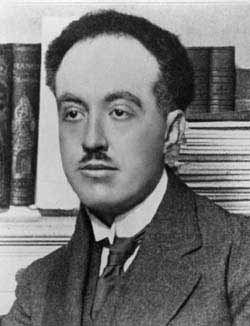 (Louis
de Broglie) The history of science teaches that the greatest
advances in the scientific domain have been achieved by bold thinkers
who perceived new and fruitful approaches that others failed to notice.
If one had taken the ideas of these scientific geniuses who have been
the promoters of modern science and submitted them to committees of
specialists, there is no doubt that the latter would have viewed them
as extravagant and would have discarded them for the very reason of
their originality and profundity. (Louis
de Broglie) The history of science teaches that the greatest
advances in the scientific domain have been achieved by bold thinkers
who perceived new and fruitful approaches that others failed to notice.
If one had taken the ideas of these scientific geniuses who have been
the promoters of modern science and submitted them to committees of
specialists, there is no doubt that the latter would have viewed them
as extravagant and would have discarded them for the very reason of
their originality and profundity. As a matter of fact, the battles waged, for example by Fresnel and by Pasteur suffice to prove that some of these pioneers ran into a lack of understanding from the side of eminent scholars which they had to fight with vigor before emerging as the winners. More recently, in the domain of theoretical physics, of which I can speak with knowledge, the magnificent novel conceptions of Lorentz and Planck, and particularly Einstein also clashed with the incomprehension of eminent scientists. The new ideas here triumphed; but, in proportion as the organization of research becomes more rigid, the danger increases that new and fruitful ideas will be unable to develop freely. Let us state in a few words the conclusion to be drawn from the foregoing. While, by the very force of circumstances, research and teaching are weighted down by administrative structures and financial concerns and by the heavy armature of strict regulations and planning, it becomes more indispensable than ever to preserve the freedom of scientific research and the freedom of initiative for the original investigators, because these freedoms have always been and will always remain the most fertile sources for the grand progress of science. (Nobel Prize Laureate Louis de Broglie, April 25, 1978) https://www.archivefreedom.org/ |
 (Albert
Einstein, 1952) The free, unhampered exchange of ideas and
scientific conclusions is necessary for the sound development of science,
as it is in all spheres of cultural life. ... (Albert
Einstein, 1952) The free, unhampered exchange of ideas and
scientific conclusions is necessary for the sound development of science,
as it is in all spheres of cultural life. ... We must not conceal from ourselves that no improvement in the present depressing situation is possible without a severe struggle; for the handful of those who are really determined to do something is minute in comparison with the mass of the lukewarm and the misguided. ... Great spirits have often encountered violent opposition from weak minds. |
 (Max
Planck) A new scientific truth does not triumph by convincing
its opponents and making them see the light, but rather because its
opponents eventually die, and a new generation grows up that is familiar
with it. (Max
Planck) A new scientific truth does not triumph by convincing
its opponents and making them see the light, but rather because its
opponents eventually die, and a new generation grows up that is familiar
with it. |
 (Charles
Darwin) Although I am fully convinced of the truth of the views
given in this volume I by no means expect to convince experienced naturalists
whose minds are stocked with a multitude of facts all viewed, during
a long course of years, from a point of view directly opposite to mine.
But I look with confidence to the future to young and rising naturalists,
who will be able to view both sides of the question with impartiality. (Charles
Darwin) Although I am fully convinced of the truth of the views
given in this volume I by no means expect to convince experienced naturalists
whose minds are stocked with a multitude of facts all viewed, during
a long course of years, from a point of view directly opposite to mine.
But I look with confidence to the future to young and rising naturalists,
who will be able to view both sides of the question with impartiality. |
 (Galileo
Galilei, 1600) I wish, my dear Kepler, that we could have a
good laugh together at the extraordinary stupidity of the mob. What
do you think of the foremost philosophers of this University? In spite
of my oft-repeated efforts and invitations, they have refused, with
the obstinacy of a glutted adder, to look at the planets or Moon or
my telescope. ... (Galileo
Galilei, 1600) I wish, my dear Kepler, that we could have a
good laugh together at the extraordinary stupidity of the mob. What
do you think of the foremost philosophers of this University? In spite
of my oft-repeated efforts and invitations, they have refused, with
the obstinacy of a glutted adder, to look at the planets or Moon or
my telescope. ...In questions of science, the authority of a thousand is not worth the humble reasoning of a single individual. |
Help Humanity
"You must be the change you wish to see in the world."
(Mohandas Gandhi)
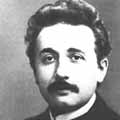 "When forced to summarize the general theory of relativity in one sentence:
Time and space and gravitation have no separate existence from matter. ... Physical objects are not in space, but these objects are spatially extended. In this way the concept 'empty space' loses its meaning. ... The particle can only appear as a limited region in space in which
the field strength or the energy density are particularly high. ...
"When forced to summarize the general theory of relativity in one sentence:
Time and space and gravitation have no separate existence from matter. ... Physical objects are not in space, but these objects are spatially extended. In this way the concept 'empty space' loses its meaning. ... The particle can only appear as a limited region in space in which
the field strength or the energy density are particularly high. ...
The free, unhampered exchange of ideas and scientific conclusions is necessary for the sound development of science, as it is in all spheres
of cultural life. ... We must not conceal from ourselves that no improvement in the present depressing situation is possible without
a severe struggle; for the handful of those who are really determined to do something is minute in comparison with the mass of the lukewarm
and the misguided. ...
Humanity is going to need a substantially new way of thinking if it is to survive!" (Albert Einstein)
 We can now deduce the most simple science theory of reality - the wave structure of matter in space. By understanding how we and everything around us are interconnected
in Space we can then deduce solutions to the fundamental problems of human knowledge in physics, philosophy, metaphysics, theology, education, health, evolution and ecology, politics and society.
We can now deduce the most simple science theory of reality - the wave structure of matter in space. By understanding how we and everything around us are interconnected
in Space we can then deduce solutions to the fundamental problems of human knowledge in physics, philosophy, metaphysics, theology, education, health, evolution and ecology, politics and society.
This is the profound new way of thinking that Einstein
realised, that we exist as spatially extended structures of the universe - the discrete and separate body an illusion. This simply confirms the
intuitions of the ancient philosophers and mystics.
Given the current censorship in physics / philosophy of science journals (based on the standard model of particle physics / big bang cosmology) the internet is the best hope for getting new knowledge
known to the world. But that depends on you, the people who care about science and society, realise the importance of truth and reality.
It is Easy to Help!
Just click on the Social Network links at top of page, or copy a nice image or quote you like and share it. We have a wonderful collection of knowledge from the greatest minds in human history, so people will appreciate your contributions. In doing this you will help a new generation of scientists see that there is a simple sensible explanation of physical reality (One Substance, One Law) - the source of truth and wisdom, the only cure for the madness of man! Thanks! Geoff Haselhurst (Updated May, 2025)
A new scientific truth does not triumph by convincing its opponents and making them see the light, but rather because its opponents eventually die, and a new generation grows up that is familiar with it. (Max Planck, 1920)
"All that is necessary for evil to succeed is for good people to do nothing."
(Edmund Burke)
"In a time of universal deceit - telling the truth is a revolutionary act."
(George Orwell)
"Hell is Truth Seen Too Late."
(Thomas Hobbes)


Legal Disclaimer and Privacy Policy
We support 'Fair Use' of these pages for Academic & Non Commercial use.
You are welcome to use images and text, but please reference them with a link to relevant web page on this site. Thanks!
