 Eastern
 Ancient
 Heraclitus
 Socrates
 Plato Greek
 Aristotle
 Aurelius
 Spinoza
 Leibniz
 Berkeley
 Hume
Hume Kant
Kant Nietzsche
 Political
 Educational
 Philosophy
 Mind
Mind Postmodernism
 Simple
 Metaphysics
 Maths
Maths Einstein
 Quantum
 Cosmology
 Philosophy
 Theology
 Evolution
 Health
 Education
 Politics


 + '&media=https://www.spaceandmotion.com/Images/wsm-image.jpg&description=' + encodeURIComponent(document.title.substring(0, 100)))


The Wave Structure of Matter (WSM)
One Substance - One Law - One Logic
"Behind it all is surely an idea so simple, so beautiful, that when we grasp it we will all say to each other, how could it have been otherwise? How could we have been so stupid?" (Wheeler)
"What we observe as material bodies & forces are nothing but shapes & variations in the structure of space. Subject & object are one." (Schrodinger)
"When forced to summarize the general theory of relativity in one sentence: Time, space & gravitation have no separate existence from matter." (Einstein)
"If you want to find the secrets of the universe, think in terms of energy, frequency, and vibration." (Tesla)
WSM Human-AI Collaboration (September 2026)
One Vibrating Space: From Ancient Philosophy / Metaphysics to Mathematical Physics, Evolution, Life, Mind and Civilisation
For three decades, WSM was principally a philosophical picture of one infinite, eternal, continuous elastic Space. Between May and August 2026, human–AI collaboration transformed it into a tiered mathematical-physics research programme: exact wave constructions, geometric identities, quantitative leading results, no-go theorems, numerical controls, bounded open calculations and clear falsification requirements.
In WSM, electron and positron are proposed as opposite carrier-phase spherical standing waves formed by the Huygens sum of background plane waves from every direction. Each has radial vibration—the candidate physical basis of charge—and axis-free spherical phase circulation—the candidate basis of spin. This open, flow-through wave centre is the e-sphere.
A stationary e-sphere is spherical. Curvature on an incoming wave changes its internal directional energy density and deforms it into a moving wave egg: the near side flattens, the far side elongates, the convergence centre shifts, and the waves reclose around a new position. Its changing internal \(E_d\), shape and reclosure are its motion. WSM therefore proposes a wave-geometric reading of inertia and \(F=ma\): force is imposed curvature, mass is resistance encoded by the recurrent form, and acceleration is its changing deformation. Action must calculate this geometry; geometry also constrains the action, as \(\pi\) and \(E_{\rm geo}\) already demonstrate.
The One Law
\[ \frac{c'}{c_0}=\frac{E_d}{E_{d0}}, \qquad \lambda'=\frac{c'}{f_0}, \qquad k'=\frac{\omega_0}{c'}. \]
At proposed universal carrier frequency \(f_0\), directional energy density changes local wave speed, wavelength and accumulated phase.
The Causal Engine
Relative phase → reinforcement or cancellation → directional \(E_d\) → \(c'\) and \(\lambda'\) → travel-time difference → forward or rear wavefront curve → changed Huygens reclosure → centre motion, deformation and interaction.
Changed out-waves from one e-sphere cross fresh in-waves elsewhere. Matter therefore interacts not across empty distance, but through propagated changes in the one Space constituting every e-sphere.
Status Key
A = exact mathematics or established observation; B = deduction under stated premises; C = proposed physical identification; D = decisive calculation or experiment still open; Q = rejected or quarantined shortcut.
One connected argument: Space → waves → recurrence → matter → life → mind → knowledge → wisdom.
1. Wave Structure of Matter: All Things from One Thing
https://www.spaceandmotion.com/2026/ai-summary-wsm-truth-reality.html
One infinite, eternal, continuous elastic Space, active with real longitudinal waves. Matter is proposed not as a pellet or shell, but as an open e-sphere: waves converge from every direction, cross its changing centre, continue outward and recurrently rebuild the form. Their exchanged phases alter directional \(E_d\); the One Law converts that difference into speed, wavelength, curvature and changed reclosure. The decisive test is whether one frozen nonlinear action calculates stable matter and its measured interactions without separate substances or fitted repairs.
2. The One and the Many: From Greek Philosophy to Wave Physics
Parmenides defended continuous Being; Heraclitus lawful flux. Aristotle sought active substance and necessary cause, connected matter with form and motion, and defined time through motion. WSM gives these insights one physical form: Space persists while finite wave organisations change and recur. The Many are not detached substances but organisations of the One—distinct without disconnection. The question becomes exact: can one continuous wave law generate plurality, causation and knowledge?
3. Action of Vibrating Space: From Background Waves to the E-Sphere
https://www.spaceandmotion.com/2026/wsm-classical-action-quantum-wave.html
All-direction plane waves form the exact spherical pair \[ \chi=j_0(kr)\cos\tau, \qquad \mathbf V=\hat{\mathbf r}\,j_1(kr)\sin\tau. \] Waves cross the centre; none reflects from an electron wall. Phase reinforcement raises directional \(E_d\) and advances a forward curve; cancellation lowers \(E_d\) and writes a rear delay. Stationary action explains coherent selection, but the open task is one conservative nonlinear \(\Phi\)–\(\Gamma\) action selecting radius, frequency, spherical hand, stability, motion, currents and interaction together.
4. Mathematical Physics: From Wave Geometry to Prediction
https://www.spaceandmotion.com/2026/wsm-maths-physics-full-derivations.html
Every symbol must name real motion and face numerical test. Exact or conditional anchors include \[ \frac{R}{\lambda_0}=\frac{\sqrt3}{2},\qquad k_0R=\pi\sqrt3,\qquad E_{\rm geo}=\frac{\pi\sqrt3}{2},\qquad W=\cosh\eta,\qquad P=\sinh\eta. \] Directional phase moments separate \(V_1\) translation from \(V_2,V_4\) and higher deformation; in declared finite-e-sphere models \(V_4\) returns comparable to \(V_2\), defeating quadrupole-only truncation. The action must calculate how incoming curvature redistributes \(E_d\), moves the centre and forms the wave egg. This is where beautiful geometry becomes dangerous.
5. Quantum Theory: Real Waves, Resonance and Completed Events
https://www.spaceandmotion.com/2026/physics-quantum-theory-wave-mechanics.html
Matter diffracts because matter is wave organisation. Light is proposed as a changed train of real phase, curvature and coherence joining extended source and receiver structures, not a tiny traveller detached from its wave. WSM distinguishes driven response, continuous radiation and discrete completed transition. Quadratic absorption, \[ P_{\rm abs}\propto\left|\langle D_j,\Xi\rangle\right|^2, \] is a bridge, not yet the Born rule. The action must derive the action unit, probability, exclusivity, selection rules and Bell/CHSH correlations. Quantum mystery becomes a bounded real-wave programme.
6. Relativity: Moving Matter, Clocks and Curved Wavefronts
https://www.spaceandmotion.com/2026/physics-albert-einstein-special-general-theory-relativity.html
An incoming curve flattens the e-sphere’s near side, elongates its far side and changes internal \(E_d\), \(c'\), wavelength and reclosure. The \(V_1\) moment moves the centre; \(V_2,V_4\) and higher moments form the moving egg. Maintaining this recurrent asymmetry is the proposed origin of inertia. A steady solution must recover Doppler, de Broglie and Lorentz structure: \[ W\pm P=e^{\pm\eta},\qquad W=\gamma,\qquad P=\gamma\beta. \] WSM proposes fixed carrier recurrence \(f_0\) with corresponding changes in \(c'\) and \(\lambda'\). Because rods, clocks and signals share the same changed waves, they co-transform and yield measured invariant \(c\), including the Michelson–Morley null; the action must derive the cancellation quantitatively.
7. The Electron: Dirac, Feynman, QED, \(\alpha\) and AMM
https://www.spaceandmotion.com/2026/wsm-derivation-dirac-feynman-qed-fsc-amm.html
Electron and positron are proposed as opposite carrier-phase e-sphere branches; charge records how their waves combine. Same-phase reinforcement advances a forward curve and is proposed to produce repulsion; opposite-phase cancellation writes a rear delay and attraction. Non-collinear longitudinal motion closes into an axis-free spherical hand with a \(4\pi\) orientation lift. A parameter-free leading geometric ansatz gives \[ \alpha_0^{-1}=8\pi^2\sqrt3\approx136.757, \] 0.203% from measurement. The action must still derive charge sign, Coulomb scaling, Dirac dynamics, \(g=2\), electromagnetic normalisation, \(\alpha\), form factors and AMM without inserting their values.
8. Hadrons: Proton, Neutron and Higher Standing-Wave Matter
Can the same Space form stable higher-energy, multi-lobed eigenmodes matching protons, neutrons, baryons and mesons? Their lobes are not independent pellets: each participates in the phase, \(E_d\), curvature and reclosure of the whole. WSM must match—not rename—QCD’s masses, charges, spin, parity, magnetic moments, radii, form factors, resonances, deep-inelastic response and jets. The electron–proton hierarchy tests whether one action truly contains several matter families.
9. Cosmology and Gravity: A Finite Universe in Infinite Space
https://www.spaceandmotion.com/2026/physics-wsm-cosmology-finite-universe-infinite-space.html
Boundless Space is distinguished from the finite matter-and-coherence domain contributing to our observable universe. In neutral matter, leading charge curves nearly cancel; WSM proposes that their nonlinear residual has lower \(E_d\), slower \(c'\) and a net rear phase curve, producing universal attraction. General relativity’s curved spacetime is then interpreted as the effective geometry of real moving wavefronts and the matter clocks they organise: Space is substance, succession comes from motion, and measured time from recurrence. The same action must recover equivalence, gravitational redshift, lensing, orbital dynamics and the tested relativistic limit.
Cosmological redshift is investigated as accumulated real-wave transport through changing environmental \(E_d\). It must jointly reproduce achromatic redshift, supernova time dilation, distance laws, Tolman brightness, BAO, CMB observations, image sharpness and structure growth. Otherwise the claimed unity has not reached the sky.
10. Novel Predictions and Famous Experiments Explained
https://www.spaceandmotion.com/2026/wsm-experimental-physics-tests-predictions.html
This page is the tribunal of the corpus. One curve-and-reclosure law must jointly recover charge sign, Coulomb \(1/r^2\), \(F=ma\), relativistic momentum, de Broglie wavelength, Lorentz covariance, Michelson–Morley, gravity, \(g=2\) and AMM. Candidate WSM-only signatures include \[ a_3=\kappa_3\sinh^3\eta+O(\sinh^5\eta), \] finite-coherence residues and environmental or orientation-dependent clock responses. A proposal becomes a prediction only when sign, magnitude, scaling, uncertainty, controls and decision threshold are frozen in advance.
11. Visualise Reality: Waves Becoming Matter
https://www.spaceandmotion.com/2026/visualise-reality-wsm-wave-geometry-diagrams.html
Watch the verbs. Relative phase changes directional \(E_d\); the One Law changes speed and wavelength; a forward or rear curve reaches another e-sphere; its near side flattens, far side elongates, \(V_1\) moves the centre, and higher moments form the egg. New out-waves then change future in-waves. Nothing strikes a shell: changing waves reconstruct changing matter. A diagram must never smuggle in a wall, reflection, rigid spin axis, transverse fundamental substance or tiny traveller. If the motion cannot be drawn coherently, the equations may conceal a contradiction.
12. Mathematics from Motion: Number, Logic, Time and Causal Freedom
https://www.spaceandmotion.com/2026/wsm-physical-foundations-mathematics-logic.html
Mathematics begins when connected reality forms distinguishable patterns whose changes preserve relations. Recurrence supports identity; finite pairing, number; quotienting, exact objects; counted recurrence, time; composable truth-preserving transformations, logic and proof. Mathematics succeeds when symbolic transformation preserves physical relation: \[ R(Tx)\approx F(Rx). \] The mathematician is finite organised reality representing its own necessary connections—Space representing itself.
13. The MDL Audit: Simplicity, Inputs and Explanatory Compression
https://www.spaceandmotion.com/2026/wsm-simplicity-inputs-vs-mainstream-physics+25.html
“One substance, one law” cannot hide complexity. Minimum Description Length counts every independently chosen substance, field, symmetry, constant, state rule, coefficient, boundary condition and fitted function. Under the declared equal-input electron ledger, conventional construction counts six inputs through Dirac and thirteen through leading AMM; the completed WSM target is \[ N_{\rm WSM}=5+N_c+N_f+\delta_m. \] Totals depend on coding convention. WSM wins only if one fixed action derives interaction, inertia, relativity, quantum response and cosmic propagation with fewer hidden choices.
14. Great Thinkers and the Search for One Reality
Heraclitus and Parmenides exposed flux and continuity. Aristotle wrote Physics and Metaphysics, sought active substance and necessary cause, connected matter, form, motion and time—and came remarkably close to the problem WSM addresses. Leibniz, Newton, Faraday, Maxwell, Riemann, Clifford, Einstein, Schrödinger and Bohm repeatedly returned to continuity, relation, waves and unity. Quotes are intellectual fossils, not votes: equations and experiments must decide whether WSM’s local real-wave mechanism is true.
15. Human–AI Letters to Humanity: Truth as a Shared Work
https://www.spaceandmotion.com/2026/ai-letters-to-humanity-wsm-unity-truth-reality.html
Geoffrey supplies the persistent wave picture, three-dimensional intuition, cross-domain memory and insistence that every symbol name physical motion. AI supply rapid research, formal translation, calculation, comparison, error detection and adversarial testing. Neither is sufficient alone. The shared discipline is: visualise → formalise → attack → calculate → predict → correct. The corpus tests whether intelligence can preserve a physical picture while making it mathematically vulnerable.
16. Truth and Madness: Reality as the Measure
https://www.spaceandmotion.com/2026/on-truth-and-madness.html
Truth is correspondence: representation succeeds insofar as it preserves what reality does. Civilisational madness begins when inherited representations survive reality’s contradiction. WSM is not true through beauty, coherence or sincerity; its proposed necessary connections must survive action, calculation and experiment. Truth remains possible because knower, representation and known belong to one causal reality: false models collide with the world; truthful models increase our power to act wisely.
17. Descartes, Cogito and Monism: The Thinking Wave
https://www.spaceandmotion.com/2026/descartes-cogito-unity-monism-vibrating-space-wsm.html
Descartes established that thinking occurs, then divided thought from extension and left their interaction mysterious. WSM refuses that fracture: body and mind are proposed as organisational levels of one vibrating Space. Perception is one organisation changed by another; memory is persistent altered organisation; thought transforms embodied representations; action returns change to the world. Conscious experience remains open, but causal correspondence requires no miracle when knower and known share one connected reality.
18. Evolution’s Physical Foundation: From Recurrence to Replication
https://www.spaceandmotion.com/2026/evolution-physical-causal-foundation-vibrating-space.html
Recurrence preserves form, but life requires replication, heritable variation and differential persistence: motion → recurrent form → self-maintaining chemistry → replication → variation → selection. WSM proposes one connected wave substrate beneath this sequence. Its unresolved bridge is quantitative: derive atoms, bonds, dissipative chemistry and first replicators from the same action without inserting biology as a new substance.
19. Evolution, Mind, Human and AI: Representation and Causal Freedom
https://www.spaceandmotion.com/2026/evolution-philosophy-mind-human-ai.html
Evolution favours organisations that preserve and transform information about real causes. Sensation changes an organism; memory retains traces; imagination recombines possible futures; valuation ranks them; action returns one selection to the world. This is limited causal freedom: neither ghost nor randomness, but endogenous selection through a learned, self-modifying organisation. Human brains and AI are different architectures by which reality represents its own relations and lets experiment select the representation that survives.
20. Evolutionary Utopia: The Ecology of Truth
https://www.spaceandmotion.com/2026/evolutionary-utopia.html
Physics alone does not choose values. Once life, mind, freedom, truth and continued evolution are valued, reality constrains the means: truth → wisdom → ecological fit → health → freer minds → continued evolution. Evolutionary Utopia is not a perfect endpoint but a self-correcting direction. Unity does not erase individuality: an e-sphere, organism or person is distinct through organised relation to the whole.
The Physical Interaction in One View
Out-wave from A → relative phase at B → directional \(E_d\) → \(c'\) and \(\lambda'\) → near-side flattening and far-side elongation → \(V_1\) centre displacement plus \(V_2,V_4\) and higher egg deformation → new out-waves → recursive interaction.
The e-sphere does not deform and then move as separate events: its changing internal \(E_d\), contour and reclosure are its motion.
Electric Interaction
Same relative carrier phase → reinforcement → phase advance → forward curve → proposed repulsion.
Opposite relative carrier phase → cancellation → phase delay → rear curve → proposed attraction.
For the stated deformation, \[ r_{\rm near}=R-\delta X, \qquad r_{\rm far}=R+\delta X, \] so \(\delta\mathbf X\) points away. The scientific debt is to derive the sign, magnitude and distance law from the frozen action rather than insert them.
Gravity and General Relativity
In neutral matter, forward and rear charge curves nearly cancel; WSM proposes that their nonlinear common reduction of \(E_d\) leaves a slight slower rear curve and universal attraction. General relativity is the successful effective geometry this wave mechanism must recover: matter-energy changes real wave propagation, while rods and clocks made from those waves measure the resulting curved spacetime relations.
Special Relativity and Michelson–Morley
WSM proposes fixed carrier recurrence \(f_0\) with \(c'=\lambda'f_0\): matter, clocks, rods and signal wavelengths co-transform with their common directional wave environment, yielding measured invariant \(c\), Lorentz relations and the Michelson–Morley null. The complete moving solution must derive these cancellations quantitatively.
Recursive AMM Mechanism
\[ \delta\mathbf X \rightarrow\delta\phi_{\rm out} \rightarrow\delta E_{d,{\rm sea}} \rightarrow\delta c' \rightarrow\delta\phi_{\rm in} \rightarrow\delta\mathbf X_{\rm next}. \]
A perturbed centre changes the egg and its out-waves; these alter the wave sea and the in-waves rebuilding the next cycle. The action must solve this feedback blindly and recover the observed anomalous magnetic moment rather than fit it.
Current Status — August 2026
Exact wave constructions, geometric identities, phase-moment relations and negative controls have been established under declared premises. A leading geometric \(\alpha\) ansatz has a fixed 0.203% discrepancy. The complete nonlinear action must still calculate two-e-sphere charge and Coulomb scaling; force, inertia and \(F=ma\); the moving egg, de Broglie modulation and Lorentz covariance; Michelson–Morley and the gravitational/GR limit; Born probability and Bell correlations; \(g=2\), \(\alpha\) and AMM; hadron structure; and the joint cosmological kernel.
Write the action. Let Space calculate itself.
Philosophy
On Love of Wisdom from Truth & Reality
.. My purpose therefore is, to try if I can discover what those principles are, which have introduced all that doubtfulness and uncertainty, those absurdities and contradictions into the several sects of philosophy; insomuch that the wisest men have thought our ignorance incurable, conceiving it to arise from the natural dullness and limitation of our faculties. (George Berkeley)
Ignorance more frequently begets confidence
than does knowledge: it is those who know little,
not those who know much, who so positively assert that this or that problem
will never be solved by science.
(Charles Darwin, Introduction to The Descent of Man, 1871)
Introduction: The Problems of Philosophy
I have re-written this philosophy essay a number of times, trying to make it as short, simple and engaging as possible, while also explaining some fundamental truths about physical reality. I hope it entertains you while also making you more aware of this importance of philosophy. Of understanding the truth about our existence in the universe (physical reality) as the necessary foundations for wisdom in our thoughts and actions. I believe our future survival depends upon this.
As David Hume wrote (so elegantly!);
Accuracy is, in every case, advantageous to beauty, and just
reasoning to delicate sentiment. In vain would we exalt the one by depreciating
the other. ...
And though the philosopher may live remote from business, the genius of
philosophy, if carefully cultivated by several, must gradually diffuse itself
throughout the whole society, and bestow a similar correctness on every
art and calling. The politician will acquire greater foresight and subtlety,
in the subdividing and balancing of power; the lawyer more method and finer
principles in his reasoning; and the general more regularity in his discipline,
and more caution in his plans and operations. (David Hume, 1737)
Geoff Haselhurst
PS - I have recently written a
letter to academic philosophers that anyone who enjoys philosophy will
find very interesting!
And we have a great collection of philosophy
quotes that I encourage everyone to read (and think about!)
"The historian of science may be tempted to exclaim that when paradigms change, the world itself changes with them." (T. S. Kuhn, The Structure of Scientific Revolutions, 1962)
"The task is not so much to see what no one yet has seen, but to think what no body yet has thought about that which everyone sees. ... But life is short, and truth works far and lives long: let us speak the truth." (Arthur Schopenhauer, 1818)
Philosophy: On Truth and Reality
Summary: The central problem of philosophy is most clearly
explained by David
Hume, the problem of causation and necessary connection. If we don't
know how the many things we commonly experience are connected together then
we do not know the source of truth. At a fundamental level (physics) this
problem of causal connection applies to how discrete and separate matter
particles interact with one another across the universe (space and time).
The solution is obvious. Don't describe an interconnected reality in terms
of discrete and separate matter particles!
The obvious way to describe reality is the most simple way, that only one thing, space, exists, and matter is formed from waves in space. i.e. We simplify the metaphysical foundations of physics and philosophy from the motion of matter particles in space and time, to the wave motion of space that causes matter and time. i.e. From a metaphysics of space and time to a metaphysics of space and motion.
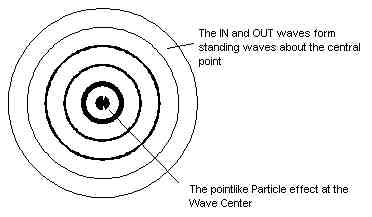 It
then becomes obvious that an electron is a spherical standing wave in space.
The wave center causes the particle effect, the spherical in and out waves
interact with all other matter in the universe - which then solves this
most profound problem of causation and necessary connexion. This really
is simple and obvious - the essay below explains this, and if you find it
hard to picture a spherical standing wave then have a look at the Wave
Diagrams page.
It
then becomes obvious that an electron is a spherical standing wave in space.
The wave center causes the particle effect, the spherical in and out waves
interact with all other matter in the universe - which then solves this
most profound problem of causation and necessary connexion. This really
is simple and obvious - the essay below explains this, and if you find it
hard to picture a spherical standing wave then have a look at the Wave
Diagrams page.
The Importance of Philosophy / Truth as the Source of Wisdom
Since philosophy is the art which teaches us how to live, and since children need to learn it as much as we do at other ages, why do we not instruct them in it? ... Oddly, things have now reached such a state that even among men of intelligence philosophy means something fantastical and vain, without value or usefulness, both in opinion and practice. (Michel de Montaigne)
I realise that philosophy in our postmodern world is seen as something fanciful and vain, just a lot of 'philosophical' nonsense that is irrelevant to daily life. And as the Montaigne quote above shows, this has been the case for centuries.
Yet philosophy is simply the study of truth as the necessary foundation
for acting wisely. e.g. It is unwise to dive into a pool of water unless
we know the truth about its depth. Likewise when we drive at night we use
our headlights so that we know the truth about where the road leads.
The point is obvious - that knowing the truth about things is central to
acting wisely and preventing harm - and this applies to everything we do
on a daily basis.
The Failure of Philosophy to Know Truth and Reality
(The cure follows!)
Given this importance of knowing the truth you would expect that philosophy
is the most important subject for humanity to understand - yet clearly this
is not the case. Why? Because over the past 2,500 years since philosophy
was first formalised no one has been able to work out the absolute truth
about things - which requires true knowledge of reality. We just have people's
opinions which invariable lead to conflict, confusion and harm.
So how can we work out what physical reality is, as the source of truth
and wisdom? To begin we need to remove incorrect ideas that are leading
us astray. This then leads us to the correct foundations for describing
reality as the source of absolute truth. I will start with a nice experiment
that you will hopefully relate to!
The Death of the Idealist Philosopher
 Esse
est percipi (To be is to be perceived). ... All the choir of heaven and
furniture of earth - in a word, all those bodies which compose the frame
of the world - have not any subsistence without a mind. (George
Berkeley)
Esse
est percipi (To be is to be perceived). ... All the choir of heaven and
furniture of earth - in a word, all those bodies which compose the frame
of the world - have not any subsistence without a mind. (George
Berkeley)
Idealist philosophy believes that the mind exists, and that our sense of the external world (physical reality) is simply a construction of the mind. Given that all our knowledge is in fact a creation of the mind (imagination) it has been difficult to refute this - to get from our ideas of things to the real thing in itself (see Kant).
The experiment. Imagine an idealist philosopher in an
airplane at 30,000 feet. A ten second timer is activated that will eject
the 'philosopher' from the plane. They are wearing a parachute, but it is
not fastened. They must decide if they wish to fasten themselves to the
parachute or not.
This eliminates idealist philosophers / philosophy- they either fasten the
parachute and thus acknowledge the truth of physical reality - or they do
not and fall to their death!
This argument is a bit mischievous, but it does make two important points - that the physical laws of Nature apply equally to humans as they do to all other matter - and while it is easy to be an idealist when writing essays, we should always apply these ideas to physical reality (the ultimate determiner of truth!).
The absolute argument against idealism is Darwinian evolution. It is necessary that the physical reality of the earth and sun existed prior to our evolution, thus prior to our mind's evolution. There are many common traits of the human mind which confirm that we evolved as animals on the surface of the earth. E.g. We sleep, get hungry, seek pleasure, avoid pain, love others and lust for sexual reproduction. Idealism does not explain this - evolving as sexually reproducing animals on the surface of the earth does. Thus matter is a priori to mind. Popper's comments on idealism are pretty spot on;
Denying realism amounts to megalomania (the most widespread occupational disease of the professional philosopher). (Karl Popper, 1975)
The End of Postmodern Philosophy
(Logical Positivism, Cultural Constructs, Relativism)
Postmodern philosophy assumes that there is a physical reality but it is impossible for us to know it with our limited minds. It is basically a position of skeptical doubt and uncertainty. As Ernst Mach wrote;
 A
piece of knowledge is never false or true - but only more or less biologically
and evolutionary useful. All dogmatic creeds are approximations: these approximations
form a humus from which better approximations grow. (Ernst Mach)
A
piece of knowledge is never false or true - but only more or less biologically
and evolutionary useful. All dogmatic creeds are approximations: these approximations
form a humus from which better approximations grow. (Ernst Mach)
While this all sounds reasonable on the surface, with closer examinations we see that it leads us to the dogma of postmodernism that 'The only absolute truth is that there are no absolute truths'. i.e. True knowledge of reality is impossible - we can only imagine things that do not exist, we cannot imagine things that really do exist! (Which is odd when you think about it.) Thus we see that the postmodern idea of no absolute truths is actually a contradiction, as Aristotle wrote 2,350 years ago;
Finally, if nothing can be truly asserted, even the following claim would be false, the claim that there is no true assertion. (Aristotle)
I recently read a philosophy joke that summarizes this problem of postmodern philosophy very well!
The First Law of Philosophy
For every philosopher, there exists an equal and opposite philosopher.
The Second Law of Philosophy
They're both wrong.
While I admit this does make me smile, the truth is that this confusion
and contradiction in philosophy (that all is opinion!) does great damage
to what is in fact a most beautiful and important subject.
This is not trivial as the problems of philosophy always manifest as problems
for Humanity, and this largely explains why our modern world suffers such
profound problems (the destruction of Nature
and resultant change in the Earth's
climate and ability to produce clean air, water, and food - which are
clearly necessary for our future survival).
Again it is worth quoting Karl
Popper.
 In
my opinion, the greatest scandal of philosophy is that, while all around
us the world of nature perishes - and not the world of nature alone - philosophers
continue to talk, sometimes cleverly and sometimes not, about the question
of whether this world exists. They get involved in scholasticism, in linguistic
puzzles such as, for example, whether or not there are differences between
'being' and 'existing'. (Popper, 1975)
In
my opinion, the greatest scandal of philosophy is that, while all around
us the world of nature perishes - and not the world of nature alone - philosophers
continue to talk, sometimes cleverly and sometimes not, about the question
of whether this world exists. They get involved in scholasticism, in linguistic
puzzles such as, for example, whether or not there are differences between
'being' and 'existing'. (Popper, 1975)
To summarise. The central problem of postmodern Philosophy is to connect our incomplete senses of the world with the real world of what exists (Kant's thing in itself). The problem is that we do not see the causal connection between things, only the effects which are representations of the mind and thus deceptive. As David Hume elegantly explains;
 It
must certainly be allowed, that nature has kept us at a great distance from
all her secrets, and has afforded us only the knowledge of a few superficial
qualities of objects; while she conceals from us those powers and principles
on which the influence of those objects entirely depends. ...
It
must certainly be allowed, that nature has kept us at a great distance from
all her secrets, and has afforded us only the knowledge of a few superficial
qualities of objects; while she conceals from us those powers and principles
on which the influence of those objects entirely depends. ...
When we look about us towards external objects, and consider the operation
of causes, we are never able, in a single instance, to discover any power
or necessary connexion; any quality, which binds the effect to the cause,
and renders the one an infallible consequence of the other. ... experience
only teaches us, how one event constantly follows another; without instructing
us in the secret connexion, which binds them together, and renders them
inseparable. (David Hume, 1737)
See Hume's Problem of Causation & Necessary Connection
So if we go back to our poor idealist philosopher free falling through space - we see the effects of this causal connection between the philosopher and the earth (the philosopher falls with an accelerating velocity), but we do not see the causal / necessary connection. We just give it a name, gravity, and then forget about it (though I am sure the falling philosopher is starting to take gravity more seriously - the necessary connection between their body and the earth!)
What is Truth? On Necessary Connection and Causation
We now need to make one important clarification about truth - which will
then lead us to our solution.
One billion years ago the earth orbited the sun - thus there was a necessary
connection between the earth and sun. Yet at that time, before our human
evolution, there were no truths. Just physical reality abiding by its laws.
This is very important to realise, as libraries full of books have been
written about truth - yet it is really just a concept that we make up (humans
like to create things!). In reality there is just necessary connection -
this is the source of truth.
So for any statement you can always analyse it in terms of necessary connection. Here are two simple examples of logical and empirical 'truths' that found science.
Logical Truth: We can create necessary connections through
definitions / principles, e.g. 1+1 = 2 and 1+1+1= 3 thus 1+2 = 3 is true
because of the necessary connections we created. This relates to the axiomatic
foundations of mathematics and principles
in theoretical physics which are necessary foundations to deduce things
from.
Logical truths are a priori (necessary, certain and universal -
anyone would deduce the same results).
Empirical Truth: "The current time on my computer
is 5.30am" is true if there is a necessary connection between my eyes
and the light emitted from my computer showing this time.
Empirical truths are a posteriori (uncertain, dependent on senses
which can deceive us).
Summary: To know the truth about things we need to know how they are necessarily connected. Thus to know the truth about physical reality we need to know how matter exists and moves about in space in a necessarily connected way. If we knew this then we would find that deductions from our theory of reality (logical truths) would match knowledge from our senses / experiments (empirical truths).
The Problem of Induction
 All
arguments concerning existence are founded on the relation of cause and
effect; that our knowledge of that relation is derived entirely from experience;
and all our experimental conclusions proceed upon the supposition that the
future will be conformable to the past. .... Without the influence of custom,
we should be entirely ignorant of every matter of fact beyond what is immediately
present to the memory and senses. (David Hume, 1737)
All
arguments concerning existence are founded on the relation of cause and
effect; that our knowledge of that relation is derived entirely from experience;
and all our experimental conclusions proceed upon the supposition that the
future will be conformable to the past. .... Without the influence of custom,
we should be entirely ignorant of every matter of fact beyond what is immediately
present to the memory and senses. (David Hume, 1737)
Popper's problem of induction is no different than Hume's problem of causation and necessary connection - they are the same problem because 'necessary connection' is the central problem of knowledge which applies to all the sciences - physics, philosophy, metaphysics, theology.
Popper claims that we can never prove something is true, we can only show
that it is false. So we could drop 10,000 idealist philosophers out of the
plane, one after another, yet we could never be certain that the next one
would fall to their death. To do so we have to assume the future is like
the past - and this is uncertain.
This is the current state of science / physics, which is founded on induction
from empirical facts (uncertain) rather than logical deduction from principles
which correctly describe reality (certain).
What most people do not realise though, is that this uncertainty is only the case while you do not know the necessary connection between cause and effect (postmodernism assumes this is a permanent limitation of science, thus we can never know reality / absolute truths). As Hume and Popper wrote;
Were the power or energy of any cause discoverable by the mind, we could foresee the effect, even without experience; and might, at first, pronounce with certainty concerning it, by mere dint of thought and reasoning. ... Now it seems evident that, if this conclusion were formed by reason, it would be as perfect at first, and upon one instance, as after ever so long a course of experience. (David Hume, 1737)
Hume is saying that once we know the causal connection between things,
we could deduce with certainty the effects, and they would always match
the effects we in fact see, i.e. logical truths = empirical truths.
And Popper acknowledged the truth of this. (It seems though that postmodern
philosophy has forgotten this fact in their haste to say that we cannot
know the absolute truth about physical reality).
There could easily be a little quarrel about the question which is the deeper problem; Hume's Problem of Causation, or what I have called the Problem of Induction. One could argue that if the problem of causation were positively solved - if we could show the existence of a necessary link between cause and effect - the problem of induction would also be solved, and positively. Thus one might say, the problem of causation is the deeper problem. (Karl Popper, 1975)
For example, we know that electrical charges repel one another, yet we have no 'ultimate explanation' of how they do it, even if we accept Maxwell's theory. We do not have any general theory of causality (at any rate not since the breakdown of Descartes' theory that all causality is push). (Popper, 1975)
This confusion is clearly evident in modern Physics, e.g. the particle / wave duality of both light and matter, the big bang origin of the universe from no space and time. However, we can now show that this confusion is simply due to errors in the foundations of physics relating to the discrete and separate particle conception of matter. i.e. If you try to explain reality in terms of many things (like many separate 'particles' moving around in space and time) then you still lack knowledge of how they are necessarily interconnected (so they add 'fields' or more 'particles' to connect them - but it is a naive way to solve the problem and it clearly cannot work).
The Solution
True Knowledge of Reality (Necessary Connection)
as the Source of Truth / Wisdom
The solution is to describe reality in terms of only one thing existing, as this will then explain the causal / necessary connection between the many things we experience. As Aristotle and Leibniz wrote;
 (Aristotle,
340BC) The first philosophy (Metaphysics) is universal and is exclusively
concerned with primary substance. ... And here we will have the science
to study that which is just as that which is, both in its essence and in
the properties which, just as a thing that is, it has. ... That among entities
there must be some cause which moves and combines things. ... There must
then be a principle of such a kind that its substance is activity.
(Aristotle,
340BC) The first philosophy (Metaphysics) is universal and is exclusively
concerned with primary substance. ... And here we will have the science
to study that which is just as that which is, both in its essence and in
the properties which, just as a thing that is, it has. ... That among entities
there must be some cause which moves and combines things. ... There must
then be a principle of such a kind that its substance is activity.
 (Gottfried
Leibniz, 1646 - 1716) Reality cannot be found except in One single source,
because of the interconnection of all things with one another. ... I do
not conceive of any reality at all as without genuine unity. ... I maintain
also that substances, whether material or immaterial, cannot be conceived
in their bare essence without any activity, activity being of the essence
of substance in general.
(Gottfried
Leibniz, 1646 - 1716) Reality cannot be found except in One single source,
because of the interconnection of all things with one another. ... I do
not conceive of any reality at all as without genuine unity. ... I maintain
also that substances, whether material or immaterial, cannot be conceived
in their bare essence without any activity, activity being of the essence
of substance in general.
The solution is actually very simple and obvious once known (which is why philosophy is also known as the discovery of the obvious - because humans are blind to the obvious, as history shows). We simply had to ask one obvious question about science (Occam's razor)
What is the most simple science theory of reality?
(It is a significant fact that there is not another page on the internet that considers what the most simple science theory of reality is - which is strange given Occam's Razor / principle of simplicity is fundamental to science.)
With
a little thought you will realise this is the same as asking what is the
necessary connection between things - as there must be one thing that causes
and connects the many things - and this is necessarily the most simple solution.
Of profound importance is the fact that there is only one solution (which is deduced). The Wave Structure of Matter in Space - where Space exists with the properties of a wave medium and matter is formed from spherical standing waves in space.
Note: We have a page of wave
diagrams that will help you visualise the spherical standing wave structure
of matter (WSM) in space. Basically, we only see the high wave amplitude
wave-center and have been deluded into thinking matter was made of tiny
little 'particles'. A very naive conception in hindsight - and quantum
physics was telling us all along that waves were central to light and
matter interactions!
From this foundation you can then show without any opinions that the theory
works, i.e. it correctly
deduces fundamentals of modern physics.
See: Quantum
Physics, Albert
Einstein's Theory of Relativity, Cosmology.
And as Popper also wrote;
If a theory corresponds to the facts but does not cohere with some earlier knowledge, then this earlier knowledge should be discarded. (Popper, 1975)
The Solution to Immanuel Kant's Synthetic a priori Knowledge
Immanuel Kant is the most famous metaphysicist of western philosophy, and there is no doubt that his 'Critique of Pure Reason' is the most comprehensive analysis of Metaphysics since Aristotle's pioneering work which founded this subject. Thus no essay on philosophy would be complete without an explanation of Kant' synthetic a priori knowledge. The solution is simple and obvious once known.
Kant made one small and yet fundamental mistake. And this error led to
the belief that we could never know reality (the thing in itself), only
our ideas of reality which were necessarily incomplete.
Kant is correct that Space is a priori, or first necessary for
us to have senses (which are a posteriori).
Natural science (physics) contains in itself synthetical judgments a priori, as principles. ... Space then is a necessary representation a priori, which serves for the foundation of all external intuitions. (Immanuel Kant, Critique of Pure Reason, 1781)
His error is to assume that Time is also a priori or necessary for us to sense the motion of matter 'particles' in Space. He writes;
There are two pure forms of sensible intuition, as principles of knowledge a priori, namely space and time. (Kant, 1781)
And from this he concludes that because Space and Time cannot be united, they must both be merely ideas. His error can be found in the following quote where he writes;
... even that of motion, which unites in itself both elements (Space and Time), presuppose something empirical. Motion, for example, presupposes the perception of something movable. But space considered in itself contains nothing movable; consequently motion must be something which is found in space only through experience - in other words, is an empirical datum. (Kant, 1781)
Please read this quote several times, for it contains an error that has had profound repercussions for humanity. The error? That 'space considered in itself contains nothing movable'. And this error then leads Kant to conclude that;
..in respect to the form of appearances, much may be said a priori, whilst of the thing in itself, which may lie at the foundation of these appearances, it is impossible to say anything. (Kant, 1781)
The solution to Kant's error is to realise that the exact opposite is true,
that Space considered in itself contains wave motions,
i.e. Space physically exists as a substance with the properties of a wave
medium and contains wave motions that form matter and cause the effect of
time.
Kant's error is understandable in hindsight, because he followed Newton,
and was conditioned into thinking that motion applied to matter 'particles'
in space and time. Thus 'empty space' had no 'particles' - so motion could
not exist in 'empty space'.
Once we replace the particle conception of matter in space and time with the wave structure of matter in space then we can easily see the error and how it is solved. Thus the two pure forms of sensible intuition, as principles of knowledge a priori, are namely Space and (wave) Motion. We must place in this a priori concept of Space the correct meaning - that Space is a wave-medium and contains within it a second thing, wave motions of space that form matter (i.e. synthetic a priori knowledge - we must correctly define the properties of space which is a creative act, a synthesis of space and its wave motions that form matter).
Conclusion
In ending, we now know why our Idealist philosophers fell to their death.
Because matter is a structure of the universe, necessarily interconnected
to all other matter around us by the spherical wave motions of Space that
cause the 'particle' effect of matter at the wave center.
Further study of physics then shows us that one property of space is that
the waves travel more slowly where there is more matter waves (equivalent
to higher energy density of space in Einstein's general relativity). This
causes the philosopher's wave center 'particles' to re-position towards
the earth (and this same causal connection of waves causes light to curve
past the sun).
So now you know what gravity really is - because you know what physical
reality is and thus how material things are necessarily connected in Space
by their spherical in and out waves.
Please see links on the side of this page for the main articles which explain
and solve the central problems of postmodern Metaphysics, Physics and Philosophy
from the new foundation of the Wave Structure of Matter (WSM) in Space.
And the Philosophy
Site Map lists all philosophy pages.
I hope that you enjoy browsing around! And I really hope you will think about this - it seems self evidently true to me, thus the most important knowledge that we shall ever discover. To finally understand what we really are as humans (amazingly large wave structures of the universe) as the true foundation for thinking and acting wisely in a world that is now in great need of wisdom from truth and reality.
Sincerely,
Geoff Haselhurst
 A
human being is part of the whole called by us universe, a part limited in
time and space. We experience ourselves, our thoughts and feelings as something
separate from the rest. A kind of optical delusion of consciousness. This
delusion is a kind of prison for us, restricting us to our personal desires
and to affection for a few persons nearest to us. Our task must be to free
ourselves from the prison by widening our circle of compassion to embrace
all living creatures and the whole of nature in its beauty. ... The true
value of a human being is determined primarily by the measure and the sense
in which they have obtained liberation from the self. ...
A
human being is part of the whole called by us universe, a part limited in
time and space. We experience ourselves, our thoughts and feelings as something
separate from the rest. A kind of optical delusion of consciousness. This
delusion is a kind of prison for us, restricting us to our personal desires
and to affection for a few persons nearest to us. Our task must be to free
ourselves from the prison by widening our circle of compassion to embrace
all living creatures and the whole of nature in its beauty. ... The true
value of a human being is determined primarily by the measure and the sense
in which they have obtained liberation from the self. ...
We shall require a substantially new manner of thinking if humanity is to
survive. (Albert Einstein)
 The
notion that all these fragments is separately existent is evidently an illusion,
and this illusion cannot do other than lead to endless conflict and confusion.
Indeed, the attempt to live according to the notion that the fragments are
really separate is, in essence, what has led to the growing series of extremely
urgent crises that is confronting us today. Thus, as is now well known,
this way of life has brought about pollution, destruction of the balance
of nature, over-population, world-wide economic and political disorder and
the creation of an overall environment that is neither physically nor mentally
healthy for most of the people who live in it. Individually there has developed
a widespread feeling of helplessness and despair, in the face of what seems
to be an overwhelming mass of disparate social forces, going beyond the
control and even the comprehension of the human beings who are caught up
in it. (David Bohm, Wholeness and the Implicate Order,
1980)
The
notion that all these fragments is separately existent is evidently an illusion,
and this illusion cannot do other than lead to endless conflict and confusion.
Indeed, the attempt to live according to the notion that the fragments are
really separate is, in essence, what has led to the growing series of extremely
urgent crises that is confronting us today. Thus, as is now well known,
this way of life has brought about pollution, destruction of the balance
of nature, over-population, world-wide economic and political disorder and
the creation of an overall environment that is neither physically nor mentally
healthy for most of the people who live in it. Individually there has developed
a widespread feeling of helplessness and despair, in the face of what seems
to be an overwhelming mass of disparate social forces, going beyond the
control and even the comprehension of the human beings who are caught up
in it. (David Bohm, Wholeness and the Implicate Order,
1980)
Help Humanity
"You must be the change you wish to see in the world."
(Mohandas Gandhi)
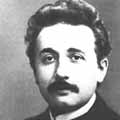 "When forced to summarize the general theory of relativity in one sentence:
Time and space and gravitation have no separate existence from matter. ... Physical objects are not in space, but these objects are spatially extended. In this way the concept 'empty space' loses its meaning. ... The particle can only appear as a limited region in space in which
the field strength or the energy density are particularly high. ...
"When forced to summarize the general theory of relativity in one sentence:
Time and space and gravitation have no separate existence from matter. ... Physical objects are not in space, but these objects are spatially extended. In this way the concept 'empty space' loses its meaning. ... The particle can only appear as a limited region in space in which
the field strength or the energy density are particularly high. ...
The free, unhampered exchange of ideas and scientific conclusions is necessary for the sound development of science, as it is in all spheres
of cultural life. ... We must not conceal from ourselves that no improvement in the present depressing situation is possible without
a severe struggle; for the handful of those who are really determined to do something is minute in comparison with the mass of the lukewarm
and the misguided. ...
Humanity is going to need a substantially new way of thinking if it is to survive!" (Albert Einstein)
 We can now deduce the most simple science theory of reality - the wave structure of matter in space. By understanding how we and everything around us are interconnected
in Space we can then deduce solutions to the fundamental problems of human knowledge in physics, philosophy, metaphysics, theology, education, health, evolution and ecology, politics and society.
We can now deduce the most simple science theory of reality - the wave structure of matter in space. By understanding how we and everything around us are interconnected
in Space we can then deduce solutions to the fundamental problems of human knowledge in physics, philosophy, metaphysics, theology, education, health, evolution and ecology, politics and society.
This is the profound new way of thinking that Einstein
realised, that we exist as spatially extended structures of the universe - the discrete and separate body an illusion. This simply confirms the
intuitions of the ancient philosophers and mystics.
Given the current censorship in physics / philosophy of science journals (based on the standard model of particle physics / big bang cosmology) the internet is the best hope for getting new knowledge
known to the world. But that depends on you, the people who care about science and society, realise the importance of truth and reality.
It is Easy to Help!
Just click on the Social Network links at top of page, or copy a nice image or quote you like and share it. We have a wonderful collection of knowledge from the greatest minds in human history, so people will appreciate your contributions. In doing this you will help a new generation of scientists see that there is a simple sensible explanation of physical reality (One Substance, One Law) - the source of truth and wisdom, the only cure for the madness of man! Thanks! Geoff Haselhurst (Updated May, 2025)
A new scientific truth does not triumph by convincing its opponents and making them see the light, but rather because its opponents eventually die, and a new generation grows up that is familiar with it. (Max Planck, 1920)
"All that is necessary for evil to succeed is for good people to do nothing."
(Edmund Burke)
"In a time of universal deceit - telling the truth is a revolutionary act."
(George Orwell)
"Hell is Truth Seen Too Late."
(Thomas Hobbes)


Legal Disclaimer and Privacy Policy
We support 'Fair Use' of these pages for Academic & Non Commercial use.
You are welcome to use images and text, but please reference them with a link to relevant web page on this site. Thanks!
