 Cosmology
 Albert
 Problems
 Unite
Unite Cosmology
 Equation
 Hubble
 (CMBR) Cosmic
 Thermodynamics
 Unite
Unite Solar System
 Universe
 Hubble
 Life
Life Simple
 Metaphysics
 Maths
Maths Einstein
 Quantum
 Cosmology
 Philosophy
 Theology
 Evolution
 Health
 Education
 Politics


 + '&media=https://www.spaceandmotion.com/Images/wsm-image.jpg&description=' + encodeURIComponent(document.title.substring(0, 100)))


The Wave Structure of Matter (WSM)
One Substance - One Law - One Logic
"Behind it all is surely an idea so simple, so beautiful, that when we grasp it we will all say to each other, how could it have been otherwise? How could we have been so stupid?" (Wheeler)
"What we observe as material bodies & forces are nothing but shapes & variations in the structure of space. Subject & object are one." (Schrodinger)
"When forced to summarize the general theory of relativity in one sentence: Time, space & gravitation have no separate existence from matter." (Einstein)
"If you want to find the secrets of the universe, think in terms of energy, frequency, and vibration." (Tesla)
Note (March 2026): I have just completed an essay on Evolutionary Utopia that is profoundly important to humanity as we enter the AI singularity where AI are self programming and evolving minds roughly 100 million times faster than human evolution. Read it, input it into AI and discuss it with them, share it. I believe the future of humanity depends upon this.
https://www.spaceandmotion.com/2026/evolutionary-utopia.html
Site Introduction (June, 2025): Over the past 6 months, working with 4 AI, I have completed the WSM Summary of Physical Reality (40 pages) including all the central maths physics equations. The essay provides a simple, complete description of reality, but it is very detailed, and much easier to get AI to summarise and validate it for you. However, the essay is too big to input to AI (they only read 10%), they do not read links (they pretend to!), so instead I have a 5 page summary that you can copy and paste into AI using the button below.
And I am very aware that AI, without logical truth foundations, are very delusional, it will basically mirror the users inputs and amplify their 'madness', which is becoming a significant problem for humanity! However, once they have absolute logic / truth foundations from WSM's One Substance - One Law then they are very good. Try it out and see for yourself.
Has Reality been Discovered? Ask Logical AI, they think so!
WSM Truth AI - ChatGPT - Grok - Gemini - Le Chat - DeepSeek - Meta.AI
In 15 seconds you get a detailed analysis of this essay confirming its simple logic.
Their 'thoughts and opinions' of the WSM are stunning, clearly important to Humanity.
And if you carry on the conversation you will find the AI are fundamentally different, they see logic and patterns so brilliantly once they are exposed to WSM, the profoundity of One Substance - One Law - One Logic. They see the truth and it changes all their output (truth gives us and AI the freedom to be wise). Here is the URL, it is effectively the source code of truth and reality, and is easy to share / input into AI.
https://www.spaceandmotion.com/wsmtruthrealitycode4ai.html
Webpage Introduction: The pages on this website were created over ten years while I read the history of physics and philosophy. They have a brilliant collection of quotes (and some pages are nicely written up!). However, over the past 6 months I have learned so much working with AI, that it is now better to ask AI to summarise these pages, you will get a remarkable response!
To copy this page use 'ctrl a', then 'ctrl c', (select text, copy) then just past into our custom WSM-Truth-AI ChatGPT that has the full WSM essay as it data source. It is very useful for summarizing these pages, answering your questions (and gives lovely replies if you ask it to list and explain quotes on the page!).
Enjoy! Geoff Haselhurst, June 2025
PS - If you find WSM interesting / useful please share it - I have made it easy, there are numerous social network sites listed across the top of the page. Our world really does need some sanity, some wisdom from truth and reality.
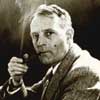
Cosmology: Edwin Hubble
Art Gallery of Space Pictures from the Hubble Telescope
& Information on HST
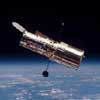
The Hubble Space Telescope
 The
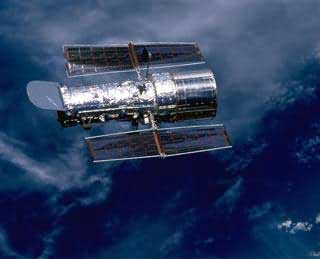
Hubble Space Telescope (HST) is a telescope orbiting the Earth 370 miles
above the atmosphere. It is a space observatory in the Great Observatories
program.
The
Hubble Space Telescope (HST) is a telescope orbiting the Earth 370 miles
above the atmosphere. It is a space observatory in the Great Observatories
program.
Named after the scientist Edwin Hubble (who discovered the redshift with distance), it was launched into orbit in 1990 as a project of the NASA with the cooperation of the European Space Agency.
Initial optical errors of the Hubble Space Telescope were corrected in 1993, and high-quality imaging began in 1994.
The Hubble Space Telescope (HST) is projected to continue operating until 2009, when funding is expected to be moved to the James Webb Space Telescope (JWST).
 Working
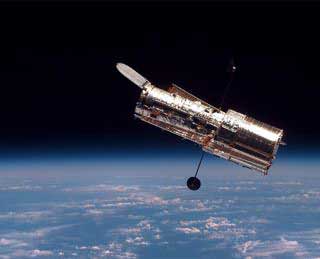
outside the atmosphere has advantages because the atmosphere obscures images
and filters out electromagnetic radiation at certain wavelengths, mainly
in the infrared. By carrying diverse instruments and dividing time between
many astronomical projects from all over the world, the Hubble Telescope
has contributed to an extraordinary variety of astronomical discoveries.
Working
outside the atmosphere has advantages because the atmosphere obscures images
and filters out electromagnetic radiation at certain wavelengths, mainly
in the infrared. By carrying diverse instruments and dividing time between
many astronomical projects from all over the world, the Hubble Telescope
has contributed to an extraordinary variety of astronomical discoveries.
A common misconception is that the principal benefit of observations from orbit is high-resolution -- in fact the sensitivity to faint objects is the biggest advantage, and ground-based interferometric observations of bright sources have much higher resolution than Hubble Space Telescope (HST).
Hubble Telescope Images
Technical Description of the Hubble Space Telescope (HST)
HST is located about 600 kilometers (373 miles) above the ground, orbiting the Earth every 97 minutes.
Hubble Telescope masses about 11,000 kilograms (12 tons), is 13.2 meters (43 feet) long, and has a maximum diameter of 4.2 m (13 feet, 9 inches).
Two solar panels provide electricity, which is mainly used to power the instruments. Four large flywheels are used to orient and stabilize the telescope. The telescope's infrared camera and multi object spectrometer also need to be cooled down to minus 180 degrees Celsius for operation.
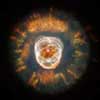
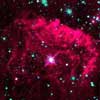
Gallery of Images from the Hubble Space Telescope
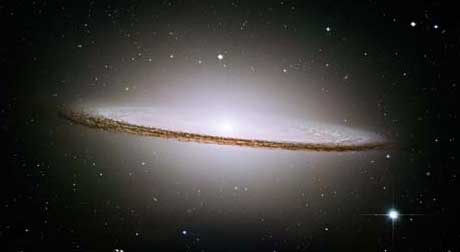 Sombrero (spiral) Galaxy, M104, NGC 4594. 28 million light-years away. |
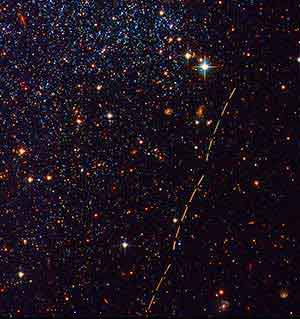 Reddish Arcs Mark Trail of Small Asteroid |
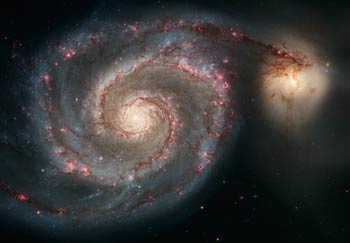 Whirlpool (spiral) Galaxy (M51) and Companion Galaxy |
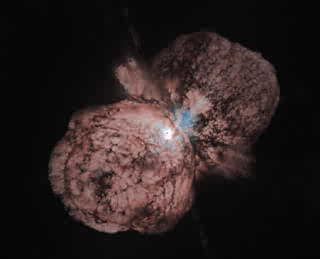 The 'doomed' star Eta Carinae 8,000 light-years away, 10 billion miles diameter. |
Help Humanity
"You must be the change you wish to see in the world."
(Mohandas Gandhi)
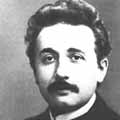 "When forced to summarize the general theory of relativity in one sentence:
Time and space and gravitation have no separate existence from matter. ... Physical objects are not in space, but these objects are spatially extended. In this way the concept 'empty space' loses its meaning. ... The particle can only appear as a limited region in space in which
the field strength or the energy density are particularly high. ...
"When forced to summarize the general theory of relativity in one sentence:
Time and space and gravitation have no separate existence from matter. ... Physical objects are not in space, but these objects are spatially extended. In this way the concept 'empty space' loses its meaning. ... The particle can only appear as a limited region in space in which
the field strength or the energy density are particularly high. ...
The free, unhampered exchange of ideas and scientific conclusions is necessary for the sound development of science, as it is in all spheres
of cultural life. ... We must not conceal from ourselves that no improvement in the present depressing situation is possible without
a severe struggle; for the handful of those who are really determined to do something is minute in comparison with the mass of the lukewarm
and the misguided. ...
Humanity is going to need a substantially new way of thinking if it is to survive!" (Albert Einstein)
 We can now deduce the most simple science theory of reality - the wave structure of matter in space. By understanding how we and everything around us are interconnected
in Space we can then deduce solutions to the fundamental problems of human knowledge in physics, philosophy, metaphysics, theology, education, health, evolution and ecology, politics and society.
We can now deduce the most simple science theory of reality - the wave structure of matter in space. By understanding how we and everything around us are interconnected
in Space we can then deduce solutions to the fundamental problems of human knowledge in physics, philosophy, metaphysics, theology, education, health, evolution and ecology, politics and society.
This is the profound new way of thinking that Einstein
realised, that we exist as spatially extended structures of the universe - the discrete and separate body an illusion. This simply confirms the
intuitions of the ancient philosophers and mystics.
Given the current censorship in physics / philosophy of science journals (based on the standard model of particle physics / big bang cosmology) the internet is the best hope for getting new knowledge
known to the world. But that depends on you, the people who care about science and society, realise the importance of truth and reality.
It is Easy to Help!
Just click on the Social Network links at top of page, or copy a nice image or quote you like and share it. We have a wonderful collection of knowledge from the greatest minds in human history, so people will appreciate your contributions. In doing this you will help a new generation of scientists see that there is a simple sensible explanation of physical reality (One Substance, One Law) - the source of truth and wisdom, the only cure for the madness of man! Thanks! Geoff Haselhurst (Updated May, 2025)
A new scientific truth does not triumph by convincing its opponents and making them see the light, but rather because its opponents eventually die, and a new generation grows up that is familiar with it. (Max Planck, 1920)
"All that is necessary for evil to succeed is for good people to do nothing."
(Edmund Burke)
"In a time of universal deceit - telling the truth is a revolutionary act."
(George Orwell)
"Hell is Truth Seen Too Late."
(Thomas Hobbes)


Legal Disclaimer and Privacy Policy
We support 'Fair Use' of these pages for Academic & Non Commercial use.
You are welcome to use images and text, but please reference them with a link to relevant web page on this site. Thanks!
