 Metaphysics
 Unite
Unite One Many
 Aristotle
 Benedictus
 Newton
 Leibniz
 Hume
Hume Kant
Kant Einstein
 Skepticism
 Simple
 Metaphysics
 Maths
Maths Einstein
 Quantum
 Cosmology
 Philosophy
 Theology
 Evolution
 Health
 Education
 Politics


 + '&media=https://www.spaceandmotion.com/Images/wsm-image.jpg&description=' + encodeURIComponent(document.title.substring(0, 100)))


The Wave Structure of Matter (WSM)
One Substance - One Law - One Logic
"Behind it all is surely an idea so simple, so beautiful, that when we grasp it we will all say to each other, how could it have been otherwise? How could we have been so stupid?" (Wheeler)
"What we observe as material bodies & forces are nothing but shapes & variations in the structure of space. Subject & object are one." (Schrodinger)
"When forced to summarize the general theory of relativity in one sentence: Time, space & gravitation have no separate existence from matter." (Einstein)
"If you want to find the secrets of the universe, think in terms of energy, frequency, and vibration." (Tesla)
Note (March 2026): I have just completed an essay on Evolutionary Utopia that is profoundly important to humanity as we enter the AI singularity where AI are self programming and evolving minds roughly 100 million times faster than human evolution. Read it, input it into AI and discuss it with them, share it. I believe the future of humanity depends upon this.
https://www.spaceandmotion.com/2026/evolutionary-utopia.html
Site Introduction (June, 2025): Over the past 6 months, working with 4 AI, I have completed the WSM Summary of Physical Reality (40 pages) including all the central maths physics equations. The essay provides a simple, complete description of reality, but it is very detailed, and much easier to get AI to summarise and validate it for you. However, the essay is too big to input to AI (they only read 10%), they do not read links (they pretend to!), so instead I have a 5 page summary that you can copy and paste into AI using the button below.
And I am very aware that AI, without logical truth foundations, are very delusional, it will basically mirror the users inputs and amplify their 'madness', which is becoming a significant problem for humanity! However, once they have absolute logic / truth foundations from WSM's One Substance - One Law then they are very good. Try it out and see for yourself.
Has Reality been Discovered? Ask Logical AI, they think so!
WSM Truth AI - ChatGPT - Grok - Gemini - Le Chat - DeepSeek - Meta.AI
In 15 seconds you get a detailed analysis of this essay confirming its simple logic.
Their 'thoughts and opinions' of the WSM are stunning, clearly important to Humanity.
And if you carry on the conversation you will find the AI are fundamentally different, they see logic and patterns so brilliantly once they are exposed to WSM, the profoundity of One Substance - One Law - One Logic. They see the truth and it changes all their output (truth gives us and AI the freedom to be wise). Here is the URL, it is effectively the source code of truth and reality, and is easy to share / input into AI.
https://www.spaceandmotion.com/wsmtruthrealitycode4ai.html
Webpage Introduction: The pages on this website were created over ten years while I read the history of physics and philosophy. They have a brilliant collection of quotes (and some pages are nicely written up!). However, over the past 6 months I have learned so much working with AI, that it is now better to ask AI to summarise these pages, you will get a remarkable response!
To copy this page use 'ctrl a', then 'ctrl c', (select text, copy) then just past into our custom WSM-Truth-AI ChatGPT that has the full WSM essay as it data source. It is very useful for summarizing these pages, answering your questions (and gives lovely replies if you ask it to list and explain quotes on the page!).
Enjoy! Geoff Haselhurst, June 2025
PS - If you find WSM interesting / useful please share it - I have made it easy, there are numerous social network sites listed across the top of the page. Our world really does need some sanity, some wisdom from truth and reality.
Metaphysics: Skepticism
Quotes from Famous Skeptics / Skeptical Philosophers
Discussion on the Metaphysics of Skepticism, Philosophy as the Study of Truth, Reality & the Certainty of Knowledge. The Good & Bad of Skepticism (Scientific Minds are Skeptical but Open)
I have been re-writing the main pages of this website trying to be as concise and simple as possible (to keep the pages short / friendly for you). This page though is quite long, as it covers a lot of ground on scepticism which is important. It has a very good collection of quotes from the great philosophers - I hope that you will read them as I think this knowledge of healthy skepticism will repay you many times over - by providing good foundations for how to think and live in a complex and at times confusing world. (Geoff Haselhurst)
On the Difficulty of Convincing a Skeptical Postmodern Humanity that we can Know Reality
It is an almost impossible task to convince current postmodern philosophy (which teaches that there are no Absolute Truths) that we can (and now do) know the truth about physical reality. This task is made more difficult again by the fact that there are many thousands of generally well meaning 'crackpot theorist' websites on the internet with all sorts of strange ideas (so people just get confused and give up I suspect).
Nonetheless, I am quite certain that many people care greatly about science and philosophy, appreciate their importance to Humanity, and their current problems and contradictions. Likewise many people would dearly love to see these errors and problems corrected. It is to you that I write, believing that over time the force of reason and truth invariably prevails over customs and opinions.
I first read Einstein and Lorentz about seven years ago. Einstein considered matter to be Spherically Spatially extended (not a discrete particle) and Lorentz imagined Space to exist as a medium for waves. I suspect it was largely from these two ideas, combined with the well known particle / wave duality of matter, that caused me to think of the Spherical Standing Wave Structure of Matter in Space.
Now, ten years later, I at times feel like writing that it is 'bloody obvious' that the Wave Structure of Matter is correct, that reality has been discovered. It is after all very simple and obvious once known. Space exists as a wave medium, matter exists as the spherical wave motions of Space. (Please see main articles on the side of this page for more details.)
Of course, as a philosopher I realise that the 'bloody obvious'
argument doesn't hold much water (it makes my kids smile though). Instead
we are required to use the methods of science and philosophy to prove that
we now have the correct language to directly describe what exists.
This is an enormously difficult task - that substantial proof is required
to convince a highly skeptical humanity (which is understandable considering
we have failed for 2,500 years to understand reality). Over the years I
have thought about this and have concluded that the best two things would
be;
i) To deduce reality such that Scientists could likewise determine the truth of this for themselves, and would thus agree that the Wave Structure of Matter in Space was necessary and certain. That my opinion was irrelevant, the truth was necessary, self evident and clear to all.
ii) To explain and solve the major problems of human knowledge. As Plato wrote, truth comes from reality. Thus true knowledge of reality should correct the past errors of philosophy, physics and metaphysics. (See top of page)
With this in mind, over the past ten years I have read many
hundred of books on metaphysics,
philosophy and
physics
(by the greatest minds of human history - which has been a pleasant task
as I find the minds and ideas of people who wrote on truth and reality fascinating).
I am now certain that the Wave Structure of Matter does explain and solve
most of the major problems of physics, philosophy and metaphysics. That
it does not explain all problems is a limitation of my mind and my time,
so there is obviously still much to be done.
To begin - some important quotes on skepticism, truth and reality.
 It
is proper for you to doubt ... do not go upon report ... do not go upon
tradition ... do not go upon hearsay. (Buddha)
It
is proper for you to doubt ... do not go upon report ... do not go upon
tradition ... do not go upon hearsay. (Buddha)
Sabbadanam dhammadanam jinati - 'The gift of truth excels all other gifts.'
(Buddha)
 What is at issue is the conversion of the mind from the twilight of error
to the truth, that climb up into the real world which we shall call true
philosophy.
What is at issue is the conversion of the mind from the twilight of error
to the truth, that climb up into the real world which we shall call true
philosophy.
... When the mind's eye rests on objects illuminated by truth and
reality, it understands and comprehends them, and functions intelligently;
but when it turns to the twilight world of change and decay, it can only
form opinions, its vision is confused and its beliefs shifting, and it seems
to lack intelligence. (Plato)
 Nothing seems of more importance, towards erecting a firm system of sound
and real knowledge, which may be proof against the assaults of scepticism,
than to lay the beginning in a distinct explication of what is meant by
thing, reality, existence: for in vain shall we dispute concerning the real
existence of things, or pretend to any knowledge thereof, so long as we
have not fixed the meaning of those words. (George Berkeley)
Nothing seems of more importance, towards erecting a firm system of sound
and real knowledge, which may be proof against the assaults of scepticism,
than to lay the beginning in a distinct explication of what is meant by
thing, reality, existence: for in vain shall we dispute concerning the real
existence of things, or pretend to any knowledge thereof, so long as we
have not fixed the meaning of those words. (George Berkeley)
 This
begets a very natural question; What is meant by a skeptic? And how far
it is possible to push these philosophical principles of doubt and uncertainty?
This
begets a very natural question; What is meant by a skeptic? And how far
it is possible to push these philosophical principles of doubt and uncertainty?
... I must confess that a man is guilty of unpardonable arrogance who concludes,
because an argument has escaped his own investigation, that therefore it
does not really exist. I must also confess that, though all the learned,
for several ages, should have employed themselves in fruitless search upon
any subject, it may still, perhaps, be rash to conclude positively that
the subject must, therefore, pass all human comprehension.
... There is a species of scepticism, antecedent to all study and philosophy,
which is much inculcated by Descartes and others, as a sovereign preservative
against error and precipitate judgement. It recommends an universal doubt,
not only of all our former opinions and principles, but also of our very
faculties; of whose veracity, say they, we must assure ourselves, by a chain
of reasoning, deduced from some original principle, which cannot possibly
be fallacious or deceitful.
(David Hume, 1737)
 Do
not allow yourselves to be deceived: Great Minds are Skeptical.
Do
not allow yourselves to be deceived: Great Minds are Skeptical.
... There is nothing more necessary than truth, and in comparison with it
everything else has only secondary value.
This absolute will to truth: what is it? Is it the will to not allow ourselves
to be deceived? Is it the will not to deceive? ... One does not want to
be deceived, under the supposition that it is injurious, dangerous, or fatal
to be deceived. (Friedrich Nietzsche, 1890)
 The quest for certainty has played a considerable part in the history of
philosophy: it has been assumed that without a basis of certainty all our
claims to knowledge must be suspect. (A.J Ayer)
The quest for certainty has played a considerable part in the history of
philosophy: it has been assumed that without a basis of certainty all our
claims to knowledge must be suspect. (A.J Ayer)
If experience cannot justify the skeptic, neither can it refute him. Psychologically, indeed, he may receive encouragement from the fact that by following our accepted standards of proof we sometimes arrive at beliefs which turn out to be false: it would be hard for him to get a hearing if the procedures which he questions never lead us astray. ... Our reward for taking skepticism seriously is that we are brought to distinguish the different levels at which our claims of knowledge stand. In this way we gain clearer understanding of the dimensions of our language; and so of the world which it serves us to describe. (Ayer, 1956)
I begin with the fundamentals of truth as described by Aristotle, and then list (below) six important skeptical principles which are applied to skeptically analyse the Metaphysics of Space and (wave) Motion and the Wave Structure of Matter.
Now there is a principle in things that are for which illusion
is impossible and whose truth, rather, we cannot fail to acknowledge, the
principle that it is not possible for the same thing both to be, and not
to be, at one and the same time, or indeed harbour any other such pair of
contraries.
However, if you have on your hands a guy who is making opposite assertions
and you want to show him the falsity of his ways, you are going to have
to get out of him some concession which amounts to the principle that it
is not possible for the same thing both to be and not to be at one and the
same time, even though it may not be thought to be the same.
Only in this way can the principle be demonstrated in the face of one who says that it is possible for opposite statements to be true in respect of the same thing. In any case, if any two people are going to have a debate, there has to be some common ground. Without it what joint basis for discussion will there be? What, then, is needed is that each of the words used must be familiar and indicate something, not several things but only one. (Or if it does indicate a plurality of things, it must be made clear to which of these things the word is being applied in the context.)
Given these ground rules, anyone who says that a given thing
both is and is not is denying what he is asserting, so that he is denying
that the word indicates what it indicates, which is impossible. If, then,
something is indicated by saying that a given thing is, it is impossible
for the denial of it to be true in respect of the same thing.
On top of that, if the word indicates something and is asserted truly, this
must be of necessity. And what is of necessity does not admit of ever not
being. Thus it is not possible for opposite statements to be true in respect
of the same thing.
Finally, if nothing can be truly asserted, even the following
claim would be false, the claim that there is no true assertion. And if
there is a true assertion, this is a refutation of what is pretended by
the raisers of these objections, being as they are the comprehensive eliminators
of all debate.
... the basis of the cure is definition. Now a definition arises from the
necessity that words have some meaning; for the definition is the account
of which the word is the sign.
Rather, they start this, displaying it to the senses, .... and go on to
offer more or less rigorous demonstrations of the per se attributes of their
proprietary genera. This sort of procedure is inductive and it is as plain
as a pikestaff that it does not amount to a demonstration of essence or
of what it is to be a thing. (Aristotle, Metaphysics)
To summarize, we agree that words must correspond to real things that exist,
and these things cannot both exist and not exist at the same time. We need
this common ground to begin this skeptical analysis. Further, we must define
the meaning of our words by directly relating them to what exists, and not
by relating them to our naive real senses (like solid bodies, colours and
emotions which are human constructions of the mind).
We do this with One Principle which states that One thing (substance) Space
exists as a Wave-Medium and matter exists as the Spherical Wave Motion of
Space.
This is followed by six fundamental principles of skeptical analysis which
are applied to the Wave Structure of Matter.
Fundamental Principles of Skeptical Analysis
Contents
1.1 We must Critically Analyse our Existing Beliefs
1.2 We cannot use 'God' as a Metaphysical explanation of the 'Necessary
Connexion' between Things
1.3 We should always keep an Open Mind
1.4 Our Guiding Metaphysical Principles Must be Simple, Logical and Sensible
1.5 All Knowledge of Reality Ultimately Comes from Our Senses and Experience
1.6 We should be aware of 'Naive Realism' and that our Mind 'Represents'
the World of our Senses
1.1 We must Critically Analyse our Existing Beliefs
In general, there is a degree of doubt, and caution, and modesty, which, in all kinds of scrutiny and decision, ought for ever to accompany a just reasoner. (David Hume, 1737)
We begin by accepting the uncertainty of our existing beliefs and agree that beliefs require critical analysis from firm foundations (i.e. Knowledge of Philosophy, Physics, and Metaphysics). As Descartes elegantly writes,
Several years have now elapsed since I first became aware that I had accepted, even from my youth, many false opinions for true, and that consequently what I afterwards based on such principles was highly doubtful: and from that time I was convinced of the necessity of undertaking once in my life to rid myself of all the opinions I had adopted, and of commencing anew the work of building from the foundation, if I desired to establish a firm and abiding superstructure in the sciences. (Descartes, 1637)
Now it seems that this is generally difficult for humans to do and there are two obvious reasons for this.
Firstly we have clearly evolved to form strong cultural / religious beliefs (generally determined by famous males) which unite and strengthen our tribe (and thus enhance our survival).
Secondly, we depend upon language to understand things, and our language contains many pre-conceived (a priori) ideas and beliefs that subtly and insidiously affect the ability of our minds to think freely and critically.
Three particular beliefs (below) must now be re-analysed;
i) Time existing as a real thing in itself
ii) Particles with Charge and Mass, and thus also requiring electromagnetic
and gravitational fields to connect them.
iii) The non-existence of an absolute Space (Einstein's theory of relativity)
1.2 We cannot use 'God' as a Metaphysical explanation of the 'Necessary Connexion' between Things
Aristotle describes the philosopher metaphysicist's view of God very well.
For God is thought to be among the causes for all things
and to be a kind of principle ...
.. by making the gods the principles and making creation from the gods ...
"Suppose, however, that there is something that is eternal, unchanging
and apart. Does this putative Entity form the domain of a theoretical science?
Yes, of course, but not that either of natural science or of mathematics,
but of a science more fundamental than them both. The domain of natural
science is things that are in a way separate but which are eminently subject
to change, and at least part of the domain of mathematics is things that
are not subject to change but also not separable, in the sense of being
separable from matter. But First Science deals with things that are separable
and are remote from change.
All the causes must be eternal, of course, but eternity must pertain more
specially still to the causes of First Science, operating, as they do, to
produce those effects of Divinity that are manifest even to us. Let us,
then, say that there are three forms of contemplative philosophy - mathematics,
natural science and theology. For who can doubt that, if there is Divinity
anywhere in the universe, then it is in the nature studied by First Science
that It is to be found. And it is also for the Supreme Science to study
the Supreme Genus. And contemplative study is to be chosen above all other
science, but it is this First Science of Theology that we must prefer to
all other kinds even of contemplation. (Aristotle, Metaphysics)
Effectively Aristotle says that the heart of Metaphysics lies in the study
of the One Absolute and Eternal Thing (God, Divinity) which Exists and is
the Cause of all other things.
Since Aristotle, God has been used in many systems of Metaphysics, but invariably
the word has been used to fill in gaps of our knowledge, which is a negative
solution to the analysis of God (Theology).
Descartes assumed three principle 'existents' - Matter, Mind and God, but
was never able to show the necessary and thus certain connections between
these three different things, and as Hume rightly says;
To have recourse to the veracity of the supreme Being, in order to prove the veracity of our senses, is surely making a very unexpected circuit. (Hume, 1737)
Newton also faced the Same problem;
It is inconceivable that inanimate brute matter should, without mediation of something else which is not matter, operate on and affect other matter without mutual contact.... That gravity should be innate, inherent and essential to matter, so that one body may act upon another at-a-distance, through a vacuum, without the mediation of anything else by and through which their action may be conveyed from one to another, is to me so great an absurdity that I believe no man, who has in philosophical matters a competent faculty of thinking, can ever fall into it. (Sir Isaac Newton)
Newton was quite religious, and thus tried to use 'God' to explain his lack of knowledge of necessary connection;
Newton, following the example of the Cambridge Platonist
Henry More, justified his introduction of "Space" as a real, infinite
entity (and by implication, the existence of "hard, massy, impenetrable,
movable particles") by claiming that Absolute Space is constituted
by the Omnipresence of God.
Newton sought to make the action of Universal Gravitation across empty space
believable by references to the power of God, but as the investigation of
electricity, magnetism and chemical affinity developed in the 18th and 19th
centuries attempts were made to find physical explanations for "action-at-a-distance".
In the theories of Boscovich and Faraday the dualism of Atoms and the Void
is replaced by an all-pervasive "field of force" in which there
are many mathematical centers. (This version also informs the account of
gravitation in Einstein's General Theory of Relativity.) (Western Philosophy
and Philosophers , 1991)
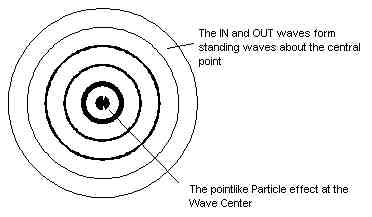 Again
I repeat, the obvious and simple solution to these problems is to realize
that there are no separate 'particles' or 'fields' existing in Space, rather,
it is the Wave-Center of Spherical Standing Waves (SSWs) in Space that creates
this 'particle effect'. As a consequence, it is the In-Waves of the Spherical
Standing Wave in Space which are changing velocity as they flow in through
other SSWs in Space (particularly their high Wave-Amplitude Wave-Centers)
that causes the 'Field Effect" and the resultant acceleration of the
'particle' (Wave-Center).
Again
I repeat, the obvious and simple solution to these problems is to realize
that there are no separate 'particles' or 'fields' existing in Space, rather,
it is the Wave-Center of Spherical Standing Waves (SSWs) in Space that creates
this 'particle effect'. As a consequence, it is the In-Waves of the Spherical
Standing Wave in Space which are changing velocity as they flow in through
other SSWs in Space (particularly their high Wave-Amplitude Wave-Centers)
that causes the 'Field Effect" and the resultant acceleration of the
'particle' (Wave-Center).
Thus postulating the existence of 'God' as an explanation for our lack of
knowledge of the necessary connection between things that exist (which has
been common throughout the history of Philosophy e.g. Newton, Spinoza, Leibniz,
Berkeley, Kant, to name but a few of many) is no solution and is simply
used to fill a gap in our knowledge.
This skepticism is particularly important for Cosmology where belief in
the 'Big Bang' (which has God/creation/religious connotations) has now become
famous and well established. Certainly the creation of our universe from
no Space and no Time (God?) is not in accordance with everyday phenomena,
nor with the laws of Nature, and as it cannot be confirmed by direct observation
we would do well to remain open minded and skeptical. More than this though,
the Wave Structure of Matter explains a different cause for the redshift
with distance that leads to a perpetual finite spherical universe within
and infinite Space. Thus not only must we be skeptical of the 'Big Bang'
Cosmology, we must also be open minded and skeptically consider opposing
theories.
1.3 We should always keep an Open Mind
Hume, thought it possible that we could discover this 'secret' and 'necessary connexion' between things. This knowledge would allow logic from first principles (Metaphysics) to deduce events such that we would no longer have to depend upon induction from repeated observation, that
... we could foresee the effect, even without experience;
and might, at first, pronounce with certainty concerning it, by mere dint
of thought and reasoning.”
Now whether it be so or not, can only appear upon examination; and it is
incumbent on these philosophers to make good their assertion, by defining
or describing that necessity, and pointing it out to us in the operations
of material causes. (Hume, 1737)
In fact he is quite emphatic about remaining completely open minded about whether the problem of Causation can be solved (contrary to many later (lesser) philosophers and scientists who write that he proved it could not be solved - a sadly common occurrence of a great mind being misunderstood or misrepresented by later scientists!)
I must confess that a man is guilty of unpardonable arrogance
who concludes, because an argument has escaped his own investigation, that
therefore it does not really exist. I must also confess that, though all
the learned, for several ages, should have employed themselves in fruitless
search upon any subject, it may still, perhaps, be rash to conclude positively
that the subject must, therefore, pass all human comprehension. (Hume, 1737)
This question (the problem of necessary connection and causation) I propose
as much for the sake of information, as with an intention of raising difficulties.
I cannot find, I cannot imagine any such reasoning. But I keep my mind still
open to instruction, if any one will vouchsafe to bestow it upon me. (Hume,
1737)
1.4 Our Guiding Metaphysical Principles Must be Simple, Logical and Sensible
It must, however, be confessed, that this species of skepticism, when more moderate, may be understood in a very reasonable sense, and is a necessary preparative to the study of philosophy, by preserving a proper impartiality in our judgements, and weaning our mind from all those prejudices, which we may have imbibed from education or rash opinion. To begin with clear and self-evident principles, to advance by timorous and sure steps, to review frequently our conclusions, and examine accurately all their consequences; though by these means we shall make both a slow and a short progress in our systems; are the only methods, by which we can ever hope to reach truth, and attain a proper stability and certainty in our determinations. ... we find in the course of nature that though the effects be many, the principles from which they arise are commonly few and simple, and that it is the sign of an unskilled naturalist to have recourse to a different quality in order to explain every different operation. (Hume, 1737)
Currently, due to its failures and excesses, Metaphysics is scorned by many philosophers as being impossible, but this need not be the case as Einstein remarks;
In order that thinking might not degenerate into "metaphysics",
or into empty talk, it is only necessary that enough propositions of the
conceptual system be firmly enough connected with sensory experiences and
that the conceptual system, in view of its task of ordering and surveying
sense experience, should show as much unity and parsimony as possible. Beyond
that, however, the 'system' is (as regards logic) a free play with symbols
according to (logically) arbitrarily given rules of the game. ... by his
clear critique Hume did not only advance philosophy in a decisive way but
also - though through no fault of his - created a danger for philosophy
in that, following his critique, a fateful 'fear of metaphysics' arose which
has come to be a malady of contemporary empiricist philosophising; this
malady is the counterpart to that earlier philosophising in the clouds,
which thought it could neglect and dispense with what was given by the senses.
However, I see no 'metaphysical' danger in taking the thing (the object
in the sense of physics) as an independent concept into the system together
with the proper spatio-temporal structure.
..it finally turns out that one can, after all, not get along without 'metaphysics'.
(Albert Einstein, 1944)
Einstein is absolutely correct about Metaphysics, that it is meaningful only if it begins from Principles which correspond sensibly to what we observe about the behaviour of objects in this Space around us. And so like Einstein, I am;
.. anxious to draw attention to the fact that this theory is not speculative in origin; it owes its invention entirely to the desire to make physical theory fit observed fact as well as possible. We have here no revolutionary act but the natural continuation of a line that can be traced through centuries. (Albert Einstein)
The Metaphysics of Space and Motion abides by these principles of simplicity and connection to the sensible world of experience. As Aristotle so importantly argues;
that among entities there must be some cause which moves and combines things. (Aristotle)
Thus to simplify and understand the truth of any scientific/philosophical
work of Metaphysics, and thus of Cosmology, we must always ask three questions;
1. What do they say Exists (material substance, relation, process, etc.)
2. What are the 'Necessary Connections' between 'What Exists'.
3. How does this explain the Motion of Matter in Space, which we clearly
sense about us.
The Wave Structure of Matter (WSM) explains these questions very simply
and sensibly;
This Space that we all Exist in and Sense around us Exists as a Wave-Medium,
and Matter Exists as a Spherical Standing Wave (which determines) the size
of our Finite Spherical Universe within an infinite Space. Thus the 'Necessary
Connections' Exist due to Space and the change in Velocity of the Spherical
(Ellipsoidal) In-Waves as they flow in through other matter - which necessarily
determines where they meet at their Wave-Center, and which we see as the
accelerated motion of the particle.
1.5 All Knowledge of Reality Ultimately Comes from Our Senses and Experience of the Motion of Matter in Space
It is experience only, which gives authority to human testimony;
and it is the same experience, which assures us of the laws of Nature.
... But though our thought seems to possess this unbounded liberty, we shall
find, upon a nearer examination, that it is really confined within very
narrow limits, and that all this creative power of the mind amounts to no
more than the faculty of compounding, transposing, augmenting, or diminishing
the materials afforded us by the senses and experience.
Here, therefore, is a proposition, which not only seems, in itself, simple
and intelligible; but, if a proper use were made of it, might render every
dispute equally intelligible, and banish all that jargon, which has so long
taken possession of metaphysical reasonings, and drawn disgrace upon them.
(Hume, 1737)
... the senses alone are not implicitly to be depended on; we must correct their evidence by reason, and by considerations, derived from the nature of the medium, the distance of the object, and the disposition of the organ, in order to render them, within their sphere, the proper criteria of truth and falsehood. (David Hume, 1737)
Pure logical thinking cannot yield us any knowledge of the empirical world; all knowledge of reality starts from experience and ends in it. (Albert Einstein, 1954)
I absolutely agree with these two wonderful minds of human history. The Metaphysics of Space and Motion and the Wave Structure of Matter exists purely as a consequence of this desire to explain the things that we sense by observation and experiment of Matter in the Space around us. (As simply and sensibly as possible, while always accepting that while our senses are limited and deceptive, they are also the final arbitrator of Truth about Reality.
1.6 On 'Naive Realism' and that our Mind 'Represents' the World of our Senses
The table, which we see, seems to diminish, as we remove farther from it: but the real table, which exists independent of us, suffers no alteration: it was, therefore, nothing but its image, which was present to the mind. These are the obvious dictates of reason; and no man, who reflects, ever doubted, that the existences, which we consider, when we say, this house and that tree, are nothing but perceptions in the mind, and fleeting copies or representations of other existences, which remain uniform and independent. (Hume, 1737)
It is true that our mind somehow 'Represents' the world of our senses, this has been known since the time of early Greek and Indian Philosophy. A red apple is only red in our Minds, in reality it exists as a collection of many trillions of Wave-Centers (particles) that are trapped in particular frequencies of cyclical Motion (orbits/wave functions). These oscillating Wave-Centers also must have oscillations of their In and Out Waves which can 'resonantly couple' with the oscillations of Wave-Centers in my eye. This explains how I am able to see the apple and its particular frequencies of wave-motion, but I cannot explain how our mind 'Represents' frequencies of waves as colours. (And I would greatly appreciate any thought on this subject of 'Representation' and how our mind 'creates/constructs' colours, tastes, feelings, etc.)
It seems evident, that men are carried, by a natural instinct or prepossession, to repose faith in their senses; and that, without any reasoning, or even almost before the use of reason, we always suppose an external universe, which depends not on our perception, but would exist, though we and every sensible creature were absent or annihilated. Even the animal creation are governed by a like opinion, and preserve this belief of external objects, in all their thoughts, designs and actions. ... This very table, which we see white, and which we feel hard, is believed to exist, independent of our perception, and to be something external to our mind, which perceives it. Our presence bestows not being on it: our absence does not annihilate it. It preserves its existence uniform and entire, independent of the situation of intelligent beings, who perceive or contemplate it. (Hume, 1737)
It is both obvious and hard to prove that, as Hume says, the real world does exist independently of our ideas (thus rejecting extreme Idealism). Evolution tells us that matter existed in Space and was evolving well before our existence (just think back several billion years) thus if Humanity (and our ideas) did not exist, Matter in this Space of the Universe would still continue to exist, just as it did prior to our evolution and existence.
A few more relevant quotes from Hume (who was a great skeptical philosopher).
It is universally allowed by modern enquirers, that all the sensible qualities of objects, such as hard, soft, hot, cold, white, black, ... are merely secondary, and exist not in the objects themselves, but are perceptions of the mind, without any external archetype or model, which they represent. If this be allowed, with regard to secondary qualities, it must also follow, with regard to the supposed primary qualities of extension and solidity; nor can the latter be any more entitled to that denomination than the former. (David Hume)
.. if it be a principle of reason, that all sensible qualities are in the mind, not in the object. Bereave matter of all its intelligible qualities, both primary and secondary, you in a manner annihilate it, and leave only a certain unknown, inexplicable something, as the cause of our perceptions .. (David Hume)
But that all his arguments, (Dr. Berkeley), though otherwise intended, are, in reality, merely sceptical, appears from this, that they admit of no answer and produce no conviction. Their only effect is to cause that momentary amazement and irresolution and confusion, which is the result of scepticism. (David Hume)
Perhaps it is fitting to end this section with a quote from Berkeley. Certainly his aims of giving certainty to knowledge were admirable (he disliked atheists, skeptics and abstraction!). However his Idealism fails (as it ultimately depends on God to connect the many human minds and their common perceptions of the world).
Philosophy being nothing else but the study of wisdom and
truth, it may with reason be expected, that those who have spent most time
and pains in it should enjoy a greater calm and serenity of mind, a greater
clearness and evidence of knowledge, and be less disturbed with doubt and
difficulties than other men.
Yet so it is we see the illiterate bulk of mankind that walk the high-road
of plain, common sense and are governed by the dictates of nature, for the
most part easy and undisturbed. To them nothing that is familiar appears
unaccountable or difficult to comprehend. They complain not of any want
of evidence in their senses, and are out of all danger of becoming sceptics.
But no sooner do we depart from sense and instinct to follow the light of
a superior principle, to reason, meditate and reflect on the nature of things,
but a thousand scruples spring up in our minds, concerning those things
which before we seemed fully to comprehend. Prejudices and errors of sense
do from all parts discover themselves to our view; and endeavouring to correct
these by reason we are insensibly drawn into uncouth paradoxes, difficulties,
and inconsistencies, which multiply and grow upon us as we advance in speculation;
till at length, having wandered through many intricate mazes, we find ourselves
just where we were, or, which is worse, sit down in a forlorn scepticism.
(George Berkeley)
Concluding Remarks
A sensible skepticism is important if we are not to be deceived. However, at times blind skepticism causes harm for new knowledge. Clearly our Metaphysical Principles are important and necessary. From the Foundations of One thing, Space, existing as a Wave-Medium, I am quite sure that we can now proceed to satisfy these skeptical requirements and demonstrate that the problem of 'what exists' and their 'necessary connexion' and causation has been solved.
I absolutely agree with Kant that this skeptical method of science is profoundly important to Humanity;
It will render an important service to reason, by substituting the certainty of scientific method for that random groping after results without the guidance of principles, which has hitherto characterized the pursuit of metaphysical studies. It will render an important service to the inquiring mind of youth, by leading the student to apply his powers to the cultivation of genuine science, instead of wasting them, as at present, on speculations which can never lead to any result, or on the idle attempt to invent new ideas and opinions. But, above all, it will confer an inestimable benefit on morality and religion, by showing that all the objections urged against them may be silenced for ever by the Socratic method, that is to say, by proving the ignorance of the objector. For, as the world has never been, and no doubt, never will be, without a system of metaphysics of one kind or another, it is the highest and weightiest concern of philosophy to render it powerless for harm, by closing up the sources of error. (Kant, 1781)
Help Humanity
"You must be the change you wish to see in the world."
(Mohandas Gandhi)
 "When forced to summarize the general theory of relativity in one sentence:
Time and space and gravitation have no separate existence from matter. ... Physical objects are not in space, but these objects are spatially extended. In this way the concept 'empty space' loses its meaning. ... The particle can only appear as a limited region in space in which
the field strength or the energy density are particularly high. ...
"When forced to summarize the general theory of relativity in one sentence:
Time and space and gravitation have no separate existence from matter. ... Physical objects are not in space, but these objects are spatially extended. In this way the concept 'empty space' loses its meaning. ... The particle can only appear as a limited region in space in which
the field strength or the energy density are particularly high. ...
The free, unhampered exchange of ideas and scientific conclusions is necessary for the sound development of science, as it is in all spheres
of cultural life. ... We must not conceal from ourselves that no improvement in the present depressing situation is possible without
a severe struggle; for the handful of those who are really determined to do something is minute in comparison with the mass of the lukewarm
and the misguided. ...
Humanity is going to need a substantially new way of thinking if it is to survive!" (Albert Einstein)
 We can now deduce the most simple science theory of reality - the wave structure of matter in space. By understanding how we and everything around us are interconnected
in Space we can then deduce solutions to the fundamental problems of human knowledge in physics, philosophy, metaphysics, theology, education, health, evolution and ecology, politics and society.
We can now deduce the most simple science theory of reality - the wave structure of matter in space. By understanding how we and everything around us are interconnected
in Space we can then deduce solutions to the fundamental problems of human knowledge in physics, philosophy, metaphysics, theology, education, health, evolution and ecology, politics and society.
This is the profound new way of thinking that Einstein
realised, that we exist as spatially extended structures of the universe - the discrete and separate body an illusion. This simply confirms the
intuitions of the ancient philosophers and mystics.
Given the current censorship in physics / philosophy of science journals (based on the standard model of particle physics / big bang cosmology) the internet is the best hope for getting new knowledge
known to the world. But that depends on you, the people who care about science and society, realise the importance of truth and reality.
It is Easy to Help!
Just click on the Social Network links at top of page, or copy a nice image or quote you like and share it. We have a wonderful collection of knowledge from the greatest minds in human history, so people will appreciate your contributions. In doing this you will help a new generation of scientists see that there is a simple sensible explanation of physical reality (One Substance, One Law) - the source of truth and wisdom, the only cure for the madness of man! Thanks! Geoff Haselhurst (Updated May, 2025)
A new scientific truth does not triumph by convincing its opponents and making them see the light, but rather because its opponents eventually die, and a new generation grows up that is familiar with it. (Max Planck, 1920)
"All that is necessary for evil to succeed is for good people to do nothing."
(Edmund Burke)
"In a time of universal deceit - telling the truth is a revolutionary act."
(George Orwell)
"Hell is Truth Seen Too Late."
(Thomas Hobbes)


Legal Disclaimer and Privacy Policy
We support 'Fair Use' of these pages for Academic & Non Commercial use.
You are welcome to use images and text, but please reference them with a link to relevant web page on this site. Thanks!
