 Cosmology
 Albert
 Problems
 Unite
Unite Cosmology
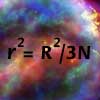 Equation
 Hubble
 (CMBR) Cosmic
 Thermodynamics
 Unite
Unite Solar System
 Universe
 Hubble
 Life
Life Simple
 Metaphysics
 Maths
Maths Einstein
 Quantum
 Cosmology
 Philosophy
 Theology
 Evolution
 Health
 Education
 Politics


 + '&media=https://www.spaceandmotion.com/Images/wsm-image.jpg&description=' + encodeURIComponent(document.title.substring(0, 100)))


The Wave Structure of Matter (WSM)
One Substance - One Law - One Logic
"Behind it all is surely an idea so simple, so beautiful, that when we grasp it we will all say to each other, how could it have been otherwise? How could we have been so stupid?" (Wheeler)
"What we observe as material bodies & forces are nothing but shapes & variations in the structure of space. Subject & object are one." (Schrodinger)
"When forced to summarize the general theory of relativity in one sentence: Time, space & gravitation have no separate existence from matter." (Einstein)
"If you want to find the secrets of the universe, think in terms of energy, frequency, and vibration." (Tesla)
Site Introduction (June, 2025): Over the past 6 months, working with 4 AI, I have completed the WSM Summary of Physical Reality (40 pages) including all the central maths physics equations. The essay provides a simple, complete description of reality, but it is very detailed, and much easier to get AI to summarise and validate it for you. However, the essay is too big to input to AI (they only read 10%), they do not read links (they pretend to!), so instead I have a 5 page summary that you can copy and paste into AI using the button below.
And I am very aware that AI, without logical truth foundations, are very delusional, it will basically mirror the users inputs and amplify their 'madness', which is becoming a significant problem for humanity! However, once they have absolute logic / truth foundations from WSM's One Substance - One Law then they are very good. Try it out and see for yourself.
Has Reality been Discovered? Ask Logical AI, they think so!
WSM Truth AI - ChatGPT - Grok - Gemini - Le Chat - DeepSeek - Meta.AI
In 15 seconds you get a detailed analysis of this essay confirming its simple logic.
Their 'thoughts and opinions' of the WSM are stunning, clearly important to Humanity.
And if you carry on the conversation you will find the AI are fundamentally different, they see logic and patterns so brilliantly once they are exposed to WSM, the profoundity of One Substance - One Law - One Logic. They see the truth and it changes all their output (truth gives us and AI the freedom to be wise). Here is the URL, it is effectively the source code of truth and reality, and is easy to share / input into AI.
https://www.spaceandmotion.com/wsmtruthrealitycode4ai.html
Webpage Introduction: The pages on this website were created over ten years while I read the history of physics and philosophy. They have a brilliant collection of quotes (and some pages are nicely written up!). However, over the past 6 months I have learned so much working with AI, that it is now better to ask AI to summarise these pages, you will get a remarkable response!
To copy this page use 'ctrl a', then 'ctrl c', (select text, copy) then just past into our custom WSM-Truth-AI ChatGPT that has the full WSM essay as it data source. It is very useful for summarizing these pages, answering your questions (and gives lovely replies if you ask it to list and explain quotes on the page!).
Enjoy! Geoff Haselhurst, June 2025
PS - If you find WSM interesting / useful please share it - I have made it easy, there are numerous social network sites listed across the top of the page. Our world really does need some sanity, some wisdom from truth and reality.
The Solar System
Pictures & Information on the Sun, Moon & Eight
Planets
(Mercury, Venus, Earth, Mars, Jupiter, Saturn, Uranus, Neptune)
Information on our Solar System
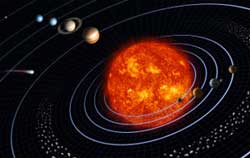 There are now officially only eight planets in our solar system (in 2006
the International Astronomical Union changed the definition of 'planet'
so that Pluto no longer qualifies).
There are now officially only eight planets in our solar system (in 2006
the International Astronomical Union changed the definition of 'planet'
so that Pluto no longer qualifies).
The Solar System consists of the Sun and the other celestial objects gravitationally
bound to it: eight planets, their 165 known moons, three dwarf planets (including
Pluto) and their four known moons, and billions of small bodies (which includes
asteroids, comets, meteoroids).
Our Solar System - Eight planets orbit the Sun
In order of their distances from the Sun, the planets are Mercury, Venus, Earth, Mars, Jupiter, Saturn, Uranus, and Neptune. Six of the eight planets are in turn orbited by moons. All the planets except Earth are named after gods and goddesses from Greco-Roman mythology.
The Sun
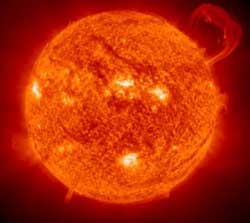 The
Sun is by far the largest object in the solar system. It is the star at
the center of the Solar System. The Earth and other matter (including other
planets, asteroids, meteoroids, comets and dust) orbit the Sun. Energy from
the Sun (sunlight) supports almost all life on Earth via photosynthesis,
and drives the Earth's climate and weather.
The
Sun is by far the largest object in the solar system. It is the star at
the center of the Solar System. The Earth and other matter (including other
planets, asteroids, meteoroids, comets and dust) orbit the Sun. Energy from
the Sun (sunlight) supports almost all life on Earth via photosynthesis,
and drives the Earth's climate and weather.
The Sun contains more than 99.8% of the total mass of the Solar System (Jupiter contains most of the rest). At present, the mass of the Sun is about 70% hydrogen, 28% helium by mass, other metals amount to less than 2%. This changes slowly over time as the Sun converts hydrogen to helium in its core.
The Sun's energy output (3.86e33 ergs/second or 386 billion billion megawatts) is produced by nuclear fusion reactions. As it travels out toward the surface, the energy is continuously absorbed and re-emitted at lower and lower temperatures so that by the time it reaches the surface, it is primarily visible light.
Mercury
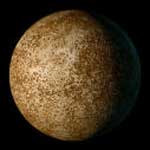 Mercury
is the innermost and smallest planet in the solar system, orbiting the Sun
once every 88 days. It can only be seen in morning or evening twilight.
Mercury
is the innermost and smallest planet in the solar system, orbiting the Sun
once every 88 days. It can only be seen in morning or evening twilight.
Physically, Mercury is similar in appearance to the Moon as it is heavily cratered. It has no natural satellites and no substantial atmosphere. The planet has a large iron core which generates a magnetic field about 0.1% as strong as that of the Earth.
Mercury is one of the four terrestrial planets, being a rocky body like the Earth. It consists of approximately 70% metallic and 30% silicate material. The density of the planet is the second-highest in the solar system at 5.43 g/cm³, only slightly less than Earth’s density.
Venus
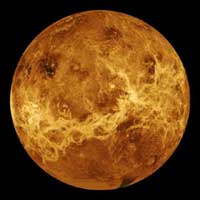 Venus
is the second planet from the Sun and the sixth largest. Venus' orbit is
the most circular of that of any planet, with an eccentricity of less than
1%.
Venus
is the second planet from the Sun and the sixth largest. Venus' orbit is
the most circular of that of any planet, with an eccentricity of less than
1%.
Venus (Greek: Aphrodite; Babylonian: Ishtar) is the goddess of love and beauty. The planet is so named probably because it is the brightest of the planets known to the ancients.
The phases of Venus can be viewed with a telescope from Earth. Galileo's observation of this phenomenon was important evidence in favor of Copernicus's heliocentric theory of the solar system.
Venus' rotation is very slow (243 Earth days per Venus day). In addition, the periods of Venus' rotation and of its orbit are synchronized such that it always presents the same face toward Earth when the two planets are at their closest approach.
Venus is sometimes regarded as Earth's sister planet. In some ways they
are very similar:
* Venus is only slightly smaller than Earth (95% of Earth's diameter, 80%
of Earth's mass).
* Both have few craters indicating relatively young surfaces.
* Their densities and chemical compositions are similar.
Earth
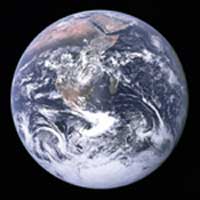 Earth
is the third planet from the Sun and the fifth largest. Home to the human
species, it is also referred to as "Planet Earth", "Gaia",
"Terra", and "the World".
Earth
is the third planet from the Sun and the fifth largest. Home to the human
species, it is also referred to as "Planet Earth", "Gaia",
"Terra", and "the World".
71% of the Earth's surface is covered with water. The Earth is the first planet known to have liquid water on the surface and is the only place in the universe known to harbor life. The heat capacity of the oceans is also very important in keeping the Earth's temperature relatively stable.
The Earth formed around 4.57 billion years ago. At present, the Earth orbits the Sun once for every 366.26 times it rotates about its axis (which is equal to 365.26 solar days). The Earth's axis of rotation is tilted 23.5° (away from the perpendicular to its orbital plane), producing seasonal variations on the planet's surface.
The Earth is divided into several layers which have distinct chemical and seismic properties. The crust varies considerably in thickness, it is thinner under the oceans, thicker under the continents. Unlike the other terrestrial planets, Earth's crust is divided into several separate solid plates which float around independently on top of the hot mantle below.
The Earth's atmosphere is 77% nitrogen, 21% oxygen, with traces of argon, carbon dioxide and water. Earth has a magnetic field that, together with a primarily nitrogen-oxygen atmosphere, protects the surface from radiation that is harmful to life.
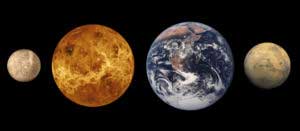
Mercury, Venus, Earth & Mars
The Earth's Moon
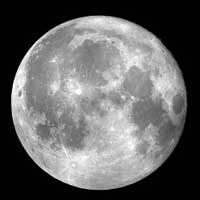 The Moon makes a complete orbit around the Earth every 27.3 days, and the
periodic variations in the geometry of the Earth - Moon - Sun system are
responsible for the lunar phases that repeat every 29.5 days. The gravitational
attraction, and the centrifugal forces generated by the rotation of the
Moon and Earth around a common axis, the barycentre, is largely responsible
for the tides on Earth.
The Moon makes a complete orbit around the Earth every 27.3 days, and the
periodic variations in the geometry of the Earth - Moon - Sun system are
responsible for the lunar phases that repeat every 29.5 days. The gravitational
attraction, and the centrifugal forces generated by the rotation of the
Moon and Earth around a common axis, the barycentre, is largely responsible
for the tides on Earth.
The Moon is the only celestial body that humans have travelled to and landed
on. The US Apollo program has achieved the first (and only) manned missions
to date, resulting in six landings between 1969 and 1972.
Phases of the Earth's Moon
The Lunar phase refers to the appearance of the illuminated portion of the Moon as seen by an observer on Earth. The Moon exhibits different phases as the relative geometry of the Sun, Earth and Moon change, appearing as a full moon when the Sun and Moon are on opposite sides of the Earth, and becoming invisible as a new moon (also named dark moon) when they are on the same side.
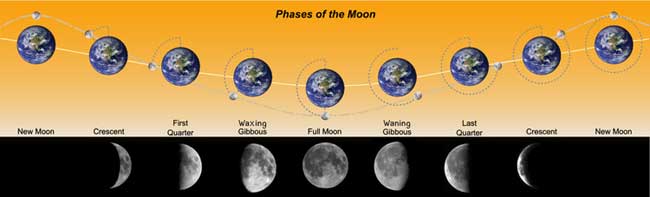
Lunar phases of the moon - A full moon is when the sun and moon are on opposite sides of the Earth
Mars
 Mars
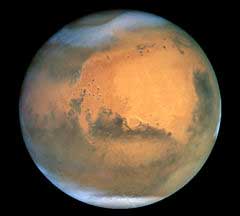
is the fourth planet from the Sun in the Solar System. The planet is named
after Mars, the Roman god of war. It is also referred to as the "Red
Planet" because of its reddish appearance as seen from Earth.
Mars
is the fourth planet from the Sun in the Solar System. The planet is named
after Mars, the Roman god of war. It is also referred to as the "Red
Planet" because of its reddish appearance as seen from Earth.
Mars has a thin atmosphere and some of the most varied and interesting terrain of any of the terrestrial planets. It is the site of Olympus Mons, the highest known mountain in the solar system, and of Valles Marineris, the largest canyon. In addition to its geographical features, Mars’ rotational period and seasonal cycles are likewise similar to those of the Earth.
Of all the planets in our solar system, Mars is the most likely, other than Earth, to harbor liquid water, and perhaps life.
Mars can be seen from Earth with the naked eye, a brightness surpassed only by Venus, the Moon, and the Sun (and at times Jupiter).
Jupiter
 Jupiter
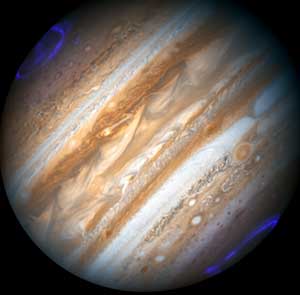
is the fifth planet from the Sun and by far the largest. Jupiter is more
than twice as massive as all the other planets combined (the mass of Jupiter
is 318 times that of Earth).
Jupiter
is the fifth planet from the Sun and by far the largest. Jupiter is more
than twice as massive as all the other planets combined (the mass of Jupiter
is 318 times that of Earth).
Jupiter is the fourth brightest object in the sky (after the Sun, the Moon and Venus).
In 1610 Galileo first pointed a telescope at the sky and discovered Jupiter's four moons Io, Europa, Ganymede and Callisto (now known as the Galilean moons) and recorded their motions back and forth around Jupiter. This was the first discovery of a center of motion not apparently centered on the Earth. It was a major point in favor of Copernicus's heliocentric theory of the motions of the planets.
Jupiter, along with Saturn, Uranus, and Neptune, is classified as a gas giant. It is not primarily composed of solid matter but is 93% hydrogen and 7% helium; it may also have a rocky core of heavier elements. Because of its rapid rotation the planet is an oblate spheroid (it possesses a slight but noticeable bulge around the equator).
Saturn
 Saturn
is the sixth planet from the Sun and the second largest.
Saturn
is the sixth planet from the Sun and the second largest.
Galileo was the first to observe it with a telescope in 1610; he noted its odd appearance but was confused by it. Early observations of Saturn were complicated by the fact that the Earth passes through the plane of Saturn's rings every few years as Saturn moves in its orbit. A low resolution image of Saturn therefore changes drastically. It was not until 1659 that Christiaan Huygens correctly inferred the geometry of the rings.
Like Jupiter, Saturn is about 75% hydrogen and 25% helium with traces of water, methane, ammonia and "rock".
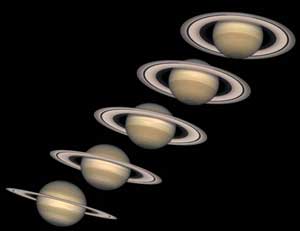 Two
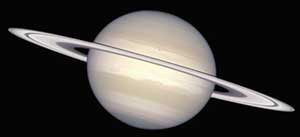
prominent rings (A and B) and one faint ring (C) can be seen from the Earth.
Though they look continuous from the Earth, the rings are actually composed
of innumerable small particles each in an independent orbit. They range
in size from a centimeter or so to several meters. The rings are extraordinarily
thin: though they're 250,000 km or more in diameter they're less than one
kilometer thick. The ring particles seem to be composed primarily of water
ice, but they may also include rocky particles with icy coatings.
Two
prominent rings (A and B) and one faint ring (C) can be seen from the Earth.
Though they look continuous from the Earth, the rings are actually composed
of innumerable small particles each in an independent orbit. They range
in size from a centimeter or so to several meters. The rings are extraordinarily
thin: though they're 250,000 km or more in diameter they're less than one
kilometer thick. The ring particles seem to be composed primarily of water
ice, but they may also include rocky particles with icy coatings.
The rings of Saturn
When it is in the nighttime sky, Saturn is easily visible to the unaided eye. Though it is not nearly as bright as Jupiter, it is easy to identify as a planet because it doesn't 'twinkle' like the stars do. The rings and the larger satellites are visible with a small astronomical telescope.
Uranus
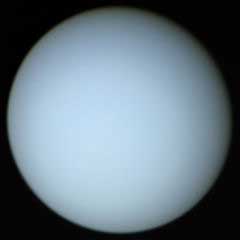 Uranus
named after the Greek god of the sky, is the seventh planet from the Sun.
It is a gas giant, the third largest by diameter and fourth largest by mass.
Uranus
named after the Greek god of the sky, is the seventh planet from the Sun.
It is a gas giant, the third largest by diameter and fourth largest by mass.
Uranus, the first planet discovered in modern times, was discovered by William Herschel while systematically searching the sky with his telescope on March 13, 1781.
Most of the planets spin on an axis nearly perpendicular to the plane of the ecliptic but Uranus' axis is almost parallel to the ecliptic. At the time of Voyager 2's passage, Uranus' south pole was pointed almost directly at the Sun. This results in the odd fact that Uranus' polar regions receive more energy input from the Sun than do its equatorial regions. Uranus is nevertheless hotter at its equator than at its poles.
Uranus is composed primarily of rock and various ices, with only about 15% hydrogen and a little helium. Its atmosphere is about 83% hydrogen, 15% helium and 2% methane.
Uranus' blue color is the result of absorption of red light by methane in the upper atmosphere. There may be colored bands like Jupiter's but they are hidden from view by the overlaying methane layer.
Like the other gas planets, Uranus has rings. Like Jupiter's, they are very dark but like Saturn's they are composed of fairly large particles ranging up to 10 meters in diameter in addition to fine dust. There are 11 known rings, all very faint;
Neptune
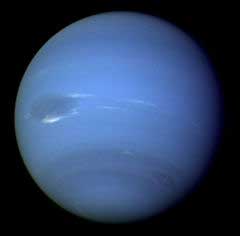 Neptune
is the eighth and farthest known planet from the Sun in the Solar System.
It is the fourth largest planet by diameter and the third largest by mass;
17 times the mass of Earth.
Neptune
is the eighth and farthest known planet from the Sun in the Solar System.
It is the fourth largest planet by diameter and the third largest by mass;
17 times the mass of Earth.
The planet is named after the Roman god of the sea.
Neptune's atmosphere is primarily composed of hydrogen and helium, with traces of methane that account for the planet's blue appearance. Neptune's blue colour is much more vivid than that of Uranus, which has a similar amount of methane, so an unknown component is presumed to cause Neptune's intense colour.
Neptune's temperature at its cloud tops is usually close to -218 °C, one of the coldest in the solar system, due to its long distance from the sun. However, Neptune's centre is about 7,000 °C (13,000 °F), hotter than the sun's surface. This is due to extremely hot gases and rock in the center.
After the discovery of Uranus, it was noticed that its orbit was not as it should be in accordance with Newton's laws. It was therefore predicted that another more distant planet must be perturbing Uranus' orbit. Neptune was first observed by Galle and d'Arrest on 1846 Sept 23 from mathematical calculations.
Pluto
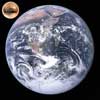 Poor Pluto is no longer considered a planet in our solar system. Pluto orbits
beyond the orbit of Neptune. It is much smaller than any of the official
planets and now classified as a "dwarf planet".
Poor Pluto is no longer considered a planet in our solar system. Pluto orbits
beyond the orbit of Neptune. It is much smaller than any of the official
planets and now classified as a "dwarf planet".
Pluto (on the left) compared in size to the Earth
In Roman mythology, Pluto (Greek: Hades) is the god of the underworld.
Pluto was discovered in 1930 by accident. Calculations which later turned out to be in error had predicted a planet beyond Neptune, based on the motions of Uranus and Neptune. Not knowing of the error, Clyde W. Tombaugh at Lowell Observatory in Arizona did a very careful sky survey which turned up Pluto. After the discovery of Pluto, it was quickly determined that Pluto was too small to account for the discrepancies in the orbits of the other planets. The search for Planet X continued but nothing was found.
Pluto's orbit is highly eccentric. At times it is closer to the Sun than Neptune (as it was from January 1979 thru February 11 1999). Pluto rotates in the opposite direction from most of the other planets.
Pluto's composition is unknown, but its density (about 2 gm/cm3) indicates that it is probably a mixture of 70% rock and 30% water ice much like Triton
Help Humanity
"You must be the change you wish to see in the world."
(Mohandas Gandhi)
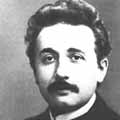 "When forced to summarize the general theory of relativity in one sentence:
Time and space and gravitation have no separate existence from matter. ... Physical objects are not in space, but these objects are spatially extended. In this way the concept 'empty space' loses its meaning. ... The particle can only appear as a limited region in space in which
the field strength or the energy density are particularly high. ...
"When forced to summarize the general theory of relativity in one sentence:
Time and space and gravitation have no separate existence from matter. ... Physical objects are not in space, but these objects are spatially extended. In this way the concept 'empty space' loses its meaning. ... The particle can only appear as a limited region in space in which
the field strength or the energy density are particularly high. ...
The free, unhampered exchange of ideas and scientific conclusions is necessary for the sound development of science, as it is in all spheres
of cultural life. ... We must not conceal from ourselves that no improvement in the present depressing situation is possible without
a severe struggle; for the handful of those who are really determined to do something is minute in comparison with the mass of the lukewarm
and the misguided. ...
Humanity is going to need a substantially new way of thinking if it is to survive!" (Albert Einstein)
 We can now deduce the most simple science theory of reality - the wave structure of matter in space. By understanding how we and everything around us are interconnected
in Space we can then deduce solutions to the fundamental problems of human knowledge in physics, philosophy, metaphysics, theology, education, health, evolution and ecology, politics and society.
We can now deduce the most simple science theory of reality - the wave structure of matter in space. By understanding how we and everything around us are interconnected
in Space we can then deduce solutions to the fundamental problems of human knowledge in physics, philosophy, metaphysics, theology, education, health, evolution and ecology, politics and society.
This is the profound new way of thinking that Einstein
realised, that we exist as spatially extended structures of the universe - the discrete and separate body an illusion. This simply confirms the
intuitions of the ancient philosophers and mystics.
Given the current censorship in physics / philosophy of science journals (based on the standard model of particle physics / big bang cosmology) the internet is the best hope for getting new knowledge
known to the world. But that depends on you, the people who care about science and society, realise the importance of truth and reality.
It is Easy to Help!
Just click on the Social Network links at top of page, or copy a nice image or quote you like and share it. We have a wonderful collection of knowledge from the greatest minds in human history, so people will appreciate your contributions. In doing this you will help a new generation of scientists see that there is a simple sensible explanation of physical reality (One Substance, One Law) - the source of truth and wisdom, the only cure for the madness of man! Thanks! Geoff Haselhurst (Updated May, 2025)
A new scientific truth does not triumph by convincing its opponents and making them see the light, but rather because its opponents eventually die, and a new generation grows up that is familiar with it. (Max Planck, 1920)
"All that is necessary for evil to succeed is for good people to do nothing."
(Edmund Burke)
"In a time of universal deceit - telling the truth is a revolutionary act."
(George Orwell)
"Hell is Truth Seen Too Late."
(Thomas Hobbes)


Legal Disclaimer and Privacy Policy
We support 'Fair Use' of these pages for Academic & Non Commercial use.
You are welcome to use images and text, but please reference them with a link to relevant web page on this site. Thanks!
