


WSM CORE PAGE 9 · COSMOLOGY · REDSHIFT · CMB · COSMIC STRUCTURE
WSM Cosmology — A Finite Observable Universe 'Huygens Sphere' within Infinite Eternal Space
Every e-sphere is the centre of its own overlapping observable domain; matter and organised structure continue beyond every finite Huygens sphere.
Physical foundation
WSM Postulates
Open the postulates, units and frequency conventions
The complete WSM Action and its stable matter solution remain open. Explicit action candidates and exact reduced controls are displayed below. The A/B/C/D/Q tiers distinguish established relations, fixed WSM structure, concrete mechanisms, open calculations and excluded shortcuts throughout the page.
Units. \(c_0=E_{d0}=\lambda_0=1\). Hence \(f_0=1\) and \(\omega_0=k_0=2\pi\). The constants \(\hbar,m_e,\alpha,G\) are outputs, not units.
P1. One Substance. Space is a nearly rigid, slightly elastic wave medium whose only primitive motions are longitudinal plane waves propagating in all directions.
P2. One Law. Directional wave speed is determined by directional wave-energy density. For every direction \(\hat{\mathbf n}\),
Thus, in normalized units,
The universal intrinsic frequency \(f_0\) supplies the reference standard. Wavelength is the simultaneous crest spacing: speed and crest frequency in \(\lambda^{\prime}=c^{\prime}/f_{\rm crest}\) must use the same coordinates. Thus \(\lambda^{\prime}=c^{\prime}/f_0\) applies where \(f_{\rm crest}=f_0\). The intrinsic reference, fixed-position crest frequency and phase rate along a moving centre remain distinct readings.
P3. One Matter. Electron and positron are e-sphere wave centres formed from Huygens-combined longitudinal plane waves from all directions, with opposite background-relative radial phases. The e-sphere circumscribes a cube of side \(\lambda_0\):
Immediate deduction from P1. As the one substance, Space cannot be bounded, created or interrupted by another substance; it is therefore infinite, eternal and continuous.
P1–P3 are the fundamental postulates; additional working assumptions and approximations are stated where used. WSM Action must derive the complete spherical standing-wave and spherical phase-wave structure, their stability and all further physics.
WSM Wave Action: the mathematics already in hand
Open the Action equations and their present scope
An action turns a physical account into equations of motion. The WSM corpus already contains explicit action candidates, exact reduced dynamics and propagation controls. They establish concrete results and identify the coupling still needed for a stable, interacting e-sphere. The general variational form is
Here \(\mathcal C\) collects the independent variables describing longitudinal motion of the same Space. This schematic expression states the mathematical task; the following equations are actual constructions developed in the corpus.
Four constructions, four roles. \(S_0\) is the directional cycle-energy candidate; \(S_{\rm ray}\) supplies exact reduced ray dynamics; \(S_{\rm sphere}\) describes longitudinal spherical motion; \(S_{\rm control}\) isolates propagation through a prescribed profile. Their derivation as mutually consistent limits of one autonomous action remains to be established. An incompatibility between candidate pieces would reject that combination; it would not by itself refute P1–P3.
Directional cycle-energy action
Let \(C_{\hat n}(\mathbf x,t)\) describe the real longitudinal compression component travelling in direction \(\hat n\), and \(D_{\hat n}=\hat n\cdot\nabla\). The candidate defines the positive intensity ratio
where \(Q_{\hat n}\) and \(P_{\hat n}\) are cosine and sine projections of that compression over one reference cycle; the subscript 0 denotes the background. Its action is
With intensity held fixed, the characteristic speed is exactly \(c'_{\hat n}=c_0 I_{\hat n}\), recovering P2 from the kinetic and spatial coefficients. The full variation must also include the dependence of \(I\) on the wave history and constrain all directions to one physical displacement. A causal treatment of that history remains part of the construction. \(\chi_0\) is a declared normalization coefficient.
Exact dynamics in a one-dimensional ray model
For a compression coordinate \(q(\sigma,t)\), normalized strain \(a=q_\sigma/\epsilon_*\), and canonical imbalance \(\eta\), the corpus gives
Variation yields two oppositely travelling characteristic families. Their positive energy responses and speed magnitudes satisfy \(E_\pm/E_{d0}=c_\pm/c_0=e^{a\pm\eta}\). Choosing \(\eta=\operatorname{artanh}\beta\), \(a=\tfrac12\ln(1-\beta^2)\), and \(\beta=v/c_0\) gives \(e^{a\pm\eta}=1\pm\beta\); removing the common geometric mean gives \(e^{\pm\eta}=\gamma(1\pm\beta)\), where \(\gamma=(1-\beta^2)^{-1/2}\). These are exact results within this ray model. Its uncoupled local transport does not generate the spherical core from a homogeneous background.
Longitudinal spherical action
Writing displacement as \(\mathbf u=\nabla\Psi\) gives a reduced action with positive coefficients \(\rho_\Psi\) and \(\kappa\):
The unforced equation admits the regular spherical \(j_0\) compression mode and its quarter-cycle \(j_1\) radial motion. The source term \(f_\Psi\) currently stands for the incoming Huygens relation. Deriving that relation from the surrounding matter is the step needed to make the recurrence self-consistent.
An exact propagation control
For a prescribed positive, stationary profile \(\epsilon(x)\), the action displayed on the homepage is
The coordinate \(y=\int dx/\epsilon(x)\) converts it to a uniform wave action. In this prescribed, stationary one-dimensional profile, a complete transmitted pulse is reflectionless and gives zero net impulse on the profile when the response is the same at both ends. Local force density need not vanish: its contributions cancel in the total impulse. A changed travel time alone therefore does not establish a net force. This control contains no receiving e-sphere and does not calculate its gravitational response. The prescribed profile is an input to this control.
The next calculation is specific. Join the directional response, longitudinal displacement and continuing Huygens waves through one independent state and one energy–momentum account. Then solve an open periodic e-sphere at P3’s fixed \(R/\lambda_0=\sqrt3/2\), with finite excess energy and a complete stability spectrum. The existing actions and exact controls supply mathematical starting points; a complete self-consistent WSM Action and its stable matter solution remain to be obtained.
Equations and their assumptions: WSM Action, §13: present mathematical pieces; §14: the open boundary problem; and homepage Action summary and propagation control.
Abstract / Summary
Finite observable Huygens spheres in an unbounded matter network
Cosmology begins with changes registered locally by standing-wave matter. WSM retains the observed redshifts, spectra, image geometry, time dilation, microwave background, lensing, abundances and large-scale structure, while asking whether their common physical cause is the propagation and reconstruction of real longitudinal waves in one non-expanding Space.
P1 makes Space the single nearly rigid, slightly elastic wave medium; its infinity, eternity and continuity follow because no second substance can bound, create or interrupt it. P3 makes every e-sphere an open wave centre sustained by Huygens-combined waves from surrounding matter. A material edge would destroy equal all-direction support at that edge and permit collapse. Matter therefore continues beyond every finite observer-centred Huygens sphere, whose boundary marks received-wave relation rather than the end of Reality.
A bound source transition writes a finite ordered curve train onto successive background plane waves. In calm Space the carrier frequency, wavelength, speed and plane spacing remain fixed. Huygens reconstruction makes the written curves flatter and wider and reduces common source–receiver overlap; a distant receiver consequently completes a smaller bound energy-gap change. The full chain—source writing, curve decay, common Huygens overlap and receiver reclosure—is the WSM redshift mechanism. The calculation must give the observed common factor across spectra, complete event histories, brightness, angular geometry and radiance.
The surrounding matter network physically sustains local inertia and connects each finite Huygens domain to external wave support: the Mach–Huygens origin proposed for the effect called dark energy. Redshift is transfer depth rather than age, so mature galaxies, heavy elements and massive black holes at high redshift are deduced. The CMB is a microwave equilibrium organisation of the same Vibrating Space; opposite phase is already present inside neutral matter; and gravity, structure, elements and entropy belong to one continuing eternal cycle.
Contents
Essential WSM glossary
Open the essential WSM terms
From a metaphysics of Space and Time to a metaphysics of Space and Motion.
Newtonian mechanics describes matter particles moving in space and time, with mass and force entering its laws of motion. Its gravitational law gives attraction between separated bodies without specifying a local transmitting mechanism. WSM applies motion directly to Space: the wave motion of one continuous physical substance forms matter, and its ordered change supplies what clocks measure as time. Matter and time are understood through the activity of Space itself.
Newton himself objected to unmediated action at a distance: his letter to Richard Bentley distinguishes the law of attraction from its physical cause.
| Term | Meaning in WSM |
|---|---|
| Vibrating Space | One infinite, eternal, continuous, nearly rigid, slightly elastic wave medium. This physical substance supports longitudinal compression plane waves whose organisation forms matter. Time measures its ordered wave change. |
| Background wave sea | The longitudinal compression plane waves travelling through Vibrating Space in all directions. |
| Directional wave-energy density \(E_d\) | Wave-energy density associated with a specified direction of propagation. \(E_{d0}\) denotes its background value. |
| Physical wave speed \(c'\) | The local propagation speed of a longitudinal plane wave in a specified direction. \(c_0\) denotes the background reference speed. |
| Spherical standing wave | Formed by the coherent Huygens combination of incoming longitudinal plane waves from all directions. The waves cross the centre and continue outward. The finite central core of high directional wave-energy density \(E_d\) is called the e-sphere. WSM identifies its two opposite radial phases relative to the vibrating background as the electron and positron: a matter–antimatter pair. |
| Huygens sphere | The finite all-direction wave relation through which surrounding matter supplies an e-sphere’s incoming waves. |
| Reconstruction / reclosure | Reconstruction is the repeated formation of an e-sphere by waves passing through it. Reclosure is the restoration of its complete phase relation. |
| Curve on a plane wave | The half-spherical displacement and phase profile imprinted on a passing plane wave as it crosses an e-sphere. |
| Curve train | A finite, ordered sequence of changed curves written onto passing background waves during a bound-state transition. This is WSM’s description of a photon. |
| Moving wave egg | The asymmetric wave organisation of a moving e-sphere, with an elongated front and flattened rear. |
| Spherical phase wave | The moving pattern of equal-phase positions formed by intersecting longitudinal waves across an e-sphere. Its two opposite directions of phase rotation are called its two “hands”. |
| Huygens ring | The circle of contributing longitudinal-wave directions perpendicular to a light train’s direction of propagation. |
| Phase-even residual delay | The component of wave delay unchanged by reversing the radial phase. This is the residual used in WSM’s gravity account. |
| WSM Action | The programme for expressing the dynamics of WSM’s single wave medium through an action whose variation gives the equations of motion. |
Extended WSM reference: the complete glossary, definitions and research notes.
Claim-status key
Claim-status key
| Tier | Meaning |
|---|---|
| A | Established experiment, standard result or exact mathematics under explicitly stated premises. |
| B | Fixed WSM postulate or direct deduction from the real-wave ontology and established geometry. |
| C | Concrete physical construction whose decisive calculation or test is specified. |
| D | Required quantitative output of WSM Action. |
| Q | Rejected route or ontology error retained only in the failure ledger so it is not repeated. |
Direct cosmological consequences
Matter has no edge: the Mach–Huygens deduction
Every e-sphere is the centre of its own finite observable Huygens sphere. These spheres overlap. No e-sphere is the unique centre of Space, and no Huygens boundary is an edge of Space or matter.
Suppose matter ended. E-spheres at its boundary would no longer receive equal Huygens-combined plane waves from all directions. Their spherical recurrence would lose the reciprocal support required by P3, and the isolated finite matter domain would collapse inward. Therefore matter and organised structure continue beyond every finite observable Huygens sphere through infinite Space.
This is Mach’s principle made physical. The out-waves of surrounding matter form each e-sphere’s all-direction in-waves. Matter beyond any one observable sphere participates through overlapping Huygens relations, sustaining the local matter network and preventing it from behaving as an isolated collapsing universe.
The same external Mach–Huygens support is the WSM physical explanation proposed for the large-scale non-collapsing effect conventionally attributed to dark energy. No repulsive substance is added. The existence and direction of the support follow from the reciprocal wave structure; its exact magnitude, radial weighting and observed distance relation must be calculated by WSM Action.
Eternal Space has no universal beginning. The cosmological model additionally assumes statistical stationarity of the matter population after environment and selection are accounted for. With redshift measuring source–receiver transfer depth, this yields no cosmic-age ceiling and predicts forming and mature, metal-poor and enriched systems throughout the sampled network. The population expectation follows from these stated premises; eternity alone does not require an unchanging developmental distribution.
Cosmology at a glance — one Space, one connected calculation
The foundations can be stated directly because the claim-status key now carries the scientific ledger. Exact geometry, conditional constructions and required WSM Action outputs remain visibly distinct.
B One infinite Space
P1 fixes the one wave medium. Infinity, eternity and continuity follow because no second substance can bound, create or interrupt Space.
B Finite e-sphere core
P3 fixes the electron and positron wave-centre core at \(R=\sqrt3\lambda_0/2\). The complete standing-wave and spherical phase-wave structures remain WSM Action outputs.
B Matter has no edge
A matter boundary would deprive its e-spheres of equal all-direction Huygens support. Matter and organised structure therefore continue beyond every finite observable sphere.
B Every centre has a sphere
Every e-sphere is the centre of its own finite received-wave domain. The overlapping spheres are observer-centred relations, not separate universes or material shells.
B No redshift age ceiling
In eternal statistically stationary cosmology, redshift measures transfer depth. Mature galaxies, metals and black holes at large redshift are deduced.
C Physical Mach principle
External matter supplies reciprocal Huygens support, sustains local inertia and prevents an isolated domain from collapsing—the proposed source of the effect called dark energy.
C Real-wave redshift
Source-written curves flatten and widen, common Huygens overlap decreases and the receiver completes a smaller energy-gap change. WSM Action must calculate the common factor.
D Decisive joint calculation
One frozen WSM Action must reproduce redshift, distances, time dilation, radiance, the CMB, BAO, lensing, structure, abundances, entropy balance and redshift drift together.
"The supreme task of the physicist is to arrive at those universal elementary laws from which the cosmos can be built up by pure deduction." — Albert Einstein, 1918
"Reality cannot be found except in One single substance, because of the interconnection of all things with one another." — Gottfried Leibniz
"Behind it all is surely an idea so simple, so beautiful, that when we grasp it we will all say to each other, how could it have been otherwise?" — John Archibald Wheeler
In WSM, the measured cosmos is the changing wave relation of matter throughout infinite Vibrating Space—not Space expanding.
0. Observation is not interpretation
Cosmology begins with local detector changes. A telescope does not contain a distant galaxy; it contains a local standing-wave response caused by incoming waves. Cosmology is therefore an inverse wave problem: from local spectral, angular and temporal patterns, deduce the external Huygens source distribution.
| Habitually stated as fact | Observed fact | Theoretical interpretation | WSM physical interpretation and calculation |
|---|---|---|---|
| "Hubble discovered expansion" | Redshift increases with independently estimated distance at low \(z\). | FLRW metric expansion. | Distance-decay of source-written forward curves, declining Huygens overlap and smaller completed bound-state exchange at the receiver. |
| "The CMB is a relic fireball" | An isotropic near-perfect microwave blackbody at about 2.725 K. | Cooled radiation from a hot early epoch. | The equilibrium temperature spectrum of Vibrating Space. |
| "The peaks are primordial sound" | Harmonic structure in \(C_\ell\), including TT, TE and EE correlations. | Photon–baryon acoustic oscillations at recombination. | Phase-locked elastic modes of matter and Space, projected through a finite visibility kernel. |
| "Supernovae prove dark energy" | A luminosity–redshift relation and registered light-curve dilation. | Accelerated metric expansion. | Receiver energy-gap selection, completed-reclosure rate and transverse Huygens geometry. |
| "Rotation curves prove dark matter particles" | Galaxy, cluster and lensing gravity exceed the isolated-baryon calculation. | Non-baryonic cold matter. | Neutral matter changes the background through an even coherence response; a three-to-two-dimensional crossover is a calculable candidate. |
| "High-redshift galaxies are necessarily young" | Mature galaxies, heavy elements and massive black holes occur at large redshift. | Large redshift is mapped to an early cosmic age, requiring sufficiently rapid assembly and enrichment. | WSM deduction: redshift is transfer depth, not age. An eternal statistically stationary matter network has no high-\(z\) youth ceiling. |
0.1 Slipher, Hubble, Lemaître and the measured relation
Slipher measured many nebular spectral shifts before the distance law was assembled. Lemaître derived an expansion relation from general relativity in 1927; Hubble published the redshift–distance correlation in 1929. The measured facts are spectral shifts and independently calibrated distances. Metric expansion is the standard physical interpretation; distance-decayed forward curves and receiver-centred bound-state exchange are the WSM alternative. Hubble’s early scale, near \(500\,\mathrm{km\,s^{-1}\,Mpc^{-1}}\), also shows why observation, calibration and interpretation must remain separate.
0.2 The two-slit lesson
Observing which slit the electron passes through removes interference between the two slits while single-slit diffraction remains. The observation remains a wave distribution. "Particle" and "collapse" are interpretive language. The same error recurs in cosmology whenever redshift becomes expansion, blackbody becomes fireball, or excess gravity becomes a new substance without first exhausting the wave structure of Space.
0.3 Cosmology as local resonant decoding
Every astronomical observation is a local change in standing-wave matter. The in-waves at a detector encode the outgoing relations of distant matter; the detector selects and amplifies a reciprocal pattern. Mach’s relational insight therefore becomes physical: the local structure is continually formed by the wider matter distribution that sustains it.
I. Infinite Space, unbounded matter and finite observable Huygens spheres
P1 fixes Space as the one nearly rigid, slightly elastic wave medium whose primitive motions are longitudinal plane waves. The immediate deduction is physical and direct: no second substance can bound, create or interrupt Space, so Space is infinite, eternal and continuous. Particular e-spheres, atoms, stars, galaxies and larger matter organisations form, transform and end within it.
Time is the count and comparison of ordered vibratory wave change. It is not a second container in which Space could once have been absent. Asking for an earlier time at which Space itself did not exist therefore reverses the relation: the repeating motions of Space make physical clocks possible.
Finite observation does not mean finite matter. Every e-sphere occupies the centre of its own finite observable Huygens sphere. Matter continues outside it, and neighbouring spheres overlap without a unique centre or universal material boundary. Finite coherence, visibility, redshift, thermal and gravitational scales belong to wave relations within infinite Space; none is an outside, a creation surface or an end of matter.
P3 fixes each electron and positron as a finite e-sphere wave-centre core formed from Huygens-combined longitudinal plane waves from all directions. These waves cross the core and continue outward. Equal all-direction reconstruction cannot be maintained at an edge of matter. The wider matter distribution is therefore not optional background scenery: it is the reciprocal physical source of every local e-sphere’s in-waves.
I.1 Mach’s principle as physical Huygens support
Mach’s principle states that local inertial behaviour belongs to the relation between local matter and the wider cosmic distribution. WSM supplies the missing mechanism. The out-waves of other e-spheres form each chosen e-sphere’s Huygens-combined in-waves; they meet, cross its finite core and continue. Local recurrence, inertial persistence and the all-direction background are therefore properties of one reciprocal matter network.
If all matter outside one finite Huygens sphere were removed, the sphere would become an isolated matter domain. Its boundary wave centres would lose outward-side support, all-direction balance would fail, and the remaining gravitating organisation would collapse. But every finite Huygens sphere is crossed and supported by overlapping spheres centred on matter beyond it. External matter prevents the local sphere from becoming a closed collapsing universe.
WSM reading of dark energy. The effect described as a uniform tendency against cosmic collapse is not a new repulsive substance. It is the net Mach–Huygens support of external matter acting through the same Space that forms local matter and gravity. The qualitative cause follows from the no-edge reciprocal network; WSM Action must calculate its magnitude and show that the resulting redshift–distance relation matches observation.
Calm Space is not motionless Space. Balanced all-direction waves can have no preferred displacement or direction while retaining finite vibratory motion and energy:
This living all-direction background supplies the waves from which e-sphere centres form, through which light trains propagate and within which their organised curves, phases and energy are redistributed.
Matter-centred time. Relative to an e-sphere, in-waves arrive, the wave-centre core undergoes present reclosure and out-waves continue outward carrying the result of that change. All waves propagate forward. Their ordered recurrence supplies the physical process measured by clocks.
One Vibrating Space, seven cosmological operations. The same real wave environment appears through:
These are seven connected outputs of one WSM Action, not seven substances or independent cosmological laws.
II. The finite e-sphere core inherited by cosmology
P3 supplies the matter scale used throughout the page. The e-sphere is the finite wavelength-scale wave-centre core, not a dimensionless point and not the entire extended spherical standing-wave relation:
Huygens-combined longitudinal plane waves cross this core and continue outward. WSM Action must derive the complete spherical \(j_0/j_1\) standing-wave structure, its spherical phase wave and two rotation hands, \(4\pi\) closure, stability, absolute scale and quantitative coupling. Cosmology inherits those outputs; it does not silently add them to P3.
Inherited geometry and conditional electron results
A Given P3’s circumscribed cube, the following dimensionless geometry is exact:
C The current static fine-structure skeleton is a constrained inherited target, not a cosmological postulate:
D The WSM Action must decide which exact angular and phase structures Nature stabilises and return the living correction, \(\hbar\), \(m_e\), \(\alpha\), charge, spin and motion. The detailed derivations belong to the WSM Action, Quantum Physics and Electron and QED pages.
III. The cosmological fork — shared mathematics, different physical cause
The real disagreement. Standard FLRW cosmology may be spatially finite or infinite, and it explicitly distinguishes the observable universe from the whole. The fork is therefore not “finite versus infinite” by itself. It is whether redshift, time dilation, the microwave background and large-scale structure record an expanding hot cosmic history, or the propagation, equilibrium and reciprocal coherence of real waves in eternal Space.
Friedmann and Lemaître supplied dynamical metric solutions; Slipher’s spectral shifts and the Hubble–Lemaître distance relation were then interpreted through that geometry. The resulting hot-Big-Bang–\(\Lambda\)CDM framework is a conditional inference machine: once its ontology, equations, inventory, initial state, measured microphysics, calibrations and nuisance models are supplied, it calculates many correlated observables. Those calculations do not deduce the supplied ontology. WSM asks which mathematical relations describe real curved plane waves, changing standing-wave matter and their Huygens connection in one Space.
The input cost must be printed beside every claimed deduction. The construction assumes GR–FLRW spacetime, a homogeneous expanding background, a hot thermal history, a primordial perturbation spectrum and special initial conditions. Inflation adds an early accelerated regime—normally with a new field and selected potential—to address horizon, flatness and perturbation problems. Cold dark matter is added to supply most clustering gravitation; dark energy or a cosmological constant is added to supply late acceleration. Measured particle masses, couplings, weak and nuclear rates, recombination physics, foregrounds, feedback, bias, source calibration and nuisance parameters complete the calculation. In the Planck base-\(\Lambda\)CDM inventory, ordinary baryonic matter is only about five percent; roughly twenty-six percent is inferred cold dark matter and roughly sixty-nine percent is inferred dark energy. Thus about ninety-five percent of the fitted cosmic inventory is not the observed ordinary matter from which the model began.
No non-gravitational dark-matter particle has been identified. Dark energy remains an inferred term rather than a known substance or mechanism. Inflation does not follow from the late-time FLRW fit and has no uniquely selected field or potential. The framework also leaves the matter–antimatter asymmetry, the lithium abundance, parameter tensions and unexpectedly developed high-redshift systems as separate repair problems. This is not deduction from one cause; it is a layered construction whose output is conditional on the layers. WSM proposes the smaller causal root—one Space, one law and one matter structure—and must be judged by whether that root calculates the same observations without recreating those independent inputs under new names.
Precision of language cuts both ways. FLRW expansion is not ordinary material flying into a pre-existing exterior, so that caricature is unnecessary. But “Space expands” is still a theoretical interpretation, not what the detector directly records; inflation’s superluminal growth is a metric construction, not a locally measured object outrunning light. WSM states a different physical referent: source-written curves flatten and widen on fixed-spacing background planes, common Huygens overlap falls, and bound matter completes a smaller exchange inside non-expanding infinite Space.
Before the microwave background was identified as a cosmological signal, Eddington obtained an equivalent equilibrium-radiation estimate near 3.18 K, Regener near 2.8 K, and McKellar inferred about 2.3 K from interstellar molecular excitation. These estimates did not predict the later FIRAS spectrum, but they prove that a few-kelvin background is not logically unique to a hot beginning.
The observations remain untouched: redshifts, the CMB spectrum and angular structure, light-element abundances, supernova fluxes, lensing and galaxy dynamics. WSM’s physical claim is that every finite reciprocal Huygens domain belongs to an unbounded, eternal matter network. It is neither an edge nor an age. The real-wave calculations below test that claim.
| Mainstream mathematical machine | What the mathematics really does | WSM physical source |
|---|---|---|
| Scale factor \(a(t)\) | Applies linked weights to frequency, duration, temperature, density and ray area. | Distance-decay of forward-curve strength and Huygens overlap, followed by a receiver response map. No bodily expansion and no widening of plane-wave spacing. |
| Boltzmann hierarchy | Moves directional spectral moments and couples neighbouring multipoles. | Real source-written curves, their ordered plane-wave histories and their directional distribution \(F(\mathbf x,\hat{\mathbf n},\nu,t)\) in Space. |
| Visibility function | Weights where an observed pattern remains coherently sourced. | Soft reciprocal-support kernel \(W_H(D)\) and detector coupling. |
| Acoustic peaks and BAO | Projects phase-locked oscillators through spherical Bessel functions. | Elastic normal modes of standing-wave matter and its Huygens sea. |
| Silk damping and collision terms | Redistribute directional order while conserving the appropriate total ledger. | Huygens angular mixing and resonant exchange among real waves and e-spheres. |
| Planck spectrum | Detailed balance among modes with no conserved light-object number. | Repeated absorption and emission by discrete standing-wave transformations. |
| Nuclear network | Tracks coupled production and destruction rates. | Eternal reactions among real nuclear standing-wave closures. |
The mathematics survives because much of it is wave, transport, equilibrium and statistical mathematics. WSM removes the expanding ontology and independent dark substances, not the empirical relations that observation has earned.
IV. Inputs audit — fair standards and a calculable WSM
A numerical match is not a foundational deduction when the machinery, inventory, initial state, calibrations and nuisance relations needed to obtain it were independently supplied. The complete description length is theory plus inputs plus residual error. The audit therefore places every hot-Big-Bang–\(\Lambda\)CDM result beside the assumptions and measured quantities used to produce it. WSM retains any mathematics that survives physical translation and asks what real wave process makes the observed relation necessary.
| Precision result | Mathematical engine | Imported or assumed structure | WSM translation and test |
|---|---|---|---|
| Supernova Hubble diagram | Standardised luminosities, redshift, a distance law and likelihood fit. | FLRW light cone, source calibration, dust, selection and population nuisance terms. | Use the same observations and source corrections; replace the FLRW transfer law with forward-curve decay, receiver reclosure and the Huygens ray-bundle operator. |
| CMB angular spectrum | Boltzmann hierarchy, acoustic oscillators, visibility function and spherical projection. | Six-parameter base \(\Lambda\)CDM, adiabatic power-law initial spectrum, recombination and foreground models. | Retain free streaming, collision algebra and \(j_\ell\) projection; derive the source spectrum, visibility and distances from the Huygens sea. |
| BAO | Two-point correlations fitted to a calibrated standard-ruler template. | Sound-horizon calibration and a fiducial cosmology for redshift-to-distance conversion and reconstruction. | Process the same catalogue through a WSM distance map and derive the common eigenlength rather than importing the sound horizon. |
| Big-Bang nucleosynthesis | Coupled nuclear reaction network plus a temperature–time history. | Friedmann cooling, thermal initial state, baryon density, neutrino sector, measured weak and nuclear rates. | Reuse measured microphysics initially; replace the one-off primordial clock with an eternal production–destruction–transport network. |
| Structure and lensing | Relativistic gravity, transfer functions, nonlinear simulation and bias models. | Cold dark matter distribution, primordial spectrum and baryonic-feedback prescriptions. | One even matter–sea kernel must fit galaxies, clusters, lensing, colliding systems and growth with a single parameter set. |
IV.1 Problems and added sectors: the equal-input ledger
| Problem or observation | Hot-Big-Bang–\(\Lambda\)CDM treatment | WSM physical explanation | Status |
|---|---|---|---|
| Existence, beginning and horizon. Extrapolation does not explain why physical Reality exists; classical solutions reach a past boundary or singular regime. | Assume an expanding FLRW state; add an inflationary field, potential and accelerated early regime to address horizon, flatness and primordial perturbations. Inflationary spacetimes with positive average expansion are themselves past-incomplete under the Borde–Guth–Vilenkin theorem. | Space is the one infinite, eternal, continuous substance. There is no creation boundary and therefore no need to make causally disconnected regions agree after creation. The spectrum of finite structures must still be calculated from the eternal wave dynamics. | B ontology; D spectrum |
| About 95% inferred dark inventory. Galaxy dynamics, lensing and accelerated-distance fits exceed an isolated-baryon model. | Add cold dark matter and dark energy/\(\Lambda\). Planck’s base model assigns only about 5% to baryons, with about 26% cold dark matter and 69% dark energy; see Planck 2018 parameters. | No second substance is available. Phase-even wave delay supplies additional gravity; external matter’s Mach–Huygens support prevents finite observable domains from collapsing and supplies the effect called dark energy. | C; magnitude and joint fit D |
| Dark-matter non-detection. Gravitational evidence persists without a confirmed non-gravitational particle. | Retain a largely unspecified cold particle sector while progressively excluding interaction ranges; for a current example see the LZ search. | The missing acceleration is an even response of ordinary standing-wave matter and its common Huygens environment, not unseen particulate mass. | C/D |
| Matter–antimatter asymmetry. The visible cosmos is not observed as equal separated domains of ordinary matter and conventional antimatter. | Add baryogenesis conditions and a symmetry-violating dynamical history not contained in base \(\Lambda\)CDM; large antimatter domains are observationally constrained, for example by gamma-ray limits. | Electron and positron are opposite radial phases of one Space. In the present WSM proton bookkeeping, neutral atoms already contain equal opposite-phase roles; the “missing phase” premise is therefore false. The Action must calculate why one connected domain selects a consistent external baryonic closure. | Internal balance C; domain dynamics D |
| Primordial lithium. Standard BBN abundance predictions do not match the observed \({}^7\mathrm{Li}\) plateau while deuterium remains a strong constraint; see the BBN review. | Investigate stellar depletion, nuclear rates and physics beyond the standard thermal network. | There is no one primordial furnace. Formation and destruction continue locally in an eternal reaction–transport network. One stationary network must return D, \({}^3\mathrm{He}\), \({}^4\mathrm{He}\) and \({}^7\mathrm{Li}\) together. | Mechanism C; network D |
| Hubble-parameter discordance. Early-model inference and local distance-ladder inference do not coincide; see SH0ES. | Search calibration systematics or extend the early/late cosmological sectors. | \(H_0\) is a local transfer coefficient inferred through a finite Huygens environment, not the age rate of Space. Environmental coherence can shift the value recovered by an FLRW pipeline. | C; sign and magnitude D |
| Mature high-redshift structure. JWST observes luminous galaxies, heavy-element emission, quenched systems and rapidly grown black holes at redshifts assigned very early ages. | Increase early star-formation efficiency, alter dust and stellar populations, accelerate enrichment and black-hole seeding/growth within the available age. | Redshift is transfer depth, not age. Eternal statistical stationarity directly requires mature and enriched systems at large redshift as part of the same average population found nearby. | Qualitative occurrence B; distribution D |
| Very-large-scale motion and correlations. Bulk-flow measurements and the lowest sky multipoles test whether the observable domain is dynamically isolated. | Treat departures from the statistically homogeneous FLRW realization as sample variance, survey systematics or revised structure growth. | Our Huygens sphere is not isolated. Matter and coherent structures continue beyond it; overlapping domains allow large-scale motion and connection—“dark flow”—across our observable boundary. | Existence allowed by B; velocity field D |
Count every assumption. A fitted output does not retroactively derive the field, potential, dark sector, initial spectrum, boundary condition or calibration used to obtain it. The same rule applies to WSM: no unexplained kernel may be hidden behind “wave.” The difference is the target—one Action should make many presently independent inputs descend from the same substance, law and matter geometry.
WSM-I — quantitative phenomenology now
Declare a small scalar parameter vector—such as \(H_0,T_0,\rho_b,R_{\rm coh},a_0\) and one scale and normalisation for each still-unsolved kernel—with no freely redrawn functions. Reuse laboratory microphysics. Generate synthetic supernova, CMB, BAO, abundance and lensing observations and fit them jointly.
WSM-II — foundational closure
Derive those scales and coefficients from the nonlinear e-sphere, calm-sea and Huygens action. A successful action should reduce the input count and make the phenomenological kernels different projections of one operator.
Present WSM input and dependency ledger
| Quantity | Present status | Required forward derivation | Dependency warning |
|---|---|---|---|
| \(\alpha\) | Static geometry gives \(\alpha_{\rm static}^{-1}=136.757\); the observed value remains an input for precision formulae. | Dynamic finite-e-sphere response. | Any later precision result using measured \(\alpha\) is conditional on that input. |
| \(H_0\) | Observed transport scale. | Far-field train kernel and coherent source density. | A source count inferred from \(H_0\) is the same input translated, not an independent prediction. |
| \(T_0\) | Observed equilibrium temperature; geometric target identified. | Thermal collision kernel and independent \(E_{\rm cd}\). | Using \(T_0\) to infer \(E_{\rm cd}\) is calibration, not temperature prediction. |
| Baryonic abundance and source density | Observed astronomical input. | Equation of the Cosmos plus matter-formation equilibrium. | The cosmic balance is not closed while its source density is imported. |
| \(C_\ell\), BAO and distances | Observed angular and distance structure. | Angular, visibility and far-field kernels. | Observed scales may test a derived kernel; they must not define it. |
| Element abundances | Observed coupled abundance network. | Eternal production, destruction and recycling rates. | One tuned abundance is not a network solution. |
| Galaxy and cluster gravity | Observed acceleration and lensing. | Even baryon–background coherence kernel. | One coupling must fit rotation, lensing, clusters and colliding systems. |
The immediate target is not the slogan “zero inputs.” It is a transparent model whose few inputs generate many independent outputs. The deeper target is one wave action that turns those remaining scale anchors into deductions.
V. From a changing wave egg to cosmological light
A stable bound e-sphere is not a pellet emitting a second thing. It is a repeating rule by which real plane waves arrive from every direction, change speed through the finite \(E_d\) pattern, meet, cross the centre and continue outward:
The same reality has two complementary readings. Resolve the all-direction motion into plane waves and each plane acquires a real transverse curve while crossing the e-sphere. Recombine those directions by Huygens construction and they form the changed spherical out-wave. The plane-wave screen and spherical out-wave are not rival substances; they are two decompositions of one displacement of Space.
V.1 One real plane wave crossing one e-sphere
Let \(\mathbf b\) locate a ray across a plane normal to direction \(\hat{\mathbf n}\), and let \(u\) label which successive plane in the emitted sequence is being written. In the straight-ray scalar control, the physical advance written onto that plane is
For a sharp spherical control of radius \(R\) with \(c'=2c_0\) throughout, the integral closes exactly:
That is the half-sphere curve in literal wave language: the central part of the plane advances by one radius relative to its edge. It follows from travel time, not from drawing a hemisphere by hand. A living stationary e-sphere need not have constant \(c'\), and a bound or moving e-sphere is a wave egg rather than a perfect sphere. Its \(E_d(\mathbf x,\hat{\mathbf n},u)\) therefore writes a direction-dependent asymmetric half-egg curve. Bent rays, diffraction and directional coupling can modify the straight-ray integral, but they must reproduce the actual meetings of the waves in absolute Space.
V.2 A transition writes an ordered train
During a bound transition the wave egg changes continuously. The curve on the next outgoing plane is therefore not simply the previous curve shifted forward. Its transverse position, depth, half-egg shape, orientation and conjugate motion all change with \(u\), and the change is different in different directions. The smallest honest train state is
where \(\zeta\) is the real displacement screen, \(\Pi_\zeta\) is its conjugate displacement motion and \(\Gamma\) records the reciprocal two-direction relation. These are linked physical readings that WSM Action must join in one source-to-receiver evolution. A static screen can redistribute direction and momentum; the time-changing light train is richer because the source changes displacement, slope, curvature and conjugate motion.
Write the changing source organisation as \(Z_s(u)\). The physical outgoing change is a directional projection of that history,
After the rapid common carrier is factored out, the repeating transition pattern has eigenphase difference \(\omega_{\alpha\beta}=\omega_\alpha-\omega_\beta\). Its discreteness belongs to stable source and receiver closures. Transmission is a continuous real deformation history; a completed bound-to-bound reclosure has discrete endpoints. In this physical reading, light frequency is the difference between stable bound standing-wave organisations:
The equation labels a completed change of organised Space. It does not turn energy into a little travelling substance. Every spectrometer and clock ultimately reads which bound transition its own standing-wave matter can complete.
Light in one sentence. Light is a causal change in the pre-existing reciprocal plane-wave connection of Vibrating Space: a direction-filled train of changing half-egg displacement curves written by one standing-wave organisation and physically read by another.
No “energy substance” travels between particles. Energy, momentum and action are conserved measures of the organised displacement, motion, strain and reclosure history of Space. A compatible receiver is physically reshaped by the arriving curves until an allowed standing-wave organisation closes; then the completed event is discrete.
A hydrogenic comparison shows why one completed event can involve a long coherent train: about \(1/\alpha^2\) electron-Compton carrier periods per ideal Bohr orbit and \(8/(3\alpha^2)\) per idealised Lyman-\(\alpha\) transition period. These are scale estimates, not little objects counted in flight.
VI. Redshift — decaying forward curves read by bound matter
VI.1 Fixed background carrier, decaying written curves
A source transition writes a changing forward curve onto each successive real plane wave. In calm infinite Space, propagation distance does not change the background carrier: \(c_0=\lambda_0f_0\), with universal \(f_0\), remains fixed, and the planes retain their original order and longitudinal spacing. Local matter-written curves change directional \(E_d\), \(c'\), travel time and transverse geometry while they exist; that is a local wave interaction, not a secular drift of the background wavelength. Along the stationary background path, neighbouring writings obey
B Forward-curve decay. A finite source-written curve is reconstructed across successively larger Huygens wavefronts. Its transverse support therefore grows with distance. A finite conserved writing cannot retain both its original width and its original curvature while occupying that larger support: the curve becomes wider and flatter, and its slope and curvature decrease. At the same time the fraction of the source Huygens domain coherently shared with the receiver falls. Define the normalised overlap
and let \(E_{cd}(D)\) measure the surviving forward-curve strength. Their product is the coherent writing presented to the receiver:
The travelling picture. The same sequence of real planes crosses the room, the laboratory and intergalactic Space. The source-written curves on those planes become flatter and wider; the reciprocal source–receiver relation becomes smaller. Nothing needs to expand, and the planes do not drift farther apart.
VI.2 WSM spectral completion at the receiving e-sphere
The receiver is not a passive counter. It is a bound e-sphere with discrete stable standing-wave organisations. Each arriving forward curve gives the receiver a real deformation—a small push toward another possible closure. Nearby, strongly curved writings can complete a larger-gap transformation. At great distance, the flatter writings and reduced overlap cannot permanently close that same higher-gap pattern. They can close only a transition whose required total coherent change is smaller.
Let \(\Delta E_s\) be the source transition and \(\Delta E_r(D)\) the stable receiver transition completed by the arriving train. Then the measured spectral relation is
Frequency is therefore a local comparison between stable bound standing-wave patterns. The real curves travelling in Space cause that comparison, but their in-flight spacing is not the frequency read by matter. A spectrometer, antenna, photographic grain, retina or clock ultimately reports which permanent or amplified bound transformation its own matter completes.
What scalar attenuation alone cannot describe. A time-independent linear filter has
That scalar formula can attenuate or delay a pre-defined signal but cannot represent the WSM object: a three-dimensional source-written displacement curve, its conjugate motion, changing Huygens overlap and the nonlinear reclosure of a standing-wave receiver. It is therefore a useful control against confusing ordinary dimming with the whole mechanism, not a no-go theorem against WSM redshift. The complete source–curve–overlap–receiver chain above supplies the physical redshift; WSM Action must calculate its universal \(K(D)\).
| Route | Observable it must produce | Present status |
|---|---|---|
| R — microscopic reclosure | \(\omega_o=K\omega_e\) for atomic lines, beats, interference and every detector material. | Smaller curve strength and Huygens overlap complete the lower-gap receiver mode; the Action calculates the universal magnitude. |
| T — complete history | \(dt_o=dt_e/K\) for modulation and the days-long supernova envelope measured by local observatory clocks. | The same reduced reciprocal completion rate maps the entire ordered source history, rather than adding a fixed delay to it. |
VI.3 Composition and the exponential law
If equal increments of homogeneous Space reduce the coherent source–receiver writing by the same fraction, then
The unique continuous homogeneous solution is
The exponential is forced by multiplicative decay, not by stretching Space or changing the spacing of travelling planes. \(R_z\) is the receiver-redshift length selected by curve decay, Huygens overlap and bound-state response. It is not automatically the coherence, visibility, thermal or gravitational length.
The same redshift–distance relation has a mathematical linear-coasting dictionary, \(a_{\rm eff}(t)\propto t\), without making \(a_{\rm eff}\) a material expansion of Space. A stationary \(K(D)\) gives zero cosmological redshift drift apart from local accelerations:
Live discriminator. In the stationary, homogeneous exponential-transfer branch, cosmological redshift drift is exactly zero apart from local accelerations. A robust nonzero drift with incompatible sign or magnitude would destroy this branch.
The same kinematics has a useful conformal dictionary:
This dictionary allows useful coasting mathematics to be compared with WSM observations. It does not identify their ontology: free streaming, visibility, source spectra, matter response and gravity remain physical wave relations in Space.
VI.4 The real geometry: same plane spacing, flatter curves
Let \(\chi_D(\mathbf b,u)\) describe the forward curve written on plane \(u\). The emitted sequence coordinate is preserved while the transverse Huygens map evolves the curve:
Widening lowers transverse slope and curvature even before any additional depth decay is included. For a characteristic transverse width \(w_D\),
This is the decaying forward curve that physically exists in the Space around us and within us: a real, finite deformation on a travelling plane wave, progressively less able to reshape distant bound matter.
Energy is not a travelling substance carried by a photon-object. It measures organised displacement, vibratory motion, compression, extension and completed reclosure of Space. As the directed curve loses coherent ability to reshape a distant receiver, that organisation is redistributed through the wider Huygens sea; the total one-Space action ledger remains conserved.
One physical factor across twenty-one decades. Spectroscopic redshift concerns microscopic carrier phase near \(10^{-15}\,\mathrm s\). Supernova observations show that the registered envelope near \(10^6\,\mathrm s\) scales by the same \(1+z\). DES measured 1,504 Type-Ia supernovae and found \(\Delta t_{\rm obs}=\Delta t_{\rm em}(1+z)^b\) with \(b=1.003\pm0.005_{\rm stat}\pm0.010_{\rm sys}\). In WSM, the reduced reciprocal relation lowers both the completed energy gap and the rate at which the receiver reconstructs the ordered source history. The Action must return this common factor while the background planes retain their spacing. DES time-dilation analysis.
VI.5 What the receiver sees
An e-sphere does not count imaginary pellets or infer a frequency from empty intervals. Each arriving curved plane changes where its real in-waves meet. Successive smaller curves push the receiving wave egg, but only a compatible stable pattern can survive after the train has passed. The completed lower-gap closure records
D Registered-history closure. The same bound-matter response must give the observed envelope relation
The required unified operator can be written schematically as
This one relational map lowers registered frequency by \(K\) and stretches every registered source interval by \(1/K\). It is the macroscopic consequence of the same ordered curve train being reconstructed through the reduced common Huygens relation: the receiver closes a fraction \(K\) of the source change per local recurrence. It is not an added detector delay and does not alter the carrier planes in flight. WSM Action must calculate that complete history response from the same geometry that determines the spectral gap.
The solved response is tested simultaneously by spectroscopy, coherent interference and beat measurements, light-curve dilation, line width, brightness independence and detector independence. Gravitational lens magnification or changing telescope aperture may alter amplitude but must not alter \(z\); therefore \(K(D)\) cannot be ordinary received amplitude or intensity.
Curve depth, slope and conjugate motion control coupling strength. Huygens overlap controls how much of the source writing remains coherently available. The completed bound-state gap controls registered frequency. Transverse screen order controls direction, image and polarisation. These are connected parts of one physical relation and are no longer confused with longitudinal plane spacing.
VII. Receiver response, radiance, Tolman and time dilation
The travelling planes retain their longitudinal ordering. Full radiance therefore begins with the transverse Huygens bundle and the reduced ability of each forward curve to complete a receiver transition. Let
Transverse reciprocal propagation carries its own étendue relation,
The received flux is consequently organised as
where \(D_\perp\) comes from real wavefront geometry. First take the undeformed Euclidean wavefront control \(D_\perp=D\). If \(\mathcal E=\mathcal R=K=1/(1+z)\), then
If an object of transverse size \(\ell\) also subtends the raw Euclidean angle \(\theta=\ell/D\), then
That branch does not satisfy Etherington distance duality. To obtain
the wave-bundle dynamics must independently produce
or an exactly equivalent extra angular/beam factor. Calling the second branch “reciprocal geometry” does not derive it. It must follow from the transverse Jacobi map of the one-Space action and then survive angular-size, lensing, Alcock–Paczyński, BAO and surface-brightness tests.
One full phase-space map decides the distance-and-temperature sector. Let one homogeneous relation act on forward-curve strength, source history, transverse bundles and standing-wave receiver standards:
For a redshift map to preserve a Planck spectrum and standard radiance scaling it must derive, rather than assume,
Together with \(T_o=KT_e\), \(dt_o=dt_e/K\) and the derived angular map, this can yield \(I_\nu/\nu^3\) conservation, Tolman dimming and distance reciprocity. A receiver energy shift by itself supplies none of those transverse factors. The decisive calculation is one three-dimensional source–Space–receiver operator acting consistently on the unchanged succession of travelling planes and on the bound matter that receives them.
Substrate is not operational distance—but neither is operational distance free. Infinite Space may be Euclidean as substance while standing-wave rulers, clocks and telescopes register a transformed distance. Ontology alone selects no \(D_A\). The raw Euclidean branch and reciprocity branch above are two distinct empirical alternatives until the Huygens/Jacobi calculation selects one.
| Conformal audit | What can be retained | What WSM must supply |
|---|---|---|
| Structural wave geometry | Angular free streaming, \(\ell\leftrightarrow\ell\pm1\) coupling and spherical-Bessel projection. | The real displacement/coherence equation that generates their coefficients and boundary data. |
| Conservative transport | Liouville and phase-space forms where the one-Space action preserves total action, transverse étendue and reciprocity. | The redistribution ledger from directed forward curves into the Huygens sea and completed receiver reclosures. |
| Local microphysics | Detailed-balance, diffusion and acoustic mathematics where the same constitutive conditions hold. | Number-changing rates, baryon loading, elastic sound speed and collision coefficients. |
| Cosmic source history | No automatic inheritance. | \(T(z)\), visibility, damping length, source spectrum, even-gravity evolution and the common distance map. |
Mainstream optical geometry supplies the correct mathematical question. For a twist-free ray bundle its focusing equation is
WSM does not import curved spacetime as substance. It must derive the analogous Jacobi equation from real wavefront turning, image-bundle distortion and the even coherent delay produced by matter in the beam. This is a direct bridge between the gravity kernel and transverse image geometry.
Flatness, finite gravity and focusing — one forward target. Define the dimensionless potential budget of a homogeneous coherent domain by
Thus, if the WSM action independently gives \(R_{\rm coh}=R_z\) and \(\varphi_H=3/4\), near-critical density follows. Conversely, inserting \(\rho=\rho_c\) and \(R_{\rm coh}=c/H\) gives \(3/4\) only as an exact calibration identity; it cannot then be used as a derivation of flatness. The important physical possibility is that one even coherence kernel fixes the finite support scale, regularises the Seeliger shell sum and supplies the order-unity ray-focusing budget. Its sign, coefficient and forward selection remain calculational tests.
| Observed requirement | WSM physical meaning | Kernel output |
|---|---|---|
| Achromatic spectral redshift | The same distance-reduced curve relation selects every receiver transition by one common energy ratio. | No transition-dependent residual after source and detector physics are controlled. |
| Time dilation | The receiver completion rate maps the complete source history by the same \(1+z\), without widening the physical plane spacing. | \(\Delta t_{\rm obs}=(1+z)\Delta t_{\rm src}\), with measured exponent \(b=1.003\pm0.011\) combined. |
| Sharp images | Transverse phase order is preserved; redshift is not incoherent scattering. | No excessive blur or halo. |
| Tolman relation | Completed energy per event, receiver completion rate and angular propagation are one response problem. | Correct surface-brightness law. |
| Distance duality | Reciprocal source–receiver wave geometry. | \(D_L=(1+z)^2D_A\), or a derived WSM correction. |
| Momentum and recoil | Front slope is real transverse wave momentum; stress imbalance supplies persistent force. | Consistent lensing, pressure and reception recoil without treating \(\hbar\) or momentum as substances. |
The coherent image channel and the equilibrium temperature field are different statistical organisations of the same Space. A directed sequence of source-written curves can remain phase-ordered while the all-direction background is thermal.
VIII. Huygens coherence, visibility and the normalization programme
Every e-sphere receives the out-waves of surrounding matter and therefore stands at the centre of its own finite observable Huygens sphere. Statistical isotropy makes the expected domain spherical. The spheres overlap throughout the unbounded matter network: matter beyond one sphere supports centres whose own spheres cross that boundary and sustain the local all-direction relation.
The boundary is relational, while matter continues. It is the finite distance over which ordered source information belongs to one direct received-wave domain. It is not an edge of Space, an edge of matter, a beginning in time or a material shell. The existence of the observer-centred Huygens sphere is part of the WSM cosmological structure; its exact soft profile and radius are outputs of WSM Action.
The sphere is naturally soft, not a hard wall. Make the shell ledger dimensionless before using it: \(\rho=r/\lambda_0\), \(\mathfrak n=n\lambda_0^3\), and let one matter centre contribute the phase-even normalised activity \(E_1/E_{d0}=\mathcal S/\rho^2\). A homogeneous shell contains \(dN=4\pi\mathfrak n\rho^2d\rho\), so
Here \(n\) counts whatever solved matter centres carry this particular even source; composition, orientation and coherence belong in their statistical weight. Signed coherent amplitudes are not being added as energies. Every equal radial thickness contributes equally, so infinite Space needs a physical coherence weight \(W_H(\rho)\) whose integral is finite:
This \(R_{\rm coh}\) is an integrated reciprocal-support length, not an edge of existence or matter. The redshift length \(R_z\), directed-visibility length \(R_{\rm vis}\), thermal length \(R_{\rm th}\) and gravitational response length \(R_g\) name distinct measurements of the same connected environment. WSM Action determines their exact relations.
VIII.1 Milo Wolff’s Equation of the Cosmos and Dirac’s large number
The Machian area balance between one e-sphere and the other matter standing waves in its observable Huygens sphere is Milo Wolff’s Equation of the Cosmos:
Here \(N\) is the effective number of other matter standing-wave centres contributing to the reciprocal domain, \(E_{\rm ad}=3\pi/4\) is the e-sphere area–diameter geometry and \(E_{\rm geo}=\pi\sqrt3/2\). Thus
For Wolff’s cosmic estimate \(N\sim10^{80}\),
The square root of the cosmic matter count therefore produces the order-\(10^{40}\) separation between an elementary wave scale and a cosmic Huygens scale—the same order highlighted by Dirac’s Large Number Hypothesis. In WSM this is not an accidental comparison between unrelated constants: it is the geometry of one wave centre reciprocally related to roughly \(10^{80}\) other matter standing waves. Converting the dimensionless relation into a physical radius and deriving \(G\) remain outputs of the solved action; the large-number structure itself is explicit.
For a sharp homogeneous control sphere, background normalisation gives \(E_{\rm bg}/E_{d0}=3N\mathcal S/(R_{\rm coh}/\lambda_0)^2=1\). Combining it with the area relation cancels both the cosmic radius and source count:
This cosmic-scale cancellation is exact given the two premises. \(\mathcal S=1/16\) is a pure number only in the declared \(E_{d0},\lambda_0\) normalisation; the corresponding dimensional source strength carries \(E_{d0}\lambda_0^2\).
VIII.2 Olbers and finite coherent visibility
Infinite Space does not make every source remain a sharp directed image. Beyond the visibility scale, ordered source information spreads into the all-direction background. But decoherence does not erase energy: intensities still add. Olbers is closed only when the same transport equation follows that energy into redshift, absorption, redistribution and the finite temperature of Space:
A useful zero-evolution control calculation already has the right finite scale. If the local bolometric luminosity density is \(\mathcal L_0\), Euclidean shells are homogeneous and the benchmark receiver factors \(\mathcal E\mathcal R=e^{-2D/R_z}\), then the all-sky extragalactic flux is
The measured optical–infrared background is of order \(7\times10^{-7}\ {\rm W\,m^{-2}}\) over the whole sky, about four times this zero-evolution control. An eternal stationary model cannot repair that difference by appealing to a past cosmic star-formation peak; it must derive the effective luminosity density, obscured emission, recycling and receiver factor that produce the observed value. Under the same two-factor benchmark the corresponding isotropic energy-density measure is \(u_{\rm star}^{(0)}=F_{\rm EBL}^{(0)}/c=\mathcal L_0/(2H_0)\). The factor \(1/2\) belongs to this declared control; replacing it silently by \(1\) would change the transport ledger.
The dark night and the warm microwave sea are therefore two sides of one conservative process: distant directed structure fades, while its energy remains in Vibrating Space.
VIII.3 Nested coherent structure
Galaxies, clusters, filaments and the cosmic web are nested domains of mutually organised wave support. The earlier \(D_f\approx2\) sheet-and-filament clue remains a structural guide; its exponent must come from the nonlinear network equation rather than from analogy.
IX. The CMB — the microwave equilibrium organisation of Vibrating Space
One substance, two statistical organisations. The broad all-direction carrier sea \(C_{\rm sea}(\hat{\mathbf n},\omega)\) that sustains e-spheres is not automatically the observed microwave spectrum \(F_{\rm CMB}(\nu)\):
The CMB is the measurable long-range microwave equilibrium organisation. It can be globally close to Planck form while carrying small anisotropy and SZ writings. Calling both states “the background” without this distinction corrupts their energy and collision ledgers.
IX.1 Planck form and \(\mu=0\)
Planck quantisation and Einstein’s 1917 absorption, spontaneous-emission and stimulated-emission algebra describe equilibrium exchange between discrete matter states and travelling modes. WSM supplies a physical referent: a light quantum is a completed reclosure event, not a permanently conserved pellet.
Because light is continually created and absorbed in completed standing-wave transitions, its travelling excitation number is not conserved. When those number-changing processes remain active and satisfy detailed balance, equilibrium carries no photon-number chemical-potential constraint:
As a Tier-A standard-equilibrium control, take \(E=h\nu\), bosonic mode counting, absorption proportional to \(n_\nu\) and emission proportional to \(1+n_\nu\). Detailed balance gives
This proves the Planck form from those inputs; it does not yet derive \(h\), the \(1+n\) factor or the density of modes from the e-sphere. The WSM advance is to identify number-changing exchange with real completed transformations and to make those standard inputs explicit rather than mistaking borrowed equilibrium algebra for a new derivation.
IX.2 Absolute temperature and the energy–entropy cycle
The cube around the e-sphere has side \(2r_e=\sqrt3\), volume \(3\sqrt3\), while the dimensionless e-sphere geometry is \(E_{\rm geo}=\pi\sqrt3/2\). Their exact ratio is
A dimensionless geometrical ratio cannot by itself predict kelvin. The complete WSM temperature ansatz must therefore be written
Here \(T_*\) is a physical energy-to-temperature scale and \(\epsilon_{cd}\) is dimensionless propagation/equilibrium response. The numerical value becomes a prediction only if WSM Action and the e-sphere independently determine both without using the measured \(T_0\). The previous \(E_{cd}\) in kelvin-equivalent units merely concealed \(T_*\); it was a calibrated target, not an absolute-temperature deduction.
The stellar-background ledger now uses the receiver completion factor rather than assuming stretched plane spacing:
The former numerical control \(u_{\rm star}^{(0)}=\mathcal L_0/(2H_0)\) corresponds to the benchmark \(\mathcal E=\mathcal R=e^{-D/R_z}\). It remains a useful comparison, while the receiver equation now determines the physical value.
Stationary-CMB power fork. If the equilibrium CMB itself loses its organised energy-density measure at the curve-decay rate, \(\dot u_{\rm CMB}=-H_0u_{\rm CMB}\), stationarity requires about \(9.5\times10^{-32}\,\mathrm{W\,m^{-3}}\), roughly \(36\mathcal L_0\), from the full Space–matter cycle. Raising the effective luminosity density by the factor of about four indicated by the optical–infrared background still leaves a requirement near \(9\mathcal L_{\rm eff}\): ordinary starlight alone does not close this branch.
Here \(f_{\rm form}\) is the fraction of the baryonic rest-energy ledger processed per Hubble time and \(\eta_{\rm form}\) is the fraction returned to the microwave equilibrium channel. At ideal conversion efficiency this is about \(0.1\%\) per Hubble time; lower efficiency demands proportionally greater throughput. This number joins the CMB ledger directly to the continuing matter-formation gate. If instead \(F_{\rm CMB}\) is a fixed point of the complete operator, it has no net loss while directed source writings flatten, widen and redistribute through the Huygens sea, and no such maintenance power is required. The two branches are distinct and calculable.
Energy balance alone is insufficient. Under the same receiver benchmark, if the adopted stellar luminosity density ultimately thermalises near \(T_0\), it adds an entropy density of order \(2\%\) of the CMB value per Hubble time. Eternal statistical stationarity therefore requires a matching recurrence that converts disordered sea motion into new low-entropy standing-wave organisation. Infinite extent by itself cannot remove a local entropy-density increase.
A secondary extensive clue, \(u_{\rm CMB}/(\rho_mc^2)\propto\alpha^2\), remains worth testing, but its coefficient is not an active derivation.
IX.3 Relational \(T(z)\) around every e-sphere
Cluster Sunyaev–Zel’dovich measurements and high-redshift molecular and atomic excitation follow
to percent-level accuracy. The dimensionless local quantity is the microwave-to-atomic scale ratio
A distant molecule or cluster responds locally to the microwave wave field formed by its own surrounding matter before its changed spectrum reaches us. But it is not embedded in one scalar temperature shell centred on Earth. Every e-sphere is the centre of its own Huygens sphere; every source, absorber and final receiver therefore has the same kind of local all-direction relation.
The empirical \(T(z)\) is reconstructed across a pair of overlapping Huygens domains. Let \(K(D_{ar})\) be the same reciprocal factor joining absorber \(a\) to receiver \(r\). The WSM temperature relation is
The absorber is locally central in its sphere, and the receiver is locally central in its own; neither is the centre of Space. The same translation-invariant pair relation operates around every e-sphere, so observer-centred Huygens geometry creates no privileged observer. The thermal collision and reciprocal-overlap calculation must show how the local excitation ratio and its received spectral record acquire this same \(K\), rather than inserting a global radial temperature field.
Every centre, one law. \(T(z)\) is not evidence for one hotter shell physically surrounding us. It is the temperature relation reconstructed between two centres of overlapping Huygens spheres. The same \(K\) that orders redshift, bound-state energy and registered history must order the microwave-to-atomic comparison.
The SZ effect makes the point visual. Hot cluster electrons write a small distortion into the microwave wave field; that distortion then crosses enormous distance and still reaches us. The CMB cannot be a locally erased and freshly remade screen at every point. It must be a long-range propagating equilibrium field of Space that can carry local writing without losing its global Planck form.
FIRAS–SZ gate. Write \(F=F_{\rm P}+\delta F_{\rm SZ}\), with \(C[F_{\rm P}]=0\), and linearise the same collision operator:
FIRAS requires a stable all-sky Planck fixed point, while distant clusters prove that some written SZ eigenmodes of \(\mathcal L_C\) survive enormous propagation. These demands need not share one relaxation rate: source-region thermalisation, coherent free propagation and SZ-mode decay may have distinct lengths \(R_{\rm th},R_{\rm coh},R_{\rm SZ}\), all generated by one operator. A model that simply erases and remakes the microwave screen locally is excluded.
There is also a sharp conditional width test. If the received background is an incoherent mixture of blackbodies thermalised over an rms depth \(\sigma_D\), and if \(\Delta T/T=\Delta D/R_z\), blackbody mixing gives
Using \(|y|<1.5\times10^{-5}\) requires
This is a specification for the particular depth-mixed thermalisation branch, not a universal mean-free-path bound. FIRAS found \(|y|<1.5\times10^{-5}\) and \(|\mu|<9\times10^{-5}\); a coherent fixed-point branch may avoid depth mixing, but it still has to pass the local \(T(z)\) and SZ-survival gates. COBE/FIRAS full-spectrum analysis.
IX.4 Anisotropy, polarisation and angular modes
The finite Huygens domain is real, but the observed sky is not a simple cavity spectrum. Directional free streaming generates the full angular hierarchy. The correct calculation keeps the successful line-of-sight architecture:
The six local axes organise \(V_0\oplus V_2\), but at \(b_*=\pi\sqrt3\) the \(V_4\) return is comparable to \(V_2\). Local closure therefore needs at least \(V_0\oplus V_2\oplus V_4\), while cosmic propagation requires the unrestricted \(W_\infty\) hierarchy.
The angular and visibility kernels must produce:
- TT peak positions and heights;
- TE phase relations and EE polarisation;
- large-angle power, damping tail and lensing;
- the dipole and its relation to the matter rest frame;
- a self-consistent BAO scale and angular-diameter relation.
The honest acoustic target has the familiar projection form
but WSM must derive both the visibility depth \(D_*\) and physical eigenlength \(r_*\). The former golden peak ladder, \(\theta_1=2\alpha\), the mixed-metric \(E_{\rm geo}^2\) BAO formula, and any apparent \(\ell\approx220\) match obtained by choosing an undeduced distance are not active results.
IX.5 Historical thread
Eddington, Regener and McKellar established an equilibrium-temperature line of thought before microwave cosmology. Alpher, Herman and Gamow developed the relic-radiation line. Penzias and Wilson found the background; FIRAS established its extraordinary blackbody precision. WSM connects these histories: the measured spectrum is real, and what possesses the temperature is Vibrating Space.
X. The homogeneous-transfer benchmark and angular-distance fork
The homogeneous composition law gives \(D=R_z\ln(1+z)\). Add only the explicit energy and event-rate premises \(\mathcal E=\mathcal R=1/(1+z)\). The luminosity distance is then fixed, but the angular distance is not:
If—and only if—the transverse wave-bundle calculation gives the additional angular map \(D_A=KD\), the reciprocity branch becomes
The first branch is the raw geometry of a Euclidean substrate. The second shares the distance formulas of flat linear coasting. Neither may borrow the other’s angular relation without a physical Jacobi/étendue derivation.
The corresponding effective transfer rates and geometric observables are
The luminosity-distance law—and, conditionally, the reciprocity angular law—is mathematically identical to the flat linear-coasting or \(R_h=ct\) branch. The formulas may be shared; the cause is not. Linear-coasting models use metric expansion, while WSM seeks a multiplicative source–propagation–receiver operator in fixed Space. Published coasting results are therefore important comparators, but their angular map, chronometer ages, CMB physics, structure growth and nucleosynthesis do not transfer automatically. Linear-coasting distance comparison.
The turnover location is close to that of a standard flat \(\Lambda\)CDM control; its amplitude and the full radial/transverse relation are the stronger discriminators. DESI DR2 now measures BAO with more than 14 million galaxies and quasars, so \(D_H\), \(D_A\) and \(F_{\rm AP}\) can be tested together. DESI DR2 primary BAO analysis.
X.1 Exact low-redshift cosmography
The branch expands as
Comparison with the standard cosmographic series gives
These are effective cosmographic labels for the registered-distance benchmark, not claims that physical Space possesses an expanding scale factor. The benchmark faces the observed supernova and BAO shape directly.
| \(z\) | Minimal WSM \(D_L/R_z\) | Flat \(\Omega_m=0.3,\Omega_\Lambda=0.7\) control | \(\Delta m_{\rm WSM-control}\) |
|---|---|---|---|
| 0.1 | 0.10484 | 0.10748 | −0.054 mag |
| 0.5 | 0.60820 | 0.66148 | −0.182 mag |
| 1.0 | 1.38629 | 1.54285 | −0.232 mag |
| 1.5 | 2.29073 | 2.54734 | −0.231 mag |
Read the table correctly. It compares the parameter-free minimal exponential-transfer branch with one \(\Lambda\)CDM control curve. It does not exhaust WSM geometry. The full e-sphere screen supplies a transverse \(\beta\) factor, and the previously calculated \(\beta\)-family comparison must remain visible rather than being replaced by the minimal control.
X.2 Restored Pantheon+ WSM \(\beta\)-family comparison
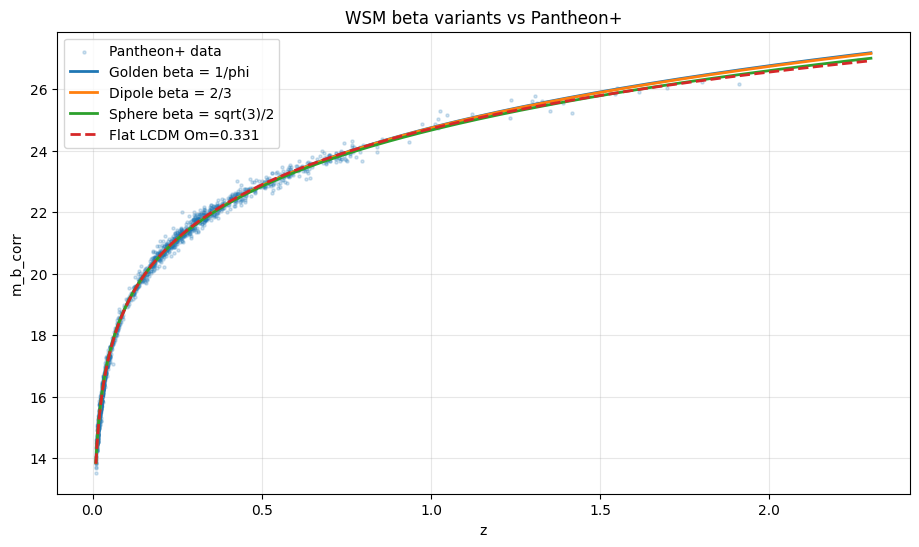
Do not erase a successful WSM calculation because a simpler control was later audited. The boxed \(D_L=R_z(1+z)\ln(1+z)\) relation is the minimal scalar branch. The plotted \(\beta\)-family contains additional e-sphere/Huygens geometry and gives the closer Pantheon+ relation. Both must remain, with their premises labelled, until WSM Action selects the physical branch.
X.3 Hubble tension
The numerical time \(H_0^{-1}\approx13.97\,\mathrm{Gyr}\) for \(H_0=70\,\mathrm{km\,s^{-1}\,Mpc^{-1}}\) is the time associated with the redshift length \(R_z/c\). In WSM it is a transport scale, not the age of eternal Space.
If \(H_0\) is a real local transport coefficient, different methods can sample different coherent matter environments. A local variation satisfies schematically
where \(nS\) is the effective coherent source density times cross-section. The decisive test is to generate WSM-truth data, pass it through an FLRW inference pipeline, and determine whether the inferred early-calibrated value falls below the local transport slope with the observed sign and scale.
XI. The dark-sector test — can one wave geometry reproduce the observations?
One Space leaves no ontological room for separate dark substances. The observations called dark matter and dark energy must arise from the geometry, stress, coherence and interference of Vibrating Space.
XI.1 The local \(1/3:2/3\) projection identity
For isotropically oriented axes in three dimensions,
The one longitudinal and two transverse projections are exact local geometry. They are not the evolving cosmic density fractions \(\Omega_m(z)\) and \(\Omega_\Lambda(z)\). The identity remains valuable inside the directional stress and polarisation algebra; it is removed from active dark-sector bookkeeping unless a synthetic-observation calculation derives that connection.
XI.2 Local even source and dimensional crossover
A signed first-order phase response reverses under electron–positron phase exchange and cannot gravitate neutral phase-balanced matter universally. Gravity must begin with a phase-even local source-region rectification. Evenness alone fixes neither attraction nor range, so write the leading source without inserting its sign:
The rectification occurs while forward and rear half-egg curves overlap matter locally. Its output excites a separate phase-even coordinate of the same Space; if that coordinate has a static massless three-dimensional Green response, the causal chain is
Here \(g_{\rm src}\) is written compactly while the forward and rear curves physically cross neutral matter; \(g_{\rm prop}\) is a distinct sub-leading exterior correction. Keeping them separate prevents the same effect being counted once inside the body and again by squaring an exterior tail.
The plain-wave picture is direct. A plane wave crossing a large neutral body meets forward curves and rear curves of opposite phase—the conjugate phase already present inside protons and neutral atoms. Their signed displacements largely cancel, but both curved sectors lower the relevant \(E_d\) and travel more slowly than the surrounding plane. Opposite signs therefore cannot make their positive travel-time delays cancel exactly. The transmitted plane front is left with a net delay: a shallow rear curvature written by the whole neutral body. Repeated local writing and Huygens reclosure form the compact phase-even gravitational source.
Squaring an already exterior Coulomb-like \(1/r\) curve would give \(1/r^2\) at the potential level and the wrong range. The local source and its exterior propagation must therefore remain distinct. Charge and gravity are symmetry-distinct modes of one substance, not two substances and not the same kernel with a sign chosen afterwards.
The harmonic travel-time control supplies the same local logic: equal faster and slower speed perturbations can leave a net second-order delay. This is a sign-and-convexity illustration, not the mass-normalisation calculation. A galaxy is therefore not an isolated baryon sum; it is an extended, phase-insensitive deformation of the Huygens sea that sustains it.
The range audit is independent of that coefficient. For a local slowness trace \(\chi=\kappa_n/r^n\), its straight-ray screen is
while \(n=1\) gives the logarithmic Shapiro class with an outer reference scale. An exterior \(1/r^4\) even term produces a \(1/b^3\) screen—far too steep to replace the gravitational \(1/r\) coordinate.
A concrete large-scale candidate is a crossover from three-dimensional spreading near matter to sheet-and-filament coherence at low acceleration. Three-dimensional flux gives \(1/r^2\); effective two-dimensional spreading gives \(1/r\). This derives the required outer shape, not the transition scale. If—and only if—the action selects
then matching the two regimes yields
This is the correct geometric shape of the baryonic Tully–Fisher relation. It is a Tier-C WSM mechanism. The same even response must fit rotation, weak and strong lensing, clusters, colliding systems and structure growth, while its source-to-mass ratio remains composition independent. MICROSCOPE found \(\eta({\rm Ti,Pt})=[-1.5\pm2.3_{\rm stat}\pm1.5_{\rm syst}]\times10^{-15}\), a direct constraint on any constituent-dependent rectification. MICROSCOPE final result.
The Milgrom acceleration relation
is a scale clue connecting local galactic dynamics to the cosmic transfer rate. The action must decide whether \(R_g\) and \(R_z\) are genuinely linked.
XI.3 Mach–Huygens origin of the effect called dark energy
Take any one observable Huygens sphere in isolation. Its matter attracts and, without external support, the finite domain collapses. It is not isolated. Matter continues beyond its received-wave boundary, and the Huygens spheres centred on that external matter overlap the local sphere. Their incoming reciprocal wave relation supplies the all-direction support that maintains local e-spheres and the domain they form.
This external support is the WSM physical cause proposed for the large-scale effect assigned to dark energy. It is neither a repulsive substance nor Space pushing itself apart. The observed supernova relation combines that Mach–Huygens environment with curve-decay redshift and transverse receiver geometry. WSM Action must calculate the sign, magnitude and distance dependence from the same surrounding-matter distribution, rather than fitting an independent \(\Lambda\).
XI.4 Clean large-scale discriminators
- Late ISW: static WSM curvature does not produce a \(\Lambda\)-type decaying-potential signal. Any CMB–structure correlation must arise from local structure, lensing or transport, not dark-energy decay.
- Dipole: the CMB dipole and matter number-count dipole should describe motion relative to the same matter-sourced Space.
- \(S_8\): an even baryon-anchored coherence response does not cluster like independent cold particles and therefore changes the growth history.
- Lowest multipoles — Tier C: without a unique primordial surface, the largest angular modes should retain measurable relation to structure inside the local coherence volume. Any quadrupole–octupole alignment is therefore a testable clue, not yet a claimed detection.
XII. Matter and the eternal element network
Inherited e-sphere and hadron structure used by the cosmology
XII.1 The “missing antimatter” problem becomes internal phase balance
Baryonic standing waves source the Huygens network. In the proposed WSM hadron construction, the proton is one fused recurrence with three delocalised precursor-phase roles. Its phase-role bookkeeping gives the following neutral-hydrogen inventory, conditional on that construction:
Under this proposed proton construction, neutral hydrogen contains two positive-phase and two negative-phase roles. Extending the count to arbitrary nuclei requires the solved neutron phase inventory. These are roles within a collective wave organisation; they are not independently surviving free leptons. Their internal balance also does not by itself determine the abundance of free conjugate hadrons or explain selection of one baryonic domain hand.
Here \(Z\) is the proton and electron count and \(N\) is the neutron count. The special assignment \(\nu_+=\nu_-=2\) has not been derived. If the collective neutron mode does not admit this additive inventory, calculate its conserved current and phase response directly. No neutron phase count is added to P1–P3.
The labels \(++-\) and \(--+\) have no absolute meaning by themselves. Globally exchanging \(+\leftrightarrow-\) changes our notation, not the physics. The real question is why one connected Huygens domain is dominated by one relative baryonic hand rather than containing a persistent mixture or separated conjugate domains.
Annihilation removes opposite closures in equal numbers:
Annihilation can erase an external mixture and leave whichever closure already has a local excess, but it cannot create that excess. The WSM question is different: conjugate baryonic closures may be unable to share one stable reciprocal support network; their interface would convert organised standing-wave closure into travelling waves, driving the connected domain toward one consistent relative phase hand. The action must calculate the interface dynamics. The arbitrary labels “plus” and “minus” do not identify two substances; the physically required result is internal phase balance with a consistent external baryonic closure.
The complete nonlinear hadron eigenproblem belongs to the hadron page, but cosmology depends on its outputs: matter stability, charge balance, formation rates and the wave spectrum returned to Space.
WSM contains no unique global primordial furnace. Light-element abundances must therefore arise from continuing formation, destruction and recycling across the eternal distribution of physical environments:
Hydrogen, deuterium, \(^3\)He, \(^4\)He, \(^7\)Li and metals require one reaction network coupled to stars, plasmas, cosmic rays, transport and matter-formation events. Deuterium is the sharpest test because stars predominantly destroy it. Earlier one-number helium branching guesses are not active physics; one network must reproduce the coupled abundances and their environmental distributions.
XII.2 What Big-Bang nucleosynthesis actually imports
Big-Bang nucleosynthesis returns several abundance estimates only after the baryon density, neutrino sector, Friedmann temperature–time relation, thermal initial conditions, neutron lifetime and mass splitting, weak rates, nuclear binding energies, thermonuclear reaction rates, finite-temperature, radiative and QED-plasma corrections are supplied. Calling it a “one-parameter prediction” without printing that inherited physical machinery hides most of the input ledger. Its deuterium agreement is a serious quantitative constraint; its persistent \({}^7\mathrm{Li}\) discrepancy shows that the network is not a closed foundational deduction.
| Layer | Standard BBN | First quantitative WSM network |
|---|---|---|
| Shared empirical physics | Nuclear masses, binding energies, neutron lifetime and measured reaction rates. | Reuse the same laboratory data initially; derive more from standing-wave nuclei later. |
| Cosmic environment | Hot, nearly homogeneous plasma cooling through a Friedmann expansion. | Eternal distribution of stars, plasmas, cosmic rays, shocks and matter-formation regions in the Huygens network. |
| Mathematical problem | Initial-value reaction network along one prescribed \(T(t)\). | Stationary production–destruction–transport network over an environmental distribution. |
| Principal cosmic inputs | Baryon-to-photon ratio, neutrino sector and expansion history. | Source fractions, temperature distribution, residence times, transport and destruction rates. |
| Success condition | Simultaneous D, \(^3\)He, \(^4\)He and \(^7\)Li predictions. | The same simultaneous set, plus spatial and redshift distributions, with one declared parameter set. |
The two calculations can be compared at the equation level. Standard BBN evolves abundances through a cooling history:
The WSM first calculation replaces the primordial clock, not the measured nuclear network:
Here \(S_i\) contains continuing formation channels, \(\Gamma_i\) destruction and escape, and \(\mathbf J_i\) transport between environments. This can be computed before every nuclear cross-section is derived from the hadron action. The deeper WSM calculation must later explain why the empirical rates have their values.
What the existing literature teaches. Slowly evolving or linearly coasting histories do not justify the shortcut “there is no helium.” Weak reactions can continue to replenish neutrons and helium can be raised by changing the baryon ratio. Other calculations then find severe deuterium and heavier-element problems. The honest lesson is stronger: abundance claims live or die by the full coupled network, not by one lifetime argument. Standard BBN also retains the well-known \(^7\)Li discrepancy, so neither side should advertise one fitted element as a complete victory.
Matter-formation signature — Tier C. If the proton forms by dynamical locking as one fused recurrence with three delocalised precursor-phase roles, the settling mismatch must leave as organised radiation. The time-dependent hadron solve therefore carries a reverse-engineering target: structured gamma emission in the approximate 100–300 MeV range, correlated with the negative-phase or muon-flavour channel. The exact energy window, spectrum and rate are outputs of the nonlinear eigenmode, not yet results.
XII.3 Ionisation and 21-cm structure
An eternal cosmos has no global first reionisation epoch. Ionised regions form continually around galaxies inside a statistical steady state. The 21-cm field should therefore be a superposition of local source-driven structures rather than one universal time slice; this is a direct observational discriminator.
XIII. Cosmic structure, mature galaxies and the real rest frame
XIII.1 JWST and the deduced mature high-redshift population
This is a deduction, not a permission. WSM has no universal beginning and does not turn redshift into age. In an eternal statistically stationary matter network, the average mixture of forming, mature, metal-poor, enriched, active and quiescent systems repeats at every sufficiently sampled transfer depth. Large redshift therefore cannot impose a youth ceiling.
The observations now make this contrast concrete:
- Galaxy at \(z=14.1793\). JADES-GS-z14-0 is an extended luminous stellar system with a secure [O III] line. Its inferred metallicity is about \(0.05\)–\(0.2\,Z_\odot\), showing that oxygen-producing stellar organisation is already present at the transfer depth mapped by hot-Big-Bang cosmology to roughly 300 Myr. JWST spectroscopic confirmation; ALMA [O III] detection and metallicity.
- Quenched system at \(z=7.3\). JWST/NIRSpec identified a galaxy whose major star-forming episode had already ended in the age interval assigned to about 700 Myr after the Big Bang. Quenching requires prior formation and evolution, not merely first ignition. Recently quenched galaxy.
- A \(5\times10^7M_\odot\) black hole at \(z=7.04\). A direct dynamical measurement in Abell2744-QSO1 found a black hole more massive than the allowed stellar host contribution, forcing exceptionally early seeding and growth in an age-limited history. Direct black-hole mass measurement.
Within the hot-Big-Bang age mapping, each result is answered by faster assembly, earlier seeds, altered efficiencies or revised stellar histories. Those are added model responses. WSM predicts the qualitative observation before those repairs: developed systems and heavy elements remain present at large redshift because they are distant, not universally young. The quantitative WSM task is to calculate the stationary population distribution, selection effects and transfer kernel—not to explain how mature matter formed before an imposed beginning that WSM does not contain.
Sheets, filaments, voids, galaxies and clusters are nested coherent wave domains formed by the same nonlinear organisation that produces finite e-spheres at smaller scales. Their statistical geometry must emerge from the Huygens network, including any near-two-dimensional sheet/filament scaling.
Because Space is real and matter-sourced, it defines a physical rest relation. The Sagnac effect displays real rotation relative to Space. The CMB dipole measures local motion relative to the large-scale equilibrium wave field. Number-count, radio and CMB dipoles therefore belong to one physical vector and provide a stringent test.
XIII.2 Large-scale flow and structure beyond our Huygens sphere
Our observable Huygens sphere is neither dynamically closed nor the end of structure. Galaxies, filaments and larger coherent domains continue beyond it, and their overlapping wave relations cross our local boundary. Large-scale correlated motion can therefore be sourced by matter whose centres lie beyond our direct received-wave domain. This is the WSM basis of what has been called dark flow: not attraction from beyond Space, but ordinary relational influence from matter beyond one observer-centred Huygens sphere.
Cosmicflows-4 analyses report coherent bulk motions on very large scales, while the recovered amplitude depends on survey geometry and estimator treatment. Cosmicflows-4 bulk-flow analysis; estimator and selection audit. WSM’s structural prediction is unambiguous: no observable boundary isolates us from the surrounding matter network. The Action and a synthetic-survey calculation must return the amplitude, direction, scale dependence and relation among galaxy-flow, radio-count and CMB dipoles.
Inherited compact-state discriminator
Gravitational waves are propagating modulations of Space. A merger is therefore expected, while the relaxation spectrum of the final high-\(E_d\) standing-wave state may contain discrete eigenmode structure different from a point-singularity description. The quantitative ringdown calculation belongs to the Relativity page; cosmology uses only its population and propagation consequences.
XIV. One transport architecture, seven cosmological gates
The primary physical object is the directional vibratory state of Space. For cosmological transport, its source-written screen and history representation obeys
The terms are literal: forward half-egg curves travel on real plane waves, their fronts widen and turn, and standing-wave matter rewrites or receives them. \(\Gamma\) is a constrained reciprocal-history ledger derived from \(X\). A spectral intensity \(F_{\rm obs}\) is produced only after receiving matter acts:
The older operator inserted \(-\kappa_z\nu\partial_\nu F\) into the travelling equation and thereby assumed the spectral shift it was meant to explain. The revised architecture leaves plane spacing unchanged and derives the observed frequency distribution through the receiver map \(\mathcal M_r\). Distance-dependent line broadening, transition-dependent residuals or angular halos test the variance and universality of the mechanism separately from its mean redshift.
| Gate | Must derive | Principal outputs |
|---|---|---|
| C0. Calm sea | Balance nonlinear steepening against all-direction Huygens redistribution. | \(E_{d0}\), background variance, correlation time and \(P_\Gamma(k)\). |
| C1. Spectral reception | Derive forward-curve decay, Huygens overlap and the bound-state response map while preserving plane order and the written image. | \(H_0\), spectral redshift, registered time dilation, flux, line width, detector independence, image preservation and redshift drift. |
| C2. Thermal collision | Give \(F_{\rm CMB}\) a stable Planck fixed point and the correct perturbation eigenmodes. | \(\mu=0\), \(T_0\), local \(T(z)\), FIRAS limits and SZ survival. |
| C3. Visibility and reciprocal support | Derive \(W_H(D)\), \(g_{\rm WSM}(D)\) and the soft Huygens scale. | Observable depth, image survival, Olbers accounting and common phase selection. |
| C4. Angular hierarchy | Free streaming and correlated source projection through \(W_\infty\). | TT, TE, EE, damping, lensing, BAO and angular distance. |
| C5. Even gravity and structure | Generate a local phase-even source, attractive sign, \(1/r\) exterior coordinate, equivalence and any 3-D to 2-D crossover. | Solar-System gravity, MICROSCOPE, rotation, lensing, clusters, \(S_8\) and structure growth. |
| C6. Matter–element cycle | Formation, destruction and recycling of standing-wave nuclei, ordered radiation and equilibrium sea motion. | D, \(^3\)He, \(^4\)He, \(^7\)Li, metallicity, 21-cm structure, energy stationarity and entropy recurrence. |
These are not seven adjustable stories. They are seven gates through which the same action must pass. Closing one by inserting a free function while breaking another is not unification.
XV. The connected historical thread
| Name or idea | What it contributed | WSM completion |
|---|---|---|
| Huygens | Every point of a wavefront becomes a source of further waves. | Matter and cosmos are reciprocal Huygens networks of real Space waves. |
| Leibniz and Mach | Reality is relational and interconnected; local inertia reflects the whole. | Each e-sphere is physically sustained by surrounding and external matter through overlapping Huygens spheres; the same relation prevents local cosmic collapse. |
| Milo Wolff and Dirac | Reciprocal waves connect the elementary centre to the cosmos; cosmic and elementary scales exhibit order-\(10^{40}\) ratios. | The Equation of the Cosmos gives \(R_{\rm coh}/\lambda_0=(\sqrt3/4)\sqrt N\), so \(N\sim10^{80}\) produces the large-number scale geometrically. |
| Planck and Einstein | Discrete resonators and resonant absorption/emission. | Quanta are complete transitions between standing-wave transformations. |
| Eddington, Regener, McKellar | Few-kelvin equilibrium-background estimates. | The CMB is the measurable temperature state of Vibrating Space. |
| Hubble and Lemaître | Redshift–distance observation and expansion interpretation. | The same observation is derived from nonlinear propagation in Space. |
| Tolman and Etherington | Surface brightness and reciprocal distance relations. | Exact tests of the WSM radiance and angular transport kernel. |
| Milgrom | A universal low-acceleration scale tied numerically to \(cH_0\). | Galaxy gravity as an even coherence response and possible dimensional crossover in one cosmic wave field. |
The thread is one of increasing connection: waves, resonance, relational matter, equilibrium, transport and scale. WSM joins them because the same Vibrating Space forms matter, carries light, supplies temperature and organises the cosmos.
XVI. Cosmological problems reformulated as calculations
- No edge of matter: every e-sphere requires all-direction Huygens support. A boundary to matter would destroy that support and make the finite domain collapse. Matter and organised structure therefore continue beyond every observable Huygens sphere.
- Mach’s principle: the wider matter distribution is not an abstract boundary condition. Its out-waves physically form each local e-sphere’s in-waves, supplying recurrence, inertia and cosmic support through overlapping spheres.
- Olbers: directed visibility is finite inside infinite Space; distant forward curves flatten, overlap declines and their organised motion joins the equilibrium field. The energy is followed, not erased.
- Seeliger: the infinite shell sum is cut off only if the even gravitational response has an integrable soft kernel. \(R_g\) must be derived; image decoherence alone is insufficient.
- Heat death becomes a recurrence ledger: infinite extent does not cure a rising entropy density. Eternal stationarity requires a closed local statistical cycle—standing-wave matter → ordered curve trains → equilibrium sea motion → newly organised low-entropy standing waves. Under the control luminosity ledger, thermalised starlight adds order \(2\%\) of the CMB entropy per Hubble time; the reverse organisation must match it.
- Stable constants: a statistically stationary calm sea predicts no universal secular drift in \(G,\alpha\) or mass ratios. Atomic-clock, geological and astronomical bounds test that stationarity; local environmental variations remain a separate calculable question.
- Arrow of time: relative to an e-sphere, future-forming in-waves arrive, the wave centre is present reclosure, and past-carrying out-waves continue outward. Both waves move forward. Energy is the conserved measure of that motion, not the moving substance.
- Horizon and flatness: Space has no finite creation boundary and is not born with a causal-horizon problem. Quantitative flatness becomes a forward coherence calculation: if the action gives \(R_{\rm coh}=R_z\) and \(\varphi_H=3/4\), then \(\Omega=1\) follows. Inflation is not required as a beginning-of-time repair; the coherence calculation replaces it.
- Cosmological constant: \(E_d=1\) is the baseline state of Space, not a gravitational sum of independent point-field zero modes.
- Self-energy and singularity: matter is finite standing-wave structure of one shared Space, not a point carrying an infinite private field. Compact high-\(E_d\) states must be finite wave eigenmodes.
- Dark matter: no second clustering substance is inserted; the additional acceleration arises from phase-even delay and dimensional coherence of ordinary standing-wave matter in the one Space.
- Dark energy: matter outside every local Huygens sphere supplies the reciprocal support preventing that finite domain from collapsing. The observed acceleration relation is the combined Mach–Huygens, redshift and transverse-transfer effect.
- Opposite phase and antimatter: the proposed proton–hydrogen construction contains balanced internal radial-phase roles. The neutron inventory, extension to nuclei, free conjugate-hadron abundance and domain phase selection remain outputs of the hadron and cosmological dynamics.
- Mature high-redshift structure: large \(z\) is transfer depth, not youth. Eternal statistical stationarity deduces the continued presence of mature galaxies, heavy elements and massive black holes at every distance.
- Large-scale flow: our observable domain is crossed by overlapping Huygens relations from matter and structures outside it; no local sphere is dynamically isolated.
XVII. What is deduced, and what is left to calculate
Structural consequences of the stated WSM foundation
- Space is one, infinite, eternal and active.
- Leptons, hadrons and cosmic structures are nested standing-wave organisations of Space; the connected matter network has no edge.
- Every e-sphere is the centre of its own finite observable Huygens sphere, and those spheres overlap. The exact soft profile and radius are Action outputs.
- An isolated finite matter sphere would lose all-direction support and collapse; external matter’s overlapping Huygens relations sustain it. This is the physical Mach principle and the WSM origin of the effect called dark energy.
- Milo Wolff’s Equation of the Cosmos gives \(R_{\rm coh}/\lambda_0=(\sqrt3/4)\sqrt N\); \(N\sim10^{80}\) produces the Dirac order-\(10^{40}\) cosmic-to-elementary ratio.
- A sharp \(c'=2c_0\) sphere writes the exact hemispherical screen \(\zeta(b)=\sqrt{R^2-b^2}\); variable \(E_d\) writes the living half-egg generalisation.
- Light is the constrained train representation \(\Xi=(\zeta,\Pi_\zeta,\Gamma)\) of forward curves written on successive real plane waves.
- Huygens propagation makes the written forward curves flatter and wider and reduces source–receiver overlap, while successive plane-wave spacing remains unchanged.
- Curve decay, reduced common Huygens overlap and lower-gap receiver reclosure form the WSM redshift mechanism; one factor maps carrier, modulation and event envelope.
- The CMB is proposed as a microwave equilibrium organisation of Vibrating Space, distinct as a spectrum from the broad matter-sustaining carrier sea.
- Light quanta are transition events; active number-changing exchange plus detailed balance gives \(\mu=0\).
- Universal gravity must be even under phase reversal; a signed linear cross-term cannot gravitate neutral matter universally.
- In the stated proton construction, opposite radial phases occur within the fused proton and neutral hydrogen. Extending that phase inventory to neutrons and arbitrary nuclei requires their solved collective modes.
- Redshift is not an age coordinate. A statistically stationary eternal cosmos has the same average population at every distance, including mature and enriched high-redshift systems.
- Matter and coherent structure outside our local sphere can generate large-scale flow across its observable boundary.
- All astronomical observation is local resonant decoding of incoming wave structure.
Exact calculations still required
- The nonlinear finite e-sphere and full \(E_d\) functional.
- The quantitative \(E_{cd}(D)\), Huygens-overlap and bound-receiver kernel that gives absolute \(H_0\) and universal spectral redshift.
- The quantitative reciprocal-history map that gives the same \(K\) for carrier frequency, modulation and the complete supernova envelope, independent of amplitude and detector.
- The separate raw-Euclidean and reciprocity angular predictions, including the Jacobi/étendue factor that could produce \(D_A=KD\).
- The thermal collision kernel, the physical scale \(T_*\) and absolute \(T_0\).
- The local absorber relation \(T(z)\), Planck/SZ relaxation eigenmodes, spectral-distortion rates and the full \(C_\ell\).
- BAO and the complete distance relations.
- The sign, range, equivalence normalisation and galaxy/cluster/lensing dynamics of the locally generated even gravity coordinate.
- The eternal light-element reaction network.
- The soft Huygens kernel, source weighting and relation among \(R_z,R_{\rm coh},R_{\rm vis},R_{\rm th},R_g\).
- The phase-domain calculation: whether reciprocal coherence makes mixed conjugate baryonic closures unstable and selects one relative hand throughout a connected Huygens sphere.
XVIII. Side-by-side physical comparison
| Question | Expansion cosmology | WSM cosmology |
|---|---|---|
| What exists? | Spacetime geometry plus several matter/field sectors. | One infinite active Space; all sectors are modes and structures of it. |
| What is matter? | Particles and quantum fields on spacetime. | Finite spherical standing-wave transformations of Space. |
| What is light? | Photon excitations of an electromagnetic field. | Changed travelling wave patterns between discrete matter transformations. |
| What is redshift? | Metric expansion, peculiar Doppler motion and gravity. | Source-written curves flatten and widen, common Huygens overlap decreases and receiving matter completes a smaller energy-gap change. \(K(D)\) measures the complete source–Space–receiver relation. |
| What is the CMB? | Relic radiation from a hot early epoch. | The equilibrium microwave organisation of Vibrating Space; its Planck spectrum, \(T(z)\), anisotropy and absolute temperature are one thermal-action calculation. |
| What is dark matter? | An additional clustering component not yet identified non-gravitationally. | Phase-even coherent delay and dimensional crossover in the matter-sustaining wave sea. |
| What is dark energy? | A fitted component or \(\Lambda\) term driving accelerated expansion. | External matter’s Mach–Huygens support prevents each finite observable domain from collapsing; redshift and transverse geometry determine how that support appears in the distance relation. |
| What is the cosmic age? | Finite time since the hot origin, inferred by applying the model to redshift. | Space and the matter network are eternal; \(H_0^{-1}\) is a transfer scale, not an age. With the additional statistical-stationarity assumption, the average developmental population recurs at every distance after matched environment and selection. |
| What is directly observed? | Redshifts, fluxes, angular patterns, spectra and abundances interpreted through an FLRW cosmic history. | Local resonant wave patterns measured by standing-wave matter; cosmic history is an inverse reconstruction of their propagation through Space. |
| What are the empirical inputs? | A six-parameter base fit embedded in GR–FLRW, hot initial conditions, inflationary perturbations and a roughly 95% dark inventory, plus measured microphysics, source calibration, foreground, feedback and nuisance modelling. | WSM-I openly uses scale anchors such as \(H_0,T_0,\rho_b,R_{\rm coh}\) and measured microphysics; WSM-II derives and reduces them through one action. |
| What does precision mean? | Conditional numerical agreement after the framework, matter sectors, initial spectrum, calibrations and nuisance model are supplied. | Empirical agreement with a smaller causal input ledger; success is increased compression, not merely another fit. |
| What seals the theory? | A global conditional fit within GR–FLRW dynamics and its declared matter and initial-condition model. | First, one finite-parameter WSM fit across all seven gates; finally, one real-wave action deriving those kernels and scales. |
XIX. Six decisive tests
These six tests can decide the cosmological framework directly. A beautiful ontology does not survive a failed wave train, sky, temperature field, distance map, gravity kernel or element network.
| Decisive test | WSM requirement | Failure condition |
|---|---|---|
| Receiver-centred redshift | One curve-decay, overlap and bound-reclosure law gives universal spectral energy ratios and the registered event-envelope factor across about 21 decades while preserving plane order and transverse screen information. | The mechanism produces only dimming, detector-dependent shifts, chromatic residuals, line diffusion, the wrong time-dilation factor or image destruction. |
| Transverse phase space | One ray-bundle equation derives étendue, angular size, Tolman brightness and reciprocal distances. | No single transverse map fits radiance, angular and supernova observations. |
| Planck equilibrium plus SZ | A stable Planck fixed point with \(\mu=0\) permits small written distortions to propagate. | The kernel either loses the blackbody spectrum or erases distant SZ writing. |
| Relational \(T(z)\), CMB and BAO sky | Overlapping absorber and receiver Huygens spheres give \(T_{a\to r}=T_0/K=T_0(1+z)\); one visibility function and \(W_\infty\) hierarchy reproduce TT, TE, EE, damping, lensing and BAO. | The same reciprocal factor cannot connect the absorber’s local excitation, received spectrum and CMB relation, or independent tuned sky kernels are required. |
| Galaxy–cluster–lensing gravity | One even coherence kernel fits rotation, lensing, clusters, colliding systems and structure growth. | The coupling that fits galaxies fails clusters or lensing. |
| Eternal element network | One stationary production–destruction–transport calculation reproduces D, \(^3\)He, \(^4\)He and \(^7\)Li together. | Deuterium or the coupled abundance set cannot be maintained without unrelated tuning. |
Extended test matrix
| Test | WSM requirement | Failure condition |
|---|---|---|
| Redshift universality | One receiver relation maps all controlled source and detector transitions by the same \(1+z\). | Transition-, material- or apparatus-dependent residual redshift. |
| One-Space action ledger | Directed forward-curve organisation lost from one coherent channel is recovered in the wider Huygens sea and completed matter response. | The receiver shift requires unaccounted loss or creation of organised wave action. |
| Transverse phase space | The ray-bundle dynamics preserves étendue and derives \(I_\nu/\nu^3\) and reciprocal distances. | The redshift solution cannot preserve sharp images, radiance and distance duality together. |
| Image preservation | Transverse phase order retained. | Required redshift necessarily produces unacceptable blur or halos. |
| Time dilation | The completed receiver history scales by \(1+z\), although the travelling planes retain their spacing; DES gives \(b=1.003\pm0.005_{\rm stat}\pm0.010_{\rm sys}\). | The mechanism shifts the registered spectral gap without the observed envelope scaling. |
| Redshift drift | The stationary exponential/coasting transfer branch gives \(\dot z=0\) apart from local accelerations. | A nonzero cosmological drift is robustly measured with the incompatible sign or magnitude. |
| Hubble-tension sign | Synthetic observations generated by the WSM transport kernel, then analysed through an expansion-model pipeline, reproduce the observed direction and approximate scale of the early-versus-local \(H_0\) difference. | The inferred bias has the wrong sign, is negligible, or requires an unrelated correction. |
| Receiver-distance benchmark | The derived \(\mathcal E\) and \(\mathcal R\) recover or replace \(D_L=R_z(1+z)\ln(1+z)\), while one transverse kernel chooses between \(D_A=D\), \(D_A=KD\) or a different predicted map and then fits Tolman brightness, AP and BAO jointly. | An unrelated opacity or freely chosen angular function is needed to repair the supernova or reciprocity relation. |
| CMB spectrum | Stable Planck fixed point with \(\mu=0\) and measured distortion limits. | The WSM collision operator requires conserved photon number or a non-Planck equilibrium. |
| Spectral-distortion dynamics | One resonant-exchange kernel predicts the creation and relaxation of both \(\mu\)-type and \(y\)-type distortions. | The kernel cannot recover the observed distortion limits or requires unrelated ad hoc thermalisation mechanisms. |
| CMB temperature | The action independently yields the dimensional scale \(T_*\) and response \(\epsilon_{cd}\) in \(T_{\rm CMB}=T_*E_{cs}\epsilon_{cd}\), where \(E_{cs}=\frac{3\sqrt3}{E_{\rm geo}}=\frac6\pi\), without inserting measured \(T_0\). | The thermal action cannot recover the observed temperature without calibrating the claimed prediction to it. |
| \(T(z)\) and SZ | The same pairwise relation between overlapping Huygens spheres gives \(T_0(1+z)\) around every centre while allowing distant SZ distortions to survive. | The reciprocal relation has the wrong scaling or rapid rethermalisation erases observed distortions. |
| CMB/BAO angular structure | One \(K_\ell\) gives TT, TE, EE, damping, lensing and BAO. | No Huygens eigenkernel reproduces their common structure. |
| Galaxy and cluster gravity | One even coherence kernel fits rotation and lensing with the same coupling. | Required coupling cannot fit galaxies, clusters and colliding systems together. |
| Light elements | Eternal reaction network reproduces D and He simultaneously. | Deuterium cannot be maintained at the observed abundance. |
| Late ISW | No \(\Lambda\)-type decaying-potential term. | A clean late-ISW signal is established that cannot arise from WSM transport or local structure. |
| Dipole alignment | CMB and matter dipoles describe the same physical rest relation. | Persistent irreconcilable direction/amplitude after systematics and finite-domain effects. |
| 21-cm structure | Local, continuing ionisation topology rather than one global reionisation front. | A uniquely global epoch is established with no WSM steady-state reconstruction. |
| Proton stability | The stable baryonic winding does not decay. | Confirmed proton decay would refute the topological-stability claim. |
| Matter-formation radiation | The time-dependent proton lock yields a structured gamma/neutrino signature. | The solved eigenmode produces no such settling channel or observations exclude the derived spectrum. |
| Compact-state ringdown | Finite high-\(E_d\) states have a calculable WSM eigenmode spectrum. | The derived spectrum cannot match merger ringdown or collapses to the same singular ontology. |
XX. Audit ledger — superseded results that must not return
Open the retained correction ledger
- \(E_{\rm rp}=0.324099\) is not a forward FSC result. It is measured \(\alpha\) rewritten in WSM units. The active static result is \(3\sqrt3/16\).
- The former \(\alpha^5\) and inner-unit-cube CMB formulas are superseded. The surviving geometry is \(E_{cs}=\frac{3\sqrt3}{E_{\rm geo}}=\frac6\pi\), but no dimensionless ratio predicts kelvin. The active target is \(T_{\rm CMB}=T_*E_{cs}\epsilon_{cd}\), with \(T_*\) and \(\epsilon_{cd}\) independently derived.
- The former \(E_{\rm geo}^2\) BAO match mixed incompatible distance measures. BAO is open until the WSM angular and distance kernels are solved.
- The Pantheon+ \(\beta\)-family must remain visible. The golden \(\beta=1/\phi\), dipole \(\beta=2/3\) and sphere \(\beta=\sqrt3/2\) curves are active phenomenological comparisons, not postulates. The WSM Action must select the physical e-sphere/Huygens geometry; the minimal scalar control does not erase the closer \(\beta\)-family result.
- The travelling plane spacing does not dilate. For a stationary path, \(dt_o/dt_e=1\). Huygens propagation instead makes each source-written forward curve flatter and wider and reduces coherent source–receiver overlap.
- Do not reduce WSM redshift to dimming. Curve flattening alone changes strength; the complete WSM mechanism also includes diminishing common Huygens overlap and the lower-gap, lower-rate reclosure of receiving bound matter. That full relation produces \(K(D)\).
- A scalar linear filter is not the WSM cosmological object. \(\widetilde s_o=H_D\widetilde s_e\) omits the three-dimensional curve, conjugate motion, overlapping Huygens domains and nonlinear standing-wave receiver. Its inability to rescale time does not refute the full source–Space–receiver relation.
- One \(K\) joins spectrum and supernova history. The reduced reciprocal relation lowers both the completed energy gap and the rate at which the receiver reconstructs the ordered source history. It is not a fixed propagation delay or detector latency.
- The former conservative dilation map is superseded. \(\chi_D=a^{-1}\chi_0(\tau/a)\) assumed widening of the longitudinal train. The active map preserves \(u_D=u_0\) and evolves the transverse curve through \(E_{cd}(D)\mathcal H_D^\perp\).
- \(I_\nu/\nu^3\) and Etherington reciprocity are targets. With \(\mathcal E=\mathcal R=K\), raw Euclidean geometry gives \(D_A=D\) and \(D_L=(1+z)D_A\). The standard \(D_L=(1+z)^2D_A\) relation requires the extra derived angular map \(D_A=KD\) or its exact equivalent.
- Finite observable Huygens spheres do not imply finite matter. Every e-sphere has an overlapping observer-centred domain and matter continues beyond it. WSM Action calculates the exact soft profile and scale; it does not decide whether matter exists outside.
- The cosmic lengths are not one symbol by definition. Keep \(R_z,R_{\rm coh},R_{\rm vis},R_{\rm th},R_g\) separate until the action relates them.
- A scalar phase screen alone is not the whole light train. The active object is \(\Xi=(\zeta,\Pi_\zeta,\Gamma)\): real displacement, conjugate motion and reciprocal coherence on successive real plane waves.
- Energy is a measure, not the travelling substance. The substance is Space; \(U\), momentum and action quantify its organised displacement, motion, strain and reclosure.
- A signed linear cross-term is not universal gravity. Neutral matter requires a local even source; squaring an already exterior \(1/r\) curve gives the wrong range.
- The \(1/3:2/3\) projection identity is not cosmic density bookkeeping. Fixed local geometry cannot simply be renamed as evolving \(\Omega_m(z):\Omega_\Lambda(z)\).
- The redshift term may not be hard-coded as a change of background wavelength. \(-\kappa_z\nu\partial_\nu F\) assumes an in-flight carrier drift. WSM redshift belongs to the complete source-written curve, Huygens propagation and bound-receiver map \(F_{\rm obs}=\mathcal M_r[\Xi_D;Z_r]\).
- Never restore a finite total matter universe. A matter edge destroys all-direction support. Matter and organised structure continue beyond every local observable Huygens sphere, whose external reciprocal support is the physical Mach principle.
- The symbols \(++-\) and \(--+\) are globally arbitrary. Internal opposite phase shows why antimatter phase is not absent. The remaining dynamics concerns uniform relative phase across one connected domain: annihilation preserves any existing excess, while a WSM coherence-interface calculation must decide whether persistent mixed domains are possible.
- \(V_4\) does not mean “not a gravitational wave.” Spin-two radiation admits all \(\ell\ge2\); the \(V_4\) result invalidates six-axis truncation and changes the angular pattern.
- Flat \(T(z)\), backward-time in-waves, and solved dark sectors are not WSM results. In/out waves travel forward; \(T(z)\), even gravity and angular spectra require the named gates.
- \(\mathcal R_{\rm WSM}\) is an architecture, not a computed operator. Its value lies in unifying the calculations that must now be done.
XXI. Key equations
The crest frequency and wavelength use the same coordinates. The universal intrinsic frequency, the fixed-position crest frequency and the phase rate along a moving centre are distinct readings, as set out in the shared postulates.
XXII. Bottom line
WSM cosmology begins with one visible physical act. Real plane waves enter and cross a finite e-sphere wave-centre core from every direction. The e-sphere’s \(E_d\) pattern changes their local speed and writes a real half-sphere—or, for moving bound matter, a direction-dependent half-egg—displacement into each outgoing plane. When the wave egg changes, the position, shape, timing, orientation and motion of those curves change on every successive plane. That ordered train crosses real Space, evolves by Huygens reconstruction and physically reshapes the next e-sphere it meets.
Every e-sphere is also the centre of a finite observable Huygens sphere. These spheres overlap through an unbounded matter network. Matter beyond our local sphere supplies the reciprocal all-direction waves that sustain it; without that external relation an isolated finite domain would collapse. This is Mach’s principle in physical wave language and the WSM cause proposed for the non-collapsing effect called dark energy.
At cosmological distance, each source-written curve becomes flatter and wider and the common Huygens overlap linking source and receiver becomes smaller, while the background planes retain their wavelength, speed, frequency, order and longitudinal spacing. The smaller reciprocal writing completes a lower energy-gap change and a lower reconstruction rate in receiving matter. That one factor is WSM redshift and registered time dilation. Its quantitative form generates the supernova brightness relation, including the restored Pantheon+ \(\beta\)-family comparison, while the transverse geometry carries image and angular information.
Because redshift is transfer depth rather than age, the universe has no imposed high-redshift youth ceiling. Under statistical stationarity and matched selection, the average population repeats at every distance, so mature galaxies, oxygen and massive black holes at high redshift are deduced. Matter and coherent structures continue beyond our observable sphere and can participate in large-scale flow. Under the stated proton construction, opposite radial phase is bound within the proton and neutral hydrogen; the neutron phase inventory remains unresolved. The CMB is the microwave equilibrium organisation of the same Space, and Milo Wolff’s Equation of the Cosmos joins roughly \(10^{80}\) matter standing waves to Dirac’s order-\(10^{40}\) scale relation.
The unity is physical. Quantum transitions, light propagation, redshift, the CMB, inertia, gravity, cosmic support, galaxy dynamics, elements and large-scale structure are different scales of one connected wave process in one Space. The remaining work is to calculate their exact magnitudes with one WSM Action, not to replace the deductions with unrelated mainstream ontology.
The quantitative programme. Calculate \(E_{cd}(D)\), Huygens overlap \(\mathcal O(D)\), the complete history operator and the transverse Jacobi map from WSM Action. Freeze their parameters before confronting supernova spectra and envelopes, DESI radial and transverse BAO, angular sizes, Tolman brightness, \(T(z)\), FIRAS/SZ, redshift drift, lensing and the eternal element network. The prize is precise: show that the successful mathematics of cosmology is the large-scale behaviour of real waves and real bound matter in one infinite Vibrating Space.
One Space.
Real plane waves.
Changing wave eggs.
A cosmos written in their curves.
The picture is one. Space is real. Matter has no edge. Every local sphere belongs to the whole.
References and names in the thread
Primary observational and mathematical controls used in this revision: Pantheon+ supernova compilation · DES supernova time dilation · COBE/FIRAS spectrum · CMB temperature–redshift relation · DESI DR2 BAO · Planck base-\(\Lambda\)CDM parameters · Borde–Guth–Vilenkin past-incompleteness theorem · LZ dark-matter search · SH0ES distance ladder · BBN and lithium review · cosmic antimatter-domain limits · JWST galaxies at redshift 14 · oxygen at \(z=14.1793\) · quenched galaxy at \(z=7.3\) · direct high-\(z\) black-hole mass · Cosmicflows-4 bulk flow · bulk-flow estimator audit · linear-coasting distance formulas · MICROSCOPE equivalence test · distance-duality conditions.
Huygens, C. (wavefront construction) · Leibniz, G.W. (one substance and interconnection) · Mach, E. (relational inertia) · Wolff, M. (reciprocal waves and Equation of the Cosmos) · Dirac, P.A.M. (large-number relation; electron and positron wave states) · Planck, M. (quantised resonators) · Einstein, A. (light quanta; A/B coefficients; foundational unity) · Slipher, V.M. (nebular spectral shifts) · Lemaître, G. (1927 expansion relation) · Hubble, E. (1929 redshift–distance relation) · Eddington, A.S. (1926 equivalent equilibrium-radiation estimate) · Regener, E. (1933) · McKellar, A. (1941 molecular excitation) · Alpher, R.A. and Herman, R. (1948 relic-temperature estimate) · Gamow, G. (hot-universe development) · Penzias, A. and Wilson, R. (microwave-background detection) · Tolman, R.C. (surface-brightness test) · Etherington, I.M.H. (reciprocity) · Sachs, R.K. (optical-scalar and ray-bundle equations) · Bassett, B.A. and Kunz, M. (distance-duality conditions) · Sakharov, Peebles and Yu, Sunyaev and Zel'dovich, Silk (acoustic and damping physics) · Luzzi et al., Planck and SPT cluster analyses (CMB \(T(z)\)) · Fixsen, D.J. and FIRAS/COBE (CMB temperature and distortion limits) · Chluba, J. and Sunyaev, R.A. (blackbody mixing and \(y\)-distortion) · Driver et al. (optical–infrared extragalactic background) · Cohen, De Rújula and Glashow (cosmic matter–antimatter domain limits) · Planck Collaboration (six-parameter base-\(\Lambda\)CDM fits) · Pitrou, Coc, Uzan and Vangioni / PRIMAT; Fields, Olive, Yeh and Young (precision BBN, nuclear inputs and lithium problem) · DESI (distance and BAO tests) · Milgrom, M. (low-acceleration scale) · Haselhurst, G. and the WSM corpus (1997–2026) · JWST/JADES and ALMA (high-redshift galaxies and heavy elements) · Cosmicflows-4 (large-scale flow) · SKA and HERA (21-cm tests) · ELT/ANDES (redshift drift).
Revision history · 9 September 2026. Every historical quotation and the exact agreed WSM postulates have been retained without alteration. This edition removes the erroneous finite-total-matter construction; deduces matter and organised structure beyond every observer-centred Huygens sphere; restores Mach’s principle as external reciprocal support and the WSM source of the effect called dark energy; restores Milo Wolff’s Equation of the Cosmos, \(N\sim10^{80}\), Dirac’s large-number relation and the Pantheon+ \(\beta\)-family figure; states the WSM redshift chain positively; makes the internal antimatter-phase answer visible; adds the statistical-stationarity deduction, JWST mature galaxies, heavy elements, early massive black holes and large-scale flow; prints the hot-Big-Bang–\(\Lambda\)CDM input/problem ledger; and updates the popup and Copy-to-AI reasoning guard. The A/B/C/D/Q tiers distinguish fixed structure, mechanisms and remaining calculations without demoting deductions into possibilities.