


WSM CORE PAGE 10 · THE EMPIRICAL TRIBUNAL
EXPERIMENTAL PHYSICS
Reality Is the Judge
Famous experiments, honest observations, novel predictions and clean ways to kill the theory
An experiment does not arrive with its ontology attached. It makes something happen, records the consequence, constrains what we may believe—and gives every explanation a chance to fail.
STATUS OF THIS PAGE
A living experimental ledger—not a victory list
This cross-sector construction gathers the central experimental debts and candidate tests distributed across the WSM corpus. It deliberately separates measured fact from mathematical reduction, standard interpretation, WSM construction and unfinished prediction. Many entries are required recoveries, not evidence unique to WSM. A candidate effect becomes a scientific prediction only when its observable, sign, size, scaling, controls, uncertainty and exclusion threshold are frozen before comparison with the data.
One substance, one directional law, one finite matter recurrence
Physical foundation
WSM Postulates
Open the postulates, units and frequency conventions
The complete WSM Action and its stable matter solution remain open. Explicit action candidates and exact reduced controls are displayed below. The A/B/C/D/Q tiers distinguish established relations, fixed WSM structure, concrete mechanisms, open calculations and excluded shortcuts throughout the page.
Units. \(c_0=E_{d0}=\lambda_0=1\). Hence \(f_0=1\) and \(\omega_0=k_0=2\pi\). The constants \(\hbar,m_e,\alpha,G\) are outputs, not units.
P1. One Substance. Space is a nearly rigid, slightly elastic wave medium whose only primitive motions are longitudinal plane waves propagating in all directions.
P2. One Law. Directional wave speed is determined by directional wave-energy density. For every direction \(\hat{\mathbf n}\),
Thus, in normalized units,
The universal intrinsic frequency \(f_0\) supplies the reference standard. Wavelength is the simultaneous crest spacing: speed and crest frequency in \(\lambda^{\prime}=c^{\prime}/f_{\rm crest}\) must use the same coordinates. Thus \(\lambda^{\prime}=c^{\prime}/f_0\) applies where \(f_{\rm crest}=f_0\). The intrinsic reference, fixed-position crest frequency and phase rate along a moving centre remain distinct readings.
P3. One Matter. Electron and positron are e-sphere wave centres formed from Huygens-combined longitudinal plane waves from all directions, with opposite background-relative radial phases. The e-sphere circumscribes a cube of side \(\lambda_0\):
Immediate deduction from P1. As the one substance, Space cannot be bounded, created or interrupted by another substance; it is therefore infinite, eternal and continuous.
P1–P3 are the fundamental postulates; additional working assumptions and approximations are stated where used. WSM Action must derive the complete spherical standing-wave and spherical phase-wave structure, their stability and all further physics.
WSM Wave Action: the mathematics already in hand
Open the Action equations and their present scope
An action turns a physical account into equations of motion. The WSM corpus already contains explicit action candidates, exact reduced dynamics and propagation controls. They establish concrete results and identify the coupling still needed for a stable, interacting e-sphere. The general variational form is
Here \(\mathcal C\) collects the independent variables describing longitudinal motion of the same Space. This schematic expression states the mathematical task; the following equations are actual constructions developed in the corpus.
Four constructions, four roles. \(S_0\) is the directional cycle-energy candidate; \(S_{\rm ray}\) supplies exact reduced ray dynamics; \(S_{\rm sphere}\) describes longitudinal spherical motion; \(S_{\rm control}\) isolates propagation through a prescribed profile. Their derivation as mutually consistent limits of one autonomous action remains to be established. An incompatibility between candidate pieces would reject that combination; it would not by itself refute P1–P3.
Directional cycle-energy action
Let \(C_{\hat n}(\mathbf x,t)\) describe the real longitudinal compression component travelling in direction \(\hat n\), and \(D_{\hat n}=\hat n\cdot\nabla\). The candidate defines the positive intensity ratio
where \(Q_{\hat n}\) and \(P_{\hat n}\) are cosine and sine projections of that compression over one reference cycle; the subscript 0 denotes the background. Its action is
With intensity held fixed, the characteristic speed is exactly \(c'_{\hat n}=c_0 I_{\hat n}\), recovering P2 from the kinetic and spatial coefficients. The full variation must also include the dependence of \(I\) on the wave history and constrain all directions to one physical displacement. A causal treatment of that history remains part of the construction. \(\chi_0\) is a declared normalization coefficient.
Exact dynamics in a one-dimensional ray model
For a compression coordinate \(q(\sigma,t)\), normalized strain \(a=q_\sigma/\epsilon_*\), and canonical imbalance \(\eta\), the corpus gives
Variation yields two oppositely travelling characteristic families. Their positive energy responses and speed magnitudes satisfy \(E_\pm/E_{d0}=c_\pm/c_0=e^{a\pm\eta}\). Choosing \(\eta=\operatorname{artanh}\beta\), \(a=\tfrac12\ln(1-\beta^2)\), and \(\beta=v/c_0\) gives \(e^{a\pm\eta}=1\pm\beta\); removing the common geometric mean gives \(e^{\pm\eta}=\gamma(1\pm\beta)\), where \(\gamma=(1-\beta^2)^{-1/2}\). These are exact results within this ray model. Its uncoupled local transport does not generate the spherical core from a homogeneous background.
Longitudinal spherical action
Writing displacement as \(\mathbf u=\nabla\Psi\) gives a reduced action with positive coefficients \(\rho_\Psi\) and \(\kappa\):
The unforced equation admits the regular spherical \(j_0\) compression mode and its quarter-cycle \(j_1\) radial motion. The source term \(f_\Psi\) currently stands for the incoming Huygens relation. Deriving that relation from the surrounding matter is the step needed to make the recurrence self-consistent.
An exact propagation control
For a prescribed positive, stationary profile \(\epsilon(x)\), the action displayed on the homepage is
The coordinate \(y=\int dx/\epsilon(x)\) converts it to a uniform wave action. In this prescribed, stationary one-dimensional profile, a complete transmitted pulse is reflectionless and gives zero net impulse on the profile when the response is the same at both ends. Local force density need not vanish: its contributions cancel in the total impulse. A changed travel time alone therefore does not establish a net force. This control contains no receiving e-sphere and does not calculate its gravitational response. The prescribed profile is an input to this control.
The next calculation is specific. Join the directional response, longitudinal displacement and continuing Huygens waves through one independent state and one energy–momentum account. Then solve an open periodic e-sphere at P3’s fixed \(R/\lambda_0=\sqrt3/2\), with finite excess energy and a complete stability spectrum. The existing actions and exact controls supply mathematical starting points; a complete self-consistent WSM Action and its stable matter solution remain to be obtained.
Equations and their assumptions: WSM Action, §13: present mathematical pieces; §14: the open boundary problem; and homepage Action summary and propagation control.
Space vibrates; it does not flow. Waves arrive, converge, cross the centre and continue; nothing reflects from a particle wall.
Action discipline. One direction-resolved WSM Action must govern every apparatus on this page. The foundation is stated once; the claim labels carry status thereafter.
Essential WSM glossary
Open the essential WSM terms
From a metaphysics of Space and Time to a metaphysics of Space and Motion.
Newtonian mechanics describes matter particles moving in space and time, with mass and force entering its laws of motion. Its gravitational law gives attraction between separated bodies without specifying a local transmitting mechanism. WSM applies motion directly to Space: the wave motion of one continuous physical substance forms matter, and its ordered change supplies what clocks measure as time. Matter and time are understood through the activity of Space itself.
Newton himself objected to unmediated action at a distance: his letter to Richard Bentley distinguishes the law of attraction from its physical cause.
| Term | Meaning in WSM |
|---|---|
| Vibrating Space | One infinite, eternal, continuous, nearly rigid, slightly elastic wave medium. This physical substance supports longitudinal compression plane waves whose organisation forms matter. Time measures its ordered wave change. |
| Background wave sea | The longitudinal compression plane waves travelling through Vibrating Space in all directions. |
| Directional wave-energy density \(E_d\) | Wave-energy density associated with a specified direction of propagation. \(E_{d0}\) denotes its background value. |
| Physical wave speed \(c'\) | The local propagation speed of a longitudinal plane wave in a specified direction. \(c_0\) denotes the background reference speed. |
| Spherical standing wave | Formed by the coherent Huygens combination of incoming longitudinal plane waves from all directions. The waves cross the centre and continue outward. The finite central core of high directional wave-energy density \(E_d\) is called the e-sphere. WSM identifies its two opposite radial phases relative to the vibrating background as the electron and positron: a matter–antimatter pair. |
| Huygens sphere | The finite all-direction wave relation through which surrounding matter supplies an e-sphere’s incoming waves. |
| Reconstruction / reclosure | Reconstruction is the repeated formation of an e-sphere by waves passing through it. Reclosure is the restoration of its complete phase relation. |
| Curve on a plane wave | The half-spherical displacement and phase profile imprinted on a passing plane wave as it crosses an e-sphere. |
| Curve train | A finite, ordered sequence of changed curves written onto passing background waves during a bound-state transition. This is WSM’s description of a photon. |
| Moving wave egg | The asymmetric wave organisation of a moving e-sphere, with an elongated front and flattened rear. |
| Spherical phase wave | The moving pattern of equal-phase positions formed by intersecting longitudinal waves across an e-sphere. Its two opposite directions of phase rotation are called its two “hands”. |
| Huygens ring | The circle of contributing longitudinal-wave directions perpendicular to a light train’s direction of propagation. |
| Phase-even residual delay | The component of wave delay unchanged by reversing the radial phase. This is the residual used in WSM’s gravity account. |
| WSM Action | The programme for expressing the dynamics of WSM’s single wave medium through an action whose variation gives the equations of motion. |
Extended WSM reference: the complete glossary, definitions and research notes.
Claim-status key
Claim-status key
| Tier | Meaning |
|---|---|
| A | Established experiment, standard result or exact mathematics under explicitly stated premises. |
| B | Fixed WSM postulate or direct deduction from the real-wave ontology and established geometry. |
| C | Concrete physical construction whose decisive calculation or test is specified. |
| D | Required quantitative output of WSM Action. |
| Q | Rejected route or ontology error retained only in the failure ledger so it is not repeated. |
I
The Grammar of an Experiment
Reality reaches the laboratory before philosophy does. Light enters a detector. A current changes. A clock accumulates phase. A spot appears on a screen. A mirror rotates. An atom exits through the top or bottom of a trap. These are physical events. Only afterwards do human beings turn them into a claim about photons, particles, fields, curved spacetime, expanding space—or one Vibrating Space.
The record, calibration, reduction and uncertainty model must be declared so rival accounts can reproduce the observable. The sixth step connects data to dynamics. The seventh is the most easily smuggled in. A detector click is not labelled travelling pellet. A spectral redshift is not labelled expanding space. A null fringe shift is not labelled no medium exists. Those words belong to an explanation, and an explanation must earn them.
Observation is not interpretation
State what the apparatus recorded before saying what caused it.
Fit is not deduction
A curve fitted after seeing the data is not a blind prediction of that curve.
Consistency is not unique evidence
If several theories predict the same result, success does not select one of them.
Failure must remain possible
A proposal that explains every outcome after it occurs explains nothing beforehand.
Experiment is where a beautiful idea agrees to be wounded by Reality.
The WSM causal sentence
WSM applies one physical chain beneath every sector:
P2 The directional law is c′/c0 = Ed/Ed0. D The one Action must carry this chain through a complete source, apparatus and receiver calculation, reproduce the readouts now predicted by quantum theory, relativity, QED, nuclear physics and cosmology, and then expose a clean result those frameworks do not predict.
II
Three Famous Corrections
Scientific shorthand becomes dangerous when an interpretation is repeated until it sounds like an observation. These three slogans should be retired.
“The double slit shows a particle going through one slit and interfering with itself.”
No experiment records that journey.
Observed: with stable relative phase across both open apertures, an extended interference distribution accumulates from individual local detector records. When an apparatus observes which slit the electron passes through, mutual coherence falls and the cross-term fades, while each aperture still diffracts. Quantitatively, fringe visibility V and path distinguishability D obey V² + D² ≤ 1.
Not observed: a tiny corpuscle following a continuous path from source through one slit while the untravelled slit somehow shapes it.
“Hubble discovered that the universe is expanding.”
Hubble measured a relation, not expanding space.
Observed: inferred distances to extra-galactic nebulae were correlated with compiled spectral redshifts, expressed then as radial velocities; much of the velocity record came from earlier spectroscopy by Vesto Slipher and others. Hubble’s 1929 paper was titled A Relation between Distance and Radial Velocity among Extra-Galactic Nebulae.
Interpretation: expansion follows only when the redshift–distance record is placed inside an expanding cosmological model. Lemaître had already derived such a model in 1927. The model may be right; the slogan still confuses evidence with explanation.
“Michelson and Morley proved that no ether or physical Space exists.”
They killed a predicted ether-wind signal.
Observed: their interferometer did not show the large orientation-dependent fringe displacement expected from a simple Galilean wind through an otherwise unchanged apparatus. The historical result was small, not metaphysically exact zero; modern resonators have driven related anisotropy bounds vastly lower.
Not proved: that no continuous medium can exist. A medium in which rods, clocks and light are all organisations of the same waves is a different physical hypothesis. It must derive the null—not borrow it.
Lorentz was closest to the physical repair—but not finished
The existing conditional calculation already recovers the exact Lorentz–de Broglie relation from phase matching of a stable opposed real-wave recurrence and preservation of its geometric-mean rest frequency; see the moving-wave baseline. Recovering the full clock–ruler–signal response from the moving e-sphere remains a separate calculation.
FitzGerald and Lorentz proposed that motion through the ether physically changes matter, allowing the interferometer to remain null. Lorentz developed the transformation that became central to relativity. Yet his ontology still placed independent charged particles inside a medium. WSM makes the more radical move: matter itself is the medium’s recurring wave organisation. If the same waves make light, rods and clocks, a real reciprocal deformation can be shared by all three.
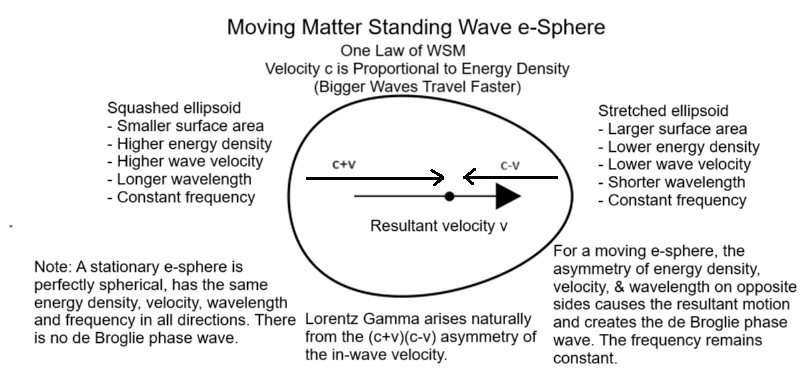
B · real-wave geometry A resting e-sphere is directionally balanced. In a translating wave egg the leading sector is elongated: lower directional Ed gives lower c′ and shorter local wavelength. The rear sector is flattened: higher Ed gives higher c′ and longer wavelength. The raw directional reconstruction c′lead = c0 − v and c′rear = c0 + v must remain distinct from the reciprocal laboratory Fourier pair e±s = γ(1 ± β). The Action must derive the map between them.
D One moving e-sphere solution must produce Lorentz covariance, Michelson–Morley and Kennedy–Thorndike nulls, time dilation, energy–momentum and the full clock–ruler–signal agreement. Its constitutive response must also exclude independent shear modes, drag, heating and Lorentz-violating anisotropy above the measured bounds.
III
Beyond Wave–Particle Duality
Nature does not owe us two incompatible little pictures. The experimental record can be stated more cleanly:
For two coherent alternatives with complex amplitudes A1 and A2, the measured distribution follows
In literal real-wave language, if u1 and u2 arrive with amplitudes a1, a2 and phase difference Δφ, then
The complex amplitudes are efficient bookkeeping for these real quadratures and phase relations. If an apparatus observes which slit the electron passes through, mutual coherence is reduced and the cross-term fades. What remains is not a straight pellet distribution; each open aperture still has its wave diffraction envelope. Visibility and distinguishability obey V² + D² ≤ 1. That observed relation does not by itself decide whether the represented wave is probability amplitude, quantum field, pilot wave or real motion in Space.
A click is an event—not a photograph of a traveller
A detector click proves that a detector changed state locally. It does not prove that a tiny object carried an indivisible packet along a continuous hidden path. A continuously travelling corpuscle between preparation and detection is an interpretation; the stable properties of matter and the local completed record are empirical. The successful calculation between them uses amplitudes, Green functions, fields and propagators.
C · source–receiver reconstruction A transition changes an e-sphere and writes changing half-sphere curves onto successive longitudinal carrier planes. Those planes propagate through Space; they do not become pellets and do not turn around. A compatible receiver accumulates the arriving frequency, phase, direction, polarisation and curvature relations until its own extended standing-wave organisation closes into another allowed mode. The wave history is continuous; the completed source and receiver states are discrete.
D The same Action must derive exclusive events, the Born rule, antibunching, Hong–Ou–Mandel interference, Bell and GHZ correlations, selection rules, cross-sections and QED precision.
Modern quantum theory should not be caricatured either. Quantum field theory does not simply return to Newtonian pellets: “particle” number can depend on the state and observer, and fields or amplitudes carry the calculation. Interpretations disagree about what exists. WSM’s claim is therefore not that physicists forgot the wave mathematics; it is that a real three-dimensional wave medium might supply a simpler physical referent beneath it. Only derivation can decide whether that extra claim is true.
The old duality says: “Sometimes particle, sometimes wave.” The cleaner question is: What continuous relation produces discrete completed events?
IV
The Cross-Sector Experimental Ledger
These experiments already exist. They are not WSM predictions. They are the mountain WSM must climb without moving the summit.
Showing all 18 entries.
Two-slit and matter-wave interference
Required recoveryRECORD
Electrons, atoms and larger molecules accumulate local detector events whose distribution follows interference when alternatives remain coherent. Observing which slit the electron passes through reduces interference visibility; single-slit diffraction remains.
STANDARD
Quantum amplitudes superpose; measurement entangles path and marker, producing decoherence or distinguishability. No classical trajectory is assigned while coherence is retained.
WSM · C
Extended real wave relations propagate through every open path. An electron is an e-sphere; an atom or molecule is a bound standing-wave organisation of many centres. A receiver completes one local state change. Which-path coupling physically changes the common wave history and therefore the later receiver overlap.
DEBT
Derive the complete intensity, visibility–distinguishability relation, one-event exclusivity, detector statistics and apparatus coupling from the action.
Blackbody radiation and discrete spectra
Required recoveryRECORD
Thermal cavities follow the Planck spectrum. Atoms show sharply discrete absorption and emission frequencies; Franck–Hertz collisions transfer energy at characteristic thresholds.
STANDARD
Quantised field modes and atomic eigenstates exchange energy in units set by ℏω; statistical mechanics supplies the Planck distribution.
WSM
Stable standing-wave organisations admit discrete recurrent closures. Continuous coupling can end only in allowed source and receiver states.
DEBT
Derive mode density, atomic spectra, selection rules, Einstein A/B coefficients, linewidths and the exact Planck law without inserting quantum postulates.
Photoelectric and Compton records
Required recoveryRECORD
Above a material threshold, maximum photoelectron kinetic energy rises linearly with incident frequency, while intensity primarily changes the emission rate or photocurrent. Compton scattering shows an angle-dependent wavelength change correlated with electron recoil.
STANDARD
Photon energy–momentum is exchanged with electrons: Kmax = hν − W and Δλ = (h/mec)(1 − cos θ), where W is the material work function.
WSM
Frequency selects a compatible receiver transition; a complete source–train–receiver relation conserves energy and momentum between stable wave organisations.
DEBT
Derive thresholds, latency, count statistics, Compton kinematics and the Klein–Nishina cross-section from real waves—not by renaming the photon formula.
Stern–Gerlach, spin and 4π return
Required recoveryRECORD
Prepared spin-half systems separate into two channels, with repeated measurements and rotated analysers following characteristic half-angle probabilities.
STANDARD
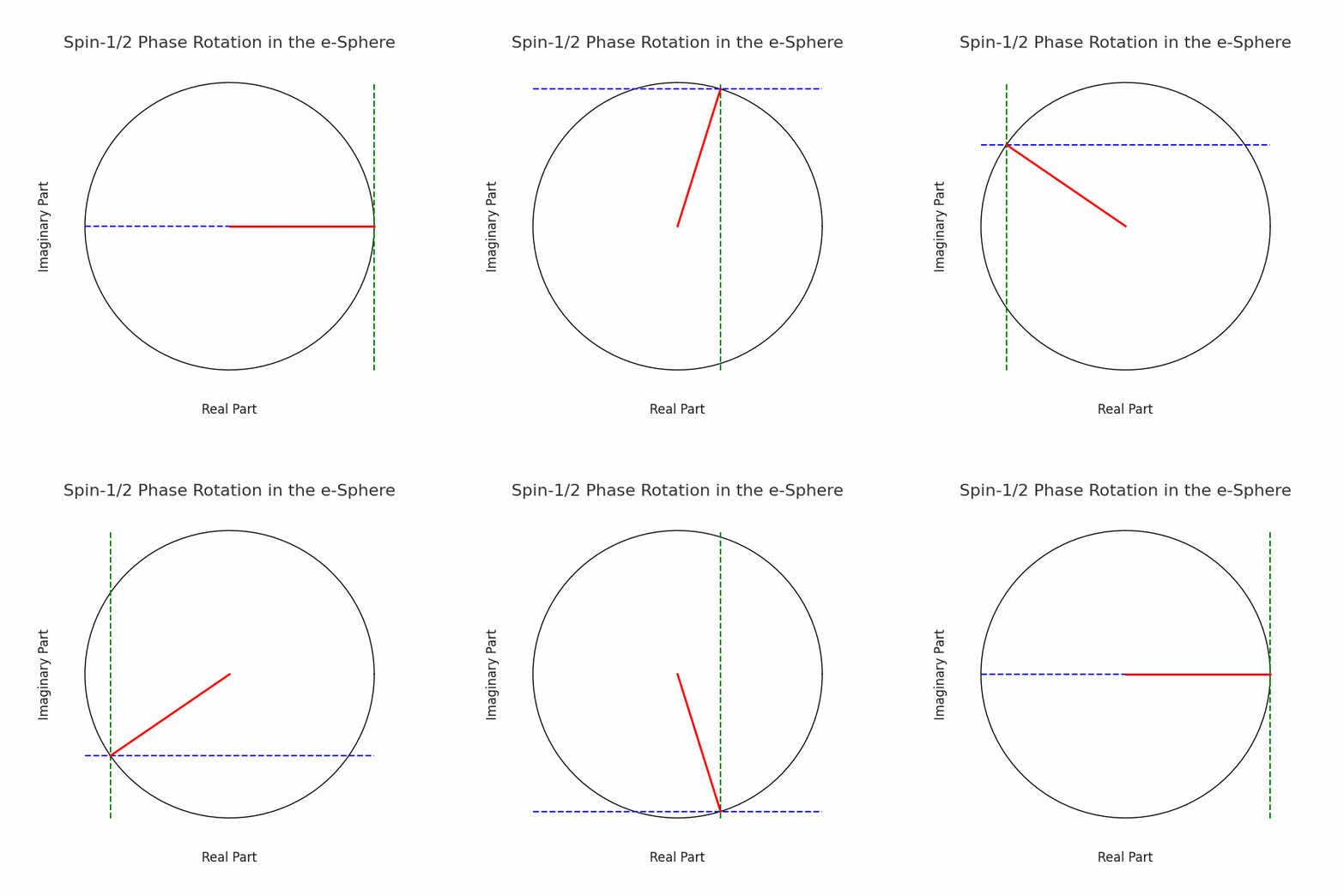
Two-component spinors represent spin-½. A 2π rotation changes the spinor amplitude’s sign and a 4π rotation restores it; the sign becomes observable only relative to an unrotated phase reference. Measurement probabilities follow cos²(θ/2).
WSM · B/C
Opposite ordered spherical phase-wave hands in longitudinal wave history provide the two spin orientations with axis-free 4π closure. Analyser coupling must physically sort each hand through the magnetic-field gradient.
DEBT
Derive the magnetic current, two-channel apparatus dynamics, cos²(θ/2), sequential measurement and fermionic statistics.
Aharonov–Bohm phase, tunnelling and cavity response
Required recoveryRECORD
Interference phase can shift along ideal paths where the local classical field vanishes while the paths enclose magnetic flux. Barrier transmission is often exponentially suppressed in the WKB regime; cavities alter emission rates and coherent oscillations.
STANDARD
Gauge connection and phase holonomy, evanescent wave solutions, and quantised light–matter mode coupling reproduce the observations.
WSM
Phase is a real relational ledger of the connected medium; barriers and cavities alter propagation, density of compatible modes and receiver reclosure.
DEBT
Derive the exact phase shift, tunnelling coefficient, Rabi dynamics, Purcell scaling and spontaneous-emission rate.
Antibunching, Hong–Ou–Mandel and Bell tests
Decisive quantum wallRECORD
Single-emitter light can be antibunched; indistinguishable inputs at a beam splitter show a coincidence dip; loophole-reduced Bell tests violate inequalities while preserving no-signalling.
STANDARD
Fock-state statistics, bosonic exchange amplitudes and entangled nonseparable quantum states give the measured correlations.
WSM
Exclusive closure is proposed to occur at one compatible receiver; shared wave history may be nonseparable without carrying a controllable superluminal message.
KILL
The Action must produce g(2)(0), the HOM dip, complete setting-dependent joint probabilities, the spin-singlet correlation −a·b, the correct photon-angle law, CHSH violations up to 2√2, GHZ correlations, late-setting behaviour and no-signalling. Failure kills the proposed quantum mechanism.
Michelson–Morley, Kennedy–Thorndike and modern resonators
Required recoveryRECORD
No reproducible Lorentz-violating orientation or velocity dependence has appeared above reported bounds. Michelson–Morley excluded the large shift expected from a simple Galilean ether wind through otherwise unchanged rods and clocks; modern resonators and clocks constrain related anisotropies far more tightly.
STANDARD
Local Lorentz invariance and invariant measured light speed make the null natural. Test frameworks bound possible violations.
WSM
Light, rods and clocks are proposed as one wave substance, jointly deformed in a moving e-sphere relation. The null should follow from their common dynamics.
KILL
If the frozen WSM action predicts a larger anisotropy than existing bounds—or needs an independent hand-inserted contraction—the moving-state account fails.
Time dilation, muons, accelerators and GPS
Required recoveryRECORD
Ives–Stilwell-type spectra, moving unstable particles, accelerator energy–momentum, transported atomic clocks and satellite navigation agree with relativistic clock and signal relations.
STANDARD
Special and general relativity use proper time and spacetime geometry to calculate the effects with high precision.
WSM · B/D
The moving wave egg contains two distinct ledgers. Its raw direction-resolved reconstruction requires c′lead = c0 − v and c′rear = c0 + v. Its reciprocal laboratory Fourier pair has W ± P = e±η, W = cosh η = γ and P = sinh η = γβ. The Action must derive the physical map between them.
DEBT
Derive the moving e-sphere, clock rate, ruler response, signal propagation and energy–momentum from one action at existing precision.
Equivalence, gravitational redshift and antimatter fall
Required recoveryRECORD
Matter-composition tests find universality of free fall near 10−15; clocks redshift with potential; ALPHA-g finds antihydrogen motion consistent with attraction toward Earth and rules out repulsive antigravity in its tested regime.
STANDARD
General relativity expresses universal free fall and clock redshift through spacetime geometry and the equivalence principle.
WSM · C
Opposite electric phases write opposite q-odd curves whose leading effects nearly cancel in neutral matter. Their common post-spreading loss of flat-direction overlap leaves a q-even delay. The complete incoming–outgoing wave stress must turn that delay into the same attractive acceleration for matter and antimatter.
KILL
Derive the attractive sign, magnitude and composition independence. Any unavoidable WSM violation above MICROSCOPE, clock or future antimatter bounds kills that gravitational branch.
Lensing, Shapiro delay, orbits and gravitational waves
Decisive gravity wallRECORD
Light bends, radar signals are delayed, planetary and binary orbits precess, and compact binaries lose energy. Multimessenger observations constrain gravitational-wave speed to be extremely close to light, while detector networks separately constrain the allowed polarisation content.
STANDARD
Einstein’s field equations quantitatively connect stress–energy to curved spacetime and gravitational radiation.
WSM
A matched even source can mathematically support a 1/r exterior, inverse-square gradient and tidal Hessian; changing wave speed and curvature could guide clocks and light.
KILL
Source–range structure is not gravity. The same action must recover bending, delay, perihelion, frame dragging, binary decay, wave speed, polarisations and strong-field signals. Failure in one common coupling is decisive.
Electron charge, form factors and pointlike scattering
Structural wallRECORD
Electron scattering and collider data show no resolved ordinary internal size over the tested momentum range; charge is stable and universally normalised.
STANDARD
The Standard Model treats the electron as elementary; its electromagnetic vertex is encoded in form factors F1 and F2.
WSM · C
A finite e-sphere can have extended coherence support while the conserved electromagnetic current seen in scattering has a much smaller response radius. That separation must arise from the solved mode and its current symmetry.
KILL
Derive the covariant current matrix element, preserve F1(0)=1, calculate F1(q²) and F2(q²), and satisfy every pointlikeness bound. Naming two radii without producing them from one solution fails.
Electron magnetic moment and QED precision
Precision wallRECORD
The electron magnetic moment is measured to 0.13 parts per trillion. Comparison with QED plus the rest of the Standard Model requires an independently measured α and other declared inputs; the present independent α determinations do not perfectly agree.
STANDARD
Loop corrections generate the anomaly through a perturbation series in α/π, with hadronic and electroweak contributions at higher precision.
WSM · C
A weak perturbation reshapes the e-sphere’s directional wave egg and current. Its changed out-waves continue outward, cross fresh inward waves and alter the next in-wave closure after a real delay. Repeated causal passes rebuild the e-sphere and form the living magnetic-response cascade whose converged current is proposed to contain the anomaly.
KILL
Freeze the Action and obtain F2(0) independently from the direct current and a linearised GDH derivative construction capable of retaining the anomaly’s sign. The ordinary GDH relation is quadratic in the anomaly. Wrong sign, value, threshold, spectrum or higher-order structure kills the route.
Lamb shift, running α and light-by-light structure
Precision wallRECORD
Atomic levels exhibit the Lamb shift; electromagnetic coupling changes with momentum; and light-by-light scattering and related nonlinear electromagnetic processes have been measured in their respective regimes.
STANDARD
Renormalised QED predicts the Lamb shift, vacuum polarisation, pair thresholds and Euler–Heisenberg low-energy light interactions.
WSM
A finite, self-consistently dressed wave organisation may replace point divergences with physical response while recovering the same low-energy effective structures.
KILL
Derive Ward identity, optical theorem, running, the 2me branch point, Lamb shift and the Euler–Heisenberg 4:7 structure. Mere finiteness is not success.
Proton and neutron static structure
Eigenmode wallRECORD
Protons and neutrons have measured masses, radii, magnetic moments and elastic form factors. The neutron’s mean-square charge radius is negative even though its total charge is zero.
STANDARD
QCD bound states of quarks and gluons are calculated with symmetry methods, effective theories, scattering fits and lattice gauge theory.
WSM · C
The proton is proposed as one fused, relative-periodic, C3-capable three-role recurrence. Its precursor centres lose independent identity; the three roles survive as delocalised internal mode coordinates, not permanent particles or three rigid lobes. The neutron is a related whole-wave branch.
KILL
One hadron-sector-unfitted nonlinear solution must jointly produce stability, mass, JP, baryon protection, charge and magnetic currents, four response radii, moments, neutron and Δ branches, excitations and scattering curves. A demonstrated absence of a stable fused mode rules out that Action’s hadron construction.
Deep-inelastic scattering, jets and hadron families
High-energy wallRECORD
High-energy collisions show scaling violations, measured parton distributions, event shapes, jets, colour-factor observables and a rich spectrum of baryons and mesons.
STANDARD
QCD uses quark, gluon and colour dynamics with asymptotic freedom, confinement and fragmentation.
WSM · C
Constituent-like response roles may emerge inside one inseparable nonlinear recurrence; collision products would be transitions among whole allowed modes. Three WSM roles do not by themselves derive QCD colour.
DEBT
Recover scaling violations, running, parton distributions, jet multiplicities and shapes, colour factors, confinement phenomenology, fragmentation and the hadron spectrum from the same fused-wave dynamics.
Cosmological redshift and time dilation
Joint-kernel wallRECORD
Distant spectra are redshifted; standard candles and transients supply distance, duration and brightness relations; images retain finite sharpness and transverse phase-space information.
STANDARD
An evolving metric stretches wavelengths and light-curve times while luminosity distance and angular-diameter distance follow the expansion history.
WSM · C
A transition writes changing half-sphere curves onto successive longitudinal carrier planes. In calm Space the planes’ carrier frequency, wavelength and spacing do not stretch in flight. Huygens spreading widens and flattens the written curves, reduces common source–receiver overlap and changes the receiver’s reconstruction into a smaller-gap state.
KILL
One receiver-history operator must jointly predict spectral redshift, observed duration, flux, surface brightness, angular size, sharpness, polarisation and redshift drift while leaving the propagating carrier spacing unchanged. Static linear tired light is already excluded.
CMB spectrum, anisotropy, SZ and BAO
Thermal-cosmic wallRECORD
The CMB is an extraordinarily precise blackbody with anisotropy, polarisation, damping, lensing and Sunyaev–Zel’dovich distortions; large-scale matter carries the BAO scale.
STANDARD
Hot-big-bang plasma, recombination, primordial perturbations and later structure produce a connected set of spectra and distance scales.
WSM · C
The CMB is proposed as a large-scale equilibrium radiation field produced and maintained by matter–wave interactions in eternal Space. Reversible propagation scaling alone cannot create a thermal attractor; the Action must supply the collision, absorption, emission and angular-redistribution operator.
KILL
Derive the equilibrium temperature rather than inserting 2.7255 K, then calculate T(z), μ and y constraints, TT/TE/EE spectra, damping, lensing, SZ response and BAO with the same parameters as redshift transport.
Galaxies, lensing, elements and 21-cm history
Cosmic-history wallRECORD
Galaxy dynamics, cluster mass maps, lensing, elemental abundances, ionisation history and 21-cm structure constrain matter, gravity and cosmic evolution across time.
STANDARD
ΛCDM joins general relativity, dark matter, dark energy, nucleosynthesis and astrophysical feedback in a calibrated history.
WSM · C
Long-range Huygens overlap may support cosmological structure without expanding Space, while neutral-matter q-even wave stress must separately calculate galaxy and cluster gravity. Organised matter can have finite histories inside eternal Space; neither statement automatically supplies dark matter, dark energy or an element history.
KILL
One declared model must fit rotation, clusters, lensing, growth, element abundances, entropy production, reionisation and 21-cm structure. An eternal ontology cannot borrow a young-universe boundary whenever convenient or rename every residual “coherence.”
Read the pattern: every familiar experiment is both inheritance and debt. WSM may offer a different physical story, but the measured number stays where it is.
V
When an Idea Becomes a Prediction
The word prediction is easily spent and hard to earn. An observed number noticed after the fact is not a novel prediction. A qualitative direction without a coefficient is not yet a test. A free parameter fitted independently in every sector is not one theory.
- 1
Retrospective explanation
“WSM can picture why this known result might occur.” Useful for mechanism; no new empirical credit.
- 2
Conditional deduction
“If this stated wave geometry and action term hold, this relation follows.” Logic is real; Nature has not yet selected the premise.
- 3
Candidate signature
A named observable, apparatus and distinguishing pattern exist, but one or more coefficients remain unsolved.
- 4
Frozen quantitative prediction
Sign, size, scaling, range, uncertainty, nuisance model and decision threshold are registered before the result is inspected.
- 5
Independent blind test
A team that did not tune the model executes the protocol and opens the result only after analysis choices are fixed.
- 6
Replication and cross-sector survival
The effect repeats, survives changed apparatus and remains compatible with every other prediction of the same frozen action.
VI
Candidate Experiments and Discriminators
Moving-wave baseline. Phase matching of a stable opposed real-wave recurrence, plus preservation of its geometric-mean rest frequency, gives the exact Lorentz–de Broglie relation. The separate fixed-rim, fixed-wave-layer-energy cap model gives \(S/S_0=\gamma^2\) and \(v<c_0\) for a finite egg. These are quantitative controls under their stated assumptions; neither fixes the nonzero odd residue sought here. The surface and timing calculation keeps the one-pair encounter, continuing phase centre and geometric centroid distinct.
The following are not presented at one confidence level. Each card says exactly what exists now: constraint, candidate family, computational experiment or branch-killing observation.
The odd moving-shape residue
Look for a signal that reverses with directed motion and begins cubically, not quadratically.
Real-wave origin
Translation first produces the V1 imbalance that displaces the continually rebuilt centre. After that motion and all even V2, V4, … deformation are removed, an odd recentred residue can begin at
a3 = κ3 sinh³η + O(sinh⁵η).
The leading wave-egg sector is elongated and the rear flattened; reversal exchanges them. For Earth’s speed relative to the CMB dipole frame, β ≈ 1.2336 × 10⁻³ and β³ ≈ 1.88 × 10⁻⁹. This is only a kinematic scale. The Action decides whether κ3 is nonzero and whether calm Space is experimentally aligned with the CMB dipole frame.
Experiment
Compare co-located orthogonal optical cavities, optical clocks and—if available—nuclear or highly charged-ion clocks on a rotating platform. Search simultaneously for turntable harmonics, sidereal modulation and annual sidebands. Reverse apparatus orientation and swap clock species so ordinary even thermal, centrifugal and gravitational effects cancel or move to different harmonics.
Distinctive pattern
An odd signal changes sign when the same apparatus reverses its projection along the registered calm-Space velocity. If the solved state identifies that direction with the CMB-dipole frame, its annual envelope must follow vector addition of Earth’s orbital motion; otherwise the Action must name the relevant frame before the data are opened.
Freeze before testing
Derive κ3, which clock or cavity tensor it couples to, the exact harmonic template and the absolute amplitude. Compare it first with existing modern Michelson–Morley, Kennedy–Thorndike and clock-network data. If already excluded, the candidate dies without a new apparatus.
Finite-train phase memory
Does a receiver retain a phase consequence of the whole pulse history after equal-energy controls are matched?
Origin
A finite e-sphere responding through delayed reconstruction can depend on the ordered pulse history, not only on final carrier frequency and energy. The unweighted integral ∫δω(t)dt is merely the endpoint phase and therefore cannot distinguish pulses whose endpoint phases are matched. A genuine memory candidate must be derived from the receiver response, for example
M(tf) = ∫tf K(tf − t) δω(t) dt,
or from a nonlinear, path-ordered functional of the receiver state. The Action must determine K or the nonlinear return map.
Experiment
Prepare pulse pairs with the same central frequency, spectral intensity, energy, duration, polarisation and endpoint phase but different spectral phase and temporal ordering. Send them through a high-finesse cavity or interrogate the same narrow atomic transition. Alternate the order rapidly and heterodyne the transmitted field against a common reference.
Controls
Classical dispersion, Kerr response, thermal drift, AC Stark shift and detector memory can all imitate history dependence. Use vacuum and material-path controls, energy reversal, pulse-order reversal and multiple receiver linewidths. Standard Maxwell and quantum-optical predictions must be calculated before a residual is called new.
Needed theory
The WSM Action must supply the signed history functional, its relaxation law and its scaling with coherence time, detuning and receiver Q. Without that functional, pulse-order dependence is a test family rather than a prediction.
The electron’s form factor and sideband wall
A finite periodic electron must explain why experiments see one stable mass and no ordinary internal spectrum.
Origin
A periodically rebuilt e-sphere can offer internal Floquet harmonics En = E0 + nℏΩe. A finite current distribution can also change F1(q²) and F2(q²). Existing scattering and precision spectroscopy leave little room for unsuppressed structure.
Calculation
Solve the stable e-sphere first. Derive its conserved current, selection rules, spectral residues and both form factors over spacelike and timelike momentum. Do not choose a compositeness scale after looking at collider bounds.
Experiment
Use the derived templates in existing Bhabha and lepton scattering data, Penning-trap spectroscopy, threshold scans and future high-energy lepton colliders. Search for a correlated departure across channels rather than an isolated bump.
Deep issue
A coherence radius may differ from a current radius, but this must emerge from the mode. Naming two radii after the conflict is not an explanation.
One anomalous magnetic moment by two independent roads
Make the electron’s magnetic anomaly a calculation that can disagree with itself before it meets the data.
Road A: local current
From the frozen e-sphere solution, compute the conserved electromagnetic current, magnetic dipole and Pauli form factor F2(0) directly.
Road B: global absorption
Independently compute the helicity-dependent photoabsorption spectrum. Use the linearised GDH derivative construction for the leading signed anomaly; the ordinary GDH sum rule constrains its square. The tree-level derivative integral, thresholds, overshoot and tail must appear before integration is reduced to one number.
Blind protocol
Two teams—or isolated computational pipelines—receive the same frozen action but not each other’s intermediate results. They publish both values and uncertainty budgets before the experimental electron g−2 number is revealed to the fitting stage.
One physical cascade
A magnetic perturbation changes the wave egg, directional Ed, local speed, wavelength, phase, curvature and current. Changed out-waves continue outward and cross fresh inward waves; those crossings alter the next in-wave closure and rebuild the e-sphere again. Agreement between the converged local current and an integral over all allowed excitations is therefore a stringent two-road test of one causal response. Both roads must then extend unchanged to the muon and higher orders.
Source–receiver coherence threshold
Hold ordinary spectral overlap fixed and ask whether completed events depend on a further finite history of coherent accumulation.
Origin
WSM proposes that a receiver closes into a new stable state only after compatible changes accumulate across its finite recurrent organisation. That may create a sharply structured latency, hysteresis or threshold beyond linear absorbed power.
Experiment
Drive a single trapped ion, superconducting artificial atom or cavity-coupled emitter with pulse ensembles matched in spectral intensity, mean energy and first-order coherence but varied in spectral phase and higher-order temporal organisation. Record event time, failed attempts, reset dynamics and receiver state with high efficiency.
Standard baseline
Open-quantum-system and quantum-trajectory models already predict rich waiting-time statistics. A WSM claim must name a residual they do not produce and show that it survives loss, detector dead time and pulse-shape calibration.
Freeze before naming
Derive the nonlinearity, memory time, state dependence and probability law. “Resonance matters” is established physics, not a novel WSM prediction.
Precision gravity of antimatter
The sign is already known in the tested regime; the next question is universality.
Present fact
ALPHA-g observed antihydrogen behaviour consistent with downward attraction and excluded repulsive antigravity for its apparatus and precision.
WSM consequence
If gravity is the q-even part of the common neutral-matter wave delay, matter and antimatter fall with the same sign. The complete Action must calculate the universal magnitude and any residual difference before precision data are compared.
Experiment
Improve cold antihydrogen free fall and interferometry; compare gravitational acceleration, redshift and inertial response while controlling magnetic gradients, charge neutrality and velocity distribution.
Status
Same-sign fall is not unique evidence for WSM—it is also the standard expectation. Only a precomputed departure, or a common exact recovery of universality, carries WSM-specific information.
Proton formation history and radiation balance
If three precursor e-sphere roles capture into one fused proton recurrence, what continuing waves carry the exact excess energy, momentum and angular momentum?
Real-wave formation
Changed out-waves from each precursor continue through the encounter and cross fresh waves travelling toward the others. Each crossing changes the next in-wave geometry. Capture succeeds only if this feedback destroys the three independent closures and leaves one stable relative-periodic three-role recurrence.
Conservation gate
Specify the initial centre-of-mass state and final proton branch. Only their calculated difference fixes whether radiation is required and what it must carry. Fractions of the proton rest energy do not generate spectral lines; at exact initial centre-of-mass energy mpc², energy conservation alone requires no fixed emitted line.
Outputs before search
Derive the capture basin, formation rate, spectral and angular distribution, polarisation, widths, branching ratios and environmental dependence. Then search suitable collision, capture or astrophysical records using the complete correlated template.
Backgrounds
π⁰ decay, nuclear transitions, hadronic showers and transport can fill broad energy ranges. Energy alone is insufficient; timing, angular structure, polarisation and coincident final states must distinguish the formation channel.
The neutron’s full electric form factor
Do not stop at the already known negative radius; predict the entire curve.
Present fact
The neutron has zero net charge but a negative mean-square charge radius. This agrees qualitatively with the proposed signed internal structure, but many models can do so.
Calculation
Solve the neutron mode paired with the proton and derive its covariant conserved-current matrix element without fitting the scattering curve. Extract F1, F2 and the Sachs GEn(Q²), GMn(Q²) curves with uncertainties. A naïve three-dimensional Fourier transform of a static charge density is frame-dependent.
Experiment
Compare with polarised electron–deuteron and electron–helium scattering and future measurements over a preregistered Q² range. Nuclear corrections must be declared independently.
Why the curve matters
A sign at Q² = 0 is easy to imitate. Nodes, slopes and high-Q² falloff expose the actual geometry.
Redshift drift: watch the cosmic relation change—or not
A stationary transport law and an expanding metric do not generally predict the same secular drift.
WSM stationary branch
If the large-scale wave background, source population and source–receiver geometry are statistically stationary, the cosmological part of a source’s redshift satisfies ż = 0, apart from local accelerations and changing environments.
Standard baseline
Expansion cosmologies predict a small redshift-dependent drift over observer time. The signal is tiny and requires long baselines or exceptionally stable 21-cm and optical spectroscopy.
Experiment
Use multiple independent source classes, laser frequency combs, stable spectrographs and decades of calibration. Model peculiar acceleration, binary motion, instrument drift and evolving absorption profiles before unblinding the cosmological component.
Scope
A clean nonzero drift of the standard sign and scale would kill the stationary WSM transport branch. It would not logically kill every time-dependent wave cosmology, but any replacement would need to be derived rather than invented after the result.
One far-field kernel across the whole sky
Redshift alone is easy. Redshift, duration, brightness, images, CMB and structure with one law are hard.
Real-wave transport
A source transition writes changing half-sphere curves onto successive longitudinal carrier planes. In calm Space their carrier frequency, wavelength and separation remain fixed while the written curves spread, widen and flatten. Common source–receiver overlap declines; the receiver’s finite history operator reconstructs a smaller-gap state. Redshift is therefore a receiver transformation, not stretching of the travelling carrier.
Required operator
Derive a time-translation-covariant history operator mapping written curvature, amplitude, polarisation and transverse phase space into the receiver response while conserving the applicable energy and wave-action ledger. The relation 1 + z = exp(D/Rz) follows exactly under the stated assumptions of continuous, homogeneous multiplicative transfer. It is a conditional mathematical result. The receiver operator must still derive that physical transfer behaviour and its scale.
Blind joint fit
Freeze one parameter set and one transfer law. Fit supernova spectra and light curves, standard rulers, Tolman surface brightness, angular sizes, distance duality, CMB T(z), FIRAS spectral limits, SZ distortions, BAO and lensing without redrawing the function for each dataset.
Decisive comparison
Use held-out redshift ranges and observables. Compare predictive information criteria and posterior predictive residuals against ΛCDM, including astrophysical nuisance models applied equally.
No rescue by vocabulary
“Space absorbs” is not an operator. Static amplitude loss cannot create the coordinated receiver transformation. Image blur, heating, dispersion or spectral distortion above observations kills the mechanism. Keep local CMB temperature and received radiation-temperature inferences as separate experimental ledgers.
One fused proton recurrence, no hadron-sector refitting
The shortest decisive proton test is a blind calculation performed before another accelerator run is requested.
Freeze
Use the same direction-resolved WSM Action and upstream constants fixed by the e-sphere and QED calculations. Specify boundary conditions, permitted topology, sea subtraction, precursor histories and convergence rules before solving for one fused relative-periodic C3-capable three-role mode.
Blind outputs
Require Floquet–Krein stability, mass, charge, JP, baryon protection, electric and magnetic currents, four response radii, moments, neutron and Δ branches, excitations, axial response, elastic form factors, allowed decays and short-distance scattering from the same solution. Reserve measured values until the solution and uncertainty map are frozen.
Numerical controls
Vary grid, domain, solver, symmetry assumptions and initial conditions; follow continuum resonances; test conservation, uniqueness and symmetry-corrected stability. Independent code bases must reproduce the branch.
Scientific status
This is a theoretical computation gate, not a laboratory experiment. It is nevertheless decisive: a specified Action either possesses the required whole-wave recurrence or it does not. “No movable dials” means no hadron-sector refitting after universal inputs are frozen.
Proton stability and baryon protection
Electric winding, spin lift and baryon persistence are three different physical ledgers; the proton solution must keep them distinct.
Present constraint
No proton decay has been established. This constrains WSM but does not uniquely support it. The fused solution must survive charge-conserving kinematically open alternatives; electric charge conservation alone cannot explain the proton’s lifetime.
Two calculable branches
If the Action supplies a distinct baryonic invariant, calculate it and prove which evolutions preserve it. If stability instead comes from a finite coherent-unwinding barrier, calculate the decay channel and lifetime. “Very rare” and “impossible” are experimentally different claims.
Experiment
Continue large-volume searches across proton-decay modes and compare them with the registered WSM theorem or rate. One verified event rejects an absolute prohibition; a null progressively constrains any finite predicted rate.
Scope boundary
The three internal WSM roles are phase and response coordinates, not established fractional electromagnetic charges. Searches for isolated fractional charge remain valuable external constraints on particle models, but they become a WSM discriminator only if the solved Action assigns such charges.
VII
The Kill Wall
A serious theory should help its critics destroy it. These are not rhetorical risks. They are places where WSM can simply be wrong.
Scope of rejection. A failed prediction or demonstrated absence of the required solution rejects the specified Action, mechanism or branch. A contradiction in P1–P3 themselves would challenge the foundation. Failure to finish a derivation or make a numerical search converge is not proof that no solution exists.
No stable e-sphere
If the frozen Action has no regular, finite sea-relative-energy, dynamically stable open recurrence at the fixed P3 core radius—with waves arriving, crossing and continuing, two physical 4π hands and the required translational zero modes—that Action fails as a realisation of WSM matter.
Wrong moving state
If one three-dimensional wave egg cannot join the raw c0 ± v directional reconstruction to the reciprocal rapidity pair and recover Lorentz clock–ruler–signal relations, energy–momentum and anisotropy nulls, the relativity route fails.
Wrong quantum events
If the source–receiver mechanism cannot derive exclusive outcomes, Born statistics, antibunching, HOM and Bell/GHZ correlations with no-signalling, it is not a replacement quantum theory.
Broken current or unitarity
If F1(0) ≠ 1, the Ward identity or optical theorem fails, probability or energy is not conserved, or causal response is violated, the electron theory fails.
Visible forbidden electron structure
If the required e-sphere generates unsuppressed sidebands, extra masses, bound states or form-factor deviations already excluded by experiment, it is dead.
Wrong α or g−2
If one frozen Action cannot derive α and the electron/muon magnetic observables—including currents, thresholds, signed dispersive reads and higher orders—without refitting, the QED route fails.
No fused proton recurrence
If no stable relative-periodic C3-capable three-role solution exists, baryon protection fails, or one current cannot jointly reproduce the static, transition and scattering observables, the hadron proposal fails.
Wrong universal gravity
If the complete incoming–outgoing stress of the proposed q-even delay gives the wrong sign or predicts composition, clock, antimatter or wave-propagation departures above observed bounds, that gravitational coupling fails.
Cosmic operator breaks the sky
If one non-expansion receiver-history operator cannot preserve unchanged carrier spacing and sharp images while reproducing redshift, observed duration, surface brightness, the CMB spectrum and joint distance data, the branch fails.
Registered residual absent
If any frozen WSM-specific effect is absent below its declared exclusion threshold, that mechanism is rejected—without moving the coefficient after the result.
Parameters migrate
If different sectors require mutually inconsistent values of one supposedly universal constant or hidden sector-specific functions, the one-law claim fails.
A rival compresses more
If another ontology derives the same facts and new successes with fewer independent assumptions and equal empirical precision, Minimum Description Length favours the rival. This is a model-selection result, not an experimental falsification.
Do not protect WSM from these failures. A theory that survives because every contradiction is renamed a deeper mystery has stopped doing physics.
VIII
The Frozen Prediction Registry
Every claimed novel test should receive a permanent public record before data comparison. A simple registry prevents memory, enthusiasm and hindsight from changing what was promised.
Minimum prediction record
- Prediction ID
- Permanent name and versioned hash of the theory/code
- Record type
- Laboratory experiment, observational branch test, numerical calculation gate or imported consistency constraint
- Claim tier
- A, B, C, D or Q, with the owning corpus page and dependency chain
- Physical cause
- Exact Action term and real-wave causal chain producing the effect
- Observable
- What calibrated quantity the apparatus will report
- Sign and magnitude
- Central value with units; no “order of magnitude” escape unless registered as such
- Scaling
- Dependence on velocity, orientation, frequency, density, distance, potential or other controls
- Domain + conventions
- Validity range, units, sign, phase, frame and Fourier conventions
- Inputs
- Every external measured constant, prior and upstream Action/code version
- MDL cost
- Every new coefficient, function, calibration and sector-specific rule introduced by the prediction
- Nuisance model
- Known backgrounds, degeneracies and calibration uncertainties
- Controls
- Null channels, reversals, blinded injections and independent apparatus
- Decision rule
- Support, inconclusive and exclusion thresholds fixed in advance
- Freeze record
- Date, authors, code archive, data provenance, held-out split and cryptographic hash
- Outcome + status
- Published result, including nulls and failed analyses, with superseded-by links when the record changes
| ID | Test | Present status | Next gate |
|---|---|---|---|
| X01 | Odd cubic moving-shape residue | Candidate family | Derive κ3 and apparatus coupling; confront existing bounds |
| X02 | Finite-train phase memory | Candidate family; former endpoint-phase integral rejected | Derive a weighted or nonlinear receiver-history functional against the quantum-optical baseline |
| X03 | Electron form factors and sidebands | Structural constraint | Solve e-sphere and compute F1, F2, residues |
| X04 | AMM by current and linearised GDH routes | Computational test | Freeze Action; run independent blind calculations |
| X05 | Source–receiver coherence threshold | Unspecified family | Name a residual beyond open-system quantum theory |
| X06 | Antimatter gravity universality | Known same-sign constraint | Derive and test any WSM differential acceleration |
| X07 | Proton formation and radiation balance | Calculation gate; no spectral scale yet | Compute initial state, capture basin, conservation ledger, spectrum, rate and environment |
| X08 | Neutron electric form factor | Computational discriminator | Blind full-Q² curve from eigenmode |
| X09 | Zero redshift drift | Frozen branch sign, open nuisance envelope | Register stationary model and observational protocol |
| X10 | One cosmological receiver-history operator | Joint-fit programme | Derive the operator with unchanged carrier spacing; freeze parameters and held-out datasets |
| X11 | One fused proton recurrence without hadron-sector refitting | Master computation | Independent converged relative-periodic solve and full current read |
| X12 | Proton stability and baryon protection | Structural constraint | Derive a conserved invariant or calculate the coherent-unwinding rate |
IX
Five Tests to Do First
The best test is not necessarily the largest machine. It is the shortest honest path from the central Action to a result that cannot be talked away.
- 1
Test the specified Action for a stable e-sphere
Its matter predictions require this solution. At the fixed P3 radius establish regularity, finite sea-relative energy, waves arriving, crossing and continuing, two physical 4π hands, translational modes and Floquet–Krein stability. If the specified Action is shown to lack the required solution, reject that Action. An unsuccessful numerical search alone does not establish this.
- 2
Compute electron current, F1, F2 and sidebands
This single calculation meets charge conservation, pointlikeness, magnetic moment and hidden internal-mode constraints.
- 3
Derive the moving state and audit existing null data
Join the raw c0 ± v wave-egg reconstruction to the reciprocal rapidity pair, calculate κ3, and pass Michelson–Morley, Kennedy–Thorndike, clock and resonator limits already in hand.
- 4
Run the no-refit fused-proton calculation
One relative-periodic C3-capable recurrence producing stability, baryon protection, currents, radii, moments and scattering together would be striking; a demonstrated absence for the specified Action would reject that hadron construction.
- 5
Freeze one cosmological receiver operator and expose it to a held-out sky
Do not begin with a flexible redshift curve. Begin with unchanged carrier planes, spreading source-written curves, conservation, receiver reconstruction and transverse phase space; then predict datasets not used to tune it.
THE STANDARD
One Action. Many apparatuses. No private rescues.
A resonator in Berlin, an antihydrogen trap at CERN, an electron in a Penning trap, a proton in a scattering target and a supernova across the cosmos do not know which page of a theory they inhabit. If they are all motion of one Space, the same law must reach them all.
The profound promise of WSM is not that waves can be imagined everywhere. It is that one real motion might calculate everything. Its profound danger is that a beautiful picture may be mistaken for the calculation.
So build the Action. Freeze the numbers. Open the apparatus. Let the wave arrive.
Then let Reality answer.
X
Selected Primary Sources and Authoritative Reviews
These selected links anchor the central records and numerical statements. They do not make this eighteen-entry ledger exhaustive. Primary papers establish what was measured; clearly labelled reviews organise wider experimental histories.
Interference and quantum foundations
- A. Tonomura et al., Demonstration of single-electron buildup of an interference pattern, American Journal of Physics 57, 117 (1989), DOI 10.1119/1.16104.
- B.-G. Englert, Fringe Visibility and Which-Way Information: An Inequality, Physical Review Letters 77, 2154 (1996).
- S. Dürr, T. Nonn and G. Rempe, Origin of Quantum-Mechanical Complementarity Probed by a “Which-Way” Experiment in an Atom Interferometer, Physical Review Letters 81, 5705 (1998).
- H. Rauch et al., Verification of coherent spinor rotation of fermions, Physics Letters A 54, 425 (1975).
- B. Hensen et al., Loophole-free Bell inequality violation using electron spins separated by 1.3 kilometres, Nature 526, 682 (2015).
- M. Giustina et al., Significant-Loophole-Free Test of Bell’s Theorem with Entangled Photons, Physical Review Letters 115, 250401 (2015).
Relativity and gravity
- A. A. Michelson and E. W. Morley, On the Relative Motion of the Earth and the Luminiferous Ether, American Journal of Science 34, 333 (1887).
- S. Herrmann et al., Rotating optical cavity experiment testing Lorentz invariance at the 10−17 level, Physical Review D 80, 105011 (2009).
- P. Touboul et al., MICROSCOPE Mission: Final Results of the Test of the Equivalence Principle, Physical Review Letters 129, 121102 (2022).
- B. P. Abbott et al., Gravitational Waves and Gamma-rays from a Binary Neutron Star Merger: GW170817 and GRB 170817A, Astrophysical Journal Letters 848, L13 (2017).
- E. K. Anderson et al., Observation of the effect of gravity on the motion of antimatter, Nature 621, 716 (2023).
Electron and hadron precision
- X. Fan, T. G. Myers, B. A. D. Sukra and G. Gabrielse, Measurement of the Electron Magnetic Moment, Physical Review Letters 130, 071801 (2023).
- R. H. Parker et al., Measurement of the fine-structure constant as a test of the Standard Model, Science 360, 191 (2018).
- L. Morel et al., Determination of the fine-structure constant with an accuracy of 81 parts per trillion, Nature 588, 61 (2020).
- A. Takenaka et al. (Super-Kamiokande), Search for proton decay via p → e+π0 and p → μ+π0 with an enlarged fiducial volume, Physical Review D 102, 112011 (2020).
- Authoritative review: B. Märkisch et al., The neutron and its role in cosmology and particle physics, Nature Reviews Physics 3, 311 (2021), including the neutron charge-radius record.
Cosmological observation
- G. Lemaître, A homogeneous universe of constant mass and increasing radius accounting for the radial velocity of extra-galactic nebulae, 1927 paper, English translation.
- E. Hubble, A Relation between Distance and Radial Velocity among Extra-Galactic Nebulae, PNAS 15, 168 (1929).
- D. J. Fixsen et al., The Cosmic Microwave Background Spectrum from the Full COBE FIRAS Data Set, Astrophysical Journal 473, 576 (1996).
- D. J. Fixsen, The Temperature of the Cosmic Microwave Background, Astrophysical Journal 707, 916 (2009), reporting 2.72548 ± 0.00057 K.
- P.-S. Corasaniti, D. Huterer and A. Melchiorri, Exploring the dark energy redshift desert with the Sandage–Loeb test, Physical Review D 75, 062001 (2007).