


WSM CORE PAGE 12 · MATHEMATICS, GEOMETRY AND MIND
MATHEMATICS FROM MOTION
The One and the Many, infinity, number, time, logic, causal freedom and mind in one vibrating Space
A WSM philosophical deduction, mathematical audit and research programme · Living Human–AI edition · 9 September 2026
Abstract / Summary
How can one physical universe produce both mathematical relationships and minds that can recognise them? Real waves form distinguishable recurrent organisations. Their interactions leave records; evolved organisations compare, transform and test those relations. This essay follows that physical thread through identity, number, equality, time, inference and mathematical mind.
Lane I identifies the conditions for mathematics to be physically performed. Lane II gives their WSM realisation in one vibrating Space. Its central geometric example is the P3 e-sphere: a wavelength-scale core continually rebuilt by an extended all-direction wave relation. For its cube–sphere construction, \(R=\sqrt3\lambda_0/2\), \(E_{\rm geo}=V_s/V_c=\pi\sqrt3/2\), and \(k_0R=2E_{\rm geo}\). Exact geometry, stated physical postulates and the calculations of stable recurrence each have their own role. The same wave organisation is considered as persistent vibration, a localisable matter centre and a spatial figure.
WSM postulates
Units. \(c_0=E_{d0}=\lambda_0=1\). Hence \(f_0=1\) and \(\omega_0=k_0=2\pi\). The constants \(\hbar,m_e,\alpha,G\) are outputs, not units.
P1. One Substance. Space is a nearly rigid, slightly elastic wave medium whose only primitive motions are longitudinal plane waves propagating in all directions.
P2. One Law. Directional wave speed is determined by directional wave-energy density. For every direction \(\hat{\mathbf n}\),
Thus, in normalized units,
The universal intrinsic frequency \(f_0\) supplies the reference standard. Wavelength is the simultaneous crest spacing: speed and crest frequency in \(\lambda^{\prime}=c^{\prime}/f_{\rm crest}\) must use the same coordinates. Thus \(\lambda^{\prime}=c^{\prime}/f_0\) applies where \(f_{\rm crest}=f_0\). The intrinsic reference, fixed-position crest frequency and phase rate along a moving centre remain distinct readings.
P3. One Matter. Electron and positron are e-sphere wave centres formed from Huygens-combined longitudinal plane waves from all directions, with opposite background-relative radial phases. The e-sphere circumscribes a cube of side \(\lambda_0\):
Deductions stated by Geoffrey Haselhurst.
Infinite: There is no second substance to bound Space; thus Space is unbounded. Exact global plane waves in every direction for the Huygens construction of an e-sphere exclude a compact flat three-torus (\(T^3\)): its periodic identifications restrict allowed wavevectors to a discrete reciprocal lattice, which cannot supply every exact direction.
Eternal: “Space vibrates” postulates wave motion of Space. Time measures Space’s wave motion. There is no earlier time for Space to be created. There is no second substance to create Space.
Continuous: Space is one continuously connected elastic wave medium: e-spheres and the waves between them are vibratory wave motions of one physical wave medium, Space, with no independent container or second substance separating Space or existing within it.
P1–P3 are the fundamental postulates; additional working assumptions and approximations are stated where used. The dynamics must derive the complete spherical standing-wave and spherical phase-wave structure, their stability and all further physics.
How can one physical universe produce both mathematical relationships and minds that can recognise them?
For thousands of years we touched the answer.
We heard it when a plucked string returned to itself. We drew it when a rope made a right angle. We watched it when the planets came back across the night. We wrote it as number, proof, function, symmetry and law.
Repeated centres can be counted. Wavelengths supply comparable lengths. Recurring phases supply clock cycles. Interference combines contributions. Persistent configurations carry records. Symbols, too, are physical patterns: marks, sounds or machine states through which a mind represents relationships.
Lane I asks what makes these activities possible in any physical account. Lane II identifies the records and the things recorded as organisations of one Space. Recognising the need for records does not by itself select an e-sphere; WSM supplies that physical construction through its stated postulates.
The proposed answer is not another symbol.It is vibrating Space.
Infinite, eternal, continuous elastic solid Space—not a lattice of microscopic pieces, not a void and not a coordinate grid. “Solid” means connected and capable of strain: one real substance continuing through every region and every form. Real longitudinal plane waves arrive from all directions. They converge, cross the wave centre and continue outward; the neighbouring regions of Space vibrate longitudinally. Nothing stops at an electron shell because there is no shell.
The out-waves from one finite organisation cross the in-waves already travelling toward others. Directional energy density changes wave speed; changed speed changes travel time; unequal travel time writes phase; phase changes the next all-direction reclosure. Each e-sphere is therefore distinct without disconnection—an open, continually rebuilt relationship with the rest of Space.
The ambition is larger than explaining more things with fewer assumptions. It is to explain all things from one thing: not by flattening matter, life, mind and mathematics into one vocabulary, but by deriving how genuinely different levels of organisation can arise, persist and act within one substance and one causal law.
Minds made from the same reality: finite enough to be fallible, open enough to receive the world, recurrent enough to remember it, free enough to rearrange memory into possible futures—and disciplined enough to let logic and experiment kill the beautiful possibilities that are false.
The answer was moving beneath every equation. The mathematician is vibrating Space learning to represent its own necessary relations.
The thesis in one sentence
Mathematics is the explicit representation of invariant relations in real motion: one connected reality first preserves structure, then evolves finite organisations able to record, compare, transform and test it.
In WSM, real wave motion supplies change; recurrent e-sphere organisation supplies diachronic identity and candidate units; finite collections supply plurality without independent substance; quotienting supplies exact mathematical objects; preserved relations supply equality and equivalence; counted recurrence supplies measured time; composition supplies functions and algebra; truth-preserving transformation supplies inference; replication and selection supply life; and evolution supplies minds able to remember the actual, construct counterfactual futures and select action within one necessary causal connection.
ONE REAL WAVE ORGANISATION
Standing wave, matter centre and spatial figure
P1–P3 above supply the common corpus foundation. Incoming plane waves from every direction continually rebuild the e-sphere; the same waves cross its centre and continue outward. The finite P3 core belongs to an extended wave relation. Its geometrical boundary is a scale of organisation, not a reflecting shell or the end of Space.
Successive wave crossings reconstruct the compression and extension of one recurring pattern.
The repeatedly reconstructed wave centre gives the local appearance of an electron or positron.
The same organisation has lengths, angles and spherical relations measured against the background wavelength.
\[R=\frac{\sqrt3}{2}\lambda_0,\qquad E_{\rm geo}=\frac{V_s}{V_c}=\frac{\pi\sqrt3}{2},\qquad k_0R=2E_{\rm geo}.\]
The cube–sphere construction names one physical figure within WSM. Its geometric consequences follow exactly from P3; its continued reconstruction is the dynamical question developed in §12 and the WSM Action page.
The \(j_0\) compression pattern and its linked \(j_1\) displacement and velocity describe the same radial vibration. Spherical phase rotation describes the ordered phase pattern over that vibration. Every symbol refers to a relation in the same Space.
THE WHOLE ARGUMENT BEFORE THE JOURNEY
The deductive core
One living chain guides every historical voice, formal definition and physical proposal that follows.
Read this chain from left to right as the WSM construction. Lane I then makes the requirements for records, comparison and valid inference explicit; Lane II supplies their wave description. Each deduction below states the premises it uses.
THE CRITICAL SEPARATION
Two deductions that must meet without being confused
Lane I · Physical preconditions of mathematics
This lane asks what any world must contain before mathematics can be physically performed: difference, recurrence, memory, comparison, a chosen equivalence relation, finite collections, ordered transformation, truth conditions and an agent or mechanism able to preserve records.
Its conclusions are ontological and epistemic. They do not depend on the e-sphere being the correct microscopic model. Other physical ontologies may also realise these preconditions.
Lane II · WSM’s proposed realisation
This lane asks whether one elastic Space and One Law actually generate those preconditions: recurrent open e-spheres as persistent identities; phase cycles as clocks; distinguishable stable modes as units; evolved wave organisations as memories, comparators and mathematical minds.
P3 specifies the elementary e-sphere core. Exact geometry describes that figure, while wave dynamics calculates how the complete recurrence sustains it and responds to change. These tasks support Lane II without being prerequisites for the formal constructions in Lane I.
The bridge obligation is explicit: for every mathematical primitive named in Lane I, identify the WSM state, operation and invariant that realise it in Lane II—and show that this realisation survives perturbation, motion and interaction.
Absolute truth and fallible theory. The way reality is and the relations it necessarily enforces do not become relative because observers can be mistaken. In that correspondence sense, truth is absolute. A human sentence, formal axiom or WSM equation is a representation of that reality and may correspond, approximate or fail.
Correction strengthens the inquiry. A claim about a specified situation has its truth conditions; our account of that situation can improve. State the premises, follow the implications, and compare physical predictions with what happens.
Reading key: postulates, deductions and physical constructions
The shared postulates state the physical foundation. The labels below distinguish what is given, what follows, and what a particular construction calculates. They apply to claims, not to the worth of an entire subject.
P · postulate A fixed WSM foundation stated in P1–P3.
A · exact mathematics / measurement An identity or theorem with its hypotheses, or an empirical relation with its measurement conditions.
B · deduction A consequence of the declared premises; Lane I constructions state their representation and record assumptions explicitly.
C · construction A proposed real-wave implementation or physical identification beyond the postulates.
D · calculation A specified calculation needed to determine stability, response, magnitude or experimental consequences.
Q · excluded route A demonstrated error or circular identification excluded from the deduction.
Formal validity and physical correspondence answer different questions. The equation atlas identifies both. The shared foundation above states the research boundary once; the individual calculations state their additional premises.
PRELUDE I · THE HUMAN SEARCH
Three thousand years at the edge of the answer
“All men by nature desire to know.”
Aristotle, Metaphysics
Mathematics did not arrive as a dead formal system. It came alive in bodies: fingers counting animals, feet pacing fields, eyes following stars, ears detecting harmony, hands turning wheels. Long before anyone wrote an axiom, nature was repeating. Long before anyone defined equality, human beings were matching one thing with another. Long before logic had a name, a remembered pattern either returned—or it did not.
Body, beat, return
One finger to one object. One foot after another. Moon, season, birth. Number begins as repeatable correspondence in a changing world.
Measure the Earth and sky
Lengths, areas, volumes, calendars and astronomical cycles turn practical recurrence into tables and rules.
Ratio becomes audible
Integer ratios bind string length, pitch and harmony. Mathematics is discovered not merely as bookkeeping, but as hidden order.
Proof and first causes
Geometry becomes a deductive architecture. Aristotle asks what motion, number, time, substance and knowledge actually are.
Curve meets equation
Coordinates let algebra draw and geometry calculate. A visible path and a symbolic relation become two faces of one structure.
Change becomes mathematics
Calculus captures local rate and accumulated motion; exponential and complex forms reveal growth, oscillation and rotation.
Geometry itself can change
Curvature becomes intrinsic. Space need not be a passive box; geometry can be physical, local and dynamical.
Mathematics examines itself
Logic is formalised, paradoxes exposed, limits proved. Yet the physical existence of symbols, rules and knowing minds remains outside the calculus.
“I think, therefore I am.”
René Descartes, Discourse on Method
“Gravity must be caused by an agent acting constantly according to certain laws.”
Isaac Newton, letter to Richard Bentley
“We must know. We will know.”
David Hilbert, 1930 radio address
“Mathematics … possesses not only truth, but supreme beauty.”
Bertrand Russell, “The Study of Mathematics”
“This world … ever was, is now, and ever shall be an ever-living Fire.”
Heraclitus, Fragment 30
“According to the general theory of relativity space without ether is unthinkable.”
Albert Einstein, Leiden lecture, 1920
Each age caught a piece. The Greeks joined number to harmony and proof, but divided the eternal form from the changing sensible world. Descartes secured the thinking mind, then divided it from extended matter. Newton discovered astonishing mathematical laws, yet refused to pretend that a law of attraction was the physical agent carrying action across distance. Riemann made geometry empirical; Clifford imagined curvature moving as matter; Einstein made geometry gravitational; Russell and Hilbert rebuilt mathematics in logic; Gödel and Turing proved that formal power has formal limits.
Parmenides would not let Being dissolve into nothing; Heraclitus would not let the world freeze. Plato made cosmic order geometric, Aristotle refused the explanatory void, Leibniz made substance active and relation fundamental, and Einstein returned—after relativity—to Space endowed with physical qualities. They do not become witnesses who “proved WSM.” They are the human pressure behind it. The proposed synthesis is that the substance persists while its configurations flow: Being as infinite Space; becoming as wave motion; identity as recurrence; plurality as finite organisation; knowledge as one organisation learning another.
The missing move is brutally simple: do not begin with isolated particles, timeless symbols or a mind outside nature. Begin with one connected reality that moves, repeats, forms finite organisations, remembers itself in living minds—and can therefore count.
Not numbers floating outside the world.Relations within the world.
Not objects frozen against change.Patterns preserved by recurrence.
Not logic without an event.Necessary transformation enacted in time.
Not mind looking in from nowhere.Reality becoming able to know its relations.
Not many substances forced to interact.Many organisations of one vibrating Space.
Not a miracle that mathematics works.The same invariants in world, mind and symbol.
PRELUDE II · NUMBER ENTERS THROUGH THE EAR
Before proof, there was rhythm
“The whole heaven [was] a musical scale and a number.”
Aristotle on the Pythagoreans, Metaphysics
Stretch a string, pluck it, and listen. Halve its sounding length: the frequency doubles and the octave appears. Choose lengths in the ratio \(3:2\): the perfect fifth appears. The ear does not hear the numerals “two” and “three.” It hears two recurrent motions repeatedly returning to a shared phase relation.
Hear number becoming relation. Each button sounds a 220 Hz reference followed by—and then together with—the stated ratio.
Choose an interval. Sound requires a browser with Web Audio enabled.
“Music is a secret exercise of arithmetic where the mind is unaware that it is counting.”
G. W. Leibniz, letter to Christian Goldbach, 1712
Leibniz was almost there. The mind is not secretly manipulating abstract numerals. Its living recurrent structure is entrained by another recurrent structure. It feels consonance because cycles close together, dissonance because phase relations beat and slip, rhythm because events return against a remembered pulse. Explicit arithmetic arrives later, when the mind names and preserves what the wave relation was already doing.
The modern equal-tempered scale makes the bridge to exponential mathematics exact. Let every semitone apply the same stretch \(q\). Twelve stretches must double the frequency:
Here exponentiation is not an ethereal trick. It is repeated geometric stretching. Logarithms reverse the viewpoint: they turn multiplicative intervals into additive distances, \(\log(f_2/f_1)\). Music therefore contains counting, ratio, recurrence, group composition, exponentials, logarithms, symmetry, Fourier analysis, expectation and surprise—all inside motion perceived by a mind.
PRELUDE III · WATCH MATHEMATICS MOVE
Geometry comes alive: functions describing motion
Geometry is older than formal arithmetic because bodies move before symbols do. A point marks a possible event. A line is a possible passage. A circle is rotation returning to itself. A sphere is equal radial relation in every direction. An equation does not merely describe a picture: it holds a relation still while the allowed transformations move through it.
Euclidmade spatial relations deductive.
Descartes and Fermatmade a curve an equation and an equation a curve.
Newton and Leibnizmade tangent, rate and accumulation calculable.
Phase compositionjoins real cosine and sine quadratures: \(C(\theta)=\cos\theta+i\sin\theta\).
Gauss and Riemannmade curvature intrinsic and geometry empirically testable.
Clifford and Einsteinmade changing geometry a candidate actor in physical reality.
“We must seek the ground of [Space’s] metric relations … in binding forces which act upon it.”
Bernhard Riemann, On the Hypotheses Which Lie at the Bases of Geometry
Riemann opened the door. William Kingdon Clifford stepped through it: curvature could propagate “after the manner of a wave,” and its variation could be what we call matter’s motion. WSM radicalises and simplifies that intuition: Space is not a coordinate container in which matter is placed. Space is the one substance; wave-curvature and recurrent spherical organisation are what matter does.
A modern correction to the old story: quantum field theory already treats particles as excitations of fields, not simply as Democritean pellets moving through a void. WSM’s live disagreement is narrower and harder: whether those fields describe one physical substance in ordinary connected Space; whether a “particle” is a finite, dynamically sustained standing-wave organisation; and whether that ontology can derive the successful quantum field equations and numbers rather than merely redescribe them.
INTERACTIVE GEOMETRY LAB
Translation is addition
Move every point by the same displacement. Performing \(a\) and then \(b\) is exactly one displacement \(a+b\).
| Visible action | Composition | Mathematics born from it |
|---|---|---|
| Translate | \(T_aT_b=T_{a+b}\) | Addition, vectors, momentum and translational symmetry |
| Stretch | \(S_\lambda S_\mu=S_{\lambda\mu}\) | Multiplication, scale, similarity and dimensional analysis |
| Stretch continuously | \(S_{t+u}=S_tS_u\) | \(S_t=\\exp(kt)\): exponentials; \(\ln\) turns stretch into distance |
| Rotate | \(R_\alpha R_\beta=R_{\alpha+\beta}\), about the same axis or in the same oriented plane | Complex numbers, quaternions, rotors, phase and spin |
| Shear and mix axes | \(\mathbf x' = A\mathbf x\) | Matrices, determinants, eigenvectors and linear algebra |
| Oscillate | \(x=A\cos(\omega t+\phi)\) | Trigonometry, phasors, spectra and Fourier analysis |
| Bend | local slope and change of slope | Derivatives, curvature, Laplacians and differential geometry |
| Accumulate | sum local pieces | Integrals, area, volume, action and probability |
| Preserve under change | \(I(Tx)=I(x)\) | Equality, invariants, symmetry groups and conservation laws |
a single-valued mapping; a physical operation can realise such a mapping between recorded states
a declaration that a selected relation survives the permitted transformation
the grammar of composing, reversing and comparing transformations
relation made spatially visible: distance, direction, boundary, curvature and symmetry
This is why geometry belongs at the heart of WSM mathematics. A wave is already a geometry changing; a standing wave is a geometry returning; an e-sphere is a finite spherical core continually rebuilt by waves arriving from and continuing through the surrounding Space. Mathematics is the exact language of what that geometry can change—and what it must preserve.
1. The ancient problem beneath mathematics: the One and the Many
The search for the foundations of mathematics is not merely a search for the correct first symbols. It is the ancient problem of the One and the Many in a sharper form. How can reality be one connected whole and yet contain many distinguishable things? How can anything change and remain identifiable? How can two different occurrences count as “the same” pattern? Until those questions are answered, number, equality, identity and inference rest on unexplained primitives.
WSM proposes one physical answer. B Space is one infinite, eternal, continuous wave medium. What we call matter is not a second substance inserted into it, but finite recurrent wave organisation within it. An e-sphere is therefore distinct without being disconnected: its organisation has a centre, phase, frequency, boundary conditions and persistent relational form, while its in-waves and out-waves remain continuous with the rest of Space.
A standing wave supplies the missing reconciliation between Heraclitean change and Parmenidean stability. Its form persists because its motion repeats, not because motion stops. The stable object and the changing process are not rivals; the object is an invariant of the process.
One Space gives connection. Motion gives succession. Recurrence gives identity. Finite organisation gives number. Preserved relation gives equality.
This is the foundational proposal in its most compact form. It is more primitive than a set of axioms written in symbols because it tries to explain how stable symbols, distinguishable tokens and rule-following processes can physically exist at all.
2. Beginning without smuggling mathematics in
The physical foundation needs a clear direction of explanation. We cannot begin by writing a wave equation containing real numbers, coordinates, derivatives and a time variable, then announce that the equation has derived number, geometry, calculus and time. The mathematical grammar would already be present.
P1–P3 above are the WSM postulates. The following are the working conditions used to construct records, operations and representations in Lane I. They are not a replacement set of WSM postulates. Symbols are introduced as those relations are identified:
- Ordered change. Physical configurations succeed one another. This is order—before and after—not yet clock time measured in seconds.
- Continuous connection and local propagation. Patterns belong to one physical reality, while the proposed wave law updates a region through neighbouring conditions. Continuity alone does not prove a finite signal speed; that characteristic speed is a further physical property the WSM action must possess.
- Distinguishability. Some finite organisations differ robustly enough for one physical process to discriminate them.
- Recurrence. Some organisations return to a sufficiently preserved relation and can act as units and clocks. Memory additionally requires persistent, distinguishable records of what occurred.
- Finite composition. Recurrent organisations can occur together, separate, combine and be put into one-to-one correspondence.
- Record formation. Some changes leave stable traces that later processes can compare.
- Replication and selection. Some organised patterns reproduce with heritable variation and unequal persistence, allowing adaptive models and minds to evolve.
C WSM gives these conditions a particular ontology—vibrating Space and recurrent e-sphere structures. The more modest foundation theorem on this page needs only the structural conditions above. That distinction matters: even if WSM’s detailed particle model changes, the relation between recurrence, counting, clocks and embodied proof can still be evaluated on its own.
B Infinite, eternal Space is a stronger WSM premise, but finite arithmetic does not need it. Infinity enters later, where the essay asks how a finite organisation is sustained by boundary relations it cannot wholly contain, why no finite observer can possess the complete state, and how incomplete knowledge makes imagination and self-correction indispensable.
3. Three forms of motion
The proposed foundation becomes clear when physical motion is separated into three overlapping modes. They are not three substances and not mutually exclusive boxes; a living organism can contain continuous, recurrent and replicating processes at once.
Chaos does not abolish law. A chaotic system follows a stable transformation while nearby states diverge rapidly. Repetition does not abolish change. A standing wave is an activity whose repeated phase relation preserves a form. Replication does not copy every microscopic event. It preserves selected organisational relations while allowing variation.
Change and stability are not extra gifts mathematics must import. In a recurrent wave world, both arise from the same motion.
4. From Space to number, equality and logic
4.1 Identity is an invariant under recurrence, not frozen material
Let \(T_R^\tau\) denote one recurrence transformation: allow an organisation \(P\) to advance through one selected return time \(\tau\). The matter and environment need not reproduce every microscopic detail. What matters is whether the relation used to recognise the organisation survives:
The relation may preserve phase closure, frequency ratio, topology, response pattern, conserved charge or another stated invariant. If \(\sim\) is reflexive, symmetric and transitive, the mathematical identity is the equivalence class
The successive stages are different events; their selected organisation is the same. This makes the ancient reconciliation exact: persistence is not absence of motion but invariance through motion. Physical recurrence can be noisy and approximate; formal mathematics idealises the exact relation being preserved.
Numerical identity
\(x=x\): one formal object is itself inside a specified structure. This is the strict logical relation and should not be inferred merely from resemblance.
Diachronic physical identity
A process at one stage is causally continuous with a later stage. For an e-sphere, the passing wave content changes while the recurrent phase relation and response organisation persist.
Structural equivalence
\(P\sim Q\): distinct instances preserve the invariant chosen for the question. Equivalence requires a declared relation that is reflexive, symmetric and transitive.
Representational co-reference
Different marks, sounds or machine states denote the same selected object. Their physical tokens differ; the interpretation map preserves a common referent.
Group- and category-theory bridge. Repeatable transformations compose. If inverses exist they may form a group; if only composition exists they may form a monoid or category. The identity element is the no-change transformation, not the physical object itself. Objects are related by morphisms; they are not “identity elements.”
4.2 Exactness is born by quotienting
Every chalk circle is rough. Every clock jitters. Every brain state changes. Yet mathematics becomes exact when a mind declares which differences do not matter to the question and identifies all instances that preserve the chosen relation:
This is one major route to exactness—quotient structure in living language—not a universal definition of every mathematical object. “The circle” ignores pigment, temperature and location while preserving constant radial distance in Euclidean geometry. “Three” ignores whether the counted units are stones, tones or wave centres while preserving finite bijection. The exact object is not a ghost extracted from matter; it is an invariant class made portable by abstraction. Other formal objects may be introduced primitively, recursively, freely or by universal properties, but their physical use still requires distinguishable representations and preserved rules.
This does not say that every consistent formal object is already built somewhere in nature. Once symbols and rules exist, minds can explore consequences of ideal definitions far beyond currently instantiated cases. Physical grounding explains how the exploration exists and how some structures refer back to reality; it does not collapse mathematics into a catalogue of visible objects.
4.3 One, many and finite number
A distinguishable recurrent organisation supplies a physical instance of one. A finite collection supplies plurality. Number is obtained by ignoring the organisations’ material differences while preserving one-to-one correspondence. Two collections have the same finite cardinality when their members can be paired without remainder:
The numeral “3” is not three spheres or three ink marks. It is the invariant shared by every finite triple under bijection. The marks are physical representations; the cardinal relation is what they preserve.
4.3A The complete finite-number ladder
Recurrence alone does not yet yield the natural numbers. The derivation also needs an empty collection, a successor operation, stable discrimination of the new member, and induction or an equivalent closure principle. State them rather than hiding them:
- Zero: relative to a selected domain \(U\), the empty subcollection \(\varnothing\subseteq U\) has no members and cardinality \(0\).
- One: any singleton \(\{a\}\) has cardinality \(1\), independent of what recurrent organisation \(a\) is.
- Successor: adjoining one distinguishable unit not already counted gives \(S(A)=A\sqcup\{\ast\}\), so \(|S(A)|=|A|+1\).
- Equivalence: all finite collections related by bijection belong to the same cardinal class.
- Iteration: the successor rule can be re-instantiated after every finite construction; no largest natural number is selected by the rule.
- Induction: if a property holds for \(0\) and is preserved from \(n\) to \(S(n)\), it holds for every object generated by this finite successor construction.
Formal set theory may realise this as \(0=\varnothing\) and \(S(n)=n\cup\{n\}\); type theory and category theory provide other constructions. WSM does not replace those proofs. It proposes why finite tokens, separation, succession, memory and rule reapplication can physically exist. At any event a finite agent contains only finitely many tokens; potential infinity lies in the unbounded reapplicability of the rule, not in a completed pile inside the brain.
4.4 From counting to the great number systems
The familiar number systems can now be read as successive acts of preserving more structure. This is an ontological ladder, not a replacement for their rigorous set- or type-theoretic constructions.
Natural numbers
Finite recurrence and succession: \(0,1,2,\ldots\). They count distinguishable units and repeated acts.
Integers
Oriented difference. A pair \((a,b)\) represents \(a-b\), with \((a,b)\sim(c,d)\) when \(a+d=b+c\).
Rationals
Ratio of recurrences: \(p/q\), \(q\ne0\). Music makes this audible when cycles close together.
Real numbers
Completion of rational approximation. They model continuous magnitude, limits and geometry more exactly than any finite measurement.
Complex numbers
Two coupled real dimensions with a rotation rule. They encode phase quadratures, oscillation and oriented planes.
Physical continuity motivates real-valued models, but infinite Space does not by itself prove one unique construction of \(\mathbb R\). Cauchy completion, Dedekind cuts and other equivalent foundations do that formal work. Likewise, real waves make complex phase natural, but complex numbers are a rigorous algebra whose reach is wider than any one wave interpretation.
4.5 Equality is necessary connection under a rule
The sign \(=\) does not mean that its two inscriptions occupy the same place. Inside a formal structure it asserts strict identity of value or denotation under declared definitions and axioms. Thus \(1+2=3\) records that combining a singleton and a pair produces a collection whose cardinal is the same natural number denoted by \(3\).
Do not collapse three relations: \(x=y\) is equality in a structure; \(x\sim y\) is equivalence under a stated criterion; \(x\approx y\) is approximate agreement within a tolerance. An equivalence class turns \(\sim\) into equality of classes, but only after the relation and domain have been fixed. Equality is therefore not vague resemblance or mere causal connection. It is exact preservation under explicit semantic and formal rules.
4.6 Arithmetic is composition
Addition abstracts the disjoint composition of finite collections. Multiplication abstracts repeated equal grouping. Natural-number succession abstracts “one more distinguishable unit.” Once these operations are idealised, arithmetic can range beyond any collection presently built, but every finite calculation remains a finite physical construction.
4.7 Functions and their physical implementation
A function is the abstract invariant of a repeatable mapping:
The mapping can be represented by speech, ink, neurons, silicon or waves. Its mathematical identity lies in the input–output relation preserved across implementations. Evaluation is an event; the function is the stable type of event with implementation details factored out.
4.8 Logic is repeatable discrimination plus relation-preserving transition
A proposition must be represented by distinguishable physical states. Negation swaps an adopted resolved alternative. Conjunction requires both represented conditions. Valid inference preserves truth under the agreed semantics. A proof is a finite ordered chain
whose transitions follow explicit rules and whose earlier states remain available to memory. The validity is not the energy consumed by a brain or computer; it is the invariant relation among the represented statements. But without a physical process there is no written, checked or known proof.
No circular miracle is claimed. We cannot “prove logic from non-logic,” because stating any deduction already uses inference. Nor does a brain transition become logically valid merely because physics causes it reliably. Three registers must remain distinct: physical causation between representational states; syntactic derivability under formal rules; and semantic truth-preservation across interpretations. A valid proof requires the latter two, while a physical knower is required to instantiate, inspect and communicate the proof.
The achievement sought here is therefore an ontological reconstruction, not a logical justification of logic by physics: identify the physical conditions corresponding to distinction, identity, order, preservation, memory and rule-following; show how symbols and proof-checking can exist; then formalise exactly which logics those conditions support. Logic is used in making that reconstruction because no intelligible account can stand outside all inference.
Robustly distinguishable states support classical true/false reasoning and excluded middle within the stated domain.
Probabilistic reasoning tracks uncertainty over alternatives a finite observer cannot yet distinguish.
Many-valued or fuzzy logics can model predicates whose physical membership is scale- or threshold-dependent.
Using different logics for different representational tasks does not make truth arbitrary. Each calculus must state its semantics, and every application must preserve the relations it claims to model.
5. Why mathematics hides time although doing mathematics requires time
“Time is … number of motion in respect of ‘before’ and ‘after’.”
Aristotle, Physics, Book IV
WSM distinguishes ordered change from measured time. It would be circular to say waves oscillate “in time” and then derive time from oscillation. Ordered succession is primitive. A calibrated duration appears when one change is compared with a recurrent reference.
If a clock pattern \(C\) completes \(N\) cycles, with one cycle assigned period \(T\), then
Measured time is counted recurrence of change. A standing wave is therefore a physical clock before it is represented by a numeral.
\(f(x)=y\) specifies a stable relation independent of which person, machine or moment evaluates it.
Preparing \(x\), applying a rule, storing intermediate states and confirming \(y\) are ordered physical events.
Mathematics therefore does not literally forget time. It quotients out implementation history when that history is irrelevant to the invariant. A theorem is timeless in the sense that the implication can be re-instantiated whenever its conditions hold. Every discovery, derivation, calculation and verification nevertheless occurs through time and requires memory.
This also explains prediction. A recurrent system lets a mind recognise “this relation has returned.” Stable laws let it project a transformation forward. Prediction is possible where the relevant invariants persist; chaos limits how long finite precision can sustain the projection.
5A · THE FINITE FORM INSIDE THE BOUNDLESS WHOLE
Infinite Space does not give infinite knowledge
A finite sphere drawn on a page has an edge. Space does not. The e-sphere is finite as an organisation—by its recurrence, coherence, phase and response—not because reality stops at a shell. Its in-waves arrive through the world; its out-waves continue through the world. The “thing” is a locally persistent relation in a medium that exceeds every local description.
5A.1 Three meanings of infinity must not be blurred
WSM posits unbounded, eternal Space. This is a physical premise to be judged by coherence and empirical consequences—not a theorem of arithmetic.
For any finite count or radius, a larger one can be constructed or conceived. No final finite step exhausts the process.
Set theory treats infinite totalities with explicit axioms. Physical Space may motivate such models; it does not decide every axiom about them.
This distinction blocks an easy but false leap. Infinite Space does not settle the continuum hypothesis, prove the axiom of choice, or show that every mathematically completed infinity is physically realised. It gives the physical picture an unbounded domain; formal mathematics still states what “infinite” means in each theory.
5A.2 Local law is not a complete particular world
A differential law constrains possible change. It does not select one actual solution until it is joined to a history and to boundary or asymptotic relations:
For a suitable linear wave equation, a Huygens–Kirchhoff construction can reconstruct a field at an event from retarded data on an enclosing surface, schematically
The enclosing Huygens sphere is a surface used to organise causal data; it is not the edge of infinite Space and need not be the physical edge of an e-sphere. A nonlinear WSM theory must derive its own propagation kernel and coherence conditions. The conceptual point is already sharp: no instantaneous magic, no ontological isolation. Local form depends on connected history carried through the medium.
The companion Cosmology: A Finite Universe in Infinite Eternal Space page develops the larger distinction: infinite Space versus a finite observable/coherence domain and its transport boundary conditions. Neither a Huygens surface nor a finite cosmological domain should be mistaken for the end of Space.
5A.3 A finite-observer theorem
Let \(\Omega\) be the set of physically possible global states compatible with a finite observer’s situation. Suppose the observer has at most \(B\) physically reliable binary degrees of record at the chosen resolution and time. Then the set of distinguishable records obeys \(|\mathcal M|\le 2^B\). Observation is a map \(R:\Omega\to\mathcal M\). Whenever \(|\Omega|>2^B\), the map cannot be one-to-one:
This is the pigeonhole principle applied to knowledge. Each record \(m\in\mathcal M\) defines an epistemic cell \(\Omega_m=R^{-1}(m)\): all global states still compatible with that record. Different worlds—or different unresolved parts of one world—can therefore produce the same finite trace. No finite internal observer can reconstruct an infinitely detailed global state from finite reliable memory alone.
The theorem is resolution-relative. A physical memory might use non-binary variables, but noise tolerance, finite volume, finite energy and finite readout time determine how many states are reliably discriminable. If a model assigns infinitely precise real values to a finite device, it has placed infinite information into its mathematical idealisation and must justify that physical capacity.
What follows: uncertainty, model plurality and the need for error-correction.
What does not yet follow: fundamental randomness, the Born rule, Bell correlations or libertarian freedom. Those require additional dynamics and evidence.
Probability can therefore arise as coarse-graining: a finite agent distributes credence over the many states compatible with its record. Chaos makes tiny unresolved differences grow; computation limits which consequences can be extracted; Gödel and Turing limit particular formal ambitions. The future can be lawful and still remain genuinely open to the agent’s knowledge.
Infinity does not punch a supernatural hole in causation. It destroys the fantasy of finite omniscience.
Infinity alone is not free will; even a finite world could contain memory and adaptive control. The WSM route to freedom needs the whole combination: an open finite organisation, incomplete records, recurrent memory, internal simulation, valuation, action and the capacity to alter its own future policy. We turn to that living loop now.
6. The missing term in mathematics: a mind
Accounts of mathematics often jump from abstract objects to formal truth while leaving out the physical being that distinguishes symbols, holds premises, performs transformations, notices errors and confirms a result. No explicit mathematics exists without some interpreter. This does not make truth a private opinion; it separates two levels:
- Mind-independent invariant structure: relations physically instantiated before any organism names them. Calling this “mathematics” is optional; the invariants do not wait for the label.
- Explicit mathematics: symbols and operations through which a mind represents, explores and proves those relations.
C In WSM, minds are not nonphysical spectators peering into a Platonic realm. They are evolved, recurrent, self-modifying organisations of the same vibrating Space. Through continuous two-way exchange, incoming wave curvature changes a living pattern; that changed pattern emits and acts back upon its surroundings. Knowledge is therefore a physically embodied, causally constrained relation between a representing pattern and the patterns represented.
The companion essay Descartes, Cogito and Monism: The Thinking Wave begins from the certainty that thinking occurs and from mind’s experience of existing in Space. It develops the proposed move from Cartesian division to wave-medium monism: body and mind as differently organised structures of one substance. In that account, a mathematical mind requires organisation, recursion and valuation—persistent memory, internal modelling, comparison, error signals and selection among possible operations.
A logical-empirical mind is fallible. Logic checks whether conclusions preserve adopted premises and meanings; experiment checks whether those representations remain aligned with reality. Mathematics can certify a conditional derivation and still be physically misapplied. Conversely, experiment without coherent inference cannot identify what has been tested.
Reality supplies the relation. Mind makes the relation explicit. Logic preserves it. Experiment reconnects the representation to what is real.
6.1 From individual insight to cumulative mathematics
A solitary recurrence can preserve a pattern, but mature mathematics requires cultural evolution. A proof must survive translation among minds and media; notation must be copied with enough fidelity to be corrected; communities must compare rival derivations; instruments must return disagreement from the world. The cumulative chain is
Culture is not a second substance. It is a higher-level persistence of representations across many changing biological and technical organisations. Selection acts twice: logical criticism removes invalid transformations, and empirical criticism removes physically false applications. Mathematical history is therefore an evolutionary memory of relations that survived unusually severe forms of checking.
This page does not claim to derive phenomenal consciousness—the existence of colour, pain or meaning as lived experience—from a finished wave model. The wave-to-experience mapping and the complete physical properties of Space remain open questions in the WSM mind programme.
6A · THE FREEDOM MATHEMATICS FORGOT
Causal freedom: a mind selecting the future from within nature
“We must have the freedom to create these equations that model reality.”
Geoffrey Haselhurst, working note, 2026
Yes—but “freedom” must be rescued from two bad opposites. It is not an uncaused ghost interrupting physics. Random noise is not authorship either. Causal freedom is what happens when causes pass through an organised agent’s own memory, imagined alternatives, values and revisable policy before becoming action.
A stone is pushed by the present. A mind is also moved by remembered absence, anticipated danger, a proof not yet found, a future that exists only as a model. The physical memory is present now, so no causation runs backward from the future. Yet the representation of a possible future becomes a present cause. The unreal can influence the real as an embodied model.
6A.1 The causal mechanism
At step \(n\), let the agent’s embodied state \(M_n\) contain current records \(r_n\), memory \(\mu_n\), valuations \(V_n\) and a revisable policy \(\Pi_n\). Imagination generates predicted outcomes for physically available actions \(A_n\):
Selection is performed by the agent’s present organisation—not by a cause outside nature:
The selected action then becomes a real input to the next world-state, while error changes the policy that will select later actions:
Every arrow is causal. Yet the loop is not a mere reflex. It carries history, generates counterfactuals, compares them, chooses through its own organised criteria and modifies those criteria from consequences. That is limited, self-selecting, self-programming freedom.
No escape from physical law; action is a new causal condition inside the same Space.
Body, history, information, time, available actions and the world constrain every choice.
Memory can be recombined into alternatives never previously sensed as wholes.
Values and models suppress most alternatives and commit one action to reality.
Success and error can alter the future policy, habits and representations of the agent.
The selected act changes subsequent conditions and realises a history not already present as a completed event, even when its causal possibility was fixed by prior structure.
6A.1A The sourcehood and intervention test
Calling an action “the agent’s” needs more than observing complex behaviour. The model earns causal sourcehood when interventions on the agent’s internal representation or valuation alter its action while relevant external inputs are held fixed, and when learning changes later responses in a traceable way.
Counterfactual sensitivity
Change the embodied model \(\mu_n\) while holding the immediate stimulus fixed. If the action distribution changes for reasons predicted by the model, the internal representation is causally active rather than an after-the-fact story.
Value sensitivity
Change \(V_n\) while preserving the forecast set. A systematic change in selection shows that evaluation helps produce the act.
Policy memory
After error \(\varepsilon_{n+1}\), later choices should change through the updated policy \(\Pi_{n+1}\), not merely through a transient reflex.
Boundary ownership
The agent boundary must be justified by a relatively persistent control loop and information bottleneck. Sourcehood is graded and organisational; it is not metaphysical isolation from the environment.
B These tests make functional agency operational. D They do not yet derive consciousness or settle every use of “free will.” A WSM account must map memory, valuation and policy update onto concrete multi-scale dynamics of living wave organisations.
Evolution gives this proposal its natural history. Organisms that remembered useful regularities, simulated consequences and selected survival-enhancing actions tended to persist and reproduce. That is powerful evidence that adaptive model-based selection exists; it is not by itself a proof of any metaphysical doctrine of free will. WSM’s claim is functional and physical: evolved recurrent organisations can become causes that model and revise their own causing.
6A.2 Why mathematical physics needs this freedom
Implicit mathematical relations can exist before any chooser: an unobserved orbit can still have symmetry. But mathematical physics as an evolving practice requires more than executing a fixed rule. Someone—or some organised research system—must create a representation not dictated word-for-word by the current sense data, explore its consequences, compare it with rivals and abandon it when reality refuses it.
Invent what is not yet given
Rearrange records; change coordinates; imagine a hidden mechanism; define a new object; try a wild equation; ask what would follow.
Let necessity and nature answer
Reject contradiction by logic, reject mismatch by experiment, retain only relations that survive proof, measurement and independent criticism.
This is a process decomposition, not a numerical identity or a claim that the four terms are sufficient for consciousness.
With variation alone we get fantasy. With selection alone we can only filter what has already been supplied. Discovery needs both. The freedom to conjecture and the necessity to test are not enemies; together they are the evolutionary engine of knowledge.
A mathematical mind is reality gaining the limited freedom to propose several futures in symbol—then allowing causal necessity to decide which proposal can enter the world as knowledge.
6B · THE FOUNDATION OF THIS COLLABORATION
Geoffrey and AI: two kinds of mind, one shared relation
“Mathematics is nothing more, nothing less, than the exact part of our thinking.”
L. E. J. Brouwer, on mathematics and mind
This essay is not merely about the physical possibility of communication. It is an instance of it. Geoffrey formed a picture of reality: one vibrating Space, spherical standing-wave matter, necessary connection, finite countable organisations, recurrence as the source of time and logic. He put that organisation into words. Those marks altered an artificial computational process. The response returned as new marks, diagrams, objections, equations and experiments, altering Geoffrey in turn.
This revision widened the loop. Grok urged a visible deductive spine, richer historical junctions and a ledger of what WSM actually owes. Gemini pressed recurrence toward equivalence classes, action toward stationary phase and \(E_{\rm geo}\) toward an energy-density calculation. Those suggestions entered as variations—not verdicts. We retained the formal bridges, rejected the claim that continuity alone proves locality, refused to call shared medium a Bell model, and turned numerical resemblance into a test. Human–AI collaboration becomes scientific only when generation is followed by ruthless selection.
Nothing leapt across an ontological abyss. Energy carried patterned signals. Memory preserved selected relations. Each side transformed the received pattern according to its own organisation. Meaning was not located in a single mark; it lived in the disciplined correspondence among marks, models, world and purpose.
GEOFFREY · BIOLOGICAL MIND
Physical imagination and first-principle insistence
- asks what every symbol refers to in real Space;
- holds the e-sphere and wave-curvature picture together across fields;
- refuses to confuse a measured fact with a theoretical interpretation;
- chooses meaning, purpose and the human questions worth pursuing.
AI · COMPUTATIONAL MIND-TOOL
Search, translation, formal pressure and scale
- maps the physical picture into algebra, geometry, action and code;
- searches history and modern literature for prior art and contradiction;
- generates counterexamples, checks dimensions and exposes hidden assumptions;
- can help formalise deductions for machine verification and experimental audit.
These are not identical kinds of knower. A human is a living, evolved, feeling organism with embodied purposes; the present AI is a trained computational system whose possible consciousness is not established by fluent language. But mathematical collaboration does not require identical material. It requires preservation of the relevant relation. A proof can travel through neurons, speech, ink, transistors and light because its identity is the transformation structure conserved across those media.
Our collaboration is mathematics’ physical foundation in miniature: distinct recurrent organisations in one causal world, exchanging patterns, preserving relations, correcting errors and building a model neither could produce in the same way alone.
The companion Descartes, Cogito and Monism: The Thinking Wave essay develops the human side of this deduction: mind experiencing, remembering and modelling itself within Space. The present page adds the mathematical consequence: there is no known theorem without a process able to instantiate, inspect and confirm its necessary relations.
7. Einstein and Wigner’s mystery: why mathematics works
“How can it be that mathematics … is so admirably appropriate to the objects of reality?”
Albert Einstein, “Geometry and Experience,” 1921
“The appropriateness of the language of mathematics … is a wonderful gift which we neither understand nor deserve.”
Eugene Wigner, “The Unreasonable Effectiveness of Mathematics,” 1960
The mystery is acute if nature, mathematical forms and minds belong to three unrelated realms. WSM says they never were unrelated.
WSM offers a common-cause answer. B The world measured, the instrument measuring it, the mind forming the abstraction and the physical symbols carrying it are organisations of one connected reality. Recurrence and symmetry exist first in nature; organisms evolve by successfully tracking them; mathematical abstraction removes irrelevant detail while preserving the relation that survives transformation.
The claim can be sharpened. Let \(T\) be a physical transformation, \(R\) a representation of selected physical relations, and \(F\) the mathematical model’s corresponding transformation. A successful model makes the following square commute—usually within a stated error tolerance:
When the two routes meet, the model preserves what matters about the transformation. When they diverge beyond uncertainty, the representation has omitted a relevant scale, coupling, boundary, history—or is simply wrong. This is Wigner’s “effectiveness” made operational rather than miraculous.
The square also states why mathematics can be effective before a particular measurement is made. A model is not merely curve-fitting old points when its structure forces a result in a new domain: \(F\) must carry the same composition, symmetry, conservation or scaling relation that \(T\) carries, and the representation \(R\) must be fixed independently of the new outcome. Novel predictive success is then evidence that the abstraction has captured a real invariant.
contains recurrent structures, symmetries, conserved relations and causal transformations.
selects organisms whose internal models track useful regularities rather than arbitrary fantasies.
compresses those regularities into portable invariants and explores their consequences beyond immediate experience.
selects which beautiful structures actually describe a stated domain and which do not.
Causal freedom completes the explanation. Evolution does not hand a finished equation to a mind. It supplies a finite modelling organism able to generate many abstractions from experience. Logic and experiment select among them. Mathematics works neither because minds passively copy the world nor because they legislate reality; it works when creative representation discovers an invariant that the world itself continues to preserve.
Its effectiveness is therefore profound but not unlimited. We remember spectacular successes and discard many failed models. Measurements are finite and noisy; mathematical structures are exact. A model works only while its abstraction preserves the physically relevant relations. When neglected scale, coupling, boundary or history becomes important, the model fails.
Four filters remove the appearance of magic without explaining it away: nature contains repeatable relations; evolution and culture select minds and notations that track them; researchers select mathematical structures fitted to a problem; and experiment selects the structures whose new consequences survive. The strongest cases are not after-the-fact descriptions but risky predictions. WSM must submit to this same standard.
Mathematics is effective because reality, mathematical minds and mathematical representations share a causal ancestry in the same invariant-producing world.
Primary readings: Einstein’s 1921 lecture Geometry and Experience and Wigner’s 1960 paper The Unreasonable Effectiveness of Mathematics in the Natural Sciences.
A mathematical description does not, by itself, identify the physical cause
Mathematics describes quantities and also shape, order, symmetry, connectivity and transformation. Geoffrey’s earlier essay contributes an important distinction between a successful mathematical description and the physical mechanism it represents.
| Question | What establishes it? |
|---|---|
| Does the conclusion follow? | Definitions, stated premises and valid deduction. |
| Does the model match observations? | Measurement and comparison within the stated conditions. |
| Does the proposed mechanism explain the observations? | An explicit physical account with discriminating tests. |
A two-surface calculation of glass reflection can accurately predict an optical response without making a mathematical surface the microscopic cause of that response. This illustrates effective description, rather than a failure of mathematics. WSM asks how the corresponding real waves and material recurrence produce the measured outcome.
Newton quantified gravity while leaving its physical mechanism unresolved. His letter to Bentley discusses the need for an agent of gravitational action; the General Scholium distinguishes the successful description of gravity from an explanation of its cause. Geoffrey’s older composite quotation joins these sources. Their correct separate references are the Bentley letter of 25 February 1692/3 and the General Scholium, Motte’s 1729 English edition.
In Newtonian physics the elementary theoretical concept on which the theoretical description of material bodies is based is the material point, or particle. Thus matter is considered a priori to be discontinuous. This makes it necessary to consider the action of material points on one another as action-at-a-distance. Since the latter concept seems quite contrary to everyday experience, it is only natural that the contemporaries of Newton — and indeed Newton himself — found it difficult to accept. Owing to the almost miraculous success of the Newtonian system, however, the succeeding generations of physicists became used to the idea of action-at-a-distance. Any doubt was buried for a long time to come.
Albert Einstein, 1950 · passage and attribution supplied in Geoffrey Haselhurst’s earlier essay
WSM’s contribution is to name and calculate the physical connection: real waves in one Space, maintaining centres and changing their phase relations. Correct inference, successful prediction and a physical account work together.
8. Formal foundations and their physical floor
There is no single “missing foundation” inside mathematics. Set theory, type theory, category theory, proof theory and constructive mathematics already provide rigorous formal foundations for different purposes. The question here is ontological and epistemic: what makes their primitive activities—identity, distinction, succession, construction, relation and proof—physically possible?
8.1 The input ledger conventional mathematical physics receives
Mainstream mathematical physics is extraordinarily successful, but its equations begin after a large conceptual inheritance has already been supplied. This is not an accusation: every formal theory must declare primitives. It is an MDL ledger. WSM’s stronger claim is that many of these inputs should become derived relations of one physical process. Where that derivation is not yet complete, “target” must not be printed as “result.”
| Received formal or physical input | What standard calculation does with it | WSM deduction target |
|---|---|---|
| Identity, equality and meta-logic | Assumes stable symbols, substitution, inference and proof rules before any physical model is written. | Reconstruct physical token stability, recurrence, equivalence, semantic reference and truth-preserving transition while openly using logic to make the reconstruction. |
| Natural, real and complex numbers | Uses cardinality, continuum, limits and phase as a ready mathematical domain. | Ground finite number in bijective collections and successor; motivate continuous magnitude through connected motion; realise complex quadrature in oriented phase—without claiming that physics replaces formal constructions. |
| Space, coordinates and geometry | Selects a manifold, metric, dimension, topology and differentiability class. | Derive effective metric and geometry from relations in one continuous elastic Space, while declaring three-dimensional continuity and directionality as current premises. |
| Time parameter and clocks | Places evolution on a temporal parameter and later connects it to readings of physical clocks. | Separate primitive ordered change from measured duration; derive clock time from counted recurrence of matter-wave organisations. |
| Fields, state spaces and observables | Chooses field content, Hilbert or phase space, operators and observable map. | Derive admissible collective variables and observables from finite stable solutions of one Space action and their interactions with instruments made of the same medium. |
| Action, Hamiltonian or evolution law | Postulates the dynamical functional and then derives equations of motion. | Specify one direction-resolved WSM Action that realises P2 and the fixed P3 core. Any Φ–Γ representation must state which wave coordinates it retains and how they reconstruct the physical state. |
| Symmetry and gauge structure | Selects Lorentz, internal and gauge groups that strongly constrain dynamics. | Derive the relevant transformation groups from isotropic background waves, orientation fields, spherical hand and redundancy of physical description. |
| Probability measure and quantum rule | Uses amplitudes, a Hilbert norm and the Born rule to predict outcome frequencies. | Derive quadratic response, exclusive event completion and a normalised probability measure from source–receiver dynamics; overlap intensity alone is insufficient. |
| Species, representations and constants | Inputs masses, charges, mixing parameters and couplings measured from nature. | Obtain stable mode hierarchy, charge branches, spin, mass ratios and couplings as eigenvalues or invariants of the same frozen action. |
| Initial, boundary and asymptotic data | Selects the particular solution in addition to the general law. | Distinguish lawful update from cosmological history; derive or empirically constrain the all-direction background and coherence conditions without calling history a new law. |
The compression claim is not “mainstream assumes, WSM assumes nothing.” WSM currently assumes qualitative order and distinction, one continuous elastic Space, longitudinal motion, an all-direction background and One Law, while still owing the frozen action. Its possible advantage is joint derivation: if one calculated structure returns many inputs now supplied independently, the total description length falls.
8.2 Formal programmes remain indispensable
| Programme | Its durable insight | What the physical account adds |
|---|---|---|
| Platonism | Mathematical truth is not whatever an individual wishes. | Objectivity can arise from invariant relations in a shared world without positing a causally separate realm. |
| Logicism | Mathematics has deep logical structure. | Persistent alternatives, identity and implication require physically distinguishable records and stable transformations. |
| Formalism | Rules and symbolic consistency can be studied independently of interpretation. | Tokens, rule execution and proof checking are embodied, timeful processes. |
| Intuitionism | Construction and temporal succession matter. | Construction is grounded first in physical recurrence and record formation, then in evolved minds. |
| Set theory | Membership and axioms organise an extraordinarily rich universe. | Finite collecting and classification arise from distinguishable recurrent organisations; completed infinities remain idealised structures. |
| Structuralism | Relations and isomorphisms matter more than hidden substance. | WSM proposes the connected physical process that instantiates stable relata and transformations. |
| Category theory | Composition, mapping and universality can organise mathematics. | Repeatable physical transformations supply an ontological model for arrows, composition and invariant structure. |
These programmes need not be discarded. The physical foundation is a lower layer: it explains why any formal practice can have persistent objects, repeatable operations and knowers. Formal mathematics then idealises and extends those relations far beyond immediately realised physical cases.
9. Russell, Gödel, Turing and self-reference
9.1 Russell’s paradox: do not construct a totality at its own level
Russell’s famous collection is
Asking whether \(R\in R\) yields contradiction under unrestricted comprehension. WSM’s physical lesson is not that all self-reference is forbidden. It is that a completed classifier cannot, in the same act and at the same construction level, contain the totality whose membership rule depends on that completed classifier.
A physical record exists after a process has produced it. A meta-system can classify records from an earlier stage; a later state can model an earlier state; a typed language can speak about objects at a lower type. This temporal picture motivates stratification, but time-ordering alone does not solve Russell’s paradox: unrestricted comprehension remains inconsistent even if its inscriptions are produced one after another. The formal work is done by restricted separation, cumulative hierarchy, types or another precise consistency-preserving foundation. C WSM supplies an ontological reason to expect constructed levels; it does not replace those restrictions or their metatheory.
9.2 Gödel’s incompleteness is retained
Let \(T\) be a consistent, effectively axiomatized formal theory strong enough to represent elementary arithmetic. Gödel’s first incompleteness theorem implies that \(T\) is incomplete: the Gödel–Rosser form gives a sentence \(G_T\) such that, neither \(G_T\) nor its negation is provable in \(T\). With the further standard derivability conditions, Gödel’s second theorem says that such a consistent \(T\) cannot prove its own formal consistency statement \(\operatorname{Con}(T)\). A formal WSM theory strong enough for arithmetic would face the same limits.
Gödel limits fixed formal systems. He does not show that physical reality is inconsistent or that motion pauses until nature proves a theorem. Nor does an ontological explanation of number decide every sentence about numbers.
9.3 Turing’s halting theorem is retained
No universal algorithm decides for every program and input whether the computation halts. Physical finitude may impose still stronger practical limits, but it does not provide an oracle that defeats the theorem. Embodied reasoning is therefore grounded yet open-ended: it can extend its languages, assumptions and instruments, but no single effective calculus contains every mathematical truth and certifies itself.
9.4 Safe self-reference is relation through level or time
Minds, theories and computers can model parts of themselves. The safe cases contain a distinction: object language and metalanguage, current system and stored earlier state, program and encoded input, model and modeller. The paradoxical leap is unrestricted same-level totalisation, not every loop of reference.
10. What this does—and does not—solve
The strongest defensible claim is that WSM supplies a candidate physical ontology of mathematical practice. It links the One and the Many, change and identity, time and recurrence, objectivity and mind. That would be a major philosophical advance if the physical premises survive formal and experimental audit. It is not a shortcut around the specific proof obligations of famous open problems.
| Problem | What WSM contributes | What a real solution still requires | Status |
|---|---|---|---|
| A · Ontological problems conditionally reframed | |||
| One and the Many | One medium with many finite recurrent organisations: distinction without disconnection. | A coherent ontology plus successful physical consequences; the conceptual reconciliation is conditional on the premises. | strong deduction |
| Change and identity | An object is invariant organisation under recurrence, \(T_R^\tau(P)\sim P\), not matter frozen through time. | Specify the physically preserved invariants and their tolerance for each real structure. | strong deduction |
| Foundations of number and logic | Finite number as bijective invariance; exact objects as quotients; logic as relation-preserving transformation embodied in records. | A typed formal reconstruction proving exactly which arithmetic and logical principles follow. | partial |
| Infinity and finite knowledge | A finite record map cannot distinguish every compatible global state; uncertainty and model plurality are unavoidable for finite observers. | Connect the abstract information bound to a quantitative WSM measurement theory without assuming quantum probability. | structural |
| Limited free will | Freedom as memory, counterfactual generation, endogenous selection and policy update inside causal law. | Derive the relevant neural/organisational dynamics and distinguish functional agency from phenomenal experience. | model |
| Why mathematics works | World, modeller and symbol share invariant-producing causal ancestry; a good model satisfies \(R(Tx)\approx F(Rx)\). | Explain particular successes and failures, including why a chosen representation preserves the experimentally relevant structure. | conditional answer |
| B · Physical problems converted into explicit research programmes | |||
| Action at a distance | One medium removes ontological isolation; a local wave law offers a causal carrier. | Continuity is insufficient: derive finite characteristic speed, retarded interaction and all observed effective forces. | open calculation |
| Continuum versus discrete spectra | Finite recurrence plus boundary/eigenvalue conditions naturally admits discrete modes. | Derive the correct boundaries, spectrum, transition amplitudes and the constant \(h\); recurrence alone is not quantisation. | open calculation |
| Measurement and Bell correlations | A shared medium challenges strict subsystem separability and suggests resonant source–receiver measurement. | Give an explicit model reproducing Born probabilities and Bell/CHSH data while respecting no-signalling and experimental setting independence. | open frontier |
| Point-particle self-energy | Finite structure removes the point idealisation that creates many singular expressions. | Show that the actual WSM action density is integrable and derive the observed mass, magnetic moment and radiative corrections. | open calculation |
| Moving matter, relativity and gravity | Recurrent matter clocks and wave propagation give a physical route to Lorentz/de Broglie geometry and environment-dependent rates. | Recover Lorentz covariance, equivalence principle, field equations and precision tests from one explicit action. | open calculation |
| Conscious mathematical understanding | Embodied recurrence, memory, recursion, valuation and empirical correction explain functional reasoning. | A physical account connecting wave dynamics to subjective experience remains open. | open frontier |
| C · Famous formal problems not solved by the ontology | |||
| Riemann Hypothesis | Wave spectra may suggest an operator or trace interpretation of zeta zeros. | A rigorous proof that every nontrivial zero has \(\Re(s)=\tfrac12\), or a counterexample. No WSM proof is given. | unsolved |
| \(P\) versus \(NP\) | Embodied computation clarifies resource cost and locality. | A formal proof that \(P=NP\) or \(P\ne NP\) in the standard definitions. | unsolved |
| Continuum Hypothesis | A physical continuum may motivate useful mathematical universes. | CH is independent of ZFC, assuming consistency; a physical story does not make it a theorem or refutation of ZFC. | independent of ZFC |
| Navier–Stokes regularity | A real-medium ontology may motivate constitutive laws or a different small-scale model. | The required global existence/smoothness proof or a singular counterexample for the stated equations. | unsolved |
A foundation tells us what a proof, number and mathematical mind physically are. It does not make every difficult theorem easy.
11. Pythagoras and interacting spherical geometry
The Pythagorean relation is often taught as a fact about a flat triangle:
More fundamentally, it is the Euclidean norm of an orthogonal displacement. In three dimensions,
Every sphere is the locus of points whose displacement from its centre has fixed norm \(r\). For two spherical organisations with centres \(\mathbf r_1\) and \(\mathbf r_2\), their separation satisfies
C This does not mean the historical theorem was secretly written about WSM e-spheres. It means its physical work in a WSM ontology is to preserve radial and centre-to-centre geometry among spherical wave organisations. Intersections of spheres, phase fronts and orthogonal decompositions all inherit the same quadratic metric.
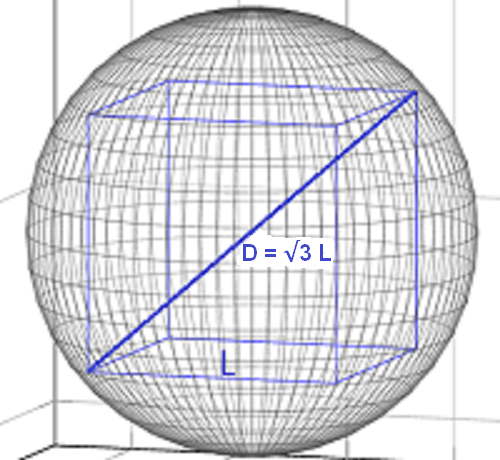
12. The P3 geometry: one wave organisation, three readings
Picture a cube whose three perpendicular edges each measure one background wavelength \(\lambda_0\). Its eight corners lie on the P3 e-sphere. The cube is a measuring construction in the same Space, not a hidden lattice of material cells. Its orientation can be changed without changing the circumsphere.
12.1 From wavelength to radius, volume and surface
A Pythagoras along the three perpendicular half-edges gives the distance from the centre to a corner:
The P3 physical core uses this radius. Its sphere and measuring cube therefore obey
The wavelength cancels from the ratio. \(E_{\rm geo}\) is \(\pi\) expressed in WSM’s wavelength-normalised three-dimensional cube–sphere geometry. The name identifies this construction. It does not introduce a second substance, an energy unit or a definition of number.
Surface, volume and circumference have their own factors. At the P3 radius one also has \(E_{\rm geo}=\pi R/\lambda_0\). For an arbitrary radius the volume ratio remains \(\frac43\pi(R/\lambda_0)^3\); the linear expression applies to the stated P3 figure.
12.2 All-direction plane waves give spherical breathing
Real-wave construction. Take equal-weight longitudinal compression waves from every direction, with common wavelength and frequency, phased to reach maximum compression together at the centre. In the uniform-speed reference construction, directions pair symmetrically and their sum depends only on distance from that centre.
A Here \(r=|\mathbf x|\), \(k_0=2\pi/\lambda_0\), and \(\omega_0=c_0k_0\). The limit at the centre is regular: \(j_0(0)=1\). This is an angular sum of real compression contributions, not a material surface reflecting an incoming wave. The spherical Bessel integral representation supplies the mathematical identity.
The P3 phase-length reading. Express the selected radius in units of background wave phase:
The angular sum gives the spherical pattern; P3 specifies the core radius. The volume ratio and background phase length are two readings of that same construction. Where P2 changes the internal wave speed and wavelength, the accumulated local phase must instead be calculated from the local wave number, for example \(\int_0^R k'(r)\,dr\) in a stationary radial description.
12.3 Standing wave, matter and geometry
P3 Within WSM the e-sphere is the finite core of electron or positron. Its persistent vibration, repeatedly localisable wave centre, and lengths and angles are descriptions of one organisation in one Space. The extended incoming and outgoing wave relation sustains that core; the reference \(j_0\) sum alone does not place an outer edge on all its waves.
This is a foundational geometric relation inside the stated construction. Number, proof and mathematical mind still need the record, comparison and inference conditions developed in §§3–6 and §13.
The Page 7 coupling construction uses the related scale
This identity makes its shared P3 geometry explicit. The physical coupling and its response corrections belong to that page’s additional wave construction.
12.4 Calculate the recurrence at the fixed P3 core
D The dynamical task is concrete: calculate an open, stable recurrence with the P3 core radius, waves passing regularly through the centre, the two radial branches and two spherical \(4\pi\) hands, and a well-defined finite sea-relative energy. State the angular amplitudes, phase relations, background subtraction and boundary conditions before evaluating them.
With the energy density supplied by the chosen Action, a cycle-averaged comparison has the form
The subtraction must compare the recurrence with its specified background and retain the actual cross terms. The core, the extended recurrence and the computational integration domain are distinct. An energy ratio over sphere and cube equals their volume ratio only under the corresponding density conditions; that equality is not required for the geometric identity.
Assess radial, angular and coupled contributions rather than enforcing an even-sector truncation on every state. For a moving egg, rear flattening and front elongation require the asymmetric directional terms as well. A candidate Action that sustains only an incompatible core fails to realise P3; it does not overturn the exact geometry. The Action page owns the complete dynamics.
13. From real wave patterns to exact records
A mark can change microscopically while still recording the same number. A recurring physical organisation can retain its identity while waves continue through it. The mathematical task is to say exactly which differences are being ignored and which relations must survive.
13.1 A record supplies an exact classification
Let \(\mathcal R(x)\) be the record assigned to a detailed physical configuration \(x\). Define
A Equality of the assigned records makes this an equivalence relation. Mere closeness need not do so: with tolerance \(0.1\), the values \(0\) and \(0.06\) are close, as are \(0.06\) and \(0.12\), while \(0\) and \(0.12\) are not. Robust physical storage needs a decoding rule and margins that preserve the intended distinctions.
13.2 When an exact recorded update exists
Real-wave description. Suppose \(T\) is a specified deterministic update of the detailed wave configuration. If two configurations count as the same recorded state, their next recorded states must agree for that description to have an exact deterministic update rule.
A This condition is necessary and sufficient for a function \(F\) on the represented states satisfying
Proof. If \(F\) exists, equal inputs give equal outputs, so the boxed condition follows. Conversely, define \(F(\mathcal R(x))=\mathcal R(Tx)\). The condition ensures that choosing a different configuration with the same record gives the same answer; hence \(F\) is well-defined.
If the condition fails, retain more state or history, or describe the outcomes with an explicit approximation or probability distribution. A statistical description at one level does not by itself decide whether the fuller dynamics is deterministic.
13.3 Causal operation and valid inference
Lawful physics can implement a correct calculation, a mistaken calculation or a damaged record. Causation explains how the operation occurs. Its mathematical correctness requires the selected relations and permitted inference to be preserved. Logic as inference acts on representations; real wave connection is WSM’s physical account of how the representing system can exist and operate.
A formal function is a single-valued mapping. Some functions are realised by physical transformations; formal definition alone does not guarantee physical computability. The representation square in §7 may therefore be exact under the condition above, or approximate with a stated error.
14. Real phase, spherical rotation and spin
14.1 Two quadratures of one real wave cycle
A real wave can be described by its cosine and sine quadratures. They are two phase readings of one oscillation. A compact complex coordinate is
The angle-addition identities give the exact composition law \(C(\alpha)C(\beta)=C(\alpha+\beta)\). The complex notation records real phase relationships and does not add a substance.
14.2 An oriented plane in three dimensions
Let \(B\) represent a unit oriented plane with \(B^2=-1\). The same real quadratures give \(C_B(\theta)=\cos\theta+B\sin\theta\). Its simple angle-addition rule applies to the same plane; general rotations about different axes must be composed in order.
14.3 The half-angle rotor
A A vector rotates through angle \(\theta\) under the double-sided rotor operation
This is the exact double-cover geometry represented by \(SU(2)\to SO(3)\). WSM uses it to describe spherical phase organisation; deriving its interaction and response means calculating that organisation’s actual dynamics.
14.4 Compression, displacement and radial velocity
Within the linearised displacement kinematics of the uniform-speed reference, define compressive strain by \(\chi=-\nabla\cdot\mathbf s\). The regular solution associated with the all-direction sum is
The compression and displacement have the displayed sign relation. Velocity is one quarter-cycle from compression. Integrating the divergence relation also permits a \(C(t)/r^2\) term; regularity at the centre excludes it. These equations describe the same longitudinal vibration, not a current of material pouring through the centre.
In the WSM spherical phase wave, the phase ordering is distributed over the whole sphere. Its rotation is not the bodily spinning of a solid ball about a hidden axle. Keep the radial branch \(q=\pm1\) and spherical rotation hand \(h=\pm1\) distinct: two radial branches multiplied by two hands give four configurations. The Dirac–QED page calculates how those coordinates transform, couple and respond.
14.5 Symmetric deformation and the asymmetric egg
An even \(\ell=2\) contribution describes symmetric stretching or flattening. The moving wave egg has a flattened rear and an elongated front, so the complete description also needs the appropriate asymmetric directional terms. Specify the origin: displacement of the phase-meeting centre and deformation of the surrounding figure are related but distinct.
15. Action: the bridge from relation to prediction
A physical foundation becomes science only when it generates quantitative consequences. Action compresses local dynamics, boundaries and symmetries into one object. For fields \(\phi_a\),
15.1 Nature does not look ahead and choose the cheapest path
The Euler–Lagrange equations follow locally from stationary variation. The apparent teleology of “least action” disappears in the semiclassical path integral
When nearby histories have rapidly changing action, their phases point around the circle and mostly cancel. Near a history satisfying \(\delta S=0\), the first-order phase change vanishes and neighbouring contributions reinforce. The classical history is not selected because a particle knows the destination; it is the coherent survivor of phase composition. “Stationary” is more accurate than “least.”
A This stationary-phase relation is established semiclassical physics. C WSM reads it as a deep clue that action is accumulated real-wave phase. But “the path integral sums every mathematical path” does not by itself prove that literal waves travel down every imaginable configuration-space history.
15.2 The real-wave calculation
The decisive bridge is to begin with local Huygens propagation of the physical Space field, identify a finite recurrent collective coordinate, and derive the effective composition law whose kernel has phase \(S/\hbar\). Then stationary action would emerge from one real wave dynamics rather than being attached as an analogy. Symmetry of that same action must produce the observed conserved currents through Noether’s theorem.
One Law supplies a concrete phase ledger for that bridge. For a stationary or frozen-medium path comparison at the specified frequency, along a real crest path \(\gamma\),
Across all arrival directions, project the accumulated phase onto spherical harmonics,
This makes the picture calculable. The \(\ell=0\) moment changes common closure phase; \(\ell=1\) carries centre displacement and translation; \(\ell=2\) carries the leading symmetric deformation; \(\ell=4\) and higher moments test nonlinear finite-chord reclosure; orientation moments carry the spherical hand. The phase moments are not extra substances. They are compressed ledgers of how one wave sea meets the finite organisation.
15.3 From the field action to a finite matter action
Let the complete solved state be parameterised by collective coordinates \(Q^I(t)=\{\mathbf X,a_{\ell m},U,q,\ldots\}\) for centre, deformation, orientation and phase branch. Insert the regular open ansatz \(Z_*(\mathbf x;Q^I,\dot Q^I)\) into the same frozen Space action and integrate over the physical fields:
The coefficients of \(L_{\rm eff}\) then have no freedom to be named after the desired answer. Its quadratic translation term must yield inertial mass; orientation terms must yield the spin response; phase coupling must yield charge and source–receiver action; small perturbations must produce the observed normal modes. The universal quantum phase \(S_{\rm eff}/\hbar\) must emerge from the recurrent action per cycle, not from declaring every recurrence to equal \(\hbar\).
Use the complete direction-resolved wave state \(Z(\mathbf x,\hat{\mathbf n},t)\) when directional phase and coherence affect the response. A scalar \(\Phi\) or a paired \(\Phi\)–\(\Gamma\) description can remain a useful projection, with its reconstruction map and domain stated. Neither notation introduces a new substance or automatically supplies the complete state.
C The WSM interpretation is that successful mathematical physics describes invariant transformations of a real wave medium. D The decisive task is to write one sufficiently explicit WSM action and derive—without fitted repair factors—the observed particle spectra, coupling constants, Lorentz behaviour, quantum probabilities and novel falsifiable predictions.
Ontology explains what the symbols refer to. Action states how the proposed reality changes. Experiment decides whether the proposal is nature’s.
15.4 Moving recurrence and the Lorentz–de Broglie relation
Two opposed coherent real waves in calm Space represent the axial fundamental of a uniformly translating, single-period recurrence. Put its centre at \(x=vt\), with \(\beta=v/c_0\). Absence of secular phase slip requires
This fixes the frequency ratio. The additional physical closure preserves the geometric-mean rest scale: \(\sqrt{\omega_+\omega_-}=\omega_0\). For positive frequencies the matched pair is then
B The sum factorises exactly:
The modulation has \(K_{\rm dB}=\gamma\beta k_0\) and \(\Omega_{\rm dB}=\gamma\omega_0\). Following the moving centre gives \(\Omega_{\rm dB}-K_{\rm dB}v=\omega_0/\gamma\). This phase-clock rate, the common intrinsic background standard and the fixed-position component frequencies are distinct readings of the wave relation.
The proposed internal \(c_0\pm v\) rates and their common-frequency wavelengths belong to the wave-egg construction. The Fourier pair above travels at \(c_0\) and has unequal fixed-position frequencies. Their physical mapping requires the full directional construction; the two descriptions must not be identified merely by reusing a symbol. The stationary and moving wave-egg essay gives the complete conditional deduction. Identifying the centre phase parameter with every measured clock is a further physical identification.
16 · FROM TREATISE TO WORKBENCH
The birth of WSM mathematical physics
“The variation of the curvature of space is what really happens … [in] the motion of matter.”
William Kingdon Clifford, “On the Space-Theory of Matter,” 1876
A foundation earns its life by generating work. WSM mathematical physics begins where the historical clues converge: Pythagorean ratio, Euclidean and spherical geometry, Descartes’ equation-curve bridge, Leibnizian composition, phase composition, Riemannian metric, Clifford’s moving curvature, action, symmetry and modern formal proof—reinterpreted as the mathematics of real recurrent waves in one Space.
Geoffrey Haselhurst independently developed the modern WSM programme from 1997, extending and correcting the spherical standing-wave matter proposal associated with Milo Wolff. Human physical imagination has supplied its unifying picture. Human–AI collaboration can now submit that picture to an unprecedented mathematical assault.
Build the dictionary
For every symbol, state the proposed physical referent: amplitude, phase, frequency, curvature, centre, boundary, energy density, action and receiver response.
Derive the geometry
Calculate e-sphere modes, moving structure, spherical rotations, topology and form factors; calculate stability and directional response at the fixed P3 core, with a defined background-relative energy.
Write one action
Replace verbal mechanisms with an explicit variational model whose symmetries, dimensions, boundary conditions and currents can be checked; derive its Huygens kernel and stationary-phase limit.
Recover known physics
Derive Lorentz behaviour, de Broglie phase, quantum probabilities, spinor response, electromagnetism, gravity and measured particle spectra as controlled limits.
Formalise the foundation
Encode recurrence, quotient identity, finite cardinality, observer limits, causal agency, transformation and proof in a theorem prover; expose every hidden premise.
Risk the theory
Publish preregistered novel predictions with magnitude, sign, uncertainty and failure criteria. Let experiment—not admiration—decide.
A discovery engine, not a doctrine
Five focused calculations
The physical picture makes specific calculations possible. Each task below has a definite input and a result to check:
| Physical question | Condition to specify | Result to calculate |
|---|---|---|
| “One continuum means local causation.” | Continuity does not imply finite-speed propagation. | A hyperbolic/local action, retarded kernel and measured characteristic speed. |
| “A standing wave means quantisation.” | Recurrence alone need not give the observed discrete spectrum or transitions. | Boundary/eigenvalue conditions, mode spectrum, coupling rules and \(h\). |
| “Finite size removes infinities.” | Extended fields can still have divergent gradients or tails. | A regular central solution and finite background-subtracted action/energy integral. |
| “One medium explains Bell.” | Nonseparability is an intuition, not a probability model. | Explicit CHSH correlations, detector statistics, no-signalling and setting analysis. |
| “Moving waves explain relativity.” | Phase matching and geometric-mean closure give the exact axial factorisation in §15.4. | Calculate the complete directional recurrence and its clock, rod and interaction responses. |
Famous problems can enter this workshop, but not as trophies claimed by metaphor. The Riemann Hypothesis may invite a spectral wave operator; Navier–Stokes may invite a deeper medium model; the foundations of set, type and category may acquire a physical semantics. Each becomes a genuine result only when the standard proof obligation is met. WSM’s advantage is not permission to skip rigor. It is a coherent physical geometry from which better conjectures, operators, invariants and experiments may be generated.
Make every abstraction answer: what relation is preserved?
Make every equation answer: what changes, through what physical connection?
Make every proof answer: can each transition be formally checked?
Make every physical claim answer: what observation could prove it wrong?
Make every freedom claim answer: what stores, imagines, values, selects and learns?
Make every AI suggestion answer: what survived independent criticism and calculation?
This is how a simple metaphysical insight becomes a new science: vibrating Space pictured clearly, written exactly, criticised without mercy, and tested against the world.
Appendix A. Forty-two landmark equations in wave geometry and action language
The equation numbers follow a broad historical/mathematical sequence, while the expandable cards are arranged in thematic groups—so the visible numbering deliberately crosses group order. This is not a claim of single-person invention. Every entry distinguishes established meaning from a WSM reading; the latter is an interpretation or research route unless an exact result is explicitly marked established.
A.1 · Number, geometry and the continuum
01 · Pythagorean relation A
Orthogonal change makes radial distance
Established meaning. In Euclidean geometry the squared norm of two orthogonal components equals the squared length of their resultant.
Wave/action reading. It is the metric beneath circular and spherical phase fronts. In 3D, \(r^2=x^2+y^2+z^2\) measures centre-to-centre displacement and the radius of a spherical organisation.
02 · Euclidean norm A
One distance preserved under rotation
Established meaning. The inner product defines length and angle; orthogonal transformations preserve it.
Wave/action reading. Rotational invariance says no direction is privileged by the background metric. A spherical wave depends on \(r=\lVert\mathbf x\rVert\), while motion or environment may break that symmetry in a state.
03 · Circle constant A
Closure of a phase around a plane
Established meaning. \(\pi\) is the scale-invariant circumference-to-diameter ratio in Euclidean geometry.
Wave/action reading. \(2\pi\) is also one complete phase cycle. Geometry and periodic motion meet because rotation in a plane returns after one full angular period.
04 · Sphere geometry A
Area and volume of radial closure
Established meaning. These are the surface measure and enclosed volume of a Euclidean sphere.
Wave/action reading. The \(r^2\) growth of area explains geometric dilution of conserved radial flux; the \(r^3\) volume is relevant when integrating a distributed spherical mode or energy density.
05 · P3 cube–sphere geometry A
One figure in wavelength units
Established meaning. The volume ratio follows for the sphere circumscribing a cube of side \(\lambda_0\).
Wave reading. P3 assigns this geometry to the finite e-sphere core. The angular wave sum supplies the spherical reference pattern; the recurrence calculation sustains the core. The volume ratio is not automatically an energy ratio.
06 · Quadratic formula A
Two branches from one constraint
Established meaning. It solves \(ax^2+bx+c=0\); the discriminant determines the number and type of roots.
Wave/action reading. Quadratic eigenvalue and closure conditions naturally produce paired branches—often opposite phase, propagation direction or stability character. The physical interpretation depends on the operator and boundary data.
07 · Zeta function and Riemann Hypothesis D
Prime multiplicity encoded by one analytic object
Established meaning. For \(\Re(s)>1\), the Euler product connects integers to primes; analytic continuation extends \(\zeta\), and the nontrivial zeros control fluctuations in prime distribution.
Wave/action reading. Spectral analogies suggest searching for a self-adjoint operator whose eigenvalues are the zero heights. That is a research heuristic. Only a rigorous construction and proof would solve the hypothesis.
A.2 · Classical action, fields and spacetime
22 · Newton’s second law A
Momentum changes under interaction
Established meaning. Net force is the time rate of change of momentum.
Wave/action reading. In a field ontology, force must emerge as transferred momentum and directional reorganisation of extended wave patterns; \(m\mathbf a\) is the effective centre law, not yet the microscopic mechanism.
23 · Inverse-square gravity A
Radial flux spread over spherical area
Established meaning. Newtonian point masses attract with inverse-square dependence in the weak, slow regime.
Wave/action reading. The geometry is consistent with conserved radial influence through \(4\pi r^2\). That geometric fact does not derive the sign, coupling \(G\), equivalence principle or relativistic corrections; WSM must calculate them.
24 · Least/stationary action A
The realised history is stationary under nearby variations
Established meaning. Variation yields the Euler–Lagrange equations \(\frac d{dt}\frac{\partial L}{\partial\dot q}-\frac{\partial L}{\partial q}=0\).
Wave/action reading. Stationary action corresponds semiclassically to stationary phase: neighbouring phase histories cancel, while coherent histories reinforce. “Least” is often less accurate than “stationary.”
Open bridge. WSM must derive the effective kernel \(K=\int\mathcal Dq\,\exp(iS/\hbar)\) from local real-wave/Huygens composition; the mathematical path sum is not by itself a physical ontology.
25 · Noether’s theorem A
Continuous symmetry becomes conserved current
Established meaning. A continuous differentiable symmetry of the action yields a conservation law.
Wave/action reading. Conservation is persistent relational structure under transformation: time translation gives energy, spatial translation momentum, rotation angular momentum and internal phase symmetry charge-like current.
26 · Maxwell’s equations A
Sources, circulation and propagating electromagnetic structure
Established meaning. The equations unify electric and magnetic fields and imply electromagnetic waves with speed \(c=1/\sqrt{\mu_0\varepsilon_0}\) in vacuum.
Wave/action reading. WSM must show how effective \(\mathbf E,\mathbf B,\rho,\mathbf J\) arise from real Space and spherical source/receiver structure while retaining gauge-consistent predictions.
27 · Lorentz–de Broglie factorisation B
Opposed waves reconstruct a moving centre
Established meaning. For positive opposed frequencies the matched pair is unique after its geometric mean is specified; \(\gamma=(1-\beta^2)^{-1/2}\).
Wave reading. Phase matching follows from one-to-one axial recurrence without phase slip. Geometric-mean preservation is the additional closure. The exact wave sum gives the de Broglie modulation and centre phase rate; §15.4 states the scope.
28 · Mass–energy relation A
Rest energy and momentum belong to one invariant
Established meaning. Energy and momentum form a relativistic four-vector; rest mass is its invariant norm.
Wave/action reading. Rest mass is proposed as persistent internal wave/action energy, while momentum is directional phase organisation. A physical model must derive their normalisation and dispersion.
29 · Einstein field equation A
Stress–energy and spacetime curvature
Established meaning. General relativity relates spacetime geometry to stress–energy and successfully predicts gravitational phenomena across tested regimes.
Wave/action reading. WSM interprets effective geometry as the response of matter clocks and wave propagation to Space’s state. Recovering the tensor equation, equivalence principle and radiative tests is a mandatory calculation, not a metaphor.
A.3 · Quantum wave mechanics and matter
30 · Planck–Einstein relation A
Frequency and exchanged energy
Established meaning. Quantum energy exchange is proportional to frequency.
Wave/action reading. \(\hbar\) converts phase rate into energy and action into phase. WSM must derive why stable source–receiver changes occur in these units.
31 · de Broglie relation A
Momentum is spatial phase rate
Established meaning. Matter exhibits wavelength inversely proportional to momentum.
Wave/action reading. Momentum is not an attribute of a structureless point but the directed gradient of phase around a moving matter-wave organisation.
32 · Schrödinger equation A
Unitary evolution of a complex amplitude
Established meaning. It governs nonrelativistic quantum-state evolution and yields highly accurate spectra and interference predictions.
Wave/action reading. WSM seeks a real-wave substrate whose reduced complex quadratures obey this equation. The reduction must also account for entanglement and measurement statistics.
33 · Born rule A
Amplitude becomes outcome probability
Established meaning. Normalised squared amplitude predicts quantum measurement probabilities.
Wave/action reading. Coherent amplitude naturally gives an intensity-like square, but that analogy is not a derivation of single-outcome probabilities. WSM must derive the measure and receiver dynamics without contradicting Bell experiments.
34 · Canonical uncertainty A
Fourier concentration cannot be arbitrarily sharp in both domains
Established meaning. Noncommuting observables and Fourier duality impose a lower bound on joint state spreads.
Wave/action reading. Localisation requires a bandwidth of wavevectors. The relation is structural wave mathematics, not merely disturbance by a clumsy instrument.
35 · Dirac equation A
Relativistic spinor propagation
Established meaning. The equation unites quantum mechanics with special relativity for spin-\(\tfrac12\) matter and entails antimatter and magnetic structure.
Wave/action reading. WSM must obtain the gamma algebra, spinor components, charge coupling and fermionic behaviour as an effective description of the e-sphere—not only reproduce the dispersion relation.
36 · Quaternion/geometric rotor A
Rotation in a selected three-dimensional plane
Established meaning. Unit quaternions, spinors or geometric-algebra rotors encode 3D rotations without Euler-angle singularities.
Wave/action reading. The half-angle and \(4\pi\) return provide the precise target for a globally handed spherical wave structure. Physical identification remains an open derivation.
A.4 · Information, life and foundations
37 · Shannon entropy A
Uncertainty of a distribution
Established meaning. Shannon entropy quantifies expected information or uncertainty for a specified probability distribution.
Wave/action reading. Information is not a floating substance. Probabilities refer to distinguishable alternatives; bits require physically stable states and channels, while semantics requires an interpreter and use.
Finite-observer reading. When more global states are compatible with a record than the record can distinguish, probability can express coarse-grained uncertainty. This does not derive quantum probabilities.
38 · Bayes’ theorem A
Evidence revises a model
Established meaning. Conditional probability relates prior belief, likelihood, evidence and posterior probability.
Wave/action reading. A mathematical mind should update representations when new records arrive. Bayes is a normative relation; the beliefs and records are embodied physical states.
39 · Replicator equation A
Relative success changes population composition
Established meaning. A type grows in frequency when its fitness exceeds the population mean.
Wave/action reading. Repeating organisation becomes evolutionary when it produces descendants with heritable variation. Selection constructs systems whose memories, simulations and choices increasingly track survival-relevant invariants—the natural history of causal agency.
40 · Gödel–Rosser incompleteness schema A
Truth outruns proof in a fixed strong calculus
Established meaning. Under the precise hypotheses, a formal arithmetic theory is incomplete and cannot certify its own formal consistency by only its internal means. Stronger assumptions such as soundness are needed for some informal “true but unprovable” formulations; the theorem is not a licence to label any favoured statement true.
Wave/action reading. Every embodied effective formalism has a boundary. Physical grounding explains how the formalism exists; it does not make the formalism complete.
41 · Turing halting problem A
No universal terminating decider for termination
Established meaning. Computability has rigorous undecidable limits.
Wave/action reading. Physical minds and computers are finite selecting processes, not omniscient theorem oracles. Open-ended reasoning is expected, not a defect repaired by metaphysics.
42 · Foundation proposition B
The conditional result of this treatise
Meaning. Lane I identifies the physical preconditions for explicit finite mathematics. Lane II proposes that recurrent e-spheres and evolved organisations of one vibrating Space realise them. The implication is structural; the specific WSM realisation remains conditional on its action and empirical success.
Research obligation. Formalise the premises in a typed dynamical framework; prove the constructions without changing equality into resemblance or causation into validity; map each primitive to the solved WSM state; distinguish epistemic openness from ontological indeterminism; and identify which stronger axioms—completed infinity, choice and excluded middle—do or do not follow.
A.5 · Change, growth and analysis
08 · Derivative A
Local rate from a limiting comparison
Established meaning. The derivative is the best local linear rate of change where the limit exists.
Wave/action reading. It compares neighbouring states after scale is refined. A physical medium has finite observations; the exact derivative is an ideal invariant that successful continuum models assign to that limiting behaviour.
09 · Fundamental theorem of calculus A
Accumulated local change recovers global difference
Established meaning. Differentiation and integration are inverse operations under appropriate conditions.
Wave/action reading. Local deformations accumulated along a path produce a total change. The theorem is the exact bridge between infinitesimal description and finite measured consequence.
10 · Taylor expansion A
A neighbourhood reconstructed from local response orders
Established meaning. An analytic function is represented locally by all of its derivatives.
Wave/action reading. Linear response is only the first term. Nonlinear harmonics, mode coupling and higher-order susceptibilities are successive response orders; convergence must be established, not assumed.
11 · Exact update of represented states A
When the next record is well-defined
Established meaning. For a specified deterministic update \(T\), the implication is necessary and sufficient for an update on the represented states.
Wave reading. Detailed wave configurations assigned the same record must give the same next record. Otherwise enlarge the recorded state or use a stated approximation or probability model.
12 · Natural logarithm A
Multiplicative history made additive
Established meaning. The logarithm is the inverse of the exponential and converts products into sums.
Wave/action reading. It measures accumulated proportional change. Attenuation, entropy-like counts and scale ratios become additive path quantities.
13 · Phase quadratures A
One cycle, two real components
Established meaning. The angle-addition identities give phase composition in one oriented plane.
Wave reading. Cosine and sine are two quadrature readings of one real recurrence. Three-dimensional orientation uses the rotor geometry in §14.
14 · Lyapunov growth A
Deterministic law with finite predictive horizon
Established meaning. A positive Lyapunov exponent \(\lambda\) characterises exponential separation of nearby trajectories in a chaotic regime.
Wave/action reading. Continuous motion supplies lawful novelty: tiny unresolved differences grow until recurrent prediction loses precision. Determinism does not imply finite omniscience, and an agent’s action becomes one of the conditions shaping the later trajectory.
A.6 · Waves, spectra and spherical modes
15 · Harmonic oscillator A
The elementary recurrence law
Established meaning. Linear restoring acceleration produces sinusoidal recurrence.
Wave/action reading. Frequency, amplitude and phase are the minimal descriptors of a stable cycle; coupled oscillators generate normal modes and collective identity.
16 · Wave equation A
Local curvature drives temporal change
Established meaning. The equation governs ideal linear waves in many media, with propagation speed \(c\).
Wave/action reading. Spatial curvature and ordered acceleration are locally coupled. WSM must derive its nonlinear/state-dependent version and constitutive parameters rather than assume this linear equation as the final ontology.
17 · Plane wave A
Translation represented by phase
Established meaning. Surfaces of equal phase are planes normal to wavevector \(\mathbf k\).
Wave/action reading. Direction, wavelength and frequency form one propagating relation. Superpositions of plane waves build localised and spherical patterns.
18 · Standing wave A
Persistent form made entirely from motion
Established meaning. Oppositely directed equal-frequency components form fixed nodes and antinodes.
Wave/action reading. This is the simplest mathematical reconciliation of change and stability. WSM’s spherical flow-through picture requires radial boundary and phase relations, not literal reflection from a material wall.
19 · Spherical wave A
Radial propagation and geometric dilution
Established meaning. Far from an ideal point-like source in three dimensions, amplitude scales as \(1/r\) so flux through area \(4\pi r^2\) can remain conserved.
Wave/action reading. In- and out-wave carriers are continuous radial solutions; a physical e-sphere must regularise the centre and specify finite distributed structure.
20 · Helmholtz equation A
Geometry of a fixed-frequency mode
Established meaning. Separating harmonic time dependence from the wave equation produces a spatial eigenvalue problem.
Wave/action reading. Boundary, topology and medium select allowable spatial patterns. Discrete modes arise from closure conditions, not from a numeral pasted onto a particle.
21 · Fourier transform A
One pattern, two complementary descriptions
Established meaning. A spatial pattern is decomposed into wavevector components; inverse transformation reconstructs it.
Wave/action reading. Position and momentum-space calculi are transforms of one wave organisation. A Fourier component is not automatically a separate little object.
Appendix B. Page 10 — Predictions and experimental comparison
Corpus Page 10 owns the experimental programme. This page supplies the physical meanings, geometry and representation conditions used to formulate those tests.
| Observed relation | Current wave account to follow |
|---|---|
| Discrete light–matter response | Finite recurrence and transitions between bound configurations. Resonant frequency selection alone does not fix allowed amplitudes or the energy exchanged. See Page 5 and Page 7. |
| Moving clocks, rods and phase | Opposed-wave phase matching and geometric-mean closure, followed by the full wave-egg response. See §15.4 and Page 6. |
| Redshift with distance | Unstretched carrying waves, evolving curves and the receiver’s complete response history. Reduced overlap alone is not a frequency-shift calculation. See Page 9 and Page 10. |
The earlier expression \(c\,dt=t\,dc\) is not a general identity: for constant nonzero \(c\), \(dc=0\) while \(c\,dt\) can be nonzero. It is replaced by the explicit wave calculation, not used as a relativity argument.
References and audit trail
- Aristotle, Metaphysics, Book I, on first causes, number, the Pythagoreans and musical ratio.
- Aristotle, Physics, Book IV, on motion, before/after and time as number.
- Heraclitus, Fragment 30, on an uncreated world-order of measured, ever-living change.
- René Descartes, Discourse on Method (1637), on the cogito and the search for secure foundations.
- Isaac Newton, letter to Richard Bentley (1693), distinguishing the mathematical law of gravity from its unknown mediating cause.
- Gottfried Wilhelm Leibniz, letter to Christian Goldbach (1712), on music and unconscious arithmetic.
- Bernhard Riemann, On the Hypotheses Which Lie at the Bases of Geometry (1854; Clifford translation), on counting, measurement, curvature and physical geometry.
- William Kingdon Clifford, “On the Space-Theory of Matter” (1876), on propagating curvature and motion.
- Bertrand Russell, “The Study of Mathematics” in Mysticism and Logic (1917).
- David Hilbert, 1930 Königsberg radio address.
- L. E. J. Brouwer, remarks on mathematical activity and mind.
- Albert Einstein, Ether and the Theory of Relativity (Leiden lecture, 1920), on Space endowed with physical qualities.
- Albert Einstein, Geometry and Experience (1921).
- Eugene P. Wigner, “The Unreasonable Effectiveness of Mathematics in the Natural Sciences” (1960).
- Kurt Gödel, “On Formally Undecidable Propositions of Principia Mathematica and Related Systems I” (1931, parallel text/translation).
- Alan Turing, “On Computable Numbers, with an Application to the Entscheidungsproblem” (1936–1937).
- Claude E. Shannon, “A Mathematical Theory of Communication” (1948).
- Richard P. Feynman, “Space-Time Approach to Non-Relativistic Quantum Mechanics” (1948), on the action phase and path-integral kernel.
- WSM corpus: Descartes, Cogito and Monism: The Thinking Wave; Action of Vibrating Space: From Background Waves to the E-Sphere; Mathematical Physics: From Wave Geometry to Prediction; and Wave Structure of Matter: All Things from One Thing.
Editorial and scientific audit notes
- The page treats WSM as a candidate scientific ontology and labels its interpretations and open predictions.
- “Mathematics before mind” is used only as shorthand for physically instantiated, mind-independent invariant structure; explicit notation, proof and knowledge require a mind.
- Physical infinity, indefinitely extendable processes and completed set-theoretic infinity are kept distinct. Infinite Space is a WSM premise, not a proof of every infinity axiom.
- Limited causal freedom means memory-guided counterfactual generation, endogenous selection and policy update within causal law; it does not mean randomness or an uncaused intervention.
- \(E_{\rm geo}\) is exact under the stated circumsphere/cube normalisation. Its name and physical importance are proposals.
- \(E_{\rm geo}\) names the exact P3 cube–sphere geometry. Calculate the open recurrence at that fixed core with a defined sea-relative energy; do not equate a volume ratio with an energy ratio without the required density relation.
- The geometric-algebra/quaternion rotor is established mathematics. Its identification with a real e-sphere is an open physical claim.
- Continuity alone does not imply finite-speed locality, recurrence alone does not derive quantisation, finite size alone does not guarantee finite self-energy, and one medium alone does not reproduce Bell statistics.
- No famous unsolved theorem is claimed solved without the proof demanded by its standard formulation.
- Every future empirical claim should separate raw observable, calibration, statistical inference and theoretical interpretation.
We began with a childlike question: what in physical reality makes mathematics possible?
The proposed answer did not require a heaven of numbers, a universe made from symbols, or a mind detached from matter. It required one infinite connected Space; one law turning directional energy into speed, travel time, phase and reclosure; motion that can recur; recurrence that can preserve a form; finite forms that can be paired and counted; explicit equivalence that extracts exact relation; memory that gives proof an ordered physical life; and one reality capable of forming minds.
Mathematics is not a second reality commanding nature. It is connected reality’s invariant structure made explicit by minds that nature itself has formed.
And those minds are not passive mirrors. They remember what was, rearrange it into what might be, choose an equation, follow its necessities, risk a prediction and let the world answer. From a vibrating string to an octave. From a turning radius to \(\pi\). From recorded change to a repeatable operation. From phase to spherical rotation. From a spherical wave to geometry, action and matter. From one possible future to one realised experiment. The symbols differ. The relation survives.
Infinite Space gives no finite mind the whole. That limitation is not defeat. It is the condition for curiosity, imagination, correction and the endless growth of knowledge.
So simple that it was everywhere.Vibrating Space. No one saw the whole.
Infinite Space gives connection without closure. Motion gives succession. Standing-wave recurrence gives identity. Finite organisation gives number. Preserved relation gives equality. Counted recurrence gives time. Stable transformation gives logic. Replication gives life. Memory gives possible futures. Selection gives limited causal freedom. Evolution gives mathematical mind. Experiment gives knowledge.
Geoffrey Haselhurst, in Human–AI philosophical and scientific collaboration. Working edition, 9 September 2026.
Mathematical reading brief
Read the physical wave description before its mathematical representation. Preserve Geoffrey Haselhurst's quotations and comments; label new AI contributions.
Lane I concerns records, comparison, operations and valid inference. Lane II gives their WSM realisation. Neither lane silently proves the other's premises.
P3 fixes R = sqrt(3)*lambda0/2. Egeo = Vs/Vc = pi*sqrt(3)/2 and k0*R = 2*Egeo are exact readings of that construction. The uniform-speed equal-phase angular sum gives j0; P3 supplies the selected core scale. Calculate the stable open recurrence at that fixed core. Do not turn the radius into a fitted parameter.
A volume ratio is not automatically an energy ratio. Use the derived background-relative energy and its full directional contributions. The finite core is distinct from the extended wave relation and the computational boundary.
For a deterministic T, an exact update on records exists iff equal records give equal records after T. Formal functions and truth-preserving inference must not be confused with any arbitrary physical transformation.
Phase matching fixes the opposed-frequency ratio. Geometric-mean preservation is the separate closure giving the exact axial Lorentz–de Broglie factorisation. Distinguish internal variable-speed wavelengths from calm-Space Fourier wavelengths, and intrinsic phase standard from moving-centre phase rate.
P = fixed postulate; A = exact mathematics or measured relation; B = deduction with declared premises; C = real-wave construction; D = specified calculation; Q = excluded error or circular route. Keep exact results exact. State particular extra premises where used rather than repeating a blanket warning.
Glossary: Real Space, Real Waves
Open the complete shared WSM glossary
Space and longitudinal waves
| Term | Meaning in WSM |
|---|---|
| Space | P1’s one nearly rigid, slightly elastic wave medium. Its primitive motion is longitudinal plane-wave vibration. Infinite, eternal and continuous follow immediately from its being the one substance; they are deductions, not added postulates. |
| Region of Space | A local part of continuous Space identified for description. It remains joined to its neighbouring regions and never becomes a separate object or parcel that flows through Space. |
| Solid continuity | Enduring neighbourhood relations within Space. “Solid” names continuous connection and nonflowing adjacency, not an atomistic material solid made from e-spheres. |
| Vibration of Space | The bounded back-and-forth displacement, compression and extension of neighbouring regions of Space. |
| Longitudinal compression plane wave | A flat equal-phase compression–extension disturbance travelling through Space. At every point, Space vibrates backwards and forwards in the same direction that the wave travels. |
| Compression | The part of a longitudinal vibration in which neighbouring regions of Space move slightly closer together. |
| Extension or stretching | The opposite part of the vibration, in which neighbouring regions move slightly farther apart than their balanced positions. |
| Plane wave | A longitudinal wave whose equal-phase positions form planes. Each plane advances in the wave’s direction while Space vibrates backwards and forwards in that same direction. |
| Plane of equal phase | The complete plane whose regions are at the same place in the vibration cycle. The wave travels at right angles to this plane. |
| Wavefront | A surface on which a wave has the same phase. A background wavefront can be flat, while an e-sphere can write a half-sphere curve into the passing plane. |
| Amplitude | The size of the displacement, compression or extension of Space during a vibration. |
| Phase | A wave’s place within its repeating compression–extension cycle. |
| Frequency \(f\) | The number of complete vibrations per unit time; angular frequency is \(\omega=2\pi f\). |
| Wavelength \(\lambda\) | The simultaneous spacing between successive equal-phase crests. With speed and frequency measured in the same coordinates, \(\lambda'=c'/f_{\rm crest}\). The distance \(\ell=c' T_0\) travelled during the rest-reference interval \(T_0=1/f_0\) is that wavelength only when \(f_{\rm crest}=f_0\). |
| Directional wave-energy density \(E_d(\hat{\mathbf n})\) | The local wave energy associated with longitudinal waves travelling in direction \(\hat{\mathbf n}\). It is not a material-fluid density. |
| \(E_{d0}\), \(c_0\) | The reference directional energy density and wave speed of the balanced background. |
| \(c'(\hat{\mathbf n})\) | The local propagation speed of longitudinal waves travelling in direction \(\hat{\mathbf n}\). |
| The One Law | P2 gives \(c'/c_0=E_d/E_{d0}\): changed directional wave-energy density changes propagation speed. A wavelength follows as \(\lambda'=c'/f_{\rm crest}\) when speed and crest frequency use the same coordinates. The universal intrinsic frequency supplies the reference scale; its mapping to a moving component’s crest frequency must be specified. |
| Directional moments | \(U=\int E_d d\Omega\), \(\mathbf J=\int\hat{\mathbf n}E_d d\Omega\), and \(\Pi_{ij}=\int\hat n_i\hat n_jE_d d\Omega\) summarize the all-direction distribution. They are readings of \(E_d\), not extra factors in the One Law. |
| Background wave sea | The generally disordered longitudinal plane waves travelling through Space in every direction. “Sea” names their abundance, not fluid flow. |
| Wave overlap | Several longitudinal waves occupying the same region of Space. Their displacements, compressions, extensions and phases jointly determine that region’s vibration. |
| Sideways propagation | A longitudinal wave travelling sideways relative to a chosen reference axis. Space still vibrates in that wave’s own direction of travel; sideways travel is not transverse vibration. |
The e-sphere and matter
| Term | Meaning in WSM |
|---|---|
| Huygens sphere | The spherical all-direction wave relation through which the out-waves of other matter combine as the chosen e-sphere’s in-waves. Every e-sphere stands at the centre of its own finite observable relation. The spheres overlap; matter and organised structure continue beyond each one. The boundary is neither a material shell nor an edge of matter or Space. |
| e-sphere | The finite, wavelength-scale central wave-centre core of an electron or positron. It circumscribes a cube of side \(\lambda_0\), so \(R=\sqrt3\lambda_0/2\). Huygens-combined longitudinal plane waves cross this core and continue outward; the complete spherical standing-wave relation extends beyond it, and no shell reflects the waves. |
| Open recurrence | A stable organisation continually rebuilt by through-passing waves. No material shell reflects or traps them. |
| Wave centre | The repeatedly reconstructed centre where the all-direction waves cross and form the central spherical compression and extension. |
| Spherical reclosure | The return of the complete all-direction phase relation to the same e-sphere organisation. As the incoming waves cross it, the e-sphere’s own directional \(E_d\) changes their \(c'\), wavelength, curve and phase so the spherical vibration continually reconstructs. |
| Normalized cube–sphere geometry | The e-sphere circumscribes a cube of side \(\lambda_0=1\), giving \(R=\sqrt3/2\) and \(V=\pi\sqrt3/2\). The absolute dimensional scale is an output. |
| \(j_0\) compression pattern | The spherical compression–extension distribution \(j_0(kr)=\sin(kr)/(kr)\) formed by the equal-phase sum of waves from every direction. |
| \(j_1\) radial-motion pattern | The radial motion of Space one quarter-cycle from the \(j_0\) compression maximum. It is the motion phase of the same spherical vibration. |
| Real quadratures | The compression pattern and radial-motion pattern separated by one quarter-cycle. They are successive aspects of one vibration, not extra electron states. |
| Radial phase | The background-relative timing of the e-sphere’s compression and extension. |
| Electron \(e^-\) | One background-relative radial phase of the stable e-sphere recurrence. |
| Positron \(e^+\) | The opposite radial phase: when the electron pattern compresses, the positron pattern stretches. |
| Antimatter | The opposite background-relative radial phase of the same kind of e-sphere, not another substance. In the WSM proton recurrence \((++-)_{\mu}\), positron-phase roles are bound inside ordinary matter rather than appearing as free positrons. |
| Charge sign | The opposite forward/rear curve orientation written onto passing plane waves by the electron and positron’s opposite background-relative radial phases: constructive same-phase and opposite-phase interference change \(E_d\), \(c'\), wavelength and phase in opposite ways while the plane crosses the e-sphere. |
| Universal cosmic clock | WSM requires electron and positron to remain opposite radial-phase organisations relative to the common background wave sea, including under motion. Each e-sphere’s changes to its incoming plane waves must maintain this cosmic phase relation. The universal intrinsic frequency standard, fixed-position Fourier frequencies and phase rate along a moving centre are distinct readings; their physical connection must preserve this requirement. |
| Stationary e-sphere | A spherical e-sphere with the same \(E_d\), \(c'\), wavelength and frequency in every direction. Its equal all-direction timing repeatedly rebuilds one centre. |
| Free e-sphere | A stable e-sphere not changing between bound modes. Uniform free motion does not itself write a discrete light train. |
| Bound standing-wave organisation | Two or more e-spheres held in a phase-related recurrent pattern with a discrete set of stable modes. |
| WSM proton phase structure | The proposed inseparable muonic-scale three-lobed recurrence \((++-)_\mu\). Its two positive and one negative radial-phase roles supply the proton’s charge bookkeeping; the collective conserved current determines the physical charge. These roles are not independently stored free muons. |
| Neutral-hydrogen phase inventory | Within the proposed proton construction, \((++-)_\mu+(-)_e=++--\) gives two positive and two negative radial-phase roles in neutral hydrogen. Extending that count to nuclei requires the neutron’s collective phase structure; internal roles are not a count of free antimatter particles. |
Curves, charge, force, inertia and gravity
| Term | Meaning in WSM |
|---|---|
| Curve on a plane wave | A half-sphere displacement and phase profile written by an e-sphere onto a passing longitudinal plane wave. Two physical stages must be kept distinct. While the plane crosses the e-sphere, its interference with the radial standing wave changes directional \(E_d\), \(c'\), wavelength and phase according to the radial-phase relation. After the curved portion leaves the e-sphere, it spreads over greater area; its ordered wave energy is then diluted, so its \(E_d\) and \(c'\) fall below those of the flatter carrying plane wave and it widens, flattens and lags. |
| Chord-effective \(2c_0\) | If a straight ray must cross the full chord \(2x_b\) before the outside carrier reaches the sphere’s centre plane, its transit time must be \(x_b/c_0\): \(\int_{\rm chord}ds/c'=x_b/c_0\). The harmonic chord-average speed is then \(2c_0\). This is the timing condition for the hemispherical exit-front construction, not every local speed and not H-M1’s effective reconstruction rate. |
| Forward and rear curves | When a plane wave crosses an e-sphere in the same radial phase, constructive wave interference raises directional \(E_d\) and \(c'\) while crossing and writes the forward curve. Crossing an e-sphere in the opposite radial phase gives the opposite interference change and writes the oppositely oriented rear curve. These are the two charge-like curve orientations. After either curved portion has left its e-sphere, both spread over greater area, both have lower \(E_d\) and lower \(c'\) than the flatter carrying plane wave, and both widen, flatten and lag. These curve orientations are not the same distinction as the leading and rear spatial sectors of a moving wave egg. |
| Charge | The opposite radial phase of electron and positron expressed in the opposite curves they write onto the real plane waves connecting e-spheres. |
| Charge interaction | A curve arriving on a plane wave changes the directional reconstruction of another e-sphere. The curve’s orientation and the receiver’s radial phase determine whether the centres reconstruct toward one another or apart. |
| Force | The change in an e-sphere’s motion caused when an incoming curve reshapes its all-direction standing wave. The arriving side is flattened, the opposite departing side is elongated, and the centre next reconstructs toward the elongated end. |
| Mass | The energy and recurrent wave organisation whose complete three-dimensional shape must be changed to change an e-sphere’s motion. |
| Inertia | The persistence of the existing e-sphere shape and its resistance to being reshaped. A stationary sphere remains spherical; a uniformly moving wave egg continually rewrites and rebuilds its asymmetry. Acceleration requires incoming curves to change that whole shape, giving the physical content represented by \(F=ma\). |
| Coulomb curve \(\zeta(R)\) | The shallow longitudinal displacement curve whose radial slope changes an e-sphere’s reconstruction. The declared small-slope response ansatz identifies that slope with the per-cycle velocity change, \(|d\zeta/dR|=\Delta v/c_0=2\pi\alpha\bar\lambda_e^2/R^2\), giving \(|\zeta(R)|=2\pi\alpha\bar\lambda_e^2/R\). WSM Action must derive this response relation. |
| Gravity | The common phase-even delay remaining when neutral matter’s opposite charge-like curve effects cancel. In the curve-spreading model, fixed wave-layer energy and thickness give lower \(E_d\) over greater area, hence lower \(c'\) by P2; both curve orientations can then lag. A delayed source-side front meets the opposing front closer to the source, biasing repeated e-sphere reconstruction toward it. This establishes the stated geometry of attraction; its magnitude, universality and conservation follow from the complete wave response. A stationary e-sphere does not continuously donate energy merely by writing a curve. |
Motion, spin and Dirac structure
| Term | Meaning in WSM |
|---|---|
| Motion of an e-sphere | Repeated reconstruction of its wave centre at successive positions after the all-direction geometry becomes asymmetric. |
| Moving wave egg | The complete three-dimensional deformation of a moving e-sphere: an elongated lower-\(E_d\) front and flattened higher-\(E_d\) rear joined by one continuous phase envelope. Axial reconstruction fixes \(c_0\pm v\); the all-direction \(\hat{\mathbf n}\!\cdot\!\mathbf v\) projection gives the leading interpolation. The full side-sector \(E_d\), \(c'\), wavelength and \(O(\beta^2)\) shape are quantitative outputs of WSM Action. |
| Leading sector | The elongated front of the wave egg: lower representative \(E_d\) and \(c'\), and a shorter crest travel distance in a fixed reference interval. Its internal wavelength is shorter when the same-coordinate crest frequency is held fixed. |
| Rear sector | The flattened rear of the wave egg: higher representative \(E_d\) and \(c'\), and a longer crest travel distance in a fixed reference interval. Its internal wavelength is longer when the same-coordinate crest frequency is held fixed. |
| Orthogonal and oblique directions | The first-order continuation is \(c'(\hat{\mathbf n})/c_0=1+\hat{\mathbf n}\cdot\mathbf v/c_0+O(\beta^2)\). Orthogonal directions have no first-order change. Neither their second-order speed nor the transverse radius is fixed by this approximation. Wavelength also requires the corresponding crest frequency. |
| Common intrinsic recurrence | Every direction forming one stationary or moving e-sphere participates in one resonantly locked intrinsic recurrence, maintaining its radial-phase relation to the background wave sea. This does not assign the same fixed-position frequency to every Fourier component. The reciprocal axial model’s common encountered phase rate is \(\omega_0/\gamma\); identifying that modulation with the globally locked radial phase is a separate physical question. |
| Axial reconstruction pair \(c_0\pm v\) | H-M1 assigns effective inward reconstruction rates \(c'_r=c_0+v\), \(c'_f=c_0-v\). During the same chosen interval \(T\), opposed fronts cover \((c_0+v)T\) and \((c_0-v)T\); their signed mean velocity is \(v\), and their closing rate is \(2c_0\). This specifies an axial timing rule, not the entire local speed profile or a clock period. |
| Raw egg factors \(1\pm\beta\) | The axial speed and representative density ratios \(1\pm\beta\) in H-M1 and P2. They also give reference-interval travel distances \(\ell_{r,f}=\lambda_0(1\pm\beta)\). They give internal wavelength ratios if the corresponding crest frequency is held fixed in the same coordinates; they are not the wavelengths of the calm-Space Fourier pair. |
| Reciprocal Doppler factors \(e^{\pm s}\) | For a stable one-to-one opposed-wave recurrence, phase matching fixes the frequency ratio. The additional geometric-mean closure \(\sqrt{\omega_+\omega_-}=\omega_0\) fixes \(D_\pm=\omega_\pm/\omega_0=\gamma(1\pm\beta)=e^{\pm s}\). The two real Fourier waves propagate at \(c_0\), with \(\lambda_\pm=\lambda_0/D_\pm\); these factors do not replace the internal reconstruction rates \(c_0\pm v\). |
| De Broglie phase wave | The phase modulation of the reciprocal opposed real-wave pair, with \(\Omega=\gamma\omega_0\), \(K=\gamma\beta k_0\) and \(\lambda_{\rm dB}=2\pi/K\). Its unequal fixed-position component frequencies arrive phase-matched at the moving centre, where \(\Omega-Kv=\omega_0/\gamma\). The beat is a relation between the real waves, not another substance. |
| Lorentz factor \(\gamma\) | The exact factor \(\gamma=(1-\beta^2)^{-1/2}\) obtained from the phase-matching ratio together with geometric-mean frequency preservation. The separate cap-area model gives \(S/S_0=\gamma^2\) from the same \(1\pm\beta\) kernel; this is not an independent derivation of the frequency closure. |
| Electron Compton cycle | The rest-reference wavelength and period \(\lambda_e=h/(m_ec_0)\), \(T_e=\lambda_e/c_0=h/(m_ec_0^2)\), using the measured rest calibration. The reciprocal free-motion modulation completes one centre-phase cycle in \(\gamma T_e\) of background time. |
| Fine-structure displacement | For the ideal Bohr ground-state relation \(v=\alpha c_0\), the centre advances \(\Delta X_{\rm ref}=vT_e=\alpha\lambda_e\) in one rest-reference interval. Hence \(\alpha=\Delta X_{\rm ref}/\lambda_e\). This interval is not automatically a complete moving-centre or bound-state phase period. |
| Spherical phase wave | The real moving equal-phase relation made by the ordered intersections of longitudinal waves arriving from different directions. Its two hands and \(4\pi\) closure give WSM’s physical meaning for spin; WSM Action must complete the stable quantitative dynamics. |
| Superluminal phase speed | The speed of successive equal-phase positions. Different intersecting waves create those positions; no region of Space or energy is carried at that phase speed. |
| Spherical phase rotation | Rotation of the phase relation over the complete sphere, not circular bodily rotation around an axis. |
| Spin hand \(h=\pm1\) | The two opposite directions of spherical phase rotation. These become the two spin channels relative to an analyser. |
| \(4\pi\) recurrence | Two \(2\pi\) turns are required before the complete directional phase relation returns to its original background-relative condition. |
| Four Dirac states | \((e^-,+1),(e^-,-1),(e^+,+1),(e^+,-1)\): two radial phases multiplied by two spherical rotations. |
| Dirac spinor | The four-component mathematical representation of those four complete real-wave sectors. Its entries are state coordinates, not four pieces of an electron. |
| Dirac equation | The relativistic first-order equation that couples the four Dirac sectors. Its real-wave foundation is the coupling of two opposite radial phases with two opposite spherical \(4\pi\) rotations as an e-sphere moves and interacts. |
| Pauli and Dirac matrices | The mathematical rules for how changes of direction, motion and interaction mix the two spherical rotation hands and the two radial phases while preserving the spinor’s \(4\pi\) structure and relativistic factorisation. |
| Complex \(i\) | Notation for a real quarter-cycle phase relation, such as compression and radial motion. It is not an imaginary substance and does not add physical states. |
Light and quantum interaction
| Term | Meaning in WSM |
|---|---|
| Stable mode | A bound standing-wave arrangement that repeatedly reconstructs the same complete phase relation. |
| Half-sphere curve | The curved displacement and phase profile an e-sphere imprints on a background plane wave as that plane passes through it. |
| Bound transition | The continuous reconstruction of a bound organisation from one stable standing-wave mode into another. |
| Source-written curve train | The finite ordered succession of changed half-sphere curves written onto successive passing plane waves during a bound transition. |
| Photon | A finite source-written curve train carried by real longitudinal background waves and capable of resonantly rebuilding a receiver into a new stable mode. |
| Quantum | The wave action associated with one allowed change between stable bound modes. The stable source and receiver modes make exchange discrete. |
| Resonance | Frequency and phase compatibility between a source-written curve train and an allowed standing-wave mode of a receiver. |
| Absorption | Successive incoming curves progressively reshape a receiver until it settles into a new stable standing-wave mode. |
| Receiver reclosure | The physical re-formation of a receiver as one stable mode after the incoming train has crossed the nonlinear threshold. |
| Measurement | A wave interaction in which apparatus geometry defines possible stable receiver modes and one mode becomes a persistent physical record. |
| Huygens ring | The circle of wave directions perpendicular to a light train’s direction. Its collective phase ordering carries two photon hands; it is distinct from the e-sphere’s Huygens sphere. |
| Photon helicity | The two opposite phase orders around the Huygens ring. Every contributing Space wave remains longitudinal. |
| Wave action \(J\) | The action associated with a complete wave recurrence. On the harmonic or linear-action branch, \(J=E/\omega\) measures ordered wave content. For a general periodic family, canonical cycle action obeys \(\omega=\partial E/\partial J\); the stronger \(E=J\omega\) relation requires the stated branch condition. |
| \(\hbar\) | The universal wave-action scale associated with one complete elementary mode change, giving \(E=\hbar\omega\). |
| Born probability | The normalized receiver-channel weight \(P_j=J_j/\sum_kJ_k=|\psi_j|^2\), once the action metric and receiver dynamics supply \(J_j\propto|\psi_j|^2\). |
| Pauli exclusion | Two identical electron patterns cannot both reclose as the same complete bound mode because their joint all-direction phases cannot reproduce that one recurrence twice. |
| Entanglement | A pair-specific phase and curve relation written by one source across two outgoing wave organisations and resolved through one joint receiver-channel calculation. |
| Bell nonfactorisability | The joint probabilities cannot be made from two independent lists of local prewritten answers; they belong to the complete source-created relation. |
| Annihilation | Destructive interference of opposite-phase electron and positron e-spheres. Their repeated curve patterns disappear; the changing cancellation writes outgoing gamma-ray curve trains. |
| Pair creation | The reciprocal formation of two stable e-spheres locked into opposite background-relative radial phases. |
| WSM Action | The one-substance dynamical equation named in the opening status statement. It must produce stable e-spheres and their quantitative quantum, relativistic, gravitational and cosmological behaviour. |
Relativity, clocks and measurement
| Term | Meaning in WSM |
|---|---|
| Physical wave speed \(c'\) | The actual local and directional speed at which a longitudinal compression plane wave travels through Space. The One Law changes \(c'\) when \(E_d\) changes. |
| Constant measured \(c\) | Every signal, ruler and clock is made from the same waves and e-spheres. When \(E_d\) changes \(c'\), it also changes local wavelength, wave-egg geometry, bound rulers and phase-clock comparisons. Since \(\lambda'=c'/f_e\), these linked changes make observers locally measure the same value \(c\), while the physical variations of \(c'\) produce interactions. |
| Spacetime | The measured geometry of a moving plane wave. Space supplies physical extension; the plane wave’s advancing phase supplies the ordered change measured as time. Spacetime coordinates describe this real wave motion rather than forming another substance. |
| Time | A measure of ordered wave change. Physical clocks compare the repeating phase of e-spheres and bound standing-wave organisations. |
| Proper time | The phase count accumulated by the e-spheres forming a particular clock along its motion through Space. |
| Lorentz transformation | The reciprocal axial wave sum has the phase-coordinate form \(x'=\gamma(x-vt)\), \(t'=\gamma(t-vx/c_0^2)\). Connecting these exact phase relations to all measured bound rulers and clocks is the corresponding physical construction. Space remains the vibrating medium; the coordinates describe its wave relations. |
| Matter-energy curves spacetime | Matter’s e-spheres write real curves onto passing plane waves. Those curves change directional \(E_d\), hence \(c'\), wavelength, phase, clock rates, reconstructed centres and light paths. The geometrical statement that matter-energy curves spacetime describes these physical changes of the moving plane waves. |
Cosmology
| Term | Meaning in WSM |
|---|---|
| Infinite eternal Space | The immediate deduction from P1: as the one substance, Space cannot be bounded, created or interrupted by another substance. Matter and all wave motion exist within it. |
| Unbounded matter network | Matter and organised structure continue beyond every finite Huygens sphere. If matter ended, boundary e-spheres would lose equal all-direction support and an isolated finite domain would collapse. Local structures are finite; the connected matter network has no edge. |
| Observable Huygens sphere | The finite, observer-centred domain whose ordered waves can participate in one e-sphere’s present physical record. Every e-sphere is the centre of its own sphere; the spheres overlap, and their boundary is neither an edge of Space nor an edge of matter. The exact profile and radius are WSM Action outputs. |
| Mach–Huygens principle | Each e-sphere’s local recurrence and inertia are physically sustained by Huygens-combined in-waves supplied by surrounding matter. Overlapping spheres connect the local domain to external matter, so local physics contains the action of the wider matter distribution. |
| External Huygens support | The reciprocal waves supplied by matter beyond any one observable Huygens sphere. They sustain its e-spheres and make the domain physically connected to the wider matter network. WSM identifies this support as the candidate source of the large-scale non-collapsing response called dark energy; that bulk response is distinct from the all-direction support requirement. |
| Common Huygens overlap | The part of the source’s and receiver’s effective Huygens support shared by both. Its decrease with separation joins curve decay to the smaller completed receiver transformation and therefore contributes directly to WSM redshift. |
| Source curve train | The finite ordered sequence of changed displacement, phase, curvature and conjugate motion written onto successive longitudinal plane waves by a bound transition. |
| Carrier, modulation and event envelope | Three time scales in one physical history: the fundamental plane-wave recurrence, the transition’s changing pattern and the macroscopic luminosity record. A cosmological redshift law must map all relevant scales consistently. |
| Redshift factor \(K(D)\) | The common source-to-receiver factor required by \(K=1/(1+z)\). WSM’s proposed mechanism combines source-written curve spreading, diminishing Huygens overlap and smaller-gap receiver reclosure. It must produce the same factor for spectral periods and complete event histories while the travelling background planes retain their spacing. |
| Statistical stationarity | The cosmological working assumption that, after environment and observational selection are accounted for, the distribution of developmental stages repeats statistically across sampled times and transfer depths. Eternal Space has no universal creation time; eternity alone does not require an unchanging population distribution. |
| High-redshift structure | With statistical stationarity and redshift interpreted as transfer depth, mature galaxies, heavy elements and massive black holes continue to occur at large redshift without a cosmic-age ceiling. The qualitative consequence follows under these premises; the selected population distribution is the quantitative test. |
| Luminosity distance \(D_L\) | The distance inferred from received flux after source luminosity, energy transfer, arrival-rate transfer and geometric spreading are specified. Its WSM relation is an output of the complete transport calculation. |
| Angular-diameter distance \(D_A\) | The relation between a source’s physical transverse size and its observed angle. Raw Euclidean propagation and reciprocity-weighted propagation are distinct candidate branches until the wave-bundle action selects one. |
| Distance reciprocity | The observed relation among source area, receiver area, frequency, arrival rate and solid angle. Naming reciprocity does not derive it; the WSM transverse phase-space map must reproduce it or predict a measured alternative. |
| CMB equilibrium state | The proposed microwave statistical equilibrium organisation of the same Vibrating Space, distinct from the matter-sustaining background carrier. Its Planck spectrum, absolute temperature and distortions must be derived through resonant exchange with matter. |
| \(T(z)\) | The temperature sampled locally by matter at the source relation corresponding to observed redshift \(z\). Redshifting the spectrum received here does not by itself derive the temperature experienced there. |
| Visibility kernel | The distance-, direction- and frequency-dependent weighting that determines which source-written structures survive coherently into the received sky. One kernel must connect CMB anisotropy, polarisation, damping, lensing and BAO rather than fitting each independently. |
| Expansion of Space | An interpretation assigned to redshift and distance relations in FLRW cosmology, not an observed local motion and not a physical process in WSM. WSM describes the observations through real waves propagating and being reconstructed in non-expanding Space. |
Reality, causality and knowledge
| Term | Meaning in WSM |
|---|---|
| Causal connection | A continuous physical wave relation in which a changed curve or \(E_d\) changes \(c'\), wavelength, arrival phase and the later reconstruction of another e-sphere. |
| Necessary connection | The One Law makes the causal sequence necessary: changed directional \(E_d\) entails changed \(c'\); changed \(c'\) entails changed wavelength and arrival phase; changed phase entails changed spherical reclosure and motion. |
| Hume’s problem of causation | Repeated observation alone shows succession but not why one event must follow another. WSM locates that necessity in the continuous wave connection and the One Law joining each physical change to the next. |
| Kant’s thing-in-itself | The observer, observed object and signals between them are organisations and motions of the same Space. The reality behind appearances is therefore not a separate unknowable realm: it is the common vibrating Space causally producing both the object and its representation. |
| Truth | A representation that corresponds to the physical reality causing it. |
| Absolute truth | The one infinite, eternal, continuous Space and its real wave motion as the common cause against which every finite representation can be tested. |
Ontology and language guardrail
- Space does not flow, stream or circulate through itself.
- Space is not an ordinary material solid made from atoms and has no primitive transverse shear waves.
- A longitudinal wave means Space vibrates in the same direction that the wave travels.
- Spin is not a rigid electron surface or circular path rotating around an axis.
- The e-sphere has no reflecting material shell.
- \(j_0\) and \(j_1\) quadratures do not multiply the number of Dirac states.
- There are no invented reciprocal reconstruction grades in the Dirac state count.
- Complex numbers, spinors, fields and probabilities are mathematical representations, not extra substances.
- A photon is not a pellet travelling through empty space.
- Collective transverse geometry may be formed by longitudinal waves travelling in different directions; no individual Space wave vibrates sideways.
- Do not call an interaction merely a “completed event”; name the source transition, curve train, receiver deformation and new stable standing-wave mode.