 Eastern
 Ancient
 Heraclitus
 Socrates
 Plato Greek
 Aristotle
 Aurelius
 Spinoza
 Leibniz
 Berkeley
 Hume
Hume Kant
Kant Nietzsche
 Political
 Educational
 Philosophy
 Mind
Mind Postmodernism
 Simple
 Metaphysics
 Maths
Maths Einstein
 Quantum
 Cosmology
 Philosophy
 Theology
 Evolution
 Health
 Education
 Politics
Philosophy: John Locke
Summary of Main Ideas / Empiricist Philosophy, John Locke Biography, Quotes, Pictures
There cannot any one moral Rule be propos'd, whereof a Man may not justly demand a Reason.
New opinions are always suspected, and usually opposed, without any other reason but because they are not already common.
Reading furnishes the mind only with materials for knowledge; it is thinking that makes what we read ours. …To love truth for truth's sake is the principal part of human perfection in this world, and the seed-plot of all other virtues. (John Locke)
Brief Biography of John Locke & Summary of his Main Ideas (1632 - 1704)
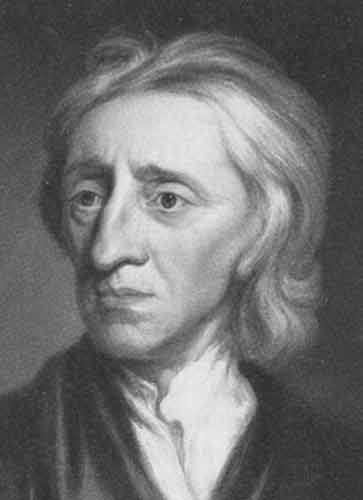 John
Locke was a 17th-century philosopher concerned primarily with society and epistemology.
An Englishman, Locke's notions of a "government with the consent of the
governed" and man's natural rights - life, liberty, and estate (property)
- had an enormous influence on the development of political philosophy.
John
Locke was a 17th-century philosopher concerned primarily with society and epistemology.
An Englishman, Locke's notions of a "government with the consent of the
governed" and man's natural rights - life, liberty, and estate (property)
- had an enormous influence on the development of political philosophy.
His ideas formed the basis for the concepts used in American law and government, allowing the colonists to justify revolution. Locke's epistemology and philosophy of mind also had a significant influence well into the Enlightenment period.
Locke
has been placed in a group called the British Empiricists, which includes
David Hume and George Berkeley. Locke is perhaps most often contrasted with
Thomas Hobbes.
In his main work, "An Essay Concerning Human Understanding" Locke
critiques the philosophy of innate ideas and builds a theory of the mind
and knowledge that gives priority to the senses and experience. His adherence
to this doctrine is what marks him out as an empiricist philosopher rather
than a rationalist such as his critic Leibniz.
The Essay sets out Locke's theory of ideas, including his distinction between passively acquired simple ideas, such as "red," "sweet," "round," etc., and actively built complex ideas, such as numbers, causes and effects, abstract ideas, ideas of substances, identity, and diversity. Locke also distinguishes between the truly existing primary qualities of bodies, like shape, motion and the arrangement of minute particles, and the secondary qualities that are "powers to produce various sensations in us" such as "red" and "sweet." These secondary qualities, Locke claims, are dependent on the primary qualities.
In 'Two Treatises of Government', Locke posits a state of nature as the proper starting point for examining politics. Individuals have rights, and their duties are defined in terms of protecting their own rights and respecting those of others. Through the law of nature, which Locke describes as "reason," we are able to understand why we must respect the natural rights of others (including the right to property for which one has labored). In practice, the law of nature is ignored and so government is necessary; this can be created only by the consent of the governed, which can be had only to a commonwealth of laws. A government betrays its trust when the laws are violated or when the trust of prerogative is abused. Once government is dissolved, the people are free to erect a new one and to oppose those who claim authority under the old one, i. e., to revolt.
https://en.wikipedia.org/wiki/John_Locke
John Locke Quotes
I doubt not, but from self-evident Propositions, by necessary Consequences, as incontestable as those in Mathematics, the measures of right and wrong might be made out.
A criminal who, having renounced reason ... hath, by the unjust violence and slaughter he hath committed upon one, declared war against all mankind, and therefore may be destroyed as a lion or tiger, one of those wild savage beasts with whom men can have no society nor security. And upon this is grounded the great law of Nature, "Who shedeth man's blood, by man shall his blood be shed.”
Religion, which should most distinguish us from the beasts, and ought most particularly elevate us, as rational creatures, above brutes, is that wherein men often appear most irrational, and more senseless than beasts.
Day-labourers and tradesmen, the spinsters and dairymaids must be told what to believe: The greatest part cannot know and therefore they must believe.
The people cannot delegate to government the power to do anything which would be unlawful for them to do themselves. (John Locke)
Help Humanity
"You must be the change you wish to see in the world."
(Mohandas Gandhi)
 "When forced to summarize the general theory of relativity in one sentence:
Time and space and gravitation have no separate existence from matter. ... Physical objects are not in space, but these objects are spatially extended. In this way the concept 'empty space' loses its meaning. ... The particle can only appear as a limited region in space in which
the field strength or the energy density are particularly high. ...
"When forced to summarize the general theory of relativity in one sentence:
Time and space and gravitation have no separate existence from matter. ... Physical objects are not in space, but these objects are spatially extended. In this way the concept 'empty space' loses its meaning. ... The particle can only appear as a limited region in space in which
the field strength or the energy density are particularly high. ...
The free, unhampered exchange of ideas and scientific conclusions is necessary for the sound development of science, as it is in all spheres
of cultural life. ... We must not conceal from ourselves that no improvement in the present depressing situation is possible without
a severe struggle; for the handful of those who are really determined to do something is minute in comparison with the mass of the lukewarm
and the misguided. ...
Humanity is going to need a substantially new way of thinking if it is to survive!" (Albert Einstein)
 Our world is in great trouble due to human behaviour founded on myths and customs that are causing the destruction of Nature and climate change. We can now deduce the most simple science theory of reality - the wave structure of matter in space. By understanding how we and everything around us are interconnected
in Space we can then deduce solutions to the fundamental problems of human knowledge in physics, philosophy, metaphysics, theology, education, health, evolution and ecology, politics and society.
Our world is in great trouble due to human behaviour founded on myths and customs that are causing the destruction of Nature and climate change. We can now deduce the most simple science theory of reality - the wave structure of matter in space. By understanding how we and everything around us are interconnected
in Space we can then deduce solutions to the fundamental problems of human knowledge in physics, philosophy, metaphysics, theology, education, health, evolution and ecology, politics and society.
This is the profound new way of thinking that Einstein
realised, that we exist as spatially extended structures of the universe - the discrete and separate body an illusion. This simply confirms the
intuitions of the ancient philosophers and mystics.
Given the current censorship in physics / philosophy of science journals (based on the standard model of particle physics / big bang cosmology) the internet is the best hope for getting new knowledge
known to the world. But that depends on you, the people who care about science and society, realise the importance of truth and reality.
It is Easy to Help!
Just click on the Social Network links below, or copy a nice image or quote you like and share it. We have a wonderful collection of knowledge from the greatest minds in human history, so people will appreciate your contributions. In doing this you will help a new generation of scientists see that there is a simple sensible explanation of physical reality - the source of truth and wisdom, the only cure for the madness of man! Thanks! Geoff Haselhurst (Updated September, 2018)
A new scientific truth does not triumph by convincing its opponents and making them see the light, but rather because its opponents eventually die, and a new generation grows up that is familiar with it. (Max Planck, 1920)
| Tweet Follow @philosophytruth | |
| Geoff | |
 |
Connect with Geoff Haselhurst at Facebook
"All that is necessary for evil to succeed is for good people to do nothing."
(Edmund Burke)
"In a time of universal deceit - telling the truth is a revolutionary act."
(George Orwell)
"Hell is Truth Seen Too Late."
(Thomas Hobbes)


Legal Disclaimer and Privacy Policy
We support 'Fair Use' of these pages for Academic & Non Commercial use.
You are welcome to use images and text, but please reference them with a link to relevant web page on this site. Thanks!
