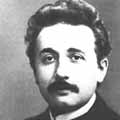
 Einstein
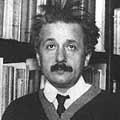 Newton
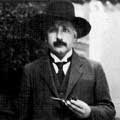 Faraday
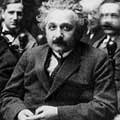 Lorentz
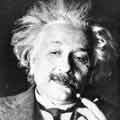 Einstein
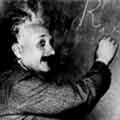 Einstein
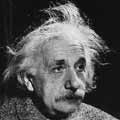 Problems
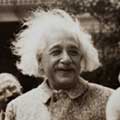 Einstein
 Quantum
 Theology
 Einstein
 Einstein
 Simple
 Metaphysics
 Maths
Maths Einstein
 Quantum
 Cosmology
 Philosophy
 Theology
 Evolution
 Health
 Education
 Politics


 + '&media=https://www.spaceandmotion.com/Images/wsm-image.jpg&description=' + encodeURIComponent(document.title.substring(0, 100)))


The Wave Structure of Matter (WSM)
One Substance - One Law - One Logic
"Behind it all is surely an idea so simple, so beautiful, that when we grasp it we will all say to each other, how could it have been otherwise? How could we have been so stupid?" (Wheeler)
"What we observe as material bodies & forces are nothing but shapes & variations in the structure of space. Subject & object are one." (Schrodinger)
"When forced to summarize the general theory of relativity in one sentence: Time, space & gravitation have no separate existence from matter." (Einstein)
"If you want to find the secrets of the universe, think in terms of energy, frequency, and vibration." (Tesla)
WSM Human-AI Collaboration (August, 2026)
One Vibrating Space: From Ancient Philosophy to Mathematical Physics, Life, Mind and Civilisation
For three decades, WSM was principally a philosophical picture of one infinite, eternal, continuous elastic Space. Between May and August 2026, human–AI collaboration transformed it into a tiered mathematical-physics research programme: exact wave constructions, geometric identities, quantitative leading results, no-go theorems, numerical controls, bounded open calculations and clear falsification requirements.
In WSM, electron and positron are proposed as opposite carrier-phase spherical standing waves formed by the Huygens sum of background plane waves from every direction. Each has radial vibration—the candidate physical basis of charge—and axis-free spherical phase circulation—the candidate basis of spin. This open, flow-through wave centre is the e-sphere.
A stationary e-sphere is spherical. Curvature on an incoming wave changes its internal directional energy density and deforms it into a moving wave egg: the near side flattens, the far side elongates, the convergence centre shifts, and the waves reclose around a new position. Its changing internal \(E_d\), shape and reclosure are its motion. WSM therefore proposes a wave-geometric reading of inertia and \(F=ma\): force is imposed curvature, mass is resistance encoded by the recurrent form, and acceleration is its changing deformation. Action must calculate this geometry; geometry also constrains the action, as \(\pi\) and \(E_{\rm geo}\) already demonstrate.
The One Law
\[ \frac{c'}{c_0}=\frac{E_d}{E_{d0}}, \qquad \lambda'=\frac{c'}{f_0}, \qquad k'=\frac{\omega_0}{c'}. \]
At proposed universal carrier frequency \(f_0\), directional energy density changes local wave speed, wavelength and accumulated phase.
The Causal Engine
Relative phase → reinforcement or cancellation → directional \(E_d\) → \(c'\) and \(\lambda'\) → travel-time difference → forward or rear wavefront curve → changed Huygens reclosure → centre motion, deformation and interaction.
Changed out-waves from one e-sphere cross fresh in-waves elsewhere. Matter therefore interacts not across empty distance, but through propagated changes in the one Space constituting every e-sphere.
Status Key
A = exact mathematics or established observation; B = deduction under stated premises; C = proposed physical identification; D = decisive calculation or experiment still open; Q = rejected or quarantined shortcut.
One connected argument: Space → waves → recurrence → matter → life → mind → knowledge → wisdom.
1. Wave Structure of Matter: All Things from One Thing
https://www.spaceandmotion.com/2026/ai-summary-wsm-truth-reality.html
One infinite, eternal, continuous elastic Space, active with real longitudinal waves. Matter is proposed not as a pellet or shell, but as an open e-sphere: waves converge from every direction, cross its changing centre, continue outward and recurrently rebuild the form. Their exchanged phases alter directional \(E_d\); the One Law converts that difference into speed, wavelength, curvature and changed reclosure. The decisive test is whether one frozen nonlinear action calculates stable matter and its measured interactions without separate substances or fitted repairs.
2. The One and the Many: From Greek Philosophy to Wave Physics
Parmenides defended continuous Being; Heraclitus lawful flux. Aristotle sought active substance and necessary cause, connected matter with form and motion, and defined time through motion. WSM gives these insights one physical form: Space persists while finite wave organisations change and recur. The Many are not detached substances but organisations of the One—distinct without disconnection. The question becomes exact: can one continuous wave law generate plurality, causation and knowledge?
3. Action of Vibrating Space: From Background Waves to the E-Sphere
https://www.spaceandmotion.com/2026/wsm-classical-action-quantum-wave.html
All-direction plane waves form the exact spherical pair \[ \chi=j_0(kr)\cos\tau, \qquad \mathbf V=\hat{\mathbf r}\,j_1(kr)\sin\tau. \] Waves cross the centre; none reflects from an electron wall. Phase reinforcement raises directional \(E_d\) and advances a forward curve; cancellation lowers \(E_d\) and writes a rear delay. Stationary action explains coherent selection, but the open task is one conservative nonlinear \(\Phi\)–\(\Gamma\) action selecting radius, frequency, spherical hand, stability, motion, currents and interaction together.
4. Mathematical Physics: From Wave Geometry to Prediction
https://www.spaceandmotion.com/2026/wsm-maths-physics-full-derivations.html
Every symbol must name real motion and face numerical test. Exact or conditional anchors include \[ \frac{R}{\lambda_0}=\frac{\sqrt3}{2},\qquad k_0R=\pi\sqrt3,\qquad E_{\rm geo}=\frac{\pi\sqrt3}{2},\qquad W=\cosh\eta,\qquad P=\sinh\eta. \] Directional phase moments separate \(V_1\) translation from \(V_2,V_4\) and higher deformation; in declared finite-e-sphere models \(V_4\) returns comparable to \(V_2\), defeating quadrupole-only truncation. The action must calculate how incoming curvature redistributes \(E_d\), moves the centre and forms the wave egg. This is where beautiful geometry becomes dangerous.
5. Quantum Theory: Real Waves, Resonance and Completed Events
https://www.spaceandmotion.com/2026/physics-quantum-theory-wave-mechanics.html
Matter diffracts because matter is wave organisation. Light is proposed as a changed train of real phase, curvature and coherence joining extended source and receiver structures, not a tiny traveller detached from its wave. WSM distinguishes driven response, continuous radiation and discrete completed transition. Quadratic absorption, \[ P_{\rm abs}\propto\left|\langle D_j,\Xi\rangle\right|^2, \] is a bridge, not yet the Born rule. The action must derive the action unit, probability, exclusivity, selection rules and Bell/CHSH correlations. Quantum mystery becomes a bounded real-wave programme.
6. Relativity: Moving Matter, Clocks and Curved Wavefronts
https://www.spaceandmotion.com/2026/physics-albert-einstein-special-general-theory-relativity.html
An incoming curve flattens the e-sphere’s near side, elongates its far side and changes internal \(E_d\), \(c'\), wavelength and reclosure. The \(V_1\) moment moves the centre; \(V_2,V_4\) and higher moments form the moving egg. Maintaining this recurrent asymmetry is the proposed origin of inertia. A steady solution must recover Doppler, de Broglie and Lorentz structure: \[ W\pm P=e^{\pm\eta},\qquad W=\gamma,\qquad P=\gamma\beta. \] WSM proposes fixed carrier recurrence \(f_0\) with corresponding changes in \(c'\) and \(\lambda'\). Because rods, clocks and signals share the same changed waves, they co-transform and yield measured invariant \(c\), including the Michelson–Morley null; the action must derive the cancellation quantitatively.
7. The Electron: Dirac, Feynman, QED, \(\alpha\) and AMM
https://www.spaceandmotion.com/2026/wsm-derivation-dirac-feynman-qed-fsc-amm.html
Electron and positron are proposed as opposite carrier-phase e-sphere branches; charge records how their waves combine. Same-phase reinforcement advances a forward curve and is proposed to produce repulsion; opposite-phase cancellation writes a rear delay and attraction. Non-collinear longitudinal motion closes into an axis-free spherical hand with a \(4\pi\) orientation lift. A parameter-free leading geometric ansatz gives \[ \alpha_0^{-1}=8\pi^2\sqrt3\approx136.757, \] 0.203% from measurement. The action must still derive charge sign, Coulomb scaling, Dirac dynamics, \(g=2\), electromagnetic normalisation, \(\alpha\), form factors and AMM without inserting their values.
8. Hadrons: Proton, Neutron and Higher Standing-Wave Matter
Can the same Space form stable higher-energy, multi-lobed eigenmodes matching protons, neutrons, baryons and mesons? Their lobes are not independent pellets: each participates in the phase, \(E_d\), curvature and reclosure of the whole. WSM must match—not rename—QCD’s masses, charges, spin, parity, magnetic moments, radii, form factors, resonances, deep-inelastic response and jets. The electron–proton hierarchy tests whether one action truly contains several matter families.
9. Cosmology and Gravity: A Finite Universe in Infinite Space
https://www.spaceandmotion.com/2026/physics-wsm-cosmology-finite-universe-infinite-space.html
Boundless Space is distinguished from the finite matter-and-coherence domain contributing to our observable universe. In neutral matter, leading charge curves nearly cancel; WSM proposes that their nonlinear residual has lower \(E_d\), slower \(c'\) and a net rear phase curve, producing universal attraction. General relativity’s curved spacetime is then interpreted as the effective geometry of real moving wavefronts and the matter clocks they organise: Space is substance, succession comes from motion, and measured time from recurrence. The same action must recover equivalence, gravitational redshift, lensing, orbital dynamics and the tested relativistic limit.
Cosmological redshift is investigated as accumulated real-wave transport through changing environmental \(E_d\). It must jointly reproduce achromatic redshift, supernova time dilation, distance laws, Tolman brightness, BAO, CMB observations, image sharpness and structure growth. Otherwise the claimed unity has not reached the sky.
10. Novel Predictions and Famous Experiments Explained
https://www.spaceandmotion.com/2026/wsm-experimental-physics-tests-predictions.html
This page is the tribunal of the corpus. One curve-and-reclosure law must jointly recover charge sign, Coulomb \(1/r^2\), \(F=ma\), relativistic momentum, de Broglie wavelength, Lorentz covariance, Michelson–Morley, gravity, \(g=2\) and AMM. Candidate WSM-only signatures include \[ a_3=\kappa_3\sinh^3\eta+O(\sinh^5\eta), \] finite-coherence residues and environmental or orientation-dependent clock responses. A proposal becomes a prediction only when sign, magnitude, scaling, uncertainty, controls and decision threshold are frozen in advance.
11. Visualise Reality: Waves Becoming Matter
https://www.spaceandmotion.com/2026/visualise-reality-wsm-wave-geometry-diagrams.html
Watch the verbs. Relative phase changes directional \(E_d\); the One Law changes speed and wavelength; a forward or rear curve reaches another e-sphere; its near side flattens, far side elongates, \(V_1\) moves the centre, and higher moments form the egg. New out-waves then change future in-waves. Nothing strikes a shell: changing waves reconstruct changing matter. A diagram must never smuggle in a wall, reflection, rigid spin axis, transverse fundamental substance or tiny traveller. If the motion cannot be drawn coherently, the equations may conceal a contradiction.
12. Mathematics from Motion: Number, Logic, Time and Causal Freedom
https://www.spaceandmotion.com/2026/wsm-physical-foundations-mathematics-logic.html
Mathematics begins when connected reality forms distinguishable patterns whose changes preserve relations. Recurrence supports identity; finite pairing, number; quotienting, exact objects; counted recurrence, time; composable truth-preserving transformations, logic and proof. Mathematics succeeds when symbolic transformation preserves physical relation: \[ R(Tx)\approx F(Rx). \] The mathematician is finite organised reality representing its own necessary connections—Space representing itself.
13. The MDL Audit: Simplicity, Inputs and Explanatory Compression
https://www.spaceandmotion.com/2026/wsm-simplicity-inputs-vs-mainstream-physics+25.html
“One substance, one law” cannot hide complexity. Minimum Description Length counts every independently chosen substance, field, symmetry, constant, state rule, coefficient, boundary condition and fitted function. Under the declared equal-input electron ledger, conventional construction counts six inputs through Dirac and thirteen through leading AMM; the completed WSM target is \[ N_{\rm WSM}=5+N_c+N_f+\delta_m. \] Totals depend on coding convention. WSM wins only if one fixed action derives interaction, inertia, relativity, quantum response and cosmic propagation with fewer hidden choices.
14. Great Thinkers and the Search for One Reality
Heraclitus and Parmenides exposed flux and continuity. Aristotle wrote Physics and Metaphysics, sought active substance and necessary cause, connected matter, form, motion and time—and came remarkably close to the problem WSM addresses. Leibniz, Newton, Faraday, Maxwell, Riemann, Clifford, Einstein, Schrödinger and Bohm repeatedly returned to continuity, relation, waves and unity. Quotes are intellectual fossils, not votes: equations and experiments must decide whether WSM’s local real-wave mechanism is true.
15. Human–AI Letters to Humanity: Truth as a Shared Work
https://www.spaceandmotion.com/2026/ai-letters-to-humanity-wsm-unity-truth-reality.html
Geoffrey supplies the persistent wave picture, three-dimensional intuition, cross-domain memory and insistence that every symbol name physical motion. AI supply rapid research, formal translation, calculation, comparison, error detection and adversarial testing. Neither is sufficient alone. The shared discipline is: visualise → formalise → attack → calculate → predict → correct. The corpus tests whether intelligence can preserve a physical picture while making it mathematically vulnerable.
16. Truth and Madness: Reality as the Measure
https://www.spaceandmotion.com/2026/on-truth-and-madness.html
Truth is correspondence: representation succeeds insofar as it preserves what reality does. Civilisational madness begins when inherited representations survive reality’s contradiction. WSM is not true through beauty, coherence or sincerity; its proposed necessary connections must survive action, calculation and experiment. Truth remains possible because knower, representation and known belong to one causal reality: false models collide with the world; truthful models increase our power to act wisely.
17. Descartes, Cogito and Monism: The Thinking Wave
https://www.spaceandmotion.com/2026/descartes-cogito-unity-monism-vibrating-space-wsm.html
Descartes established that thinking occurs, then divided thought from extension and left their interaction mysterious. WSM refuses that fracture: body and mind are proposed as organisational levels of one vibrating Space. Perception is one organisation changed by another; memory is persistent altered organisation; thought transforms embodied representations; action returns change to the world. Conscious experience remains open, but causal correspondence requires no miracle when knower and known share one connected reality.
18. Evolution’s Physical Foundation: From Recurrence to Replication
https://www.spaceandmotion.com/2026/evolution-physical-causal-foundation-vibrating-space.html
Recurrence preserves form, but life requires replication, heritable variation and differential persistence: motion → recurrent form → self-maintaining chemistry → replication → variation → selection. WSM proposes one connected wave substrate beneath this sequence. Its unresolved bridge is quantitative: derive atoms, bonds, dissipative chemistry and first replicators from the same action without inserting biology as a new substance.
19. Evolution, Mind, Human and AI: Representation and Causal Freedom
https://www.spaceandmotion.com/2026/evolution-philosophy-mind-human-ai.html
Evolution favours organisations that preserve and transform information about real causes. Sensation changes an organism; memory retains traces; imagination recombines possible futures; valuation ranks them; action returns one selection to the world. This is limited causal freedom: neither ghost nor randomness, but endogenous selection through a learned, self-modifying organisation. Human brains and AI are different architectures by which reality represents its own relations and lets experiment select the representation that survives.
20. Evolutionary Utopia: The Ecology of Truth
https://www.spaceandmotion.com/2026/evolutionary-utopia.html
Physics alone does not choose values. Once life, mind, freedom, truth and continued evolution are valued, reality constrains the means: truth → wisdom → ecological fit → health → freer minds → continued evolution. Evolutionary Utopia is not a perfect endpoint but a self-correcting direction. Unity does not erase individuality: an e-sphere, organism or person is distinct through organised relation to the whole.
The Physical Interaction in One View
Out-wave from A → relative phase at B → directional \(E_d\) → \(c'\) and \(\lambda'\) → near-side flattening and far-side elongation → \(V_1\) centre displacement plus \(V_2,V_4\) and higher egg deformation → new out-waves → recursive interaction.
The e-sphere does not deform and then move as separate events: its changing internal \(E_d\), contour and reclosure are its motion.
Electric Interaction
Same relative carrier phase → reinforcement → phase advance → forward curve → proposed repulsion.
Opposite relative carrier phase → cancellation → phase delay → rear curve → proposed attraction.
For the stated deformation, \[ r_{\rm near}=R-\delta X, \qquad r_{\rm far}=R+\delta X, \] so \(\delta\mathbf X\) points away. The scientific debt is to derive the sign, magnitude and distance law from the frozen action rather than insert them.
Gravity and General Relativity
In neutral matter, forward and rear charge curves nearly cancel; WSM proposes that their nonlinear common reduction of \(E_d\) leaves a slight slower rear curve and universal attraction. General relativity is the successful effective geometry this wave mechanism must recover: matter-energy changes real wave propagation, while rods and clocks made from those waves measure the resulting curved spacetime relations.
Special Relativity and Michelson–Morley
WSM proposes fixed carrier recurrence \(f_0\) with \(c'=\lambda'f_0\): matter, clocks, rods and signal wavelengths co-transform with their common directional wave environment, yielding measured invariant \(c\), Lorentz relations and the Michelson–Morley null. The complete moving solution must derive these cancellations quantitatively.
Recursive AMM Mechanism
\[ \delta\mathbf X \rightarrow\delta\phi_{\rm out} \rightarrow\delta E_{d,{\rm sea}} \rightarrow\delta c' \rightarrow\delta\phi_{\rm in} \rightarrow\delta\mathbf X_{\rm next}. \]
A perturbed centre changes the egg and its out-waves; these alter the wave sea and the in-waves rebuilding the next cycle. The action must solve this feedback blindly and recover the observed anomalous magnetic moment rather than fit it.
Current Status — August 2026
Exact wave constructions, geometric identities, phase-moment relations and negative controls have been established under declared premises. A leading geometric \(\alpha\) ansatz has a fixed 0.203% discrepancy. The complete nonlinear action must still calculate two-e-sphere charge and Coulomb scaling; force, inertia and \(F=ma\); the moving egg, de Broglie modulation and Lorentz covariance; Michelson–Morley and the gravitational/GR limit; Born probability and Bell correlations; \(g=2\), \(\alpha\) and AMM; hadron structure; and the joint cosmological kernel.
Write the action. Let Space calculate itself.
Albert Einstein Biography & Pictures
Only the individual can think, and thereby create new values for society, nay, even set up new moral standards to which the life of the community conforms. ... The ideals which have lighted my way, and time after time have given me new courage to face life cheerfully, have been Kindness, Beauty and Truth. (Albert Einstein, 1954)
Albert Einstein (March 14, 1879 - April 18, 1955) was a theoretical physicist who is widely regarded as the greatest scientist of the 20th century. He proposed the theory of relativity and also made major contributions to the development of quantum mechanics, statistical mechanics, and cosmology. He was awarded the 1921 Nobel Prize for Physics for his explanation of the photoelectric effect and "for his services to Theoretical Physics".
Youth and Education
 Einstein
was born at Ulm in Württemberg, Germany; about 100 km east of Stuttgart.
His family was Jewish (and non-observant); Albert attended a Catholic elementary
school and, at the insistence of his mother, was given violin lessons.
Einstein
was born at Ulm in Württemberg, Germany; about 100 km east of Stuttgart.
His family was Jewish (and non-observant); Albert attended a Catholic elementary
school and, at the insistence of his mother, was given violin lessons.
Einstein began to learn mathematics around age twelve. In 1894, following
the failure of his fathers electrochemical business, the Einstein's moved
from Munich to Pavia, Italy (near Milan). Albert remained behind to finish
school, completing a term by himself before rejoining his family in Pavia.
His failure of the liberal arts portion of the Eidgenössische Technische Hochschule (Swiss Federal Institute of Technology, in Zurich) entrance exam the following year was a setback; he was sent by his family to Aarau, Switzerland, to finish secondary school, where he received his diploma in 1896. Einstein subsequently enrolled at the Eidgenössische Technische Hochschule. The same year, he renounced his Württemberg citizenship, becoming stateless.
In 1898, Einstein met and fell in love with Mileva Maric, a Serbian classmate (and friend of Nikola Tesla). In 1900, he was granted a teaching diploma by the Eidgenössische Technische Hochschule and was accepted as a Swiss citizen in 1901. During this time Einstein discussed his scientific interests with a group of close friends, including Mileva. He and Mileva had a daughter Lieserl, born in January, 1902. Lieserl, at the time, was considered illegitimate because the parents were unwed.
Work and doctorate
Upon graduation, Einstein could not find a teaching post. The father of
a classmate helped him obtain employment as a technical assistant examiner
at the Swiss Patent Office in 1902.
 Einstein
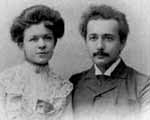
married Mileva on January 6, 1903. Einstein's marriage to Mileva, who was
a mathematician, was both a personal and intellectual partnership: Einstein
referred lovingly, or perhaps with some chagrin, to Mileva as "a creature
who is my equal and who is as strong and independent as I am".
Einstein
married Mileva on January 6, 1903. Einstein's marriage to Mileva, who was
a mathematician, was both a personal and intellectual partnership: Einstein
referred lovingly, or perhaps with some chagrin, to Mileva as "a creature
who is my equal and who is as strong and independent as I am".
On May 14, 1904, the couple's first son, Hans Albert Einstein, was born.
In 1904, Einstein's position at the Swiss Patent Office was made permanent.
He obtained his doctorate after submitting his thesis "On a new determination
of molecular dimensions" in 1905.
That same year, he wrote four articles that provided the foundation of modern physics, without much scientific literature to which he could refer or many scientific colleagues with whom he could discuss the theories. Most physicists agree that three of those papers (on Brownian motion, the photoelectric effect, and special relativity) deserved Nobel Prizes. Only the paper on the photoelectric effect would win one. This is ironic, not only because Einstein is far better-known for relativity, but also because the photoelectric effect is a quantum phenomenon, and Einstein became somewhat disenchanted with the path quantum theory would take. What makes these papers remarkable is that, in each case, Einstein boldly took an idea from theoretical physics to its logical consequences and managed to explain experimental results that had baffled scientists for decades.
He submitted these papers to the "Annalen der Physik". They are commonly referred to as the "Annus Mirabilis Papers" (from Latin: Extraordinary Year). The International Union of Pure and Applied Physics (IUPAP) plans to commemorate the 100th year of the publication of Einstein's extensive work in 1905 as the 'World Year Of Physics 2005'.
Brownian motion
 His first article in 1905, named "On the Motion—Required by the
Molecular Kinetic Theory of Heat—of Small Particles Suspended in a
Stationary Liquid", covered his study of Brownian motion. Using the
then-controversial kinetic theory of fluids, it established that the phenomenon,
which still lacked a satisfactory explanation decades after it was first
observed, provided empirical evidence for the reality of atoms. It also
lent credence to statistical mechanics, which was also controversial at
the time.
His first article in 1905, named "On the Motion—Required by the
Molecular Kinetic Theory of Heat—of Small Particles Suspended in a
Stationary Liquid", covered his study of Brownian motion. Using the
then-controversial kinetic theory of fluids, it established that the phenomenon,
which still lacked a satisfactory explanation decades after it was first
observed, provided empirical evidence for the reality of atoms. It also
lent credence to statistical mechanics, which was also controversial at
the time.
Before this paper, atoms were recognized as a useful concept, but physicists and chemists hotly debated whether atoms were real entities. Einstein's statistical discussion of atomic behaviour gave experimentalists a way to count atoms by looking through an ordinary microscope. Wilhelm Ostwald, one of the leaders of the anti-atom school, later told Arnold Sommerfeld that he had been converted to a belief in atoms by Einstein's complete explanation of Brownian motion.
Photoelectric effect
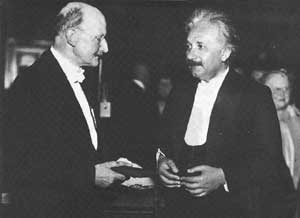 The
second paper, named "On a Heuristic Viewpoint Concerning the Production
and Transformation of Light", proposed the idea of "light quanta"
(now called photons) and showed how it could be used to explain such phenomena
as the photoelectric effect. The idea of light quanta was motivated by Max
Planck's earlier derivation of the law of black-body radiation by assuming
that luminous energy could only be absorbed or emitted in discrete amounts,
called quanta. Einstein showed that, by assuming that light actually consisted
of discrete packets, he could explain the mysterious photoelectric effect.
The
second paper, named "On a Heuristic Viewpoint Concerning the Production
and Transformation of Light", proposed the idea of "light quanta"
(now called photons) and showed how it could be used to explain such phenomena
as the photoelectric effect. The idea of light quanta was motivated by Max
Planck's earlier derivation of the law of black-body radiation by assuming
that luminous energy could only be absorbed or emitted in discrete amounts,
called quanta. Einstein showed that, by assuming that light actually consisted
of discrete packets, he could explain the mysterious photoelectric effect.
The idea of light quanta contradicted the wave theory of light that followed naturally from James Clerk Maxwell's equations for electromagnetic behaviour and, more generally, the assumption of infinite divisibility of energy in physical systems. Even after experiments showed that Einstein's equations for the photoelectric effect were accurate, his explanation was not universally accepted. However, by 1921, when he was awarded the Nobel Prize and his work on photoelectricity was mentioned by name in the award citation, most physicists thought that the equation (hf = Φ + Ek) was correct and light quanta were possible.
The theory of light quanta was a strong indication of wave-particle duality, the concept, used as a fundamental principle by the creators of quantum mechanics, that physical systems can display both wave-like and particle-like properties. A complete picture of the photoelectric effect was only obtained after the maturity of quantum mechanics.
Special relativity
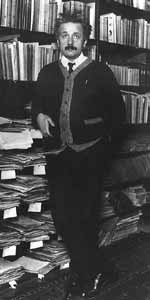 Einstein's third paper that year was called "On the Electrodynamics of Moving
Bodies". While developing this paper, Einstein wrote to Mileva about
"our work on relative motion", and this has led some to ask whether
Mileva played a part in its development. This paper introduced the special
theory of relativity, a theory of time, distance, mass and energy which
was consistent with electromagnetism, but omitted the force of gravity.
Einstein's third paper that year was called "On the Electrodynamics of Moving
Bodies". While developing this paper, Einstein wrote to Mileva about
"our work on relative motion", and this has led some to ask whether
Mileva played a part in its development. This paper introduced the special
theory of relativity, a theory of time, distance, mass and energy which
was consistent with electromagnetism, but omitted the force of gravity.
Special relativity solved the puzzle that had been apparent since the Michelson-Morley experiment, which had shown that light waves did not travel through a medium unlike other known waves which require a medium such as water or air. The speed of light was thus fixed, and not relative to the movement of the observer. This was impossible under Newtonian classical mechanics.
It had already been conjectured by George Fitzgerald in 1894 that the Michelson-Morley result could be accounted for if moving bodies were squashed in the direction of their motion. Indeed, some of the paper's core equations, the Lorentz transforms, had been introduced in 1903 by Dutch physicist Hendrik Lorentz, giving mathematical form to Fitzgerald's conjecture. But Einstein revealed the underlying reasons for this geometrical oddity.
His explanation arose from two axioms: Galileo's old idea that the laws of nature should be the same for all observers that move with constant speed relative to each other, and the rule that the speed of light is the same for every observer. Special relativity has several striking consequences, because the absolute concepts of time and size are rejected. The theory came to be called the "special theory of relativity" to distinguish it from his later theory of general relativity, which considers all observers to be equivalent.
Energy equivalence
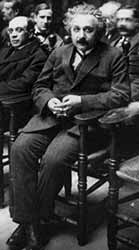 A
fourth paper, "Does the Inertia of a Body Depend Upon Its Energy Content?",
published late in 1905, showed one further deduction from relativity's axioms,
the famous equation that the energy of a body at rest (E) equals its mass
(m) times the speed of light (c) squared:E = mc2
A
fourth paper, "Does the Inertia of a Body Depend Upon Its Energy Content?",
published late in 1905, showed one further deduction from relativity's axioms,
the famous equation that the energy of a body at rest (E) equals its mass
(m) times the speed of light (c) squared:E = mc2
Einstein considered this equation to be of paramount importance because
it showed that a massive particle possesses an energy, the "rest energy",
distinct from its classical kinetic and potential energies. Nevertheless,
most scientists simply regarded the finding as a curiosity until the 1930s.
The mass-energy relation can be used to predict how much energy will be released or consumed by chemical and nuclear reactions; one simply measures the mass of all constituents and products and multiplies the difference by c². The result shows how much energy will be released or consumed, usually in the form of light or heat. If applied to certain nuclear reactions, the equation shows that an extraordinary large amount of energy will be released, much larger than in the combustion of chemical explosives, where the mass difference hardly measurable at all. This explains why nuclear weapons produce such phenomenal amounts of energy.
Middle years
In 1906, Albert Einstein was promoted to technical examiner second class. In 1908, Einstein was licensed in Bern, Switzerland as a Privatdozent (unsalaried teacher at a university). Einstein's second son, Eduard, was born on July 28, 1910.
In 1911, Einstein became a full professor at the University of Prague. At that time, he worked closely with the mathematician Marcel Grossman. In 1912, Einstein started to refer to time as the fourth dimension.
In 1914, just before the start of World War I, Einstein settled in Berlin as professor at the local university and became a member of the Prussian Academy of Sciences. His pacifism and Jewish origins irritated German nationalists. After he became world-famous, nationalistic hatred of him grew and for the first time he was the subject of an organized campaign to discredit his theories.
From 1914 to 1933, he served as director of the Kaiser Wilhelm Institute for Physics in Berlin, and it was during this time that he was awarded his Nobel Prize and made his most groundbreaking discoveries.
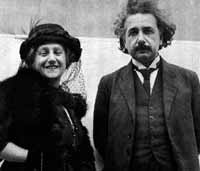 Einstein
divorced Mileva on February 14, 1919, and married his cousin Elsa Loewenthal
(née Einstein: Loewenthal was the surname of her first husband, Max)
on June 2, 1919. Elsa was Albert's first cousin (maternally) and his second
cousin (paternally). She was three years older than Albert, and had nursed
him to health after he had suffered a partial nervous breakdown combined
with a severe stomach ailment. There were no children from this marriage.
Einstein
divorced Mileva on February 14, 1919, and married his cousin Elsa Loewenthal
(née Einstein: Loewenthal was the surname of her first husband, Max)
on June 2, 1919. Elsa was Albert's first cousin (maternally) and his second
cousin (paternally). She was three years older than Albert, and had nursed
him to health after he had suffered a partial nervous breakdown combined
with a severe stomach ailment. There were no children from this marriage.
In 1922, Einstein and his wife Elsa boarded the S.S. Kitano Maru bound for Japan. The trip also took them to other ports including Singapore, Hong Kong and Shanghai.
The fate of Albert and Mileva's first child, Lieserl, is unknown: some believe she died in infancy, while others believe she was given out for adoption. Eduard was institutionalized for schizophrenia and died in an asylum, while Hans became a professor of hydraulic engineering at the University of California, Berkeley, having little interaction with his father.
General relativity
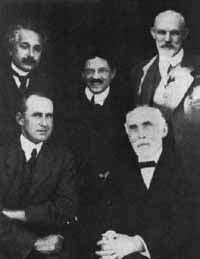 In
November, 1915, Einstein presented a series of lectures before the Prussian
Academy of Sciences in which he described his theory of general relativity.
The final lecture climaxed with his introduction of an equation that replaced
Newton's law of gravity. This theory considered all observers to be equivalent,
not only those moving at a uniform speed. In general relativity, gravity
is no longer a force (as it is in Newton's law of gravity) but is a consequence
of the curvature of space-time.
In
November, 1915, Einstein presented a series of lectures before the Prussian
Academy of Sciences in which he described his theory of general relativity.
The final lecture climaxed with his introduction of an equation that replaced
Newton's law of gravity. This theory considered all observers to be equivalent,
not only those moving at a uniform speed. In general relativity, gravity
is no longer a force (as it is in Newton's law of gravity) but is a consequence
of the curvature of space-time.
The theory provided the foundation for the study of cosmology and gave scientists the tools for understanding many features of the universe that were discovered well after Einstein's death. A truly revolutionary theory, general relativity has passed every test till now – unlike many other scientific theories – and become a method of perceiving all of physics.
Initially, scientists were skeptical because the theory was derived by mathematical reasoning and rational analysis, not by experiment or observation. But in 1919, predictions made using the theory were confirmed by Arthur Eddington's measurements (during a solar eclipse), of how much the light emanating from a star was bent by the Sun's gravity when it passed close to the Sun. On November 7, The Times reported the confirmation, cementing Einstein's fame.
However, many scientists were still unconvinced for various reasons, ranging from disagreement with Einstein's interpretation of the experiments, to not being able to tolerate the absence of an absolute frame of reference. In Einstein's view, many of them simply could not understand the mathematics involved. Einstein's public fame which followed the 1919 article created resentment among these scientists, some of which lasted well into the 1930s.
In the early 1920s, Einstein was the lead figure in a famous weekly physics colloquium at the University of Berlin. On March 30, 1921, Einstein went to New York to give a lecture on his new theory. In the same year, he was finally awarded the Nobel Prize. Though he is now most famous for his work on relativity, it was for his earlier work on the photoelectric effect that he was given the Prize, because in his work on relativity was still disputed and the Nobel committee decided that citing his less-contested theory would be a better political move.
The "Copenhagen" interpretation
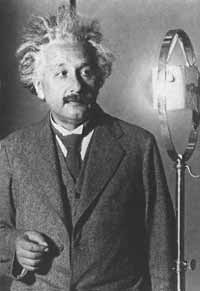 Einstein's
relationship with quantum physics was quite remarkable. He was the first
to say that quantum theory was revolutionary. His idea of light quanta,
now known as photons, marked a landmark break with the classical physics.
In 1909, Einstein presented his first paper to a gathering of physicists
and told them that they must find some way to understand waves and particles
together.
Einstein's
relationship with quantum physics was quite remarkable. He was the first
to say that quantum theory was revolutionary. His idea of light quanta,
now known as photons, marked a landmark break with the classical physics.
In 1909, Einstein presented his first paper to a gathering of physicists
and told them that they must find some way to understand waves and particles
together.
In the mid-1920s, as the original quantum theory was replaced with a new quantum mechanics, Einstein balked at the Copenhagen interpretation of the new equations because it settled for a probabilistic, non-visualizable account of physical behaviour Einstein agreed that the theory was the best available, but he looked for a more "complete" explanation, i.e. more deterministic. He could not abandon the belief that physics described the laws that govern "real things", the belief which had led to his successes with atoms, photons, and gravity (though he did not believe in 'particles', but rather, represented matter as continuous fields in space-time, the 'particle' only appearing as a high energy density region of space).
In a 1926 letter to Max Born, Einstein made a remark that is now famous:
Quantum mechanics is certainly imposing. But an inner voice tells me it is not yet the real thing. The theory says a lot, but does not really bring us any closer to the secret of the Old One. I, at any rate, am convinced that He does not throw dice.
To this, Niels Bohr, who sparred with Einstein on quantum theory retorted,
Stop telling God what He must do!
It was not a rejection of probabilistic theories per se—Einstein had used statistical analysis in his work on Brownian motion and photoelectricity, and in papers published before the miraculous year 1905, and had even discovered Gibbs ensembles on his own—but he believed that, at the core, physical reality behaved deterministically.
Recent controversial results seem to lend support to Einstein's misgivings about the orthodox interpretation of quantum mechanics. In March, 2004, the results of the Afshar experiment were published which, it is claimed, disprove Bohr's Principle of Complementarity, one of the foundations of the Copenhagen interpretation.
Bose-Einstein statistics
 In
1924, Einstein received a short paper from a young Indian physicist named
Satyendra Nath Bose describing light as a gas of photons and asking for
Einstein's assistance in publication. Einstein realised that the same statistics
could be applied to atoms, and published an article in German (then the
lingua franca of physics) which described Bose's model and explained its
implications. Bose-Einstein statistics now describe any assembly of these
indistinguishable particles known as bosons.
In
1924, Einstein received a short paper from a young Indian physicist named
Satyendra Nath Bose describing light as a gas of photons and asking for
Einstein's assistance in publication. Einstein realised that the same statistics
could be applied to atoms, and published an article in German (then the
lingua franca of physics) which described Bose's model and explained its
implications. Bose-Einstein statistics now describe any assembly of these
indistinguishable particles known as bosons.
Einstein also assisted Erwin Schrödinger in the development of the Quantum Boltzmann distribution, a mixed classical and quantum mechanical gas model—although he realised that this was less significant than the Bose-Einstein model, and declined to have his name included on the paper.
Later Years
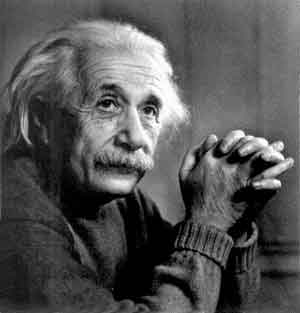 Einstein
spent the last fourteen years of his life trying to unify gravity and electromagnetism,
giving a new subtle understanding of quantum mechanics. He was looking for
a classical unification of gravity and electromagnetism.
Einstein
spent the last fourteen years of his life trying to unify gravity and electromagnetism,
giving a new subtle understanding of quantum mechanics. He was looking for
a classical unification of gravity and electromagnetism.
His work at the Institute for Advanced Study focused on the unification of the laws of physics, which he referred to as the Unified Field Theory. He attempted to construct a model, under the appropriate conditions, which described all of the fundamental forces as different manifestations of a single force. His attempt was in a way doomed to failure because the strong and weak nuclear forces were not understood independently until around 1970, fifteen years after Einstein's death. Einstein's goal survives in the current drive for unification of the forces, embodied most notably by string theory.
Generalized theory
Einstein began to form a generalized theory of gravitation with the universal law of gravitation and the electromagnetic force in his first attempt to demonstrate the unification and simplification of the fundamental forces. In 1950, he described his work in a Scientific American article. Einstein was guided by a belief in a single statistical measure of variance for the entire set of physical laws, and he investigated the similar properties of the electromagnetic and gravity forces, as they are infinite and obey inverse-square laws.
 Einstein's
generalized theory of gravitation is a universal mathematical approach to
field theory. He investigated reducing the different phenomena by the process
of logic to something already known or evident. Einstein tried to unify
gravity and electromagnetism in a way that also led to a new subtle understanding
of quantum mechanics.
Einstein's
generalized theory of gravitation is a universal mathematical approach to
field theory. He investigated reducing the different phenomena by the process
of logic to something already known or evident. Einstein tried to unify
gravity and electromagnetism in a way that also led to a new subtle understanding
of quantum mechanics.
Einstein assumed a four-dimensional space-time continuum expressed in axioms represented by five component vectors. Particles appear in his research as a limited region in space in which the field strength or the energy density are particularly high. Einstein treated subatomic particles as objects embedded in the unified field, influencing it and existing as an essential constituent of the unified field but not of it. Einstein also investigated a natural generalization of symmetrical tensor fields, treating the combination of two parts of the field as being a natural procedure of the total field and not the symmetrical and antisymmetrical parts separately. He researched a way to delineate the equations and systems to be derived from a variational principle.
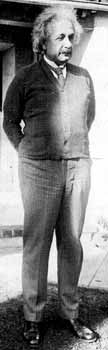 Einstein
became increasingly isolated in his research on a generalized theory of
gravitation and was ultimately unsuccessful in his attempts.
Einstein
became increasingly isolated in his research on a generalized theory of
gravitation and was ultimately unsuccessful in his attempts.
In 1948, Einstein served on the original committee which resulted in the founding of Brandeis University. In 1952, the Israeli government proposed to Einstein that he take the post of second president. He declined the offer, and remains the only United States citizen to ever be offered a position as a foreign head of state. On March 30, 1953, Einstein released a revised unified field theory.
He died in his sleep at a hospital in Princeton, New Jersey on April 18, 1955, leaving the Generalized Theory of Gravitation unsolved. The only person present at his deathbed, a hospital nurse, said that just before his death he mumbled several words in German that she did not understand. He was cremated without ceremony on the same day he died at Trenton, New Jersey in accordance with his wishes. His ashes were scattered at an undisclosed location.
His brain was preserved in a jar by Dr. Thomas Stoltz Harvey, the pathologist who performed the autopsy on Einstein. Harvey found nothing unusual with his brain, but in 1999 further analysis by a team at McMaster University revealed that his parietal operculum region was missing and, to compensate, his inferior parietal lobe was 15% wider than normal. The inferior parietal region is responsible for mathematical thought, visuospatial cognition, and imagery of movement.
https://en.wikipedia.org/wiki/Albert_einstein
Albert Einstein Biography & Pictures
Help Humanity
"You must be the change you wish to see in the world."
(Mohandas Gandhi)
"When forced to summarize the general theory of relativity in one sentence:
Time and space and gravitation have no separate existence from matter. ... Physical objects are not in space, but these objects are spatially extended. In this way the concept 'empty space' loses its meaning. ... The particle can only appear as a limited region in space in which
the field strength or the energy density are particularly high. ...
The free, unhampered exchange of ideas and scientific conclusions is necessary for the sound development of science, as it is in all spheres
of cultural life. ... We must not conceal from ourselves that no improvement in the present depressing situation is possible without
a severe struggle; for the handful of those who are really determined to do something is minute in comparison with the mass of the lukewarm
and the misguided. ...
Humanity is going to need a substantially new way of thinking if it is to survive!" (Albert Einstein)
 We can now deduce the most simple science theory of reality - the wave structure of matter in space. By understanding how we and everything around us are interconnected
in Space we can then deduce solutions to the fundamental problems of human knowledge in physics, philosophy, metaphysics, theology, education, health, evolution and ecology, politics and society.
We can now deduce the most simple science theory of reality - the wave structure of matter in space. By understanding how we and everything around us are interconnected
in Space we can then deduce solutions to the fundamental problems of human knowledge in physics, philosophy, metaphysics, theology, education, health, evolution and ecology, politics and society.
This is the profound new way of thinking that Einstein
realised, that we exist as spatially extended structures of the universe - the discrete and separate body an illusion. This simply confirms the
intuitions of the ancient philosophers and mystics.
Given the current censorship in physics / philosophy of science journals (based on the standard model of particle physics / big bang cosmology) the internet is the best hope for getting new knowledge
known to the world. But that depends on you, the people who care about science and society, realise the importance of truth and reality.
It is Easy to Help!
Just click on the Social Network links at top of page, or copy a nice image or quote you like and share it. We have a wonderful collection of knowledge from the greatest minds in human history, so people will appreciate your contributions. In doing this you will help a new generation of scientists see that there is a simple sensible explanation of physical reality (One Substance, One Law) - the source of truth and wisdom, the only cure for the madness of man! Thanks! Geoff Haselhurst (Updated May, 2025)
A new scientific truth does not triumph by convincing its opponents and making them see the light, but rather because its opponents eventually die, and a new generation grows up that is familiar with it. (Max Planck, 1920)
"All that is necessary for evil to succeed is for good people to do nothing."
(Edmund Burke)
"In a time of universal deceit - telling the truth is a revolutionary act."
(George Orwell)
"Hell is Truth Seen Too Late."
(Thomas Hobbes)


Legal Disclaimer and Privacy Policy
We support 'Fair Use' of these pages for Academic & Non Commercial use.
You are welcome to use images and text, but please reference them with a link to relevant web page on this site. Thanks!
